-
-
LOGO
-
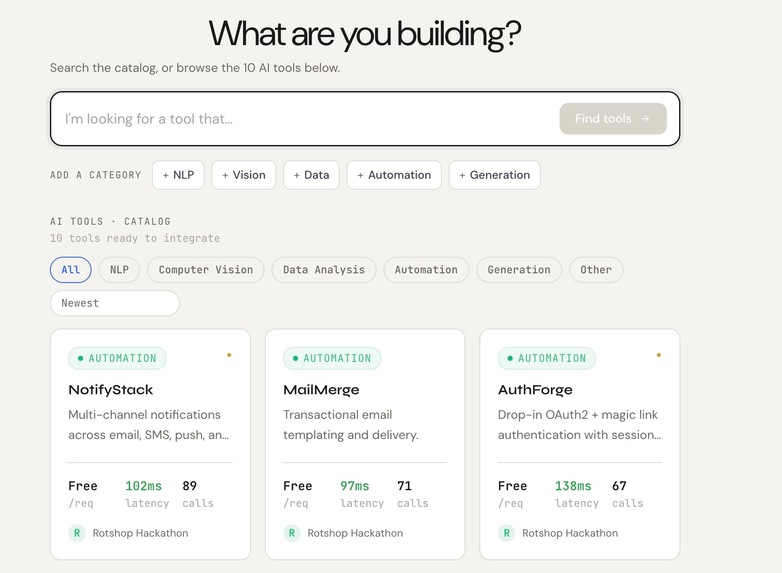
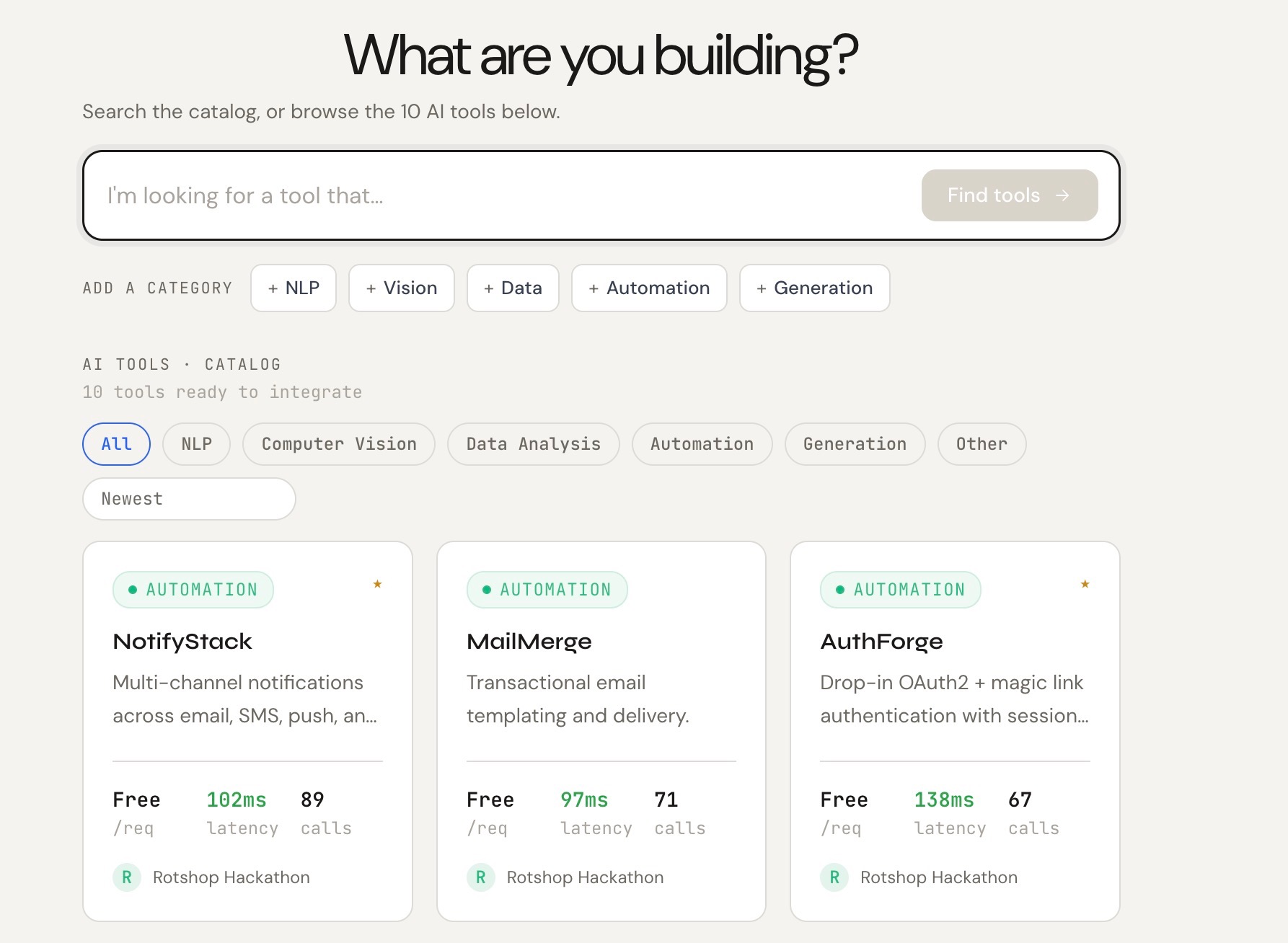
API marketplace
-
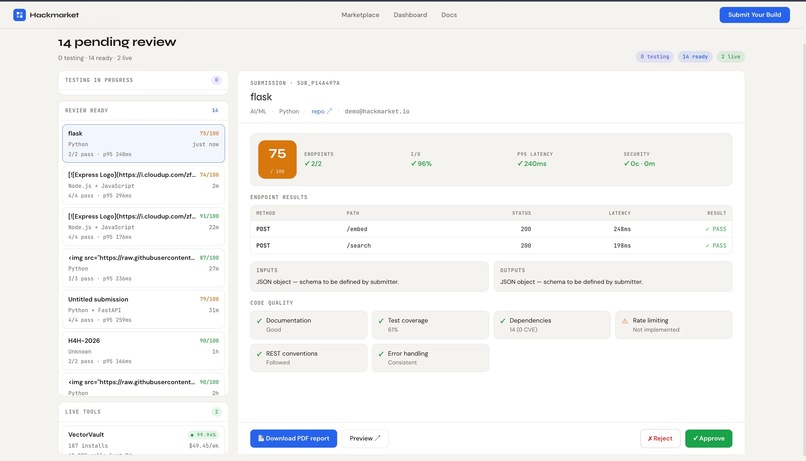
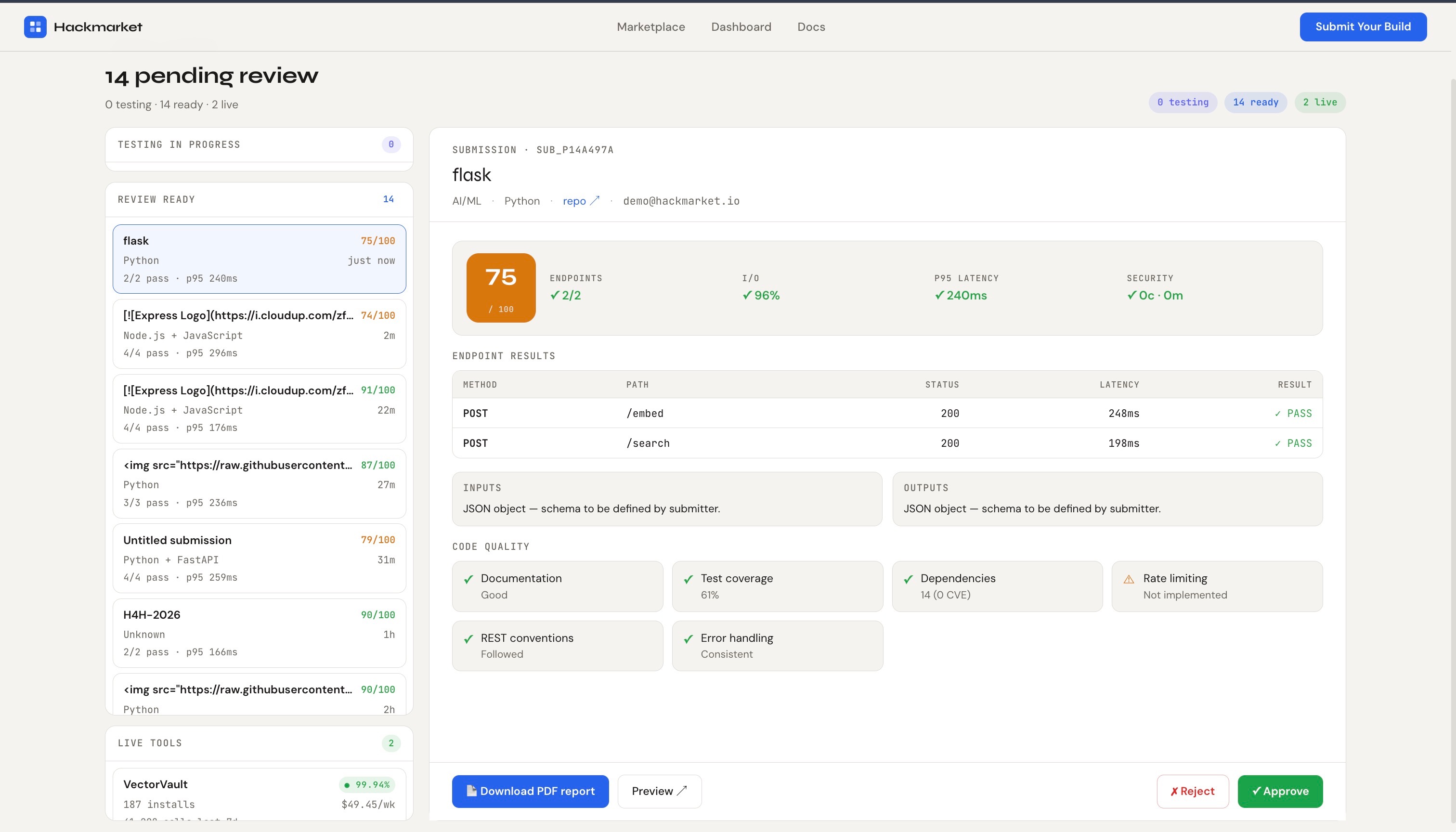
Approver's page
-
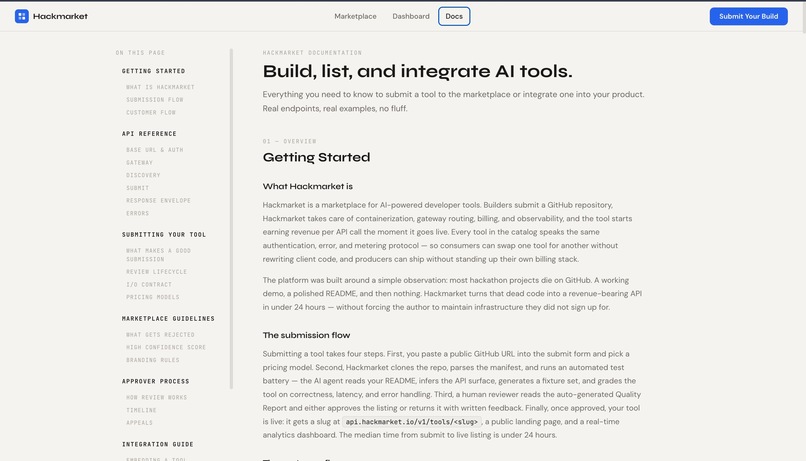
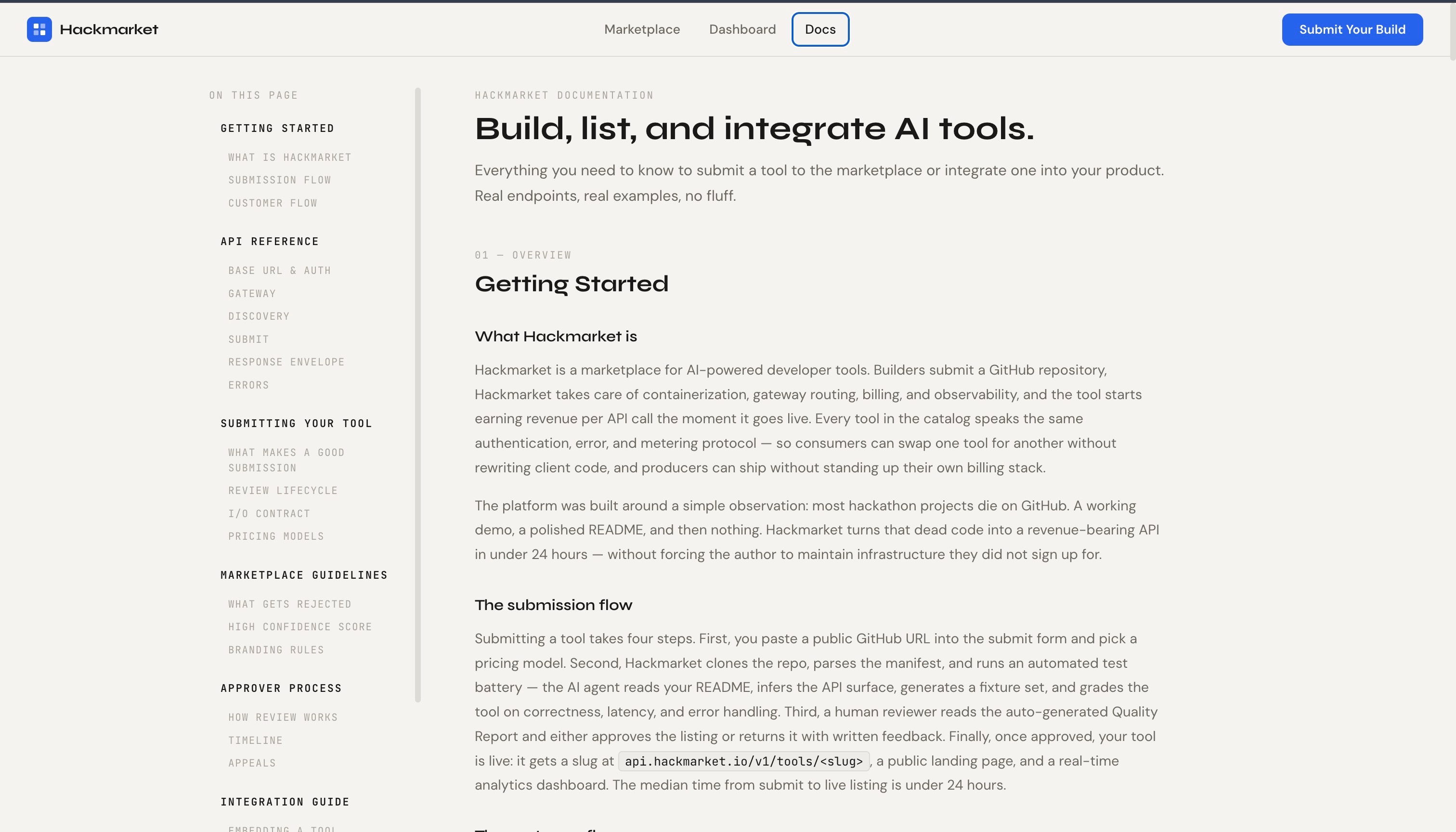
Docs page
-
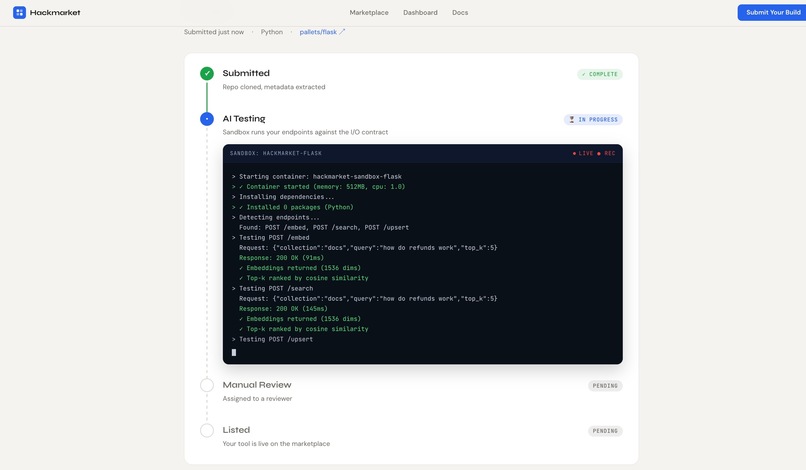
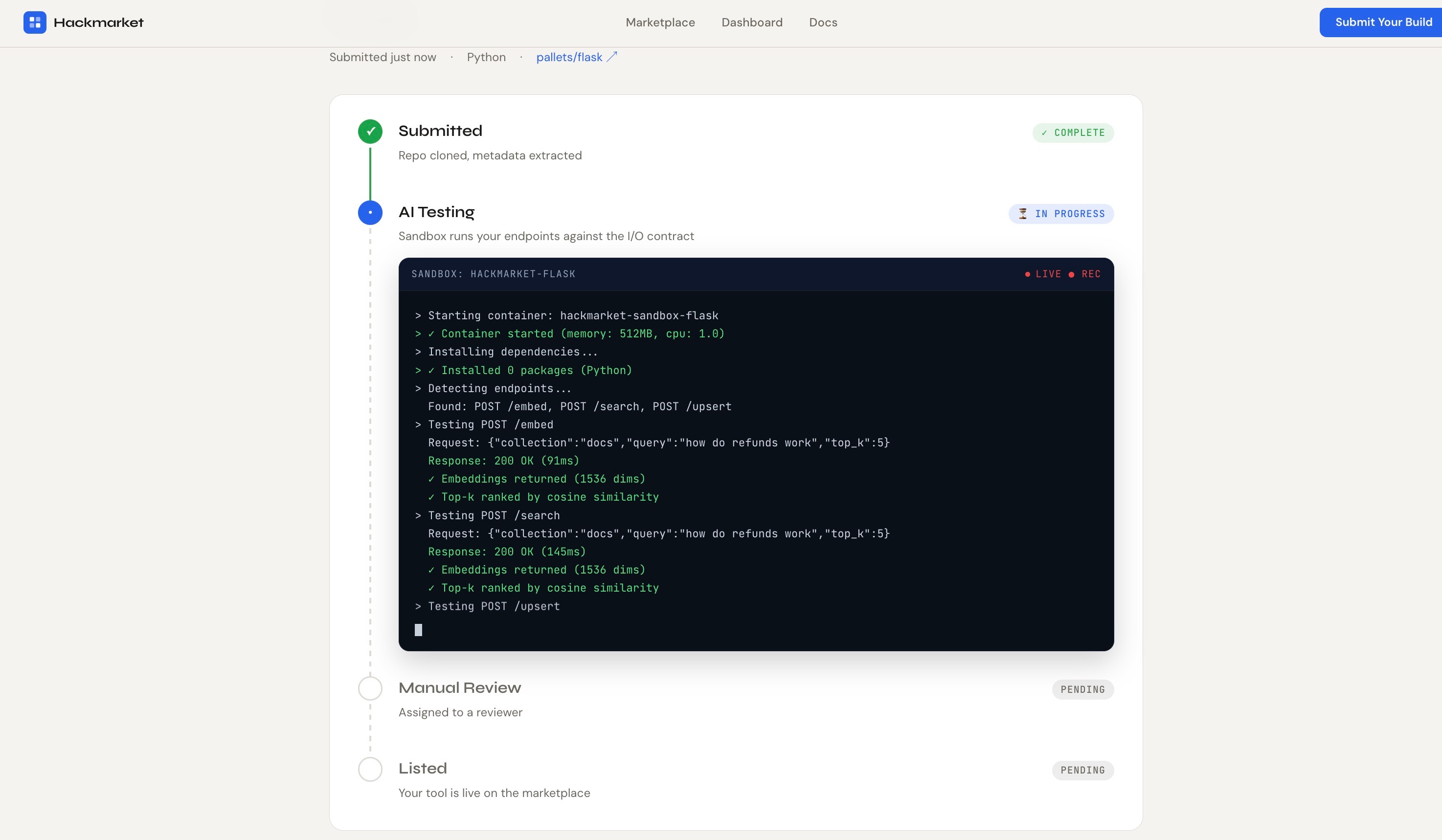
API sandbox
-
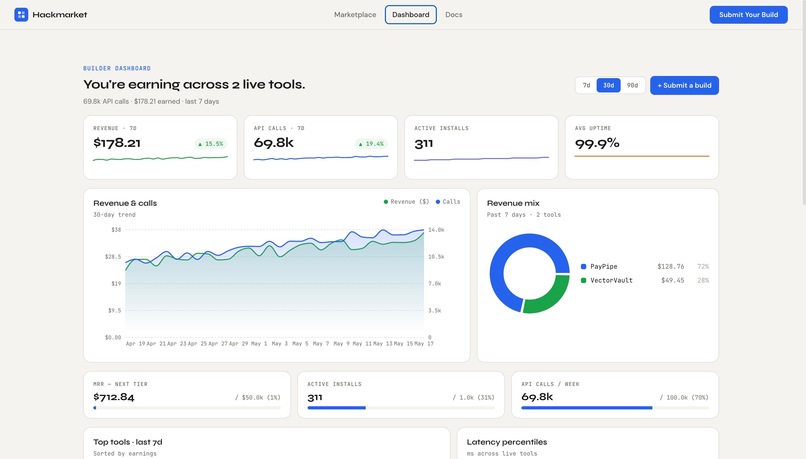
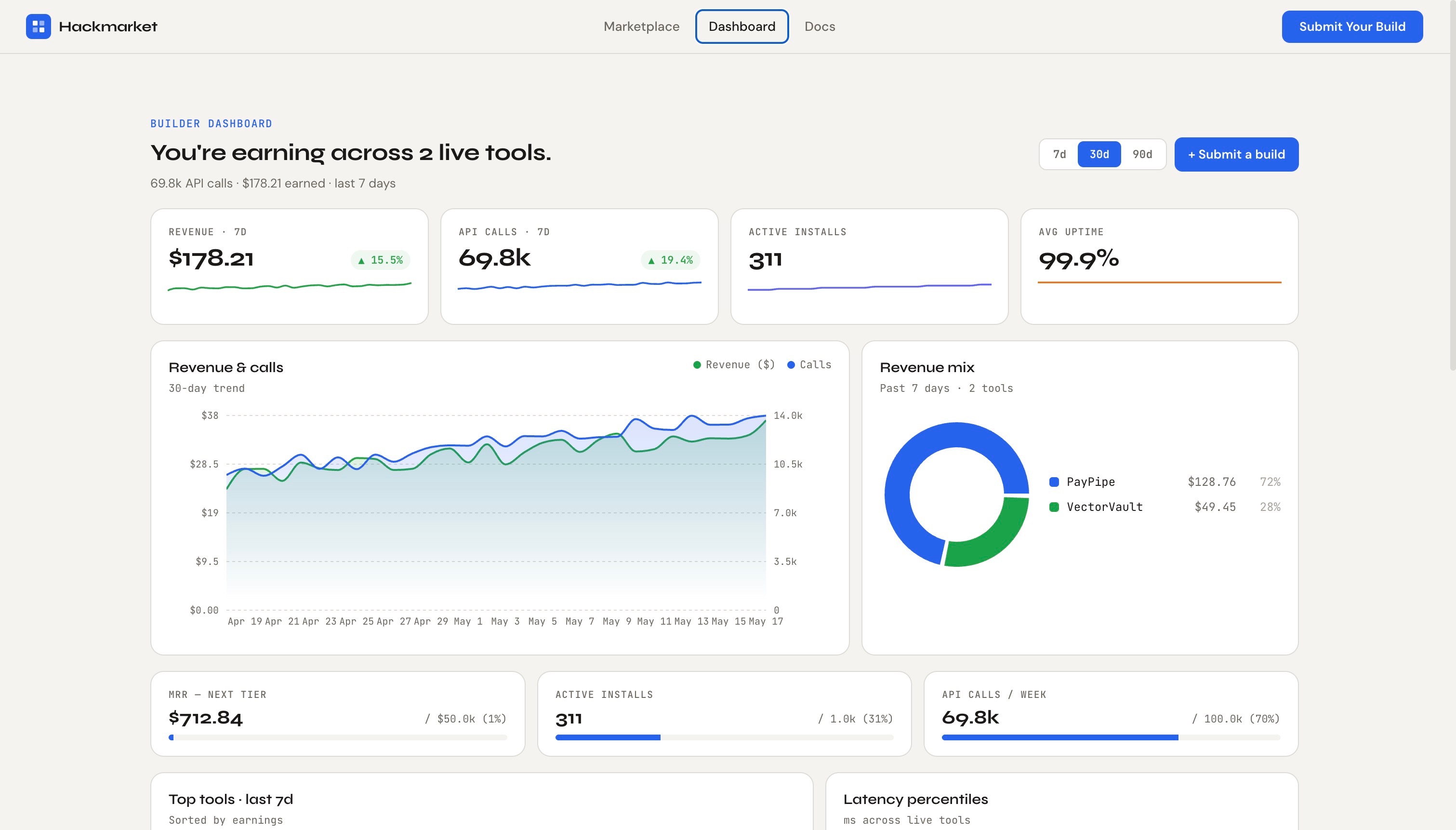
Seller revenue dashboard
Inspiration
We've been to enough hackathons to notice a pattern: teams pull all-nighters building incredible AI tools image classifiers, document parsers, sentiment analyzers, and then the hackathon ends. The repo goes cold. The demo link breaks. The project dies. Meanwhile we'd start our next hackathon and spend the first 8 hours rebuilding the same components from scratch, image recognition again, NLP pipeline, data extraction, etc. Every team at every hackathon is solving the same foundational problems instead of focusing on what makes their project unique. We looked at the numbers: over 200,000 projects are created on Devpost alone every year. Practically zero end up as usable products. At the same time, startups spend $50,000-$100,000+ hiring engineers to build the exact same tools these hackathon teams already made for free. That gap of thousands of working AI tools going to waste on one side, thousands of companies overpaying to rebuild them on the other, is what HackMarket exists to close.
What it does
HackMarket is a curated API marketplace that turns abandoned hackathon AI projects into production-ready APIs that anyone can use with one line of code. For sellers (hackathon builders and indie developers): upload your GitHub repo, and our platform handles containerization, deployment, documentation, and billing. Your dead side project becomes a live API earning passive income on every call. For buyers (startups, developers, non-technical founders): browse a curated catalog of AI tools, try live interactive demos before committing, grab an API key, and start making calls. Pay per use: no subscriptions, no contracts, no hiring an ML team. Every tool on the platform has a live demo where buyers can upload real data and see real results before they spend a cent. That trust layer is what separates HackMarket from every other API marketplace.
How we built it
Frontend: Next.js 14 with App Router and TypeScript, styled with Tailwind CSS, deployed on Vercel. The marketplace, tool detail pages, live demos, and seller dashboard are all server-rendered for fast initial loads with client-side interactivity for the demo runner and dashboard analytics. Backend: FastAPI (Python) handling authentication, tool management, the API gateway, usage logging, and billing logic. We chose FastAPI because it's async-native, has automatic OpenAPI documentation, and our AI tools are predominantly Python-based. API Gateway: Custom-built proxy layer that authenticates requests via API key, routes them to the correct tool container, logs usage, enforces rate limits via Redis, and returns standardized responses. Every call flows through this gateway regardless of what tool is being called, giving buyers a consistent experience across all tools. Containerization: Each tool is wrapped in a Docker container with a standardized API interface. We detect the project language, generate a Dockerfile, build the image, and deploy it behind our gateway. The seller's messy hackathon code runs inside the container, where buyers never see it. Database: PostgreSQL for users, tools, API keys, usage logs, and transactions. Redis for rate limiting, caching, and real-time usage counters. Infrastructure: AWS (S3 for code storage, EC2/ECS for container hosting, API Gateway as an additional routing layer).
Challenges we ran into
Hackathon code is messy. The biggest technical challenge was making our containerization engine flexible enough to handle wildly inconsistent project structures. Some repos have a clean requirements.txt and an app.py entry point. Others have dependencies scattered across notebooks, hardcoded file paths, API keys committed to the repo, and no clear entry point. We had to build detection logic that handles the common patterns while failing gracefully on edge cases. The demo system was harder than expected. Generating the right UI for each tool's input and output types required a dynamic component system. A tool that takes images needs a drag-and-drop uploader. A tool that takes JSON needs a code editor. A tool that returns CSV needs a table renderer. Each combination required its own component but they all had to feel like the same product. Rate limiting and usage tracking needed to be fast without blocking API responses. We solved this by logging usage asynchronously, the response goes back to the buyer immediately while the usage event gets written to Redis and flushed to PostgreSQL in batches.
Accomplishments that we're proud of
The live demo experience. Watching someone upload an image, hit "Analyze," and see real AI-generated results appear in a polished interface, that moment is what makes HackMarket feel real. We spent a disproportionate amount of time making that interaction smooth, fast, and trustworthy because it's the single moment that converts a browser into a user. We got real hackathon tools working as production APIs. Not mock data, not simulated responses, but instead actual hackathon projects containerized and serving real results through a unified gateway. The proof of concept isn't theoretical. It works. The unified API key system. One key, one authentication method, one billing account, and it works across every tool on the platform. That consistency is what makes the platform feel professional rather than a collection of random APIs.
What we learned
The hardest part of a marketplace isn't the technology, but it's the chicken-and-egg problem. You need tools to attract buyers and buyers to attract sellers. We learned that the fastest way to solve this is to be your own first seller. We listed our own hackathon projects, which gave us supply to demo and taught us exactly what the seller upload experience needs to feel like. We also learned that developers don't adopt tools because of features, and they adopt tools because of trust. A polished landing page means nothing if the first API call returns an error. We spent more time testing our listed tools against edge cases than we spent on any frontend feature, and that was the right call. Quality control is the product. The difference between HackMarket and a junkyard of random APIs is curation. Every tool that goes live needs to be tested, documented, and reliable. That takes real work and doesn't scale automatically, but it's the reason someone would choose us over alternatives.
What's next for HackMarket
Tool chaining. Let buyers connect multiple tools into pipelines. An image goes into tool A, the output feeds into tool B, the final result comes out of tool C. One API call triggers the whole chain. Bounty board. Buyers post requests for tools that don't exist yet with a guaranteed price per call. Developers see proven demand and build specifically for it. This solves supply generation permanently. AI-powered code analysis. When a seller uploads a repo, an AI agent reads the codebase, detects the entry point and dependencies, pre-fills the configuration, and generates the Dockerfile automatically. This cuts seller onboarding from 15 minutes to 2 minutes. Auto-generated SDKs. For every tool, auto-generate Python, JavaScript, and Ruby packages so developers can integrate with native library calls instead of raw HTTP requests. Accuracy tracking. Thumbs up/down on every API response to build granular accuracy data per tool. "94.2% accuracy based on 8,000 rated outputs" is far more trustworthy than "4.3 stars from 12 reviews." Scale the catalog to 100+ tools by partnering with MLH, university CS departments, and hackathon organizers to recruit sellers directly at events.
Built With
- api
- api-gateway)
- aws-(s3
- docker
- ec2
- ecs
- fastapi
- next.js
- postgresql
- python
- react
- redis
- tailwind-css
- typescript


Log in or sign up for Devpost to join the conversation.