-
-
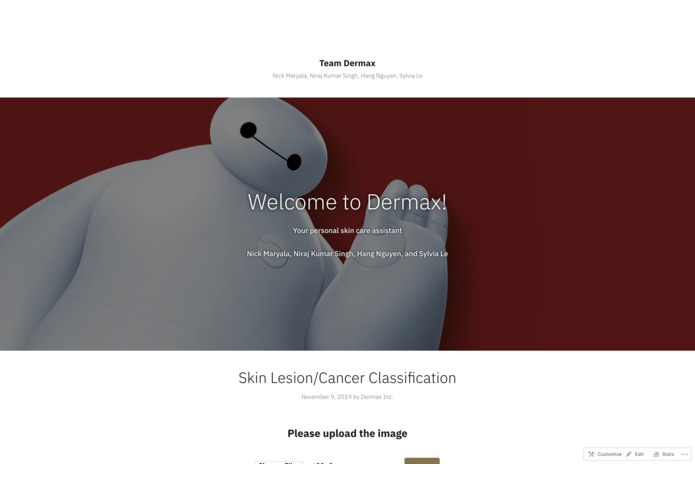
Website_1
-
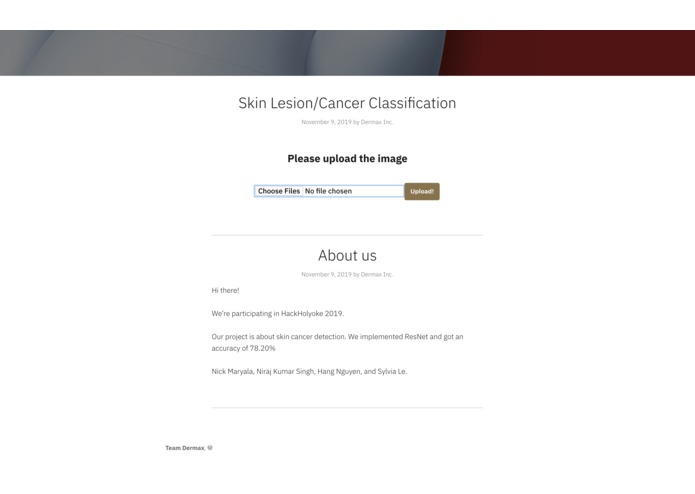
Website_2
Inspiration
Skin cancer is one of the most commonly diagnosed cancer in the US, and other parts of the world alike, though most cases are preventable. The number of people diagnosed with skin cancer in the last three decades is higher than all previous decades combined, and that number is still increasing. $8.1 million dollars a year goes to skin cancer treatment, with $3.3 million alone attribute to melanoma. The ratio of dermatologists vs patients with skin diseases some of the third world countries is 1:6700. Thus, it becomes challenging for patients to find dermatologists and bear a huge financial burden for themselves, their families and substantial healthcare costs for the nation's economy.
Earlier diagnosis can prevent patients from missing the best time of treatments, hence can reduce the costs of treatment and avoid complications. It can also be a powerful tool in helping doctors to make a faster, more reliable and more efficient diagnosis of the diseases. We see great potential in technologies like artificial intelligence with various applications in the healthcare industry, which in turn inspires us to use it for solving skin disease prediction problems, to make this world a better place for everyone. In this hackathon, we have developed ‘DerMax’, a personal skincare assistant.
What it does
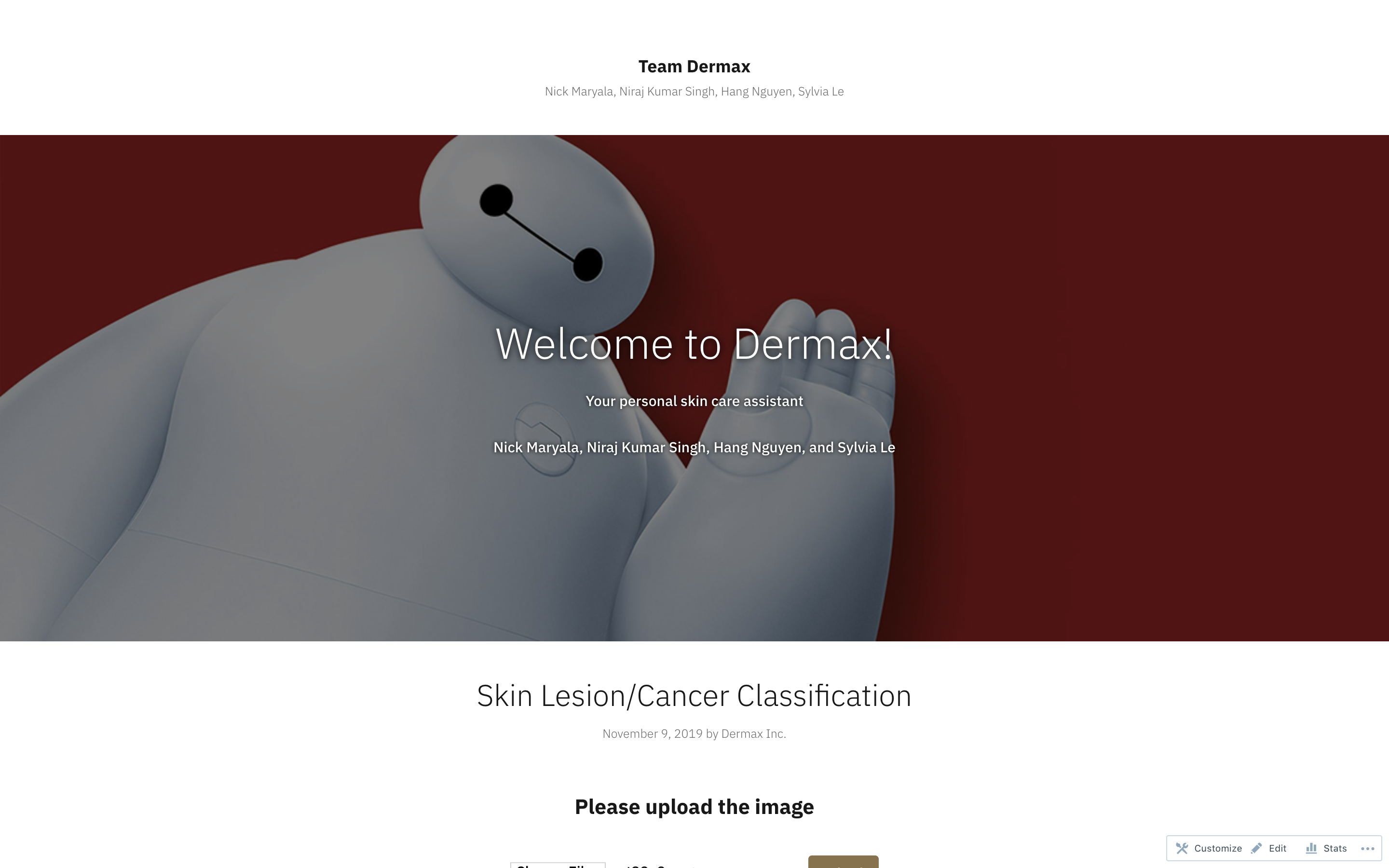
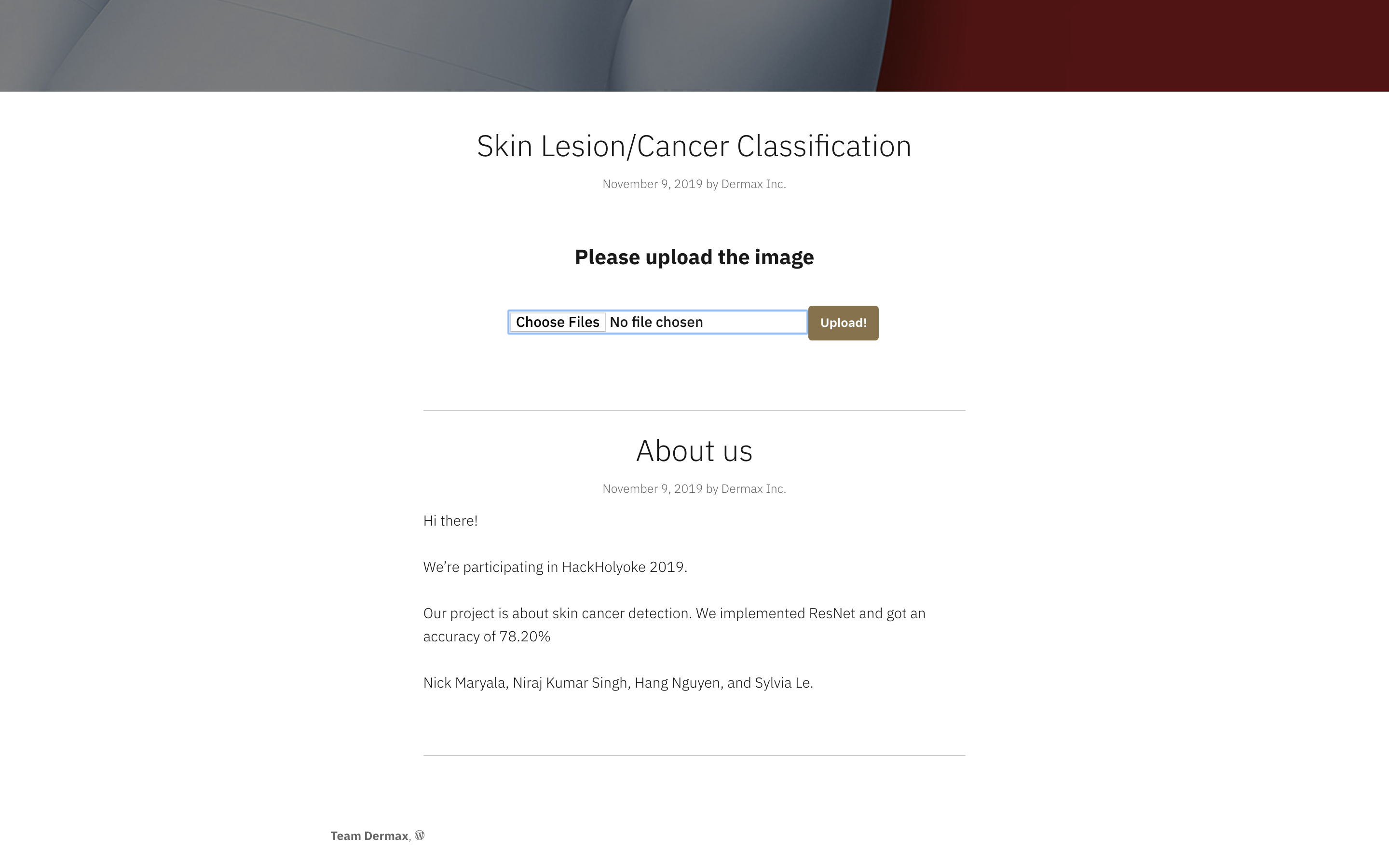
Our proposed product, ‘DerMax’, is a personal skincare assistant that can be used to check if one has any skin disease and by dermatologists, providing an extra hand/brain to create a faster diagnosis of skin diseases. We have created a basic website, on which a patient suspected to have some skin disease, can upload a picture of the affected skin region, and at the backend, our image classifier classifies into one of the 10 possible skin diseases. The website then generates a result that shows the probability of the patient having one of the 10 diseases. If the model predicts a high probability of particular skin disease, we plan to direct the patients to one of the best dermatologists in his/her vicinity, decided by a PageRank-like algorithm and can be visualized on the google maps, which is integrated into our website.
How I built it
We got an open-source dataset for Skin cancer MNIST dataset from Kaggle, which classifies skin lesion images into either cancerous of skin-disease category. We trained a Resnet 50 classifier on 10,000 images (without data augmentation) and 40,000 images (with data augmentation - flip, mirror, grayscale images, etc.) and classified it into 10 different skin disease classes. We used the pre-trained weights of ResNet50 from the ImageNet dataset and did transfer learning by learning the weights of the final layer. The best accuracy that we received on the validation set was 78.2% while training the model for 50 epochs. We plan to improve on this model’s accuracy by taking the following steps:
Challenges I ran into
We faced many difficulties while working on this. Firstly, it was a little difficult to get an open-source dataset from the internet, and after searching for a long time, we got a dataset on SKIN CANCER MNIST from Kaggle. Secondly, it was to identify the right model architecture, which could potentially learn the subtle features that differentiate one skin-disease from others. While training the network, tuning the hyperparameters, like the number of neurons in the final layer, learning rate, dropout probabilities, etc. took a substantial amount of our time. Combining machine learning pipeline to the website without compromising any features is one of the tough ones, as we didn’t stop to just make a mock-up but wanted to complete it as a whole.
Accomplishments that I'm proud of
Our team is proud of the fact that out of many interesting ideas that we brainstormed, we could work on something which has a direct impact on people's health globally, in a very short span of time. We as a team believe that working on challenging problems with powerful technology like artificial intelligence will dramatically help democratize healthcare to the hands of people.
What I learned
We learned what it means to work with people of different backgrounds, with diverse skill sets. While reading on the scale that this can affect people, we as a team would thrive to find such problems in society, and use the latest technologies to solve them. We learned how difficult it can be to tune parameters of a machine learning model, and what goes into building a technology that can impact multiple domains, right from healthcare, to autonomous cars, robotics and much more.
What's next for hackholyoke
We are committed to taking this project to the next level by making the algorithms better and enhancing the user experience. We believe we have a decent revenue model for the project to sustain itself by bringing various stakeholders like doctors, patients, and research organizations. Given a chance, we would like to help organize the event, popularize the events to gather much more foot-falls and make hackholyoke 2020 an even bigger event!
Presentation
You can have a look at our beautiful presentation of the project at Prezi.


Log in or sign up for Devpost to join the conversation.