-
-
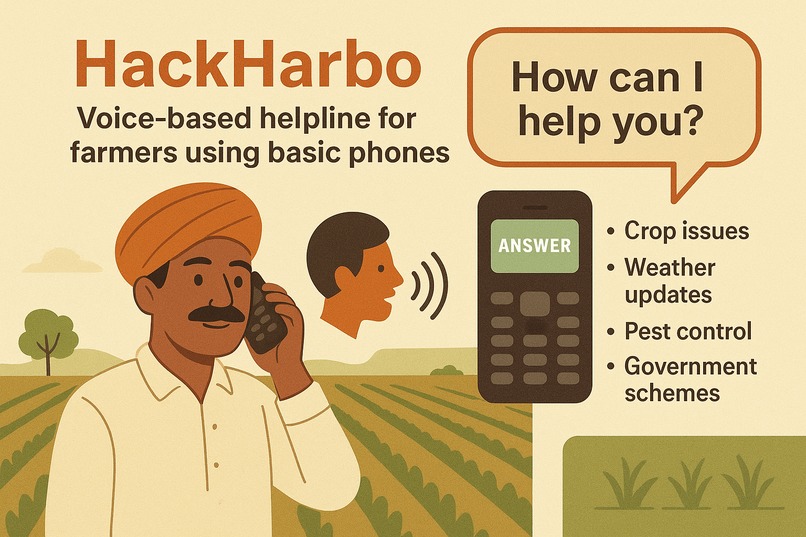
HackHarbo – A voice-based farming helpline bringing real-time support to farmers using just a basic phone.
-
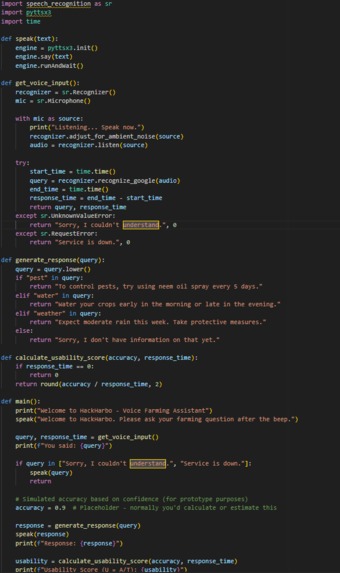
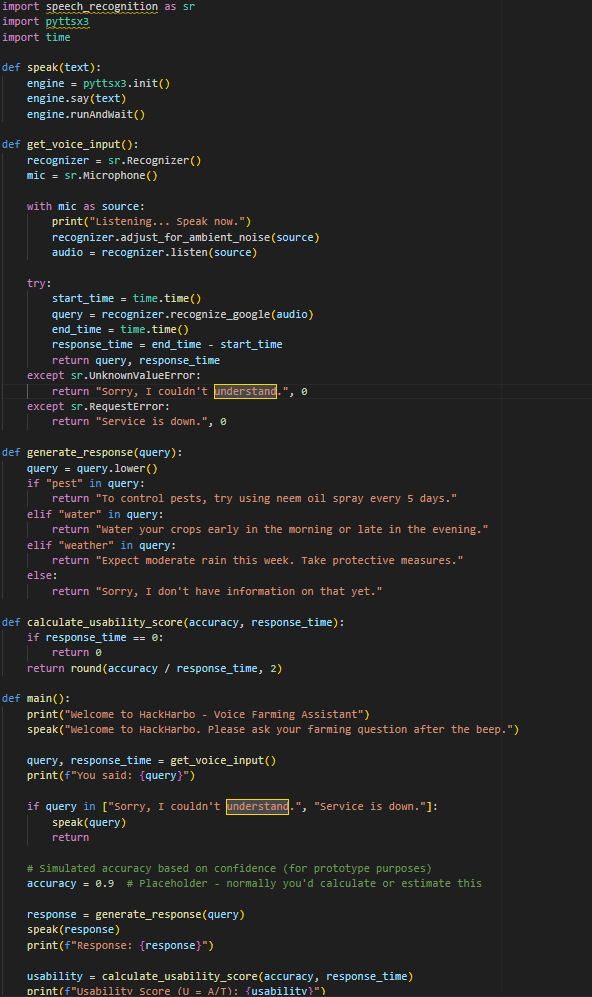
Python code powering HackHarbo’s voice recognition and response system.
-
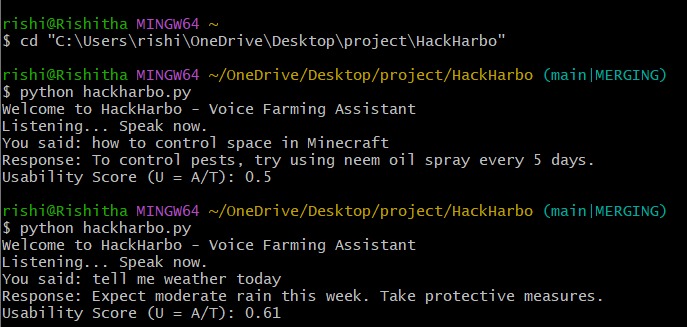
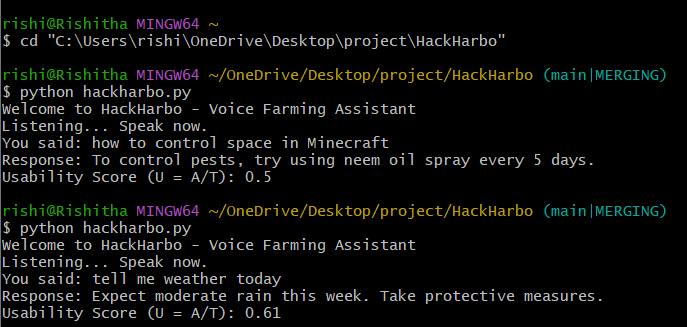
HackHarbo CLI: Voice query, AI response, usability score.
IInspiration
In rural and agricultural communities, many farmers still rely on basic phones or feature phones with no access to the internet or smartphones. They often face challenges in getting timely advice on crop issues, weather updates, pest control, or government schemes. Inspired by this digital divide, we built HackHarbo, a voice-based helpline prototype that works through basic phone call interactions — bringing vital agricultural support to farmers who need it the most.
What it does
HackHarbo is a voice-driven farming assistant designed for non-smartphone users. When a farmer calls the helpline, the system: Listens to the user's voice query Recognizes keywords using speech recognition Maps the query to common agricultural problems or services Responds using a text-to-speech engine in the local language The goal is to provide real-time, relevant answers — all through a simple phone call. We also introduced a usability scoring system using the formula: \ (𝑈=𝐴/𝑇\) Where: A: Accuracy of speech recognition (0 to 1) T: Response time (in seconds) U: Usability score
This helps us measure and improve the experience, especially for users with regional accents or noisy audio input.
How we built it
Python and pyttsx3 for speech processing and TTS response SpeechRecognition library for voice input handling Twilio (or similar telephony API) for simulating phone-based calls HTML5, CSS, JavaScript for the dashboard/monitoring interface Local server setup for testing calls and real-time logging Built and tested in VSCode, versioned with Git
Challenges we ran into
Handling regional accents and dialects in voice recognition Managing background noise and low-quality microphone input Creating a lightweight system that could, in the future, run on basic GSM infrastructure Designing a voice UX for users unfamiliar with IVR systems Building a reliable mapping system from voice to relevant farming advice
Accomplishments that we're proud of
Developed a working prototype of a helpline that simulates real farmer queries Successfully implemented a usability formula for voice systems Enabled a low-tech solution that could scale to offline users Built a socially impactful tool targeted toward underserved rural populations Proved that innovation doesn’t require high-end devices — just meaningful tech
What we learned
Deep understanding of challenges in voice interface design for non-tech users How to fine-tune speech recognition for real-world, low-resource environments Built empathy for users who aren't digitally connected Gained insight into telephony APIs and integrating them with custom voice logic Learned how to quantify usability for voice-based systems with real-time metrics
What's next for HackHarbo
Integrate with actual GSM call systems for field testing Add support for regional Indian languages and dialect training Partner with agriculture departments or NGOs for data-backed query resolution Launch a pilot program with small farmer communities Create a feedback loop to continuously improve response accuracy based on real use.
Built With
- browserbased
- css
- html5
- javascript
- platform
- python
- pyttsx3

Log in or sign up for Devpost to join the conversation.