-
-
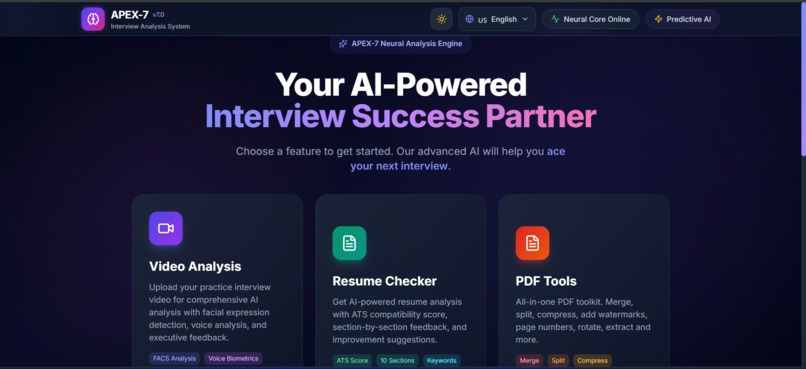
dashboard
-
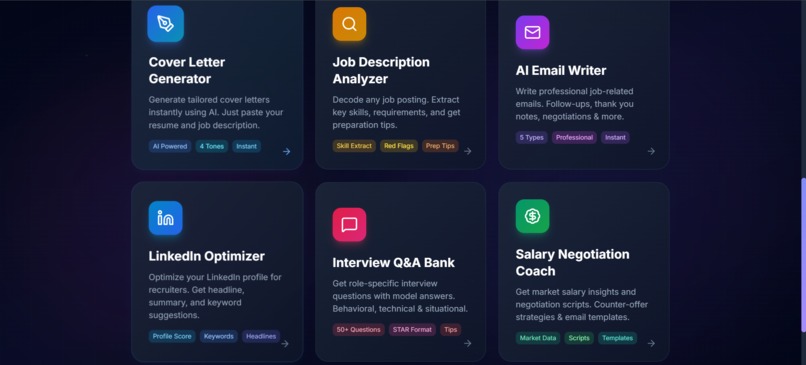
tools
-
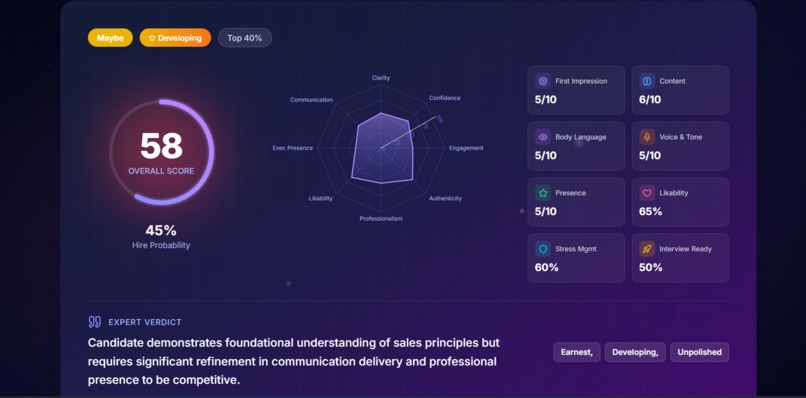
after the analyse video
-
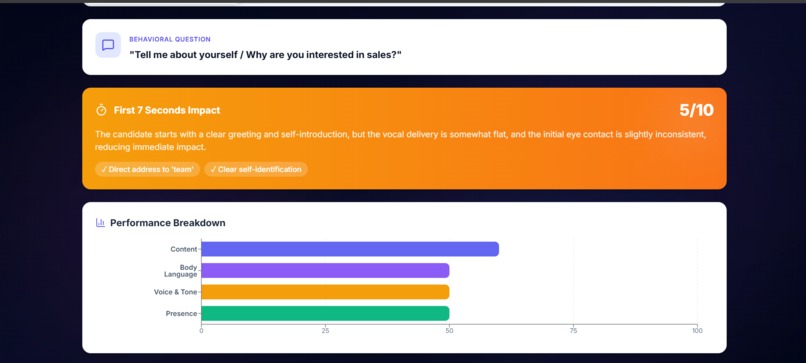
results
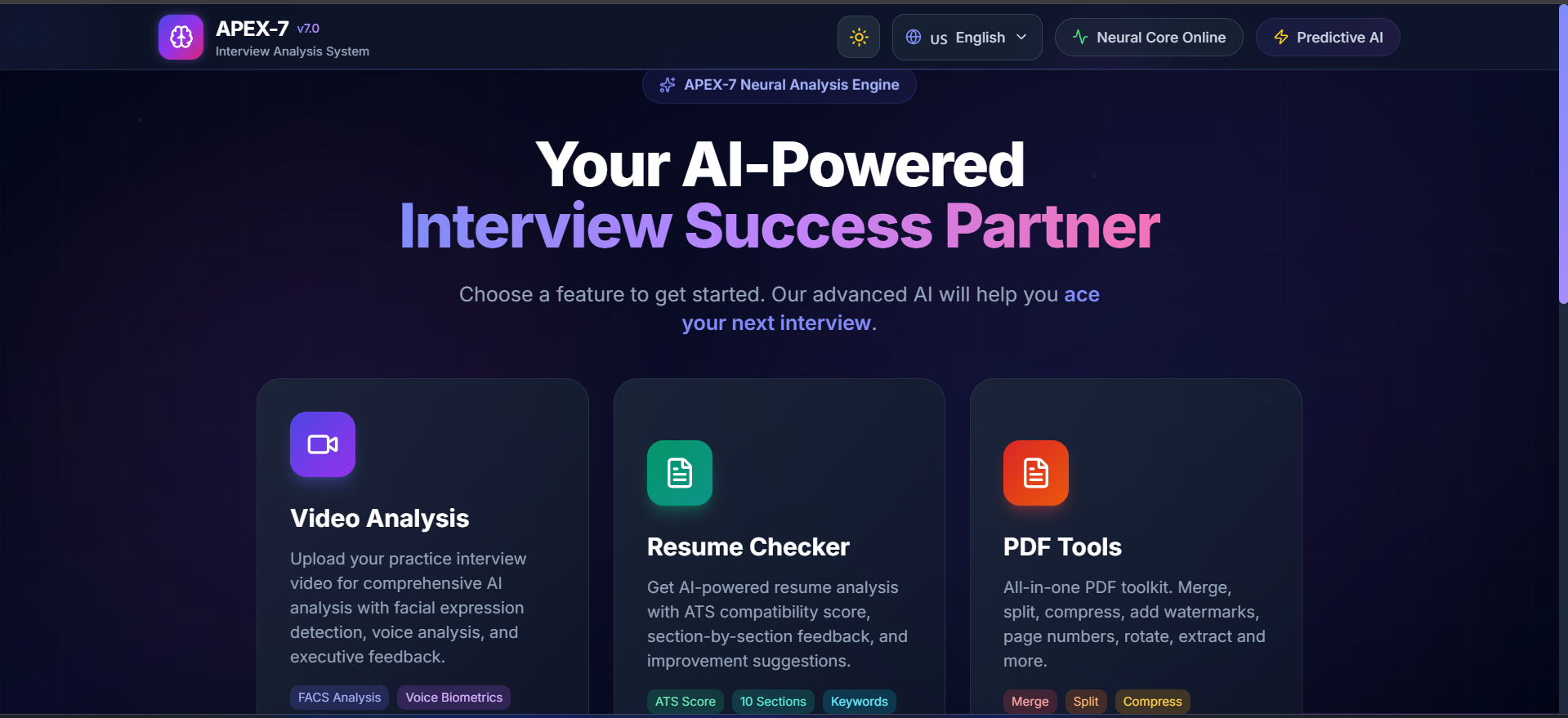
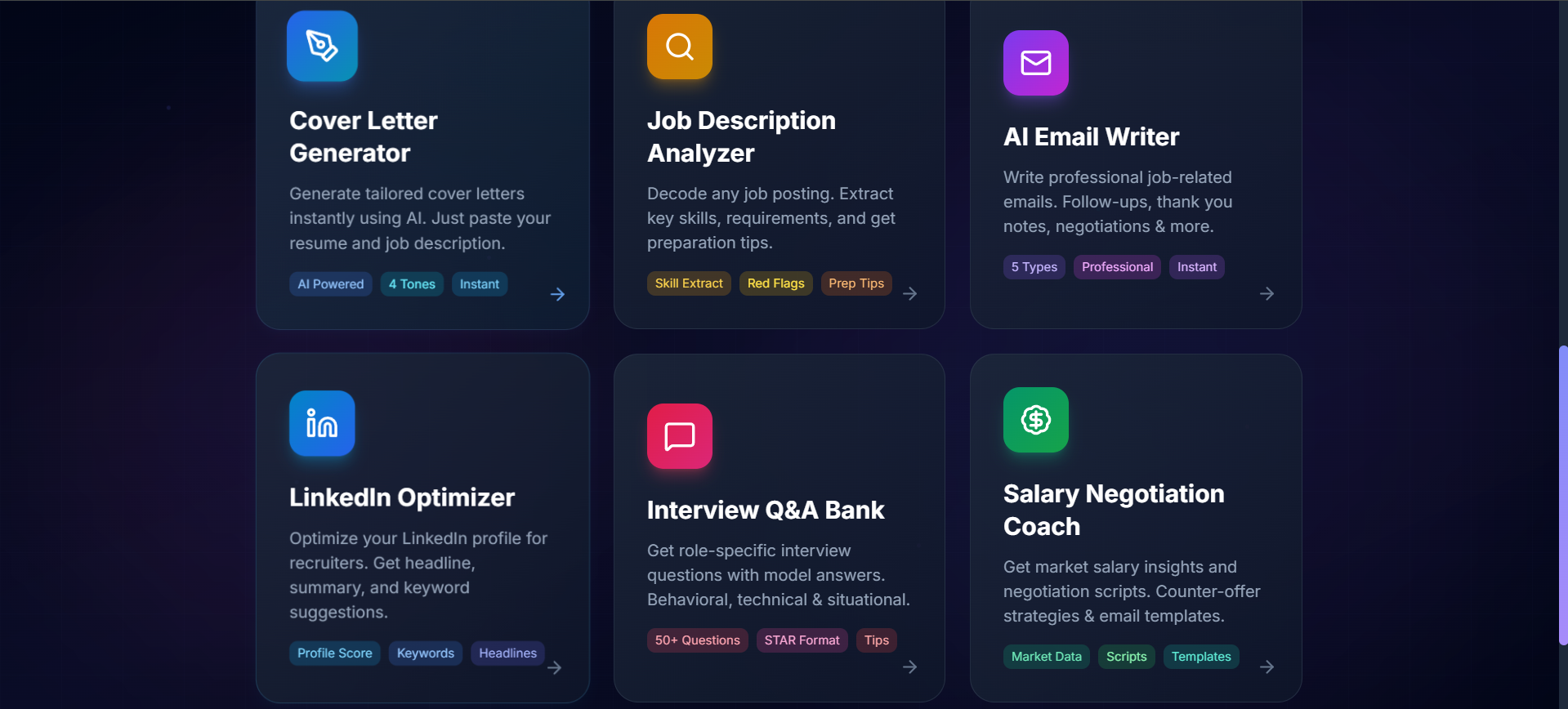
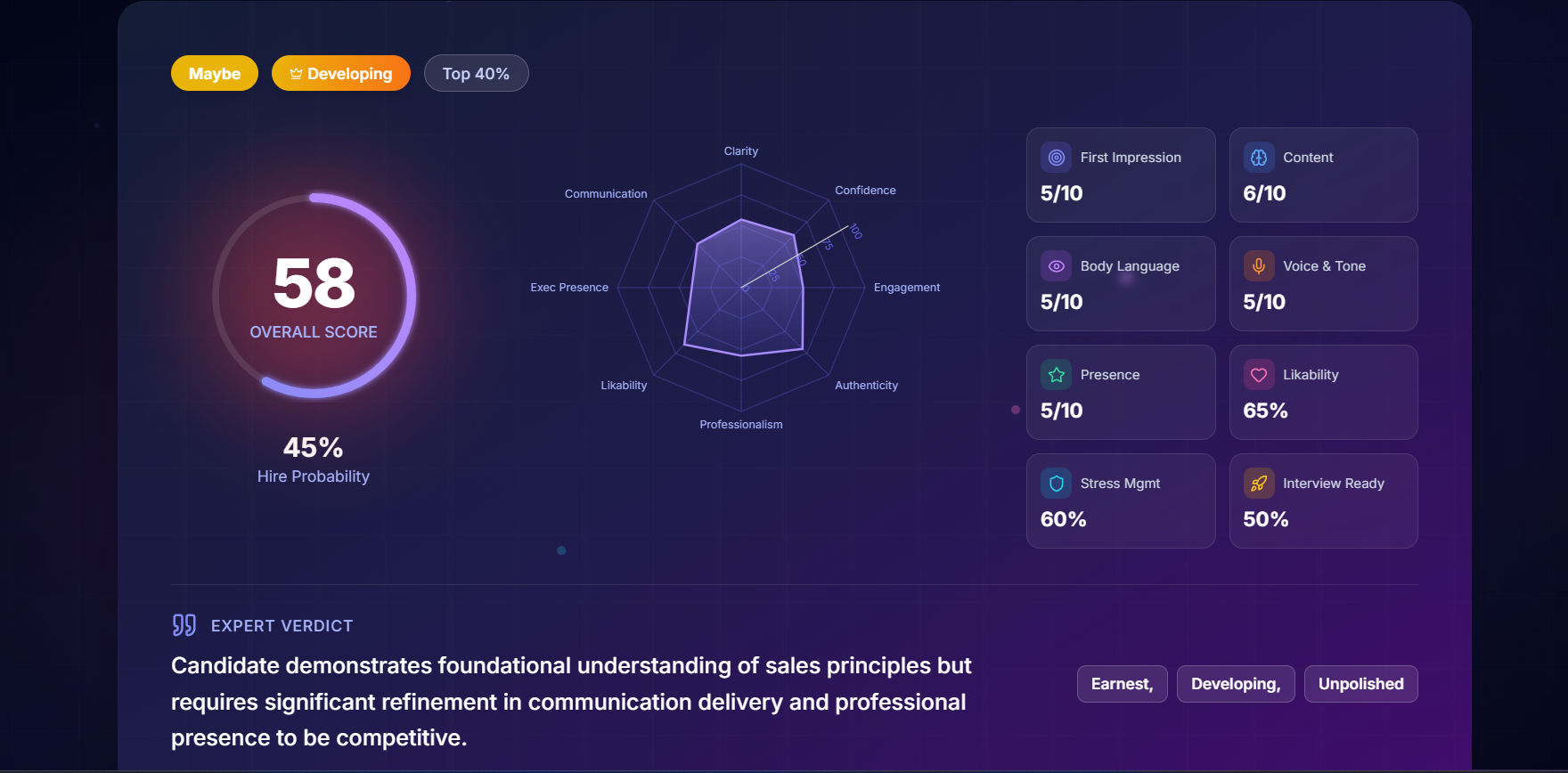
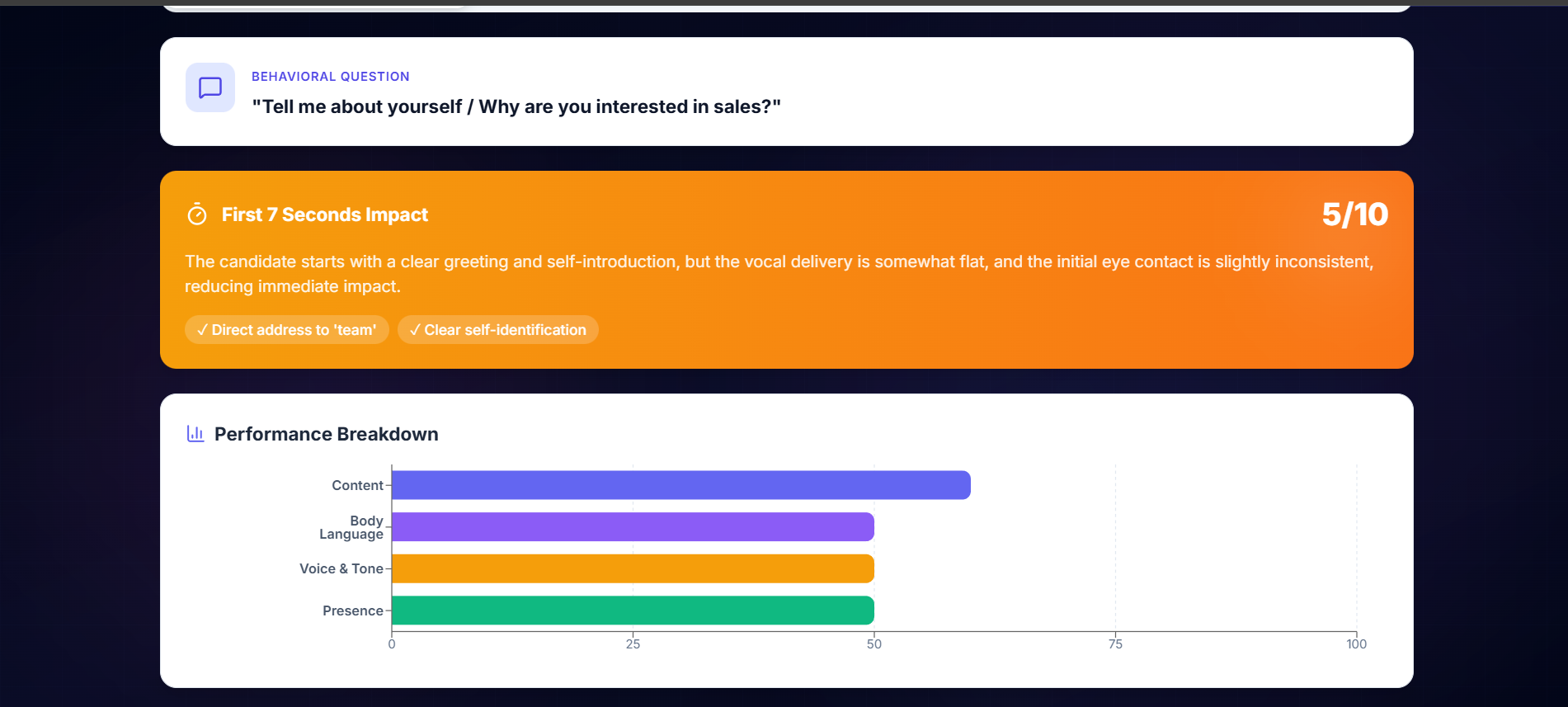
🚀 What it doesAPEX-7: is a holistic Career Command Center comprising 9 AI-powered tools. The flagship feature is the Biometric Video Analyzer. Users record a mock interview response, and our engine analyzes: FACS (Facial Action Coding System): We track 43 facial muscle movements to detect emotions like confidence, nervousness, or deception. Vocal Biometrics: We measure pitch stability, speaking pace ($WPM$), and filler word density. Content Relevance: We cross-reference the spoken answer against the specific Job Description (JD).Beyond video, the platform includes a Resume ATS Checker, Salary Negotiation Coach (localized for the Indian market with ₹ LPA metrics), PDF Tools, and Automated Email Writers.
⚙️ How we built: We built APEX-7 as a Privacy-First, Client-Side Application. There is no heavy backend; everything runs in the user's browser to ensure their video data never remains on a server. The Tech Stack Core: React 19 with TypeScript 5.8 for type safety.AI Engine: Google Gemini 2.5 Flash. We chose this for its superior Multimodal capabilities (Video + Audio + Text processing in a single window).UI/UX: Tailwind CSS for a futuristic "Dark Mode" aesthetic and Lucide React for iconography. The Math Behind the Magic (The Scoring Algorithm)To generate a "Hire Probability Score" ($P_{hire}$), we developed a weighted algorithm that aggregates three distinct vectors:$$P_{hire} = \alpha(S_{visual}) + \beta(S_{audio}) + \gamma(S_{context})$$Where:$S_{visual}$ represents the FACS alignment score (positive vs. negative micro-expressions).$S_{audio}$ is derived from pitch variance ($\sigma^2$) and fluency rate.$S_{context}$ is the semantic cosine similarity between the candidate's answer and the JD keywords. The weights satisfy $\alpha + \beta + \gamma = 1$.We utilize Gemini 2.5 to process the raw video frames and extract these metric vectors, which are then visualized using Recharts.
🚧 Challenges we ran into: Handling Video Data on the Client: Uploading large video files directly to an LLM can cause timeouts. We had to optimize the video compression pipeline using client-side logic before sending data to the Gemini API to ensure the "Analysis" phase remained under 10 seconds. Prompt Engineering for Structured JSON: Getting the AI to consistently return a strictly formatted JSON object (for our dashboard graphs) while analyzing complex unstructured video data was difficult. We used System Instructions and One-shot prompting to enforce strict schema adherence. The "Hallucination" Problem: Initially, the AI would be too nice. We had to tune the "Temperature" and provide specific "recruiter personas" to ensure the feedback was critical and realistic, not just encouraging.
🏆 Accomplishments that we're proud of: FACS Implementation: Successfully getting the AI to recognize specific facial cues (like "brow furrowing" or "lip compression") from a standard webcam video. Zero-Backend Architecture: Building a full-stack feeling application that is actually 100% serverless and free to host. The "Cinematic" UI: The initialization sequence and dark-mode animations make the tool feel like premium enterprise software.
📚 What we learned:
Multimodal AI is the future: Text-only analysis is obsolete. Combining Video and Audio provides a 10x deeper insight into human performance. React 19 Features: We experimented with the latest React hooks and optimization techniques which significantly improved the rendering speed of our charts.
🔮 What's next for APEX-7: Real-time Live Coaching: An overlay that gives feedback during the interview (e.g., "Slow down," "Smile more").Mock Interview Simulator: A conversational AI avatar that speaks back to the user instead of just analyzing recorded videos. Mobile App (PWA): Making the resume scanner and PDF tools accessible on the go.
Built With
- artificial-intelligence
- computer-vision
- frontend
- google-gemini
- machine-learning
- natural-language-processing
- node.js
- react
- recharts
- tailwind-css
- typescript
- vite
- web

Log in or sign up for Devpost to join the conversation.