-
-

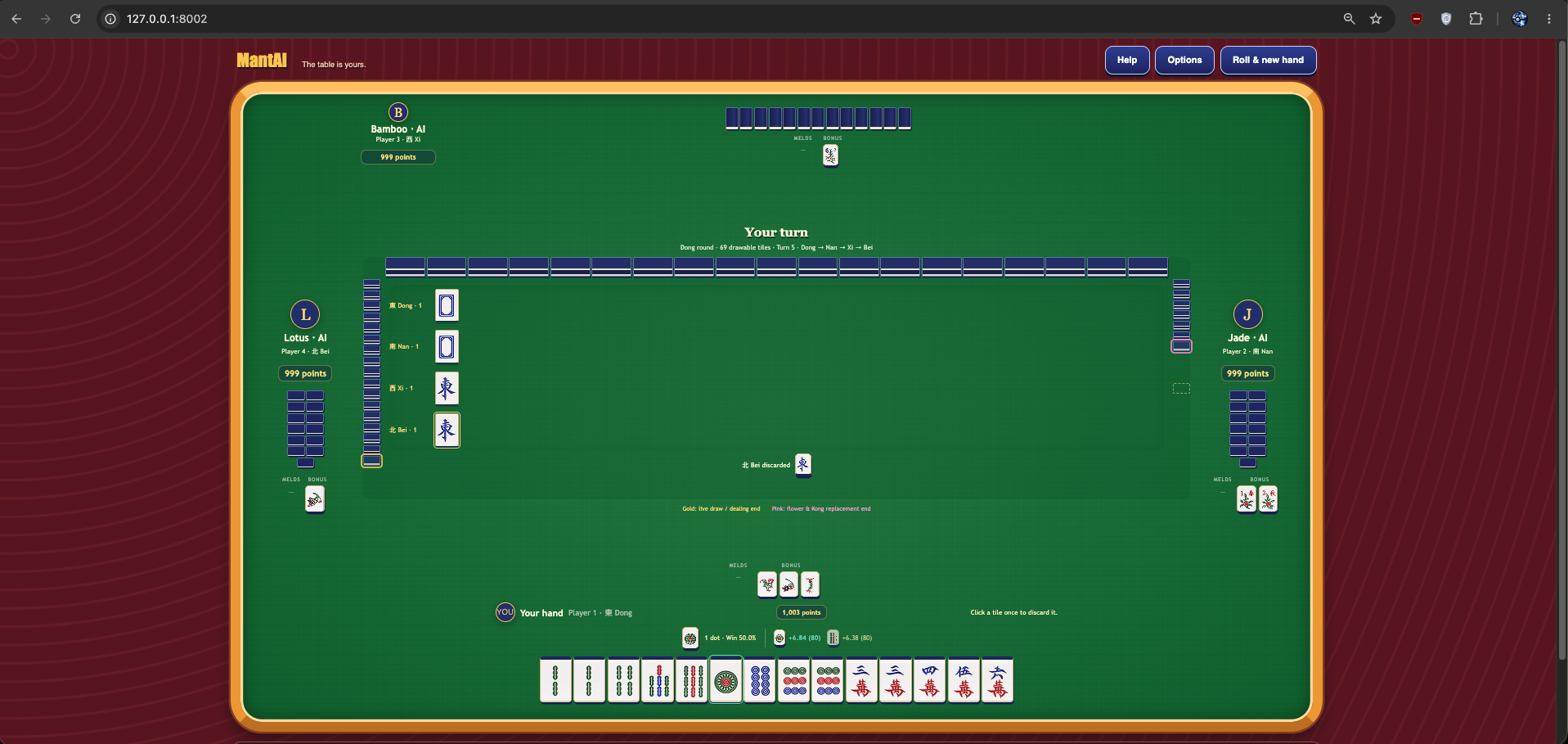
AI model recommending which tile to discard
-
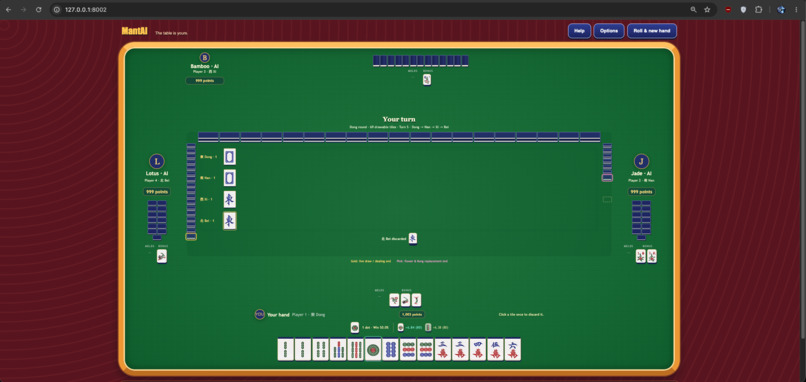
example of a gameplay

Inspiration
mantAI began with a question inspired by AlphaGo: could an AI learn to make better Mahjong decisions, beyond simply checking whether a hand is valid?
Mahjong combines pattern recognition, planning and uncertainty. We wanted to build a coach that helps players understand their options and feel more confident playing, with a longer-term goal of supporting practice and community Mahjong sessions for older adults.
What it does
mantAI analyses a player’s hand and the available game state to recommend discards and provide guidance on legal claims. It combines learned models with simulated outcomes to compare possible moves.
The AI uses public information, including discards and claims, to estimate possible opponent hands. It cannot see opponents’ hidden tiles.
How we built it
We built Python components around a Mahjong simulation and a hand-tuned strategy engine.
A policy network proposes discards, a value network estimates expected points, and an opponent danger model estimates readiness and discard risk. Search combines these models with simulated games to evaluate candidate moves.
We trained the models using simulated games and self-play, connected the components through an API, and evaluated their performance against the strategy engine.
Challenges we faced
Hidden tiles make Mahjong decisions uncertain. The AI must consider several possible game states instead of assuming it knows every player’s hand.
We also had to balance recommendation quality with speed. More simulations provide additional evidence, but they increase the time needed to suggest a move.
Evaluation was another challenge. Results from different sample sizes are difficult to compare, so testing approaches on the same deals was especially useful.
Accomplishments
We brought hand analysis, learned models and simulation search together into a working prototype.
In a recorded evaluation, adding search increased the network’s average points per hand. However, the hand-tuned engine still performed better on matched deals, giving us a clear benchmark for further development.
What we learned
Building a useful Mahjong AI requires more than recognising winning hands. It requires reasoning about incomplete information, comparing future outcomes and evaluating performance carefully.
We also learned to distinguish our intended social benefits from demonstrated results. We have not tested improvements in loneliness or dementia outcomes.
What’s next for mantAI
We plan to improve self-play training, reduce search time and better calibrate the AI’s probability estimates.
We also want to test larger tiles and clearer controls with older adults, then explore facilitated Mahjong sessions with families or community groups. These pilots would help us assess usability, enjoyment and social participation.

Log in or sign up for Devpost to join the conversation.