Problem
The public healthcare provider is struggling with too many patients visiting the doctor's without a proper reason. This behavior causes long queues, customer frustration and inefficient use of human and financial resources. Often, these cases can be solved by other healthcare professionals such as nurses, health coaches, therapists, wellness experts or other specialists.
Solution
We decided to solve the problem by creating a channel guiding customers towards the right action by taking advantage of state of the art technology. The automated channel will diagnose customer’s condition and determine the optimal action. Depending on the customer's health condition, the system will book an appointments with an according health expert, give medical advice and provide prescription. We believe in creating a larger ecosystem of health providers that consists of partners such as pharmacies, psychologists, wellness coaches, therapists, fitness experts, nutritionists sports gyms etc. Our solution is combining all these health service providers to one network.
There are already different health condition analysis programs available on the market and our solution is improving current solutions with intelligence. For example, Sitra has created the virtual clinic which is arranging video call appointments to healthcare experts according to symptoms a customer inserts to an online template. Our system is expanding the health service network and adding new interface to the solution with an intelligent assistant. The assistant uses voice, speech and text technology to make it super easy for the patient to interact with the service. The customer can describe symptoms using voice and with speech recognition the service will conduct pre-screening of the potential disease. The customer can also type the symptoms and interact with the assistant’s chat interface which offers options for potential symptoms based on initial user data input. The intelligent assistant makes the healthcare experience more inclusive and accessible as it can be used from 5 year old children to 85 year old seniors.
Inspiration
We did some homework and found out some inspiring examples for developing our ideas:
Babylon Health - Hand-picked doctors, supported by cutting edge AI technology https://www.babylonhealth.com/ DeepMind Health - Help clinicians to get patients from test to treatment, faster https://deepmind.com/applied/deepmind-health/ Nike on demand - Helps athletes to raise their game and stay accountable to their training plan https://www.rga.com/work/case-studies/nike-on-demand-2 Sense.ly - Virtual nurse who provides customized monitoring and follow-up care, with a strong focus on chronic diseases http://sensely.com/ Lark Technologies - Personalized A.I for Chronic Disease http://www.web.lark.com/
A local concept that we would want to collaborate with is the Virtual Clinic concept by Sitra which provides information, assistance and self-care instructions as needed to patients. We discovered that this concept provides good ground and opportunity for further development. We want to integrate our solution to existing services so that it helps make the public healthcare system more human-centered and personalize the experience to an individual level.
What it does
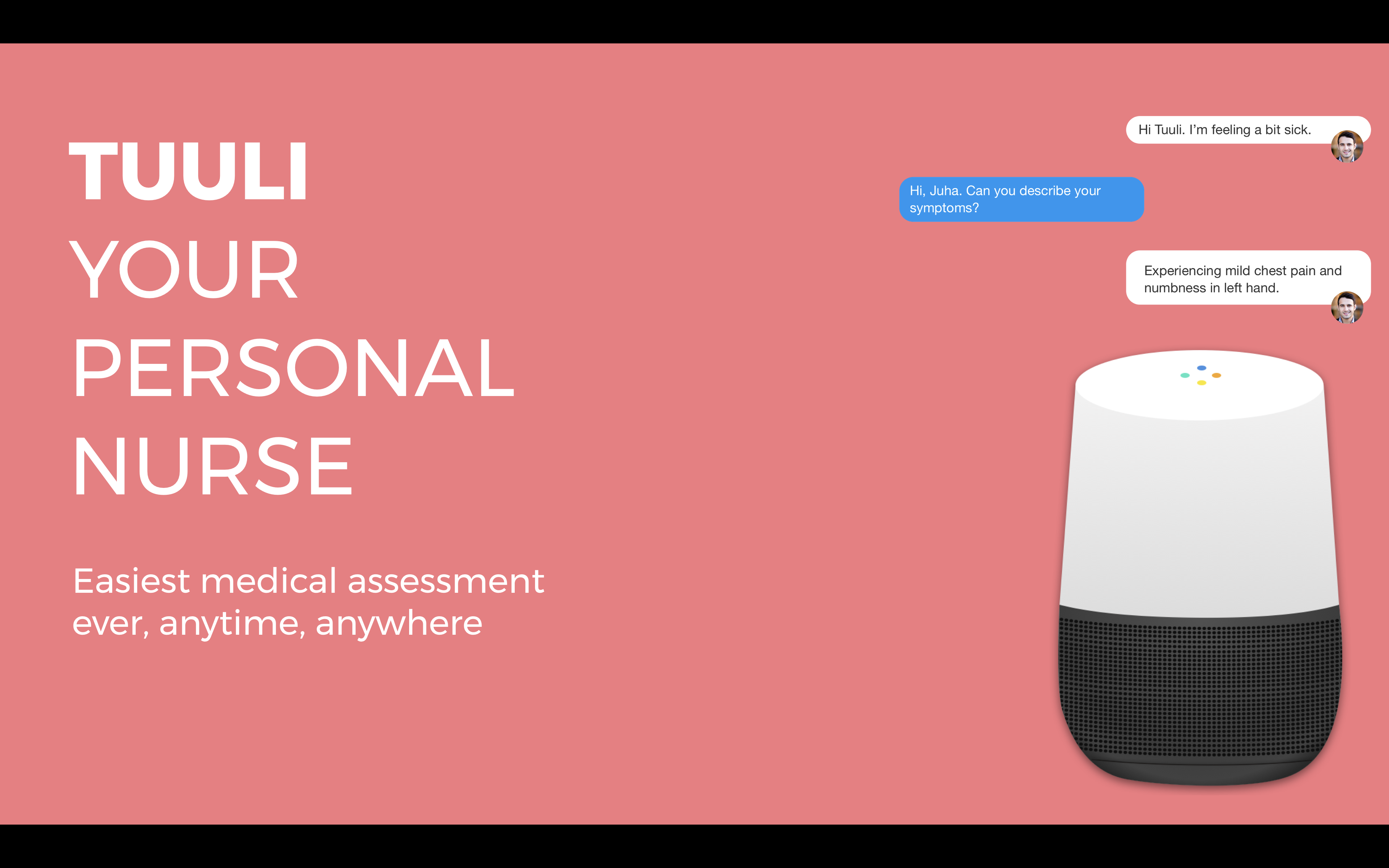
Tuuli is an intelligent assistant who carefully pre-screens people’s health conditions, which could be viewed as an extension to the existing “Virtual clinic” by Sitra. Instead of using a web interface, Tuuli is a conversational interface people can chat or speak with via multiple devices such as the smartphone, Ipad, smart home speaker or any device that is connect to the internet.
Initially, the user will go through the pre-screening process with Tuuli. Based on the severity of the health condition, patients will be either connected to health professionals immediately or Tuuli will provide the first step to cure the symptoms without doctor visit. Later on if the symptoms remain without getting better, patients will be connected to a doctor. Tuuli aims to create a more genuine and human-centred way of interaction while shifting the focus on a human touch and decreasing the perception of a technical tool. In the future there will be customer segments of one and hence it is essential that can provide more contextual service for every person’s individual needs.
How we built it
We started the whole problem-solving process by understanding how the healthcare process works. Based on that, we formulated personas based on our research findings and understood that many diseases start from small minor symptoms and then they escalate over time. Many illnesses such as cardiovascular diseases, diabetes, depression etc. might occur during a person’s working life in their 50’s and they get worse over time. Much of the problem is due lack of health awareness and understanding of the body. Educating the customer on individual health already helps many people to start doing preventive healthcare and also prevent them for seeking doctor’s advice when it’s unnecessary and there is no acute reason. Talking to users and experts we learned that customers fundamentally believe that a doctor is the authority that helps them to cure their illness when symptoms occur. This behaviour has put strain to the existing public healthcare system and this was something we aimed to tackle with our solution.
Understanding this human behaviour, we figured that an intelligent system that learns from user input and becomes smarter and more personal for the user helps to tailor health advice for the individual user’s needs. Using machine learning to understand the customer’s symptoms and matching the input to public health databases and private partner company health datasets, the system will learn exponentially about Finnish population’s health and tailor care accordingly. The intelligent assistant is the most natural user interface to reach the vast majority of the population and make it more accessible and democratic.
After empathizing with the target customer and identifying current bottlenecks in the public healthcare system, we brainstormed using double diamond and design thinking methodologies. We ideated different solutions and approaches to the problem and built different prototypes and versions of the solution. We conducted user and expert interviews and demoed the idea to potential users and selected the most valid version of the prototype to develop further. We built a storyboard to present our customer journey and showcase how the intelligent assistant interacts and communicates with the patient using voice and text. Our final product is a prototype that validates that this kind of a service is easy to build and develop further to a pilot project.
Accomplishments that we're proud of
We created multiple concepts to solve different problems in the healthcare industry. In the end, we decided to choose the Virtual Nurse idea because it contains several advantages compared to the other ideated concepts. The Virtual Nurse is easy to implement to the existing Virtual Hospital concept in the DigiSuomi initiative making the existing system more human-centered in a short timeframe. It is much more user-friendly compared to Motivisti and other apps that have been developed under Terveyskylä.fi project.
The first phase of this service focuses on instant value creation for the public healthcare provider and there were many ideas how to develop long-tail and long-term value for the service. Other concepts we created were more focused on preventative health care and following the health development progress of the patient. These solutions are definitively interesting for developing our concept further and enhancing the patient experience further.
Challenges we ran into
Similar to other cases, our biggest hurdle was to make the service secure, solve legal data issues and build a rapport with users that ensures their needs would be covered through our solution.
After working through the challenges we did find a touchpoint to insert our idea within the current ODA (Self Care and Digital Value Services) project funded by Sitra and which already has gone through several phases of validation and testing for example for video consultation for the student health care service.
What we learned
We learned that the healthcare system is extremely complex and involves innumerable partners and stakeholders. Especially legal limitations for collection, access and processing of patient data is a crucial topic which makes innovation opportunities difficult and puts a special emphasis on data security. We realized that for this hackathon and challenge it is necessary to find an existing touchpoint for our concept to place it so that it can be implemented in the near future.
Before and during the hackathon our group managed to gather a large amount of information and knowledge about the Finnish healthcare industry and gain a deeper understanding about the current and future situation. During and before the design process we made a lot of research related to the topic. We consulted experts working in the industry including nurses, doctors, medical students and developers. In addition we talked with different users of health services and tried to approach the problems from all the users perspective. We gathered a big amount of information about health services worldwide and analysed possible market scenarios in the future. We realised that the domain, public healthcare, is a huge subject already by itself, but in order to innovate in this domain, you have to dive really deep in order to understand the whole process. Our group is proud of comprehensive research it has done. In addition to working in an interdisciplinary and international team we also learned to dig up information from mentors, partners and other experts involved with the hackathon conference.
What's next for Tuuli - Virtual nurse
We believe that Tuuli has the potential to be included into current Sitra concepts in order to help patients even more by interacting with the platform by voice and chat. We believe that the system can be integrated into a larger ecosystem of health partners that help create value for the end user and make the overall patient experience more human-centered.
Built With (keywords)
Conversational interface (visual and audio), machine learning, pre-screening, Google Dialogue Flow (Api.AI), Diagnosis
Built With
- chatbot
- google-home


Log in or sign up for Devpost to join the conversation.