-
-
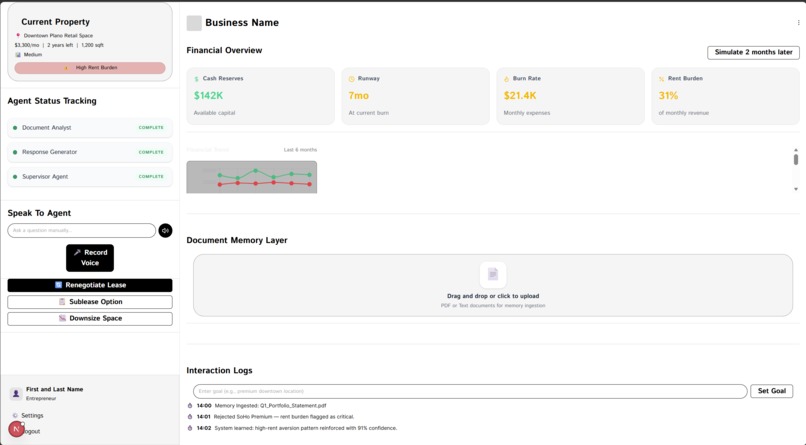
dashboard
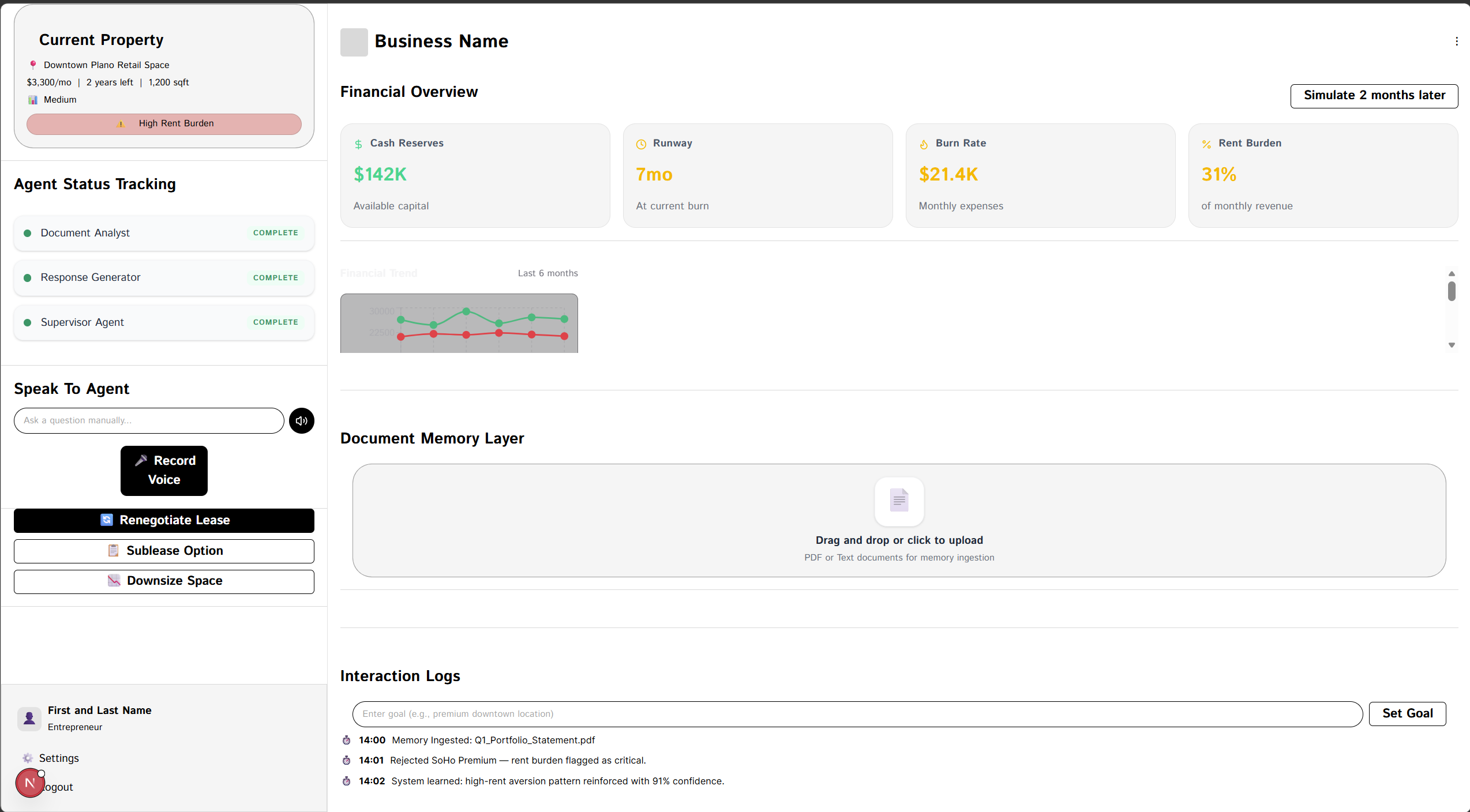
ComPal: Memory-Driven Commercial Real Estate Intelligence
Inspiration
Small business owners face complex and high-risk decisions when choosing commercial real estate. Unlike large enterprises, they often lack access to expert advisors, financial analysis tools, and historical insights to guide their decisions. Most platforms today provide static listings, not intelligent guidance.
We were inspired to build a system that acts like a trusted senior advisor, one that doesn't just display data, but absorbs it, remembers past decisions, and continuously improves recommendations over time through a persistent memory layer.
What it does
ComPal is a memory-driven AI system that helps small business owners make better commercial real estate decisions. By ingesting business documents and lease agreements, it constructs a "Document Memory Layer" that links financial health with property-level operational risks. The system:
- Extracts Intelligence: Ingests PDF/Text documents to identify financial and operational weaknesses.
- Identifies Operational Risks: Analyzes property data (HVAC status, lease expiry, rent burden) to flag potential capital expenditure shocks.
- Learns Preferences: Remembers user decision patterns (e.g., cost-sensitivity, growth focus) to pivot future advice.
- Retains Context: Uses long-term episodic memory to provide context-aware "Next Steps Forward."
- Voice Synthesis: Vocalizes agent insights using ElevenLabs for hands-free intelligence.
How we built it
We built ComPal as a multi-agent system (MAS) utilizing specialized agents and a sophisticated dual-memory architecture:
- Property Manager Agent: Evaluates commercial properties to identify operational risks (e.g., aging infrastructure like HVAC) and leasing constraints.
- Supervisor Agent: The "Brain" of the system. It synthesizes insights from the property manager, queries long-term memory, and retrieves semantic graph data to generate unified, prescriptive recommendations.
Architecture & Memory Layer:
- Long-Term Memory (Mem0 & PGVector): Stores historical user decisions and preferences (episodic memory) to ground agent behavior in real-world context.
- Semantic/Graph Memory (Neo4j): Maps the relationships between business accounts, operational risks, and property performance (e.g. how a 'Poor' HVAC status in Neo4j impacts cash flow).
- Real-Time Agent Pipeline: A LangGraph-orchestrated workflow that ensures deterministic, high-quality synthesis of every interaction.
Challenges we ran into
The core challenge was moving beyond "static" RAG. We had to design a system where memory actually changes the agent's behavior. Coordinating between a graph database (Neo4j) for relationships and a vector database (Pgvector) for preferences required careful synthesis in the Supervisor node to ensure recommendations were both accurate and explainable.
Accomplishments that we're proud of
We are proud of building a truly adaptive multi-agent system where the agents share a unified memory. Achieving the Document Memory Layer allows users to simply drag-and-drop a lease or financial doc and receive a deterministic, high-quality advisor report that feels like it has years of context about their specific business needs.
What we learned
We learned that memory is the bridge between a "chatbot" and an "assistant." Designing memory requires deep thought about what needs to be indexed for retrieval versus what needs to be linked in a graph. We also learned that in high-stakes industries like CRE, explainability is as important as accuracy.
What's next for ComPal
- Live Financial Integration: Connect to real-time banking APIs (like Plaid or Capital One) to replace mock financial signals with live cash-flow data.
- Agent Self-Reflection: Implement a loop where agents can "correct" their own memory if a user's decision deviates from predicted patterns.
- Multi-Tenant Memory: Allow fragmented memory pools for users with multiple distinct businesses.
- Interactive Memory Visualization: Expand the memory graph into a fully interactive frontend component using React Flow.
Built With
- docker
- elevenlabs
- fastapi
- gemini
- mem0
- neo4j
- next
- node.js
- pgvector
- postgresql
- python
- react
- typescript
- vultr


Log in or sign up for Devpost to join the conversation.