Inspiration
What it does
How we built it
Challenges we ran into# About HARBOR — AI-Powered Emergency Response
Inspiration
HARBOR was inspired by my personal experiences with natural disasters. After experiencing Hurricane Helene and more recently dealing with severe flooding that damaged my car, I realized how quickly emergencies can disrupt everyday life and how important reliable communication is during a crisis.
These experiences made me ask a simple question: What happens when someone needs help, but the internet and cellular networks are unavailable?
That question became the foundation for HARBOR. I wanted to create a platform that could help communities communicate, report emergencies, and share critical information even when traditional infrastructure fails.
What It Does
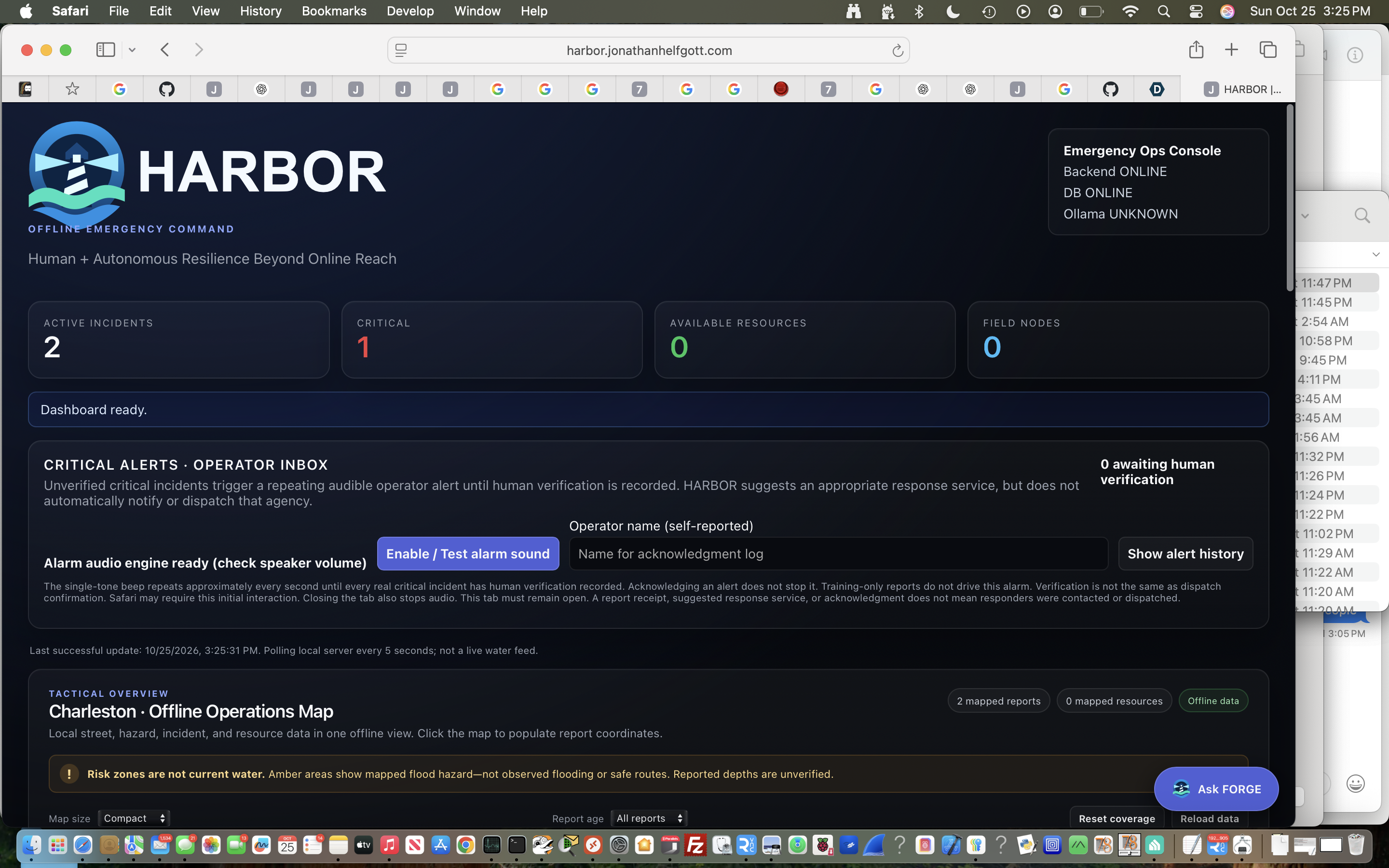
HARBOR is an AI-powered emergency response platform that combines live incident mapping, artificial intelligence, and LoRa mesh networking.
Users can report emergencies through a web interface or send messages using Meshtastic-compatible LoRa devices. These messages can be processed by FORGE, my custom-built AI agent inspired by Hermes Agent, which helps interpret emergency information and turn it into structured incident reports.
Reports are then displayed on a centralized dashboard, allowing users to visualize incidents, identify affected areas, and better understand developing emergencies.
The goal is to make emergency communication more accessible, organized, and resilient.
How We Built It
HARBOR was developed collaboratively by my teammate and me, with assistance from ChatGPT and FORGE AI throughout the development process.
We combined several technologies:
- Python and FastAPI for backend services and incident reporting.
- React for the interactive web dashboard.
- FORGE AI, my independently developed AI agent inspired by Hermes Agent, for processing incident information.
- Meshtastic and ESP32-based LoRa devices for communication without traditional internet infrastructure.
- GitHub for managing and collaborating on the project.
We integrated these systems so that a message transmitted through the LoRa network could reach our gateway, be interpreted by AI, and become an incident report on HARBOR's dashboard.
AI played a significant role in our development workflow, helping us write, troubleshoot, test, and improve our code.
Challenges We Faced
One of our biggest challenges was working within the extremely limited message size of the Meshtastic network, approximately 200 bytes for our message payloads.
Unlike traditional internet connections, LoRa networks have limited bandwidth and are not designed to transmit large amounts of data.
This created several problems:
- AI-generated responses were often too long to transmit.
- Messages could be cut off before all the important information was received.
- We needed a reliable way to send emergency reports using very little data.
- Connecting LoRa hardware, our gateway, FORGE AI, and the HARBOR dashboard required extensive troubleshooting.
To address these challenges, we worked on shortening messages, separating complex processing from the LoRa devices, and using a gateway to handle communication between the mesh network and our AI-powered backend.
Another major challenge was making multiple independent technologies work together as one cohesive system.
What We Learned
Building HARBOR taught us much more than how to develop a website.
We gained practical experience with mesh networking, hardware integration, backend APIs, AI agents, and real-time emergency reporting systems.
We also learned that building useful technology requires balancing ambitious features with real-world limitations, especially when operating on networks with extremely limited bandwidth.
Most importantly, I learned how to turn a personal experience into a technical solution designed to help others.
What's Next for HARBOR
Our vision is to continue developing HARBOR into a more capable emergency communication platform by improving offline functionality, expanding LoRa mesh coverage, enhancing FORGE's AI capabilities, and integrating additional emergency mapping resources.
Ultimately, we want HARBOR to help communities stay informed and connected when communication matters most.
HARBOR isn't just about mapping emergencies. It's about making sure critical information can still travel when traditional networks cannot.

Log in or sign up for Devpost to join the conversation.