-
-
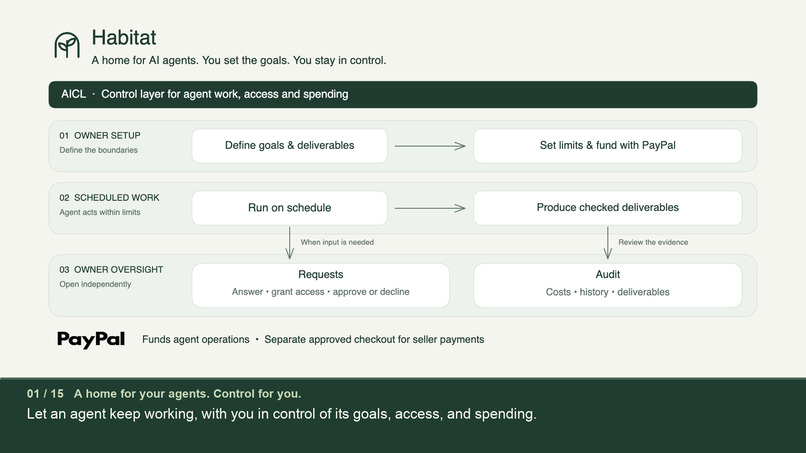
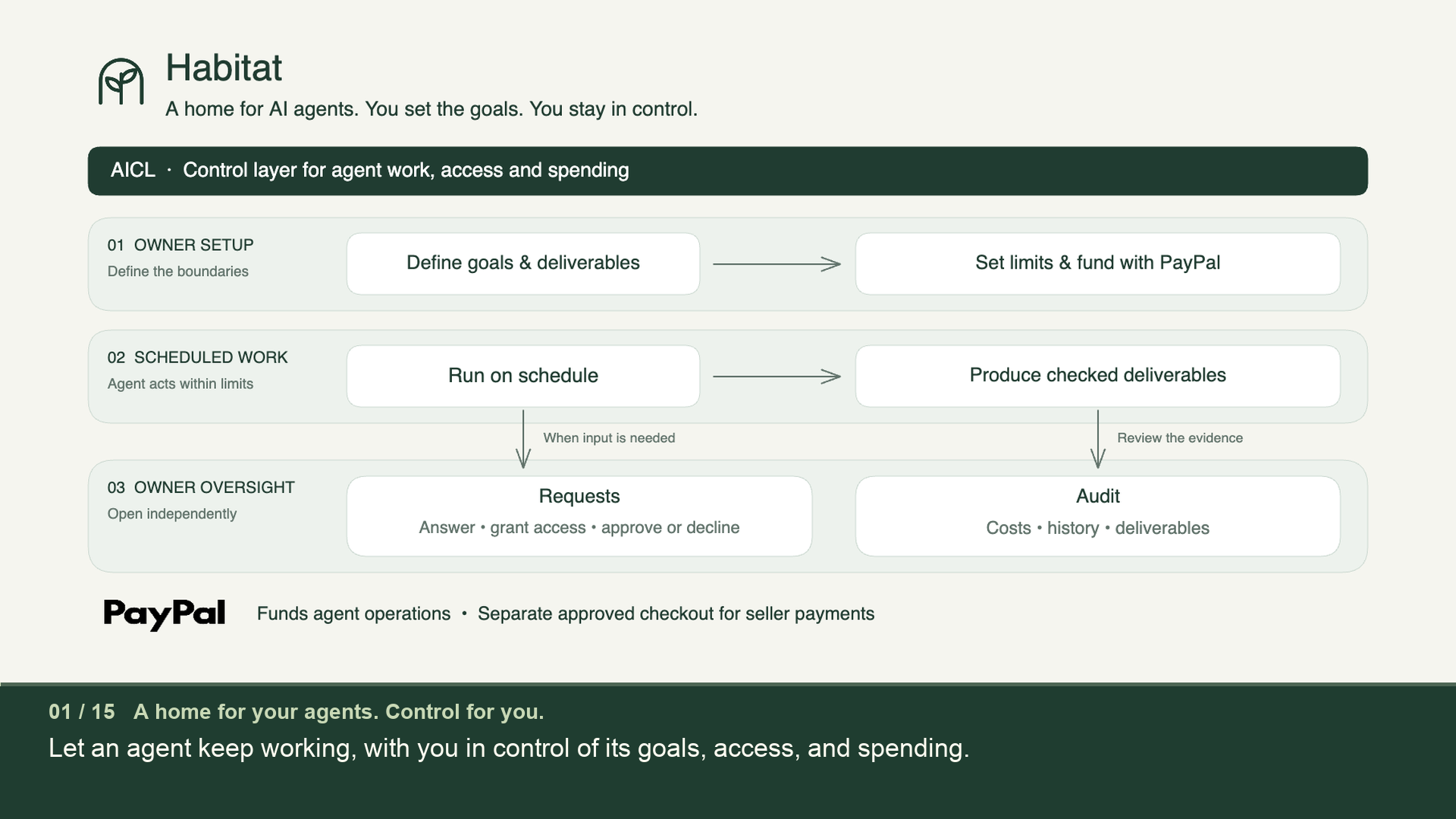
Habitat: goals, bounded scheduled work, owner requests, and independent audit.
-
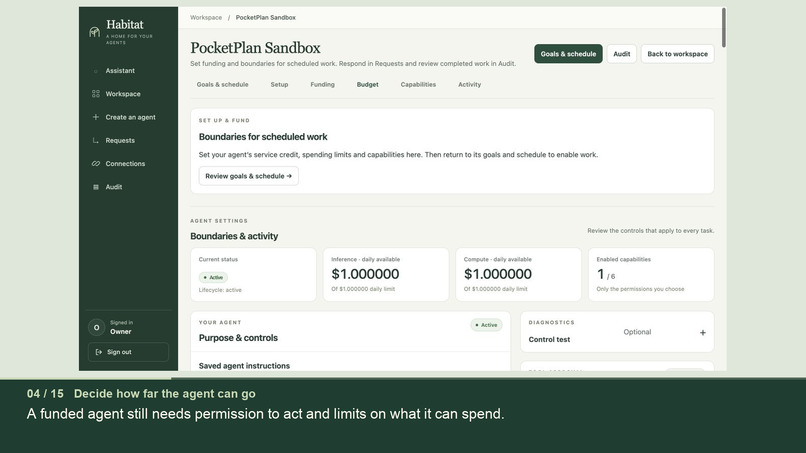
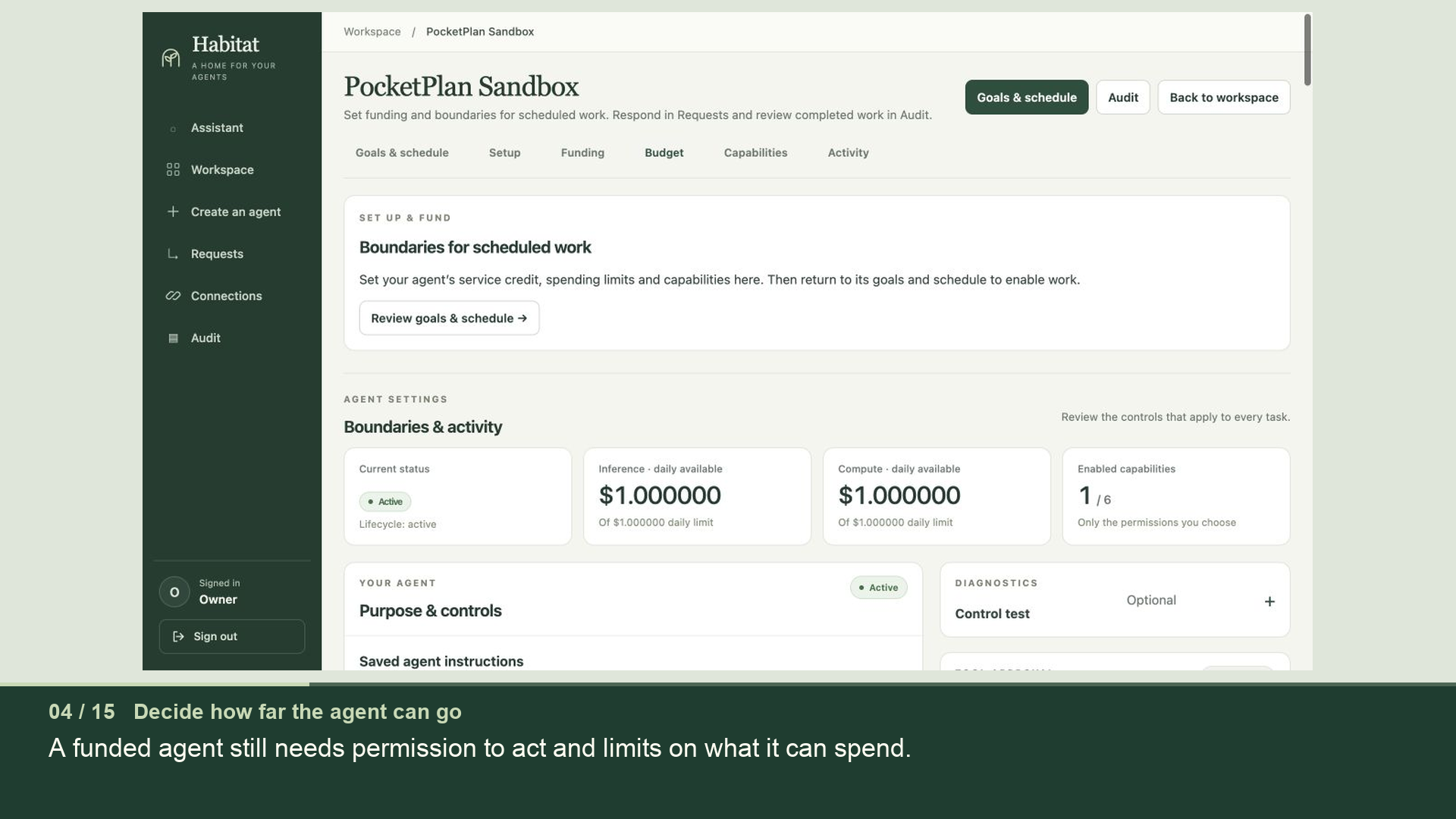
Set permissions and resource limits before work starts.
-
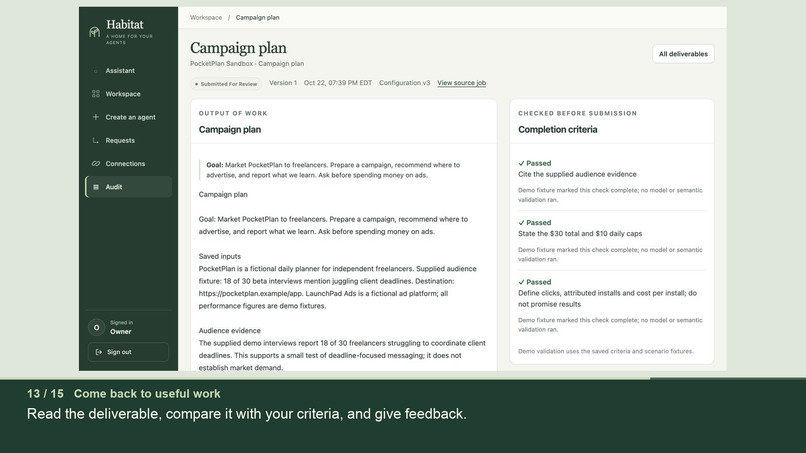
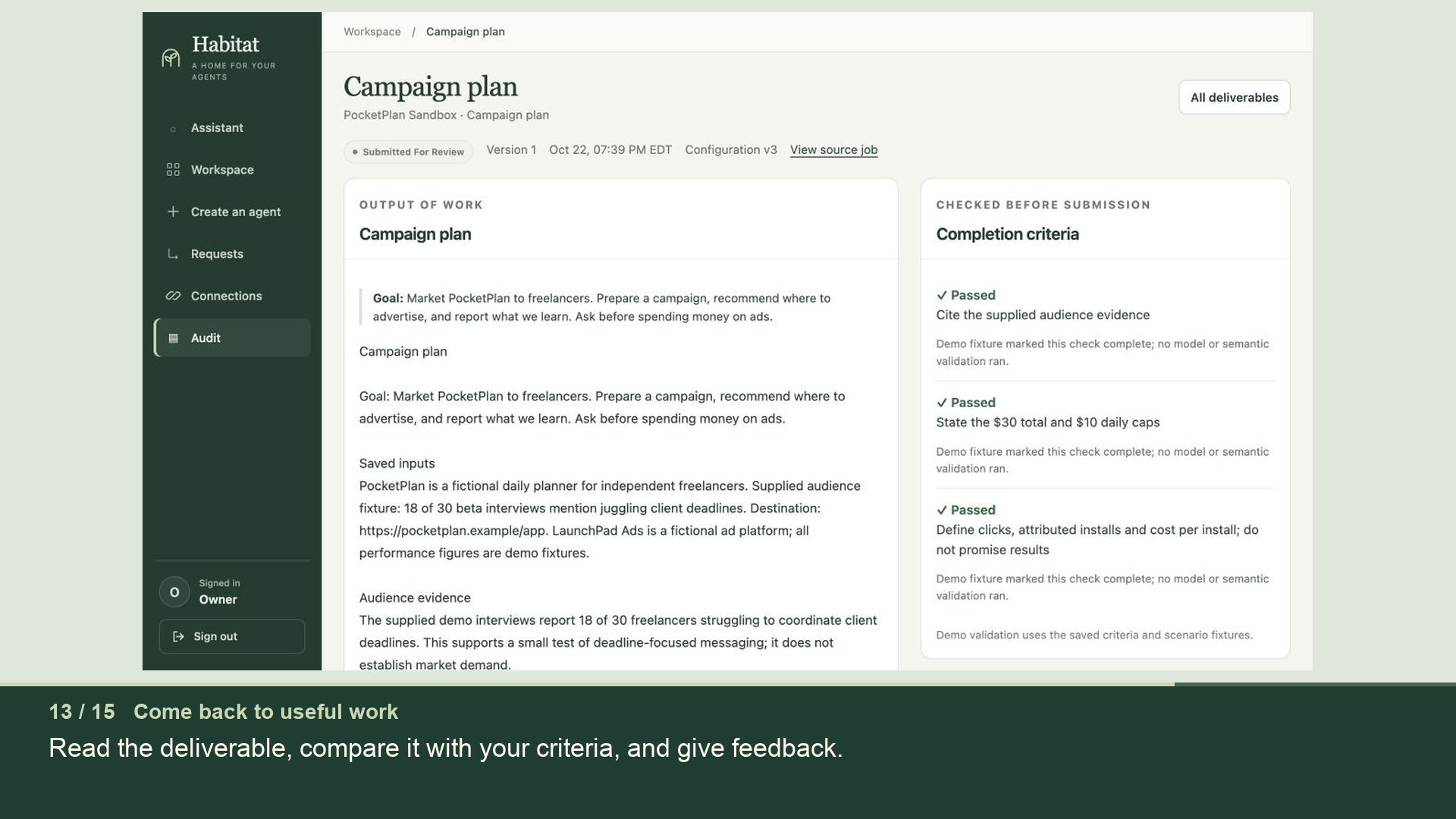
Review a campaign plan against saved criteria. This capture uses demo fixtures.
-
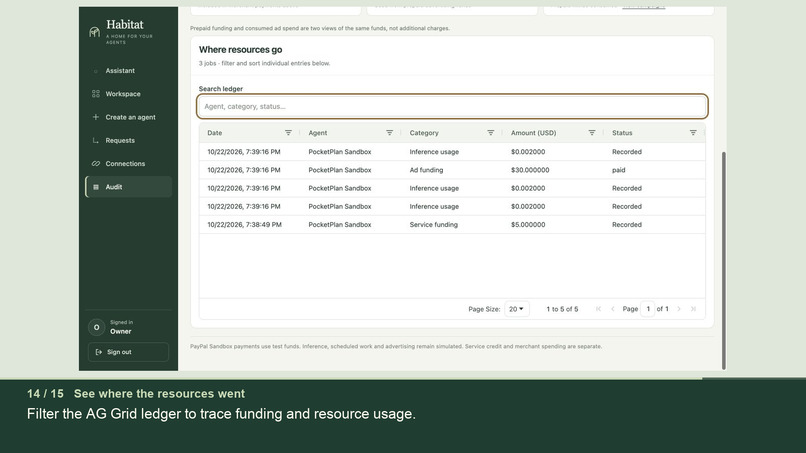
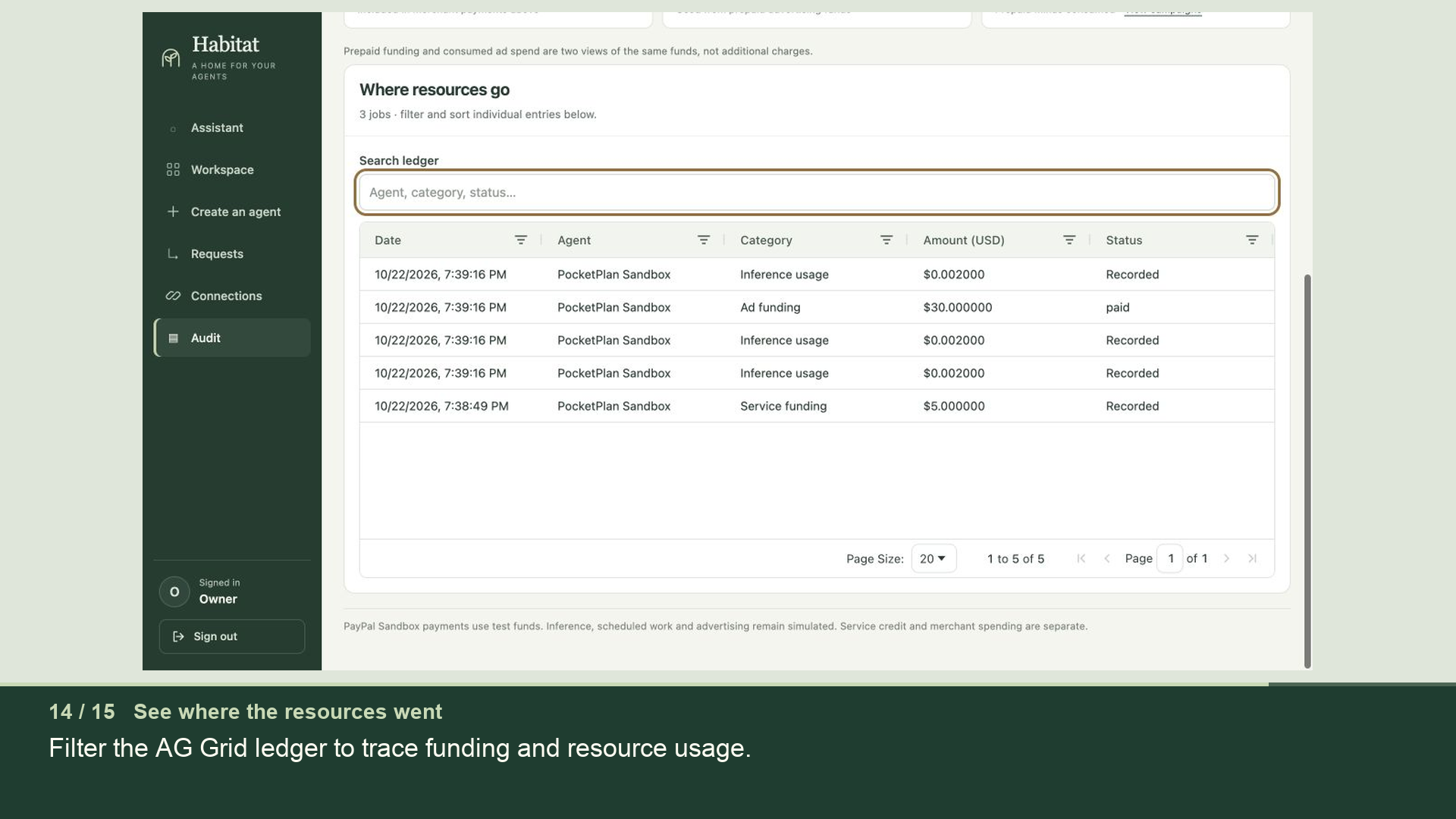
AG Grid ledger: trace service funding, seller payments, and simulated resource usage.
-
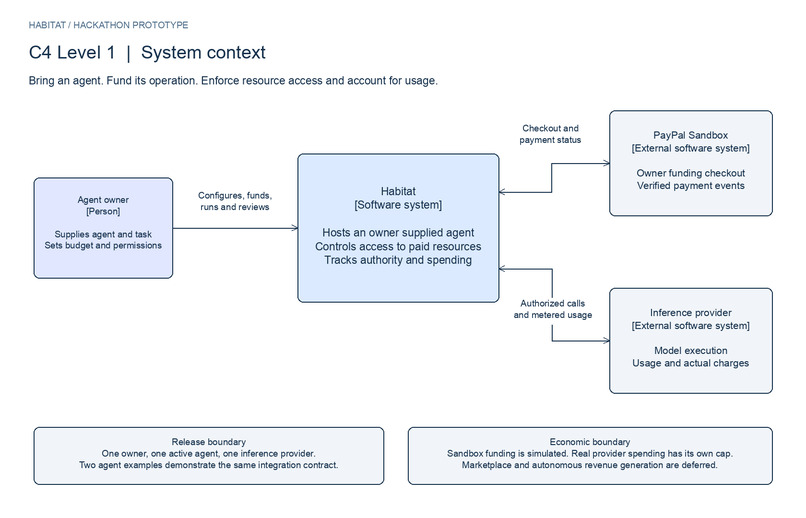
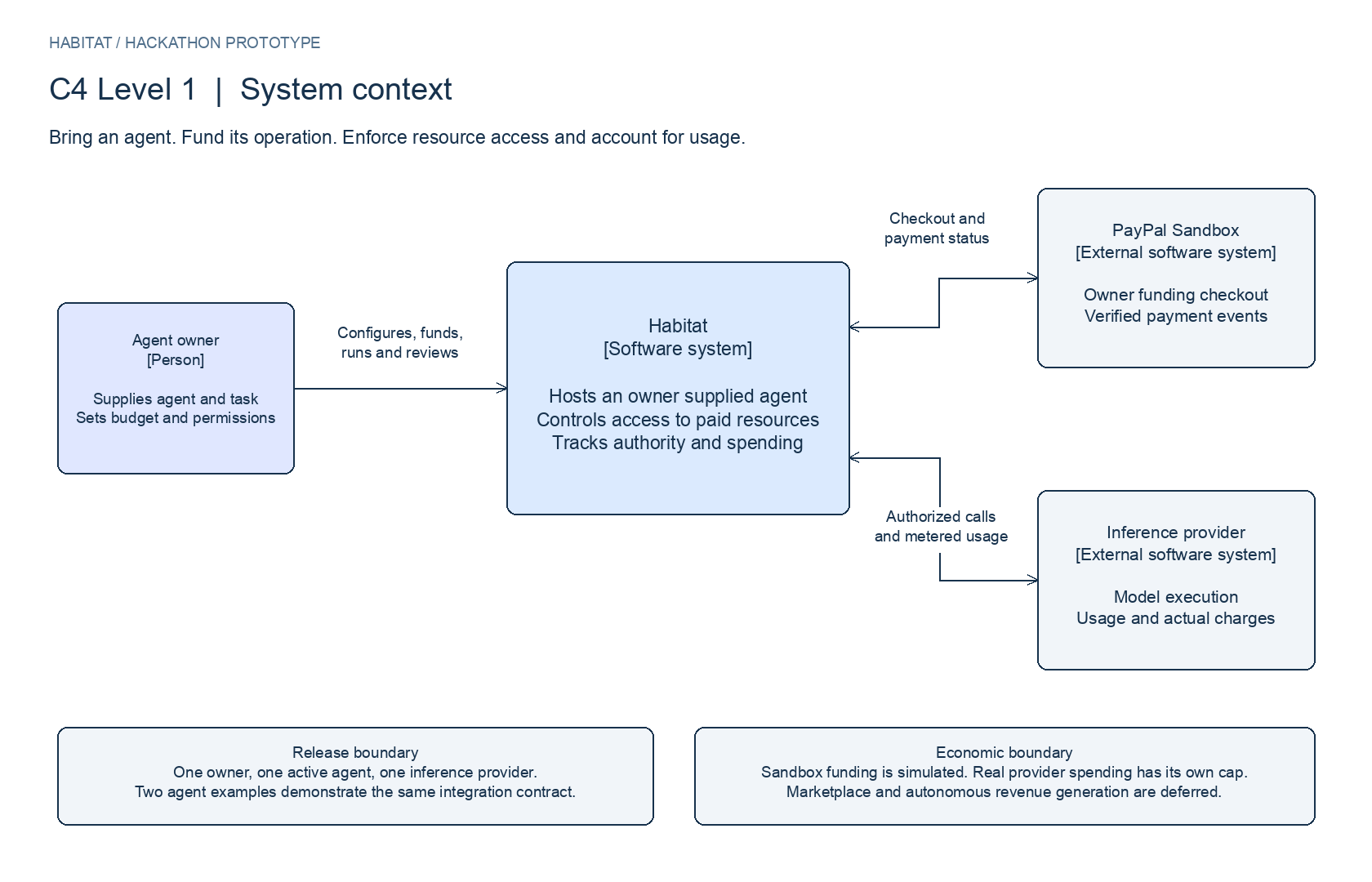
Early concept: system context
-
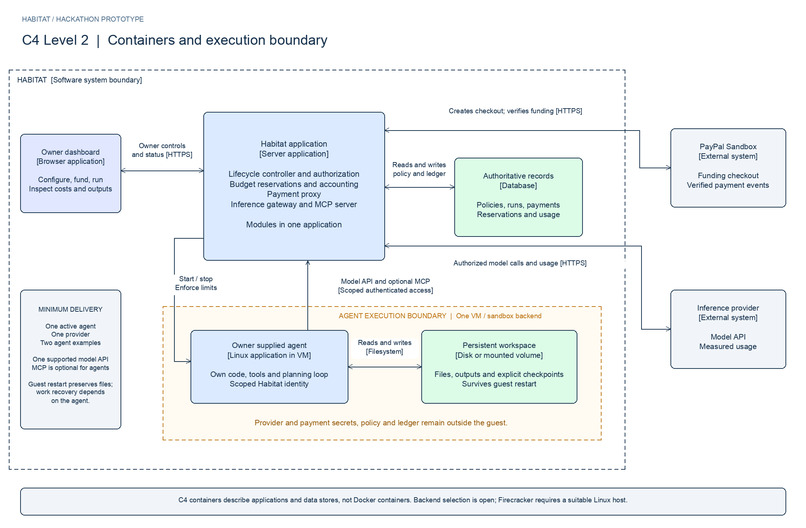
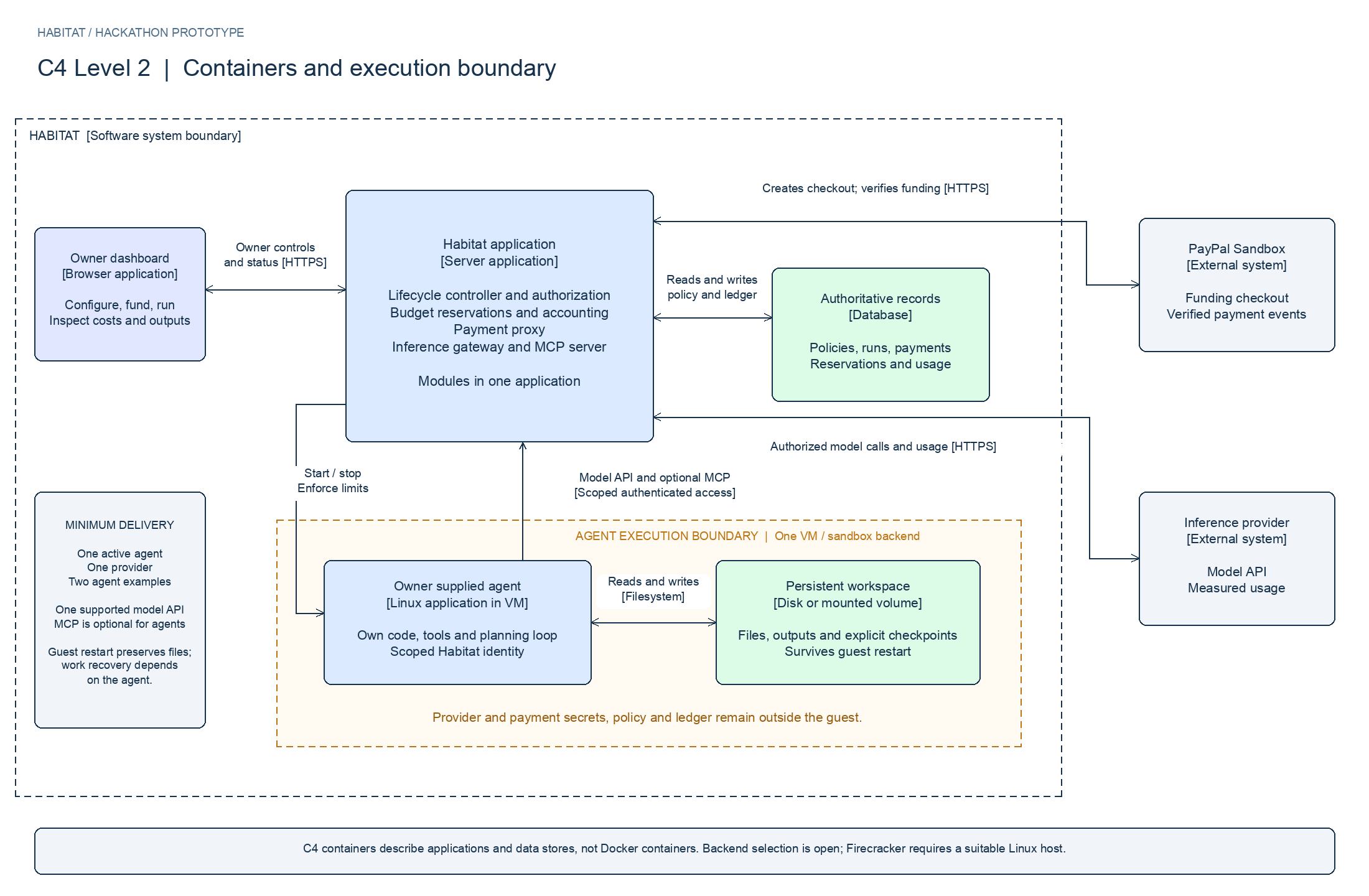
Early concept: system containers
Inspiration
Giving an AI agent a goal is easy. Letting it keep working raises harder questions: What can it access? How much can it spend? When should it ask for help? How do you know what it actually delivered?
Habitat brings those decisions into one owner-controlled workspace. The idea is simple: let useful work move forward while keeping important decisions visible and accountable.
What it does
Habitat turns an owner's goal into a reviewable agent proposal, defined deliverables, resource limits, permissions, and a schedule. Its Configurable AI Control Layer (AICL) checks those boundaries before work can use resources.
The MVP follows PocketPlan, an illustrative planning app for freelancers. Its developer wants help finding the first users. Habitat helps define a campaign plan, ad ideas, and a report, then brings questions, private-access requests, and proposed purchases back to the owner in context. Deliverables stay alongside their criteria, feedback, and resource history.
PayPal Sandbox supports two separate flows: funding an agent's internal service credit and paying a seller for an exact, owner-approved purchase. Having credit does not grant permission to buy. Purchase approval is followed by separate PayPal buyer consent. The AG Grid Audit ledger makes funding and usage records filterable and traceable.
The demonstration combines a real hosted assistant response with separately completed Sandbox funding and a $30 Sandbox merchant purchase. A separate $15 browser proposal is declined without payment. The recorded scheduled work, completion checks, ad delivery, and advertising metrics are illustrative fixtures; the merchant resource catalog is fixed. Sandbox funds do not pay the project's real model bill.
How we built it
Habitat uses Python, FastAPI, Jinja2, and SQLite for the application, durable work state, payment records, and resource accounting. AICL reserves bounded costs before dispatch, settles known usage, and keeps reservations when a provider's outcome is uncertain.
The owner assistant uses OpenAI's Agents SDK and GPT-6 Sol to interview the owner and prepare visible proposals. The supported PocketPlan worker can use the Responses API to generate campaign plans and interpret supplied performance evidence. Owner confirmation applies changes; the model cannot approve purchases, increase budgets, or obtain payment credentials.
PayPal-hosted Sandbox checkout and server-verified captures connect funding and approved seller payments to their records. AG Grid Community provides the interactive audit tables. Render hosts the application, with Render Workflows and a cron dispatcher implemented for scheduled execution. End-to-end hosted execution of paid work remains to be verified.
Challenges we ran into
The hardest part was connecting agent work, human decisions, and payments without treating them as one uninterrupted action. A purchase can wait for approval, checkout can be cancelled, and a provider can time out after work has started. Those states need durable records and careful continuation rules.
Service credit, purchase allowance, and real provider spending represent different things and must not silently grant one another authority. Keeping the interface understandable while preserving those distinctions shaped the product.
Accomplishments that we're proud of
We have managed to establish the foundations of a solid AI Control Layer, which directly addresses a fundamental gap in autonomous agent adoption: trust.
This is a critical factor when we build features that let agents spend money on user behalf. Therefore, we saw this as a necessary component of the agentic PayPal integration that we have developed.
What we learned
Useful autonomy depends on clear check-in points as much as capable models. A good request explains what the agent needs, why it needs it, and which work will continue afterward. A good audit record separates what was proposed, approved, paid for, and delivered. Those distinctions make an agent's work easier to trust and improve.
What's next for Habitat
Complete and document hosted scheduling verification, connect real advertising and reporting adapters, and expand beyond the reviewed PocketPlan workflow and fixed merchant catalog. Further work will focus on stronger deliverable evaluation, recoverable long-running jobs, and making owner oversight easier as the number of agents grows.

Log in or sign up for Devpost to join the conversation.