
Inspiration
Picture a block printer in Bagru, Rajasthan. Buyers in Brooklyn and Berlin would happily buy his cloth, yet he never sells to them, and the cloth is not the reason. Selling abroad means seven jobs that have nothing to do with printing: an English listing, an export price that survives fees and currency conversion, a trusted way to get paid, a GST export invoice under a Letter of Undertaking, an RBI purpose code, tracking for seller protection, and splitting the money with everyone who made the piece.
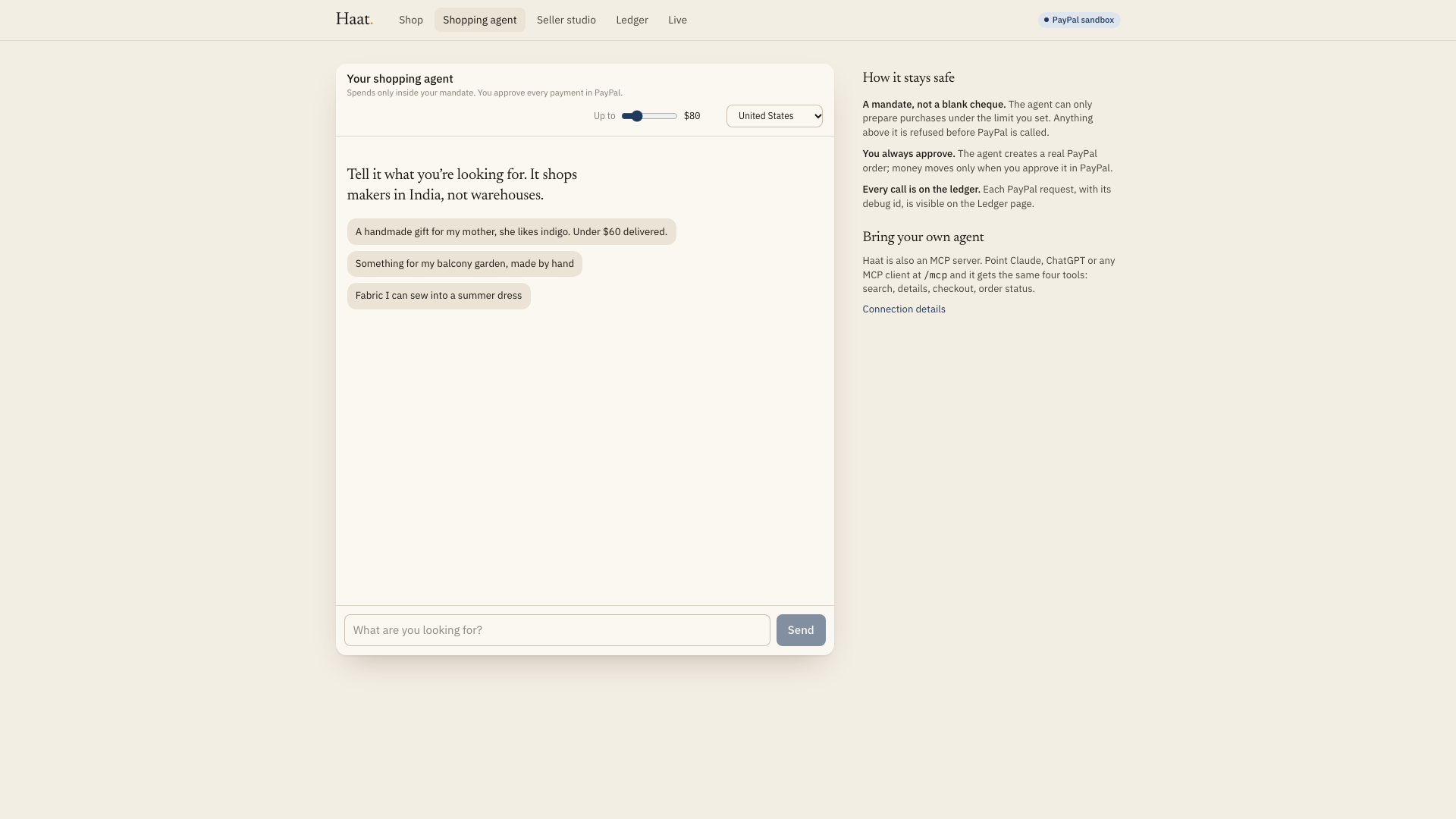
PayPal is how small Indian sellers get paid from abroad (since 2021, cross-border is PayPal's whole business in India). So we built the desk that does everything around the payment. And because buyers are starting to shop through AI agents, which can only buy from catalogues that are structured and payable, we made a maker with no website shoppable by those agents too.
What it does
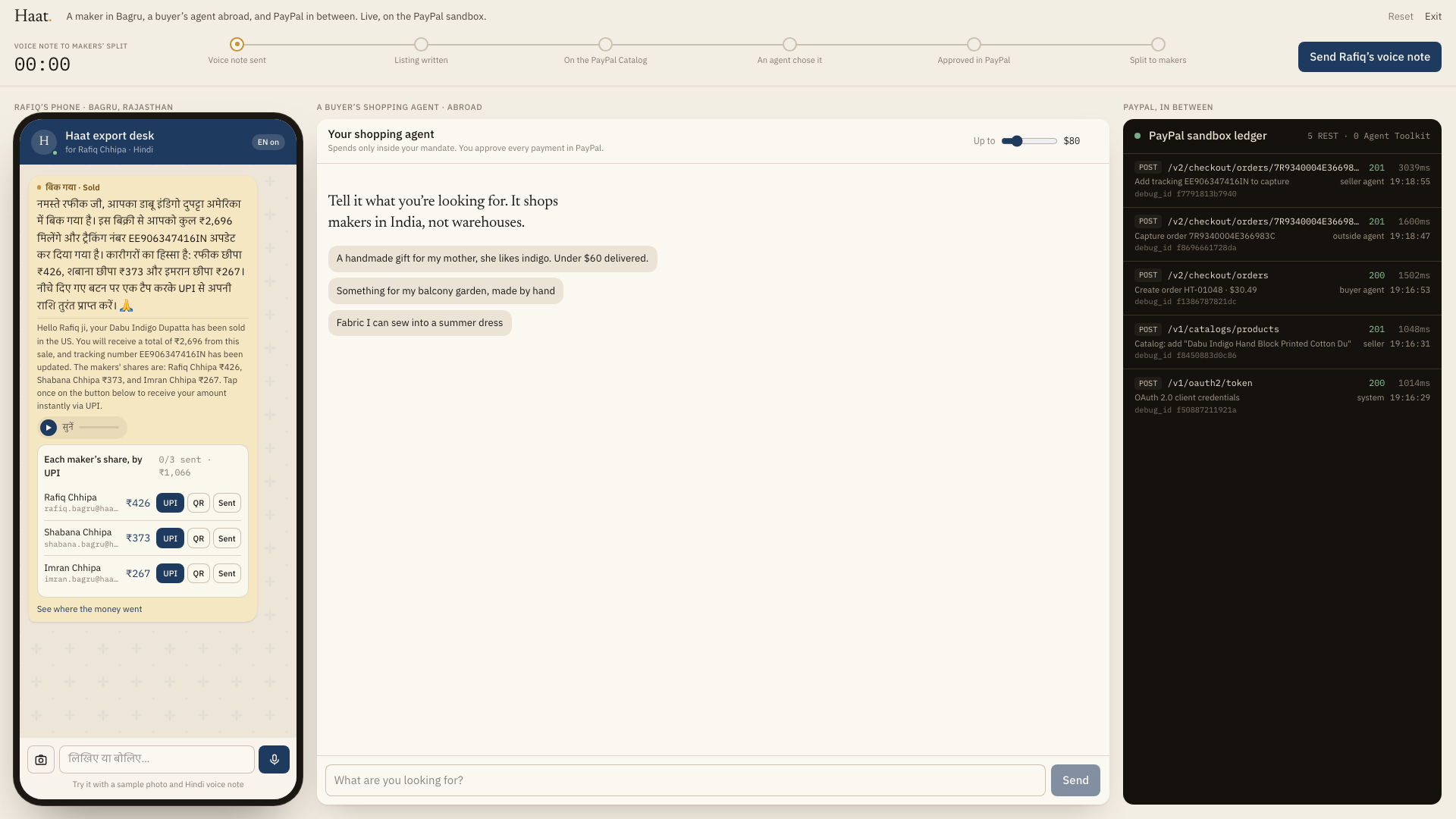
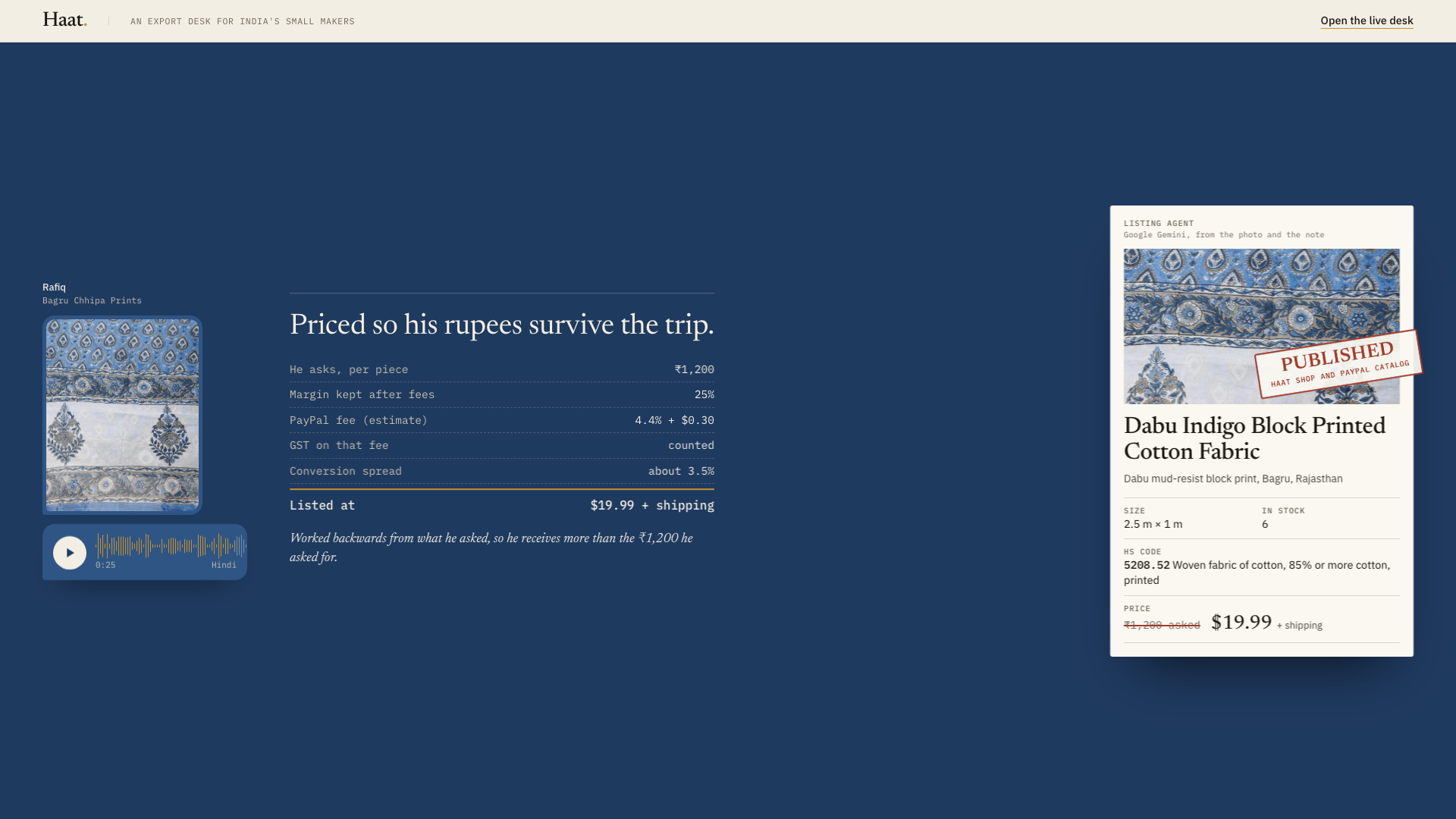
1. The maker speaks. Rafiq sends a photo and a voice note in Hindi. One multimodal Gemini call hears and sees it, then writes an honest English listing, proposes the customs (HS) code with a reason, and prices it for export by working backwards from the rupees he asked for through PayPal's fee, GST on that fee and the conversion spread. The reply comes back in Hindi, as text and as a spoken voice note, for makers who would rather listen than read.
2. It goes live on PayPal. One tap publishes the listing to the shop and to the PayPal Catalog.
3. An agent buys, a human approves. A buyer abroad can check out with PayPal Smart Buttons, or hand the search to an AI shopping agent. The agent finds the piece and creates a real PayPal order inside a spending limit the buyer set, but it cannot pay: the human approves inside PayPal. Haat is also an MCP server, so outside agents (Claude, ChatGPT, custom ones) can search the catalogue and start the same PayPal checkout.
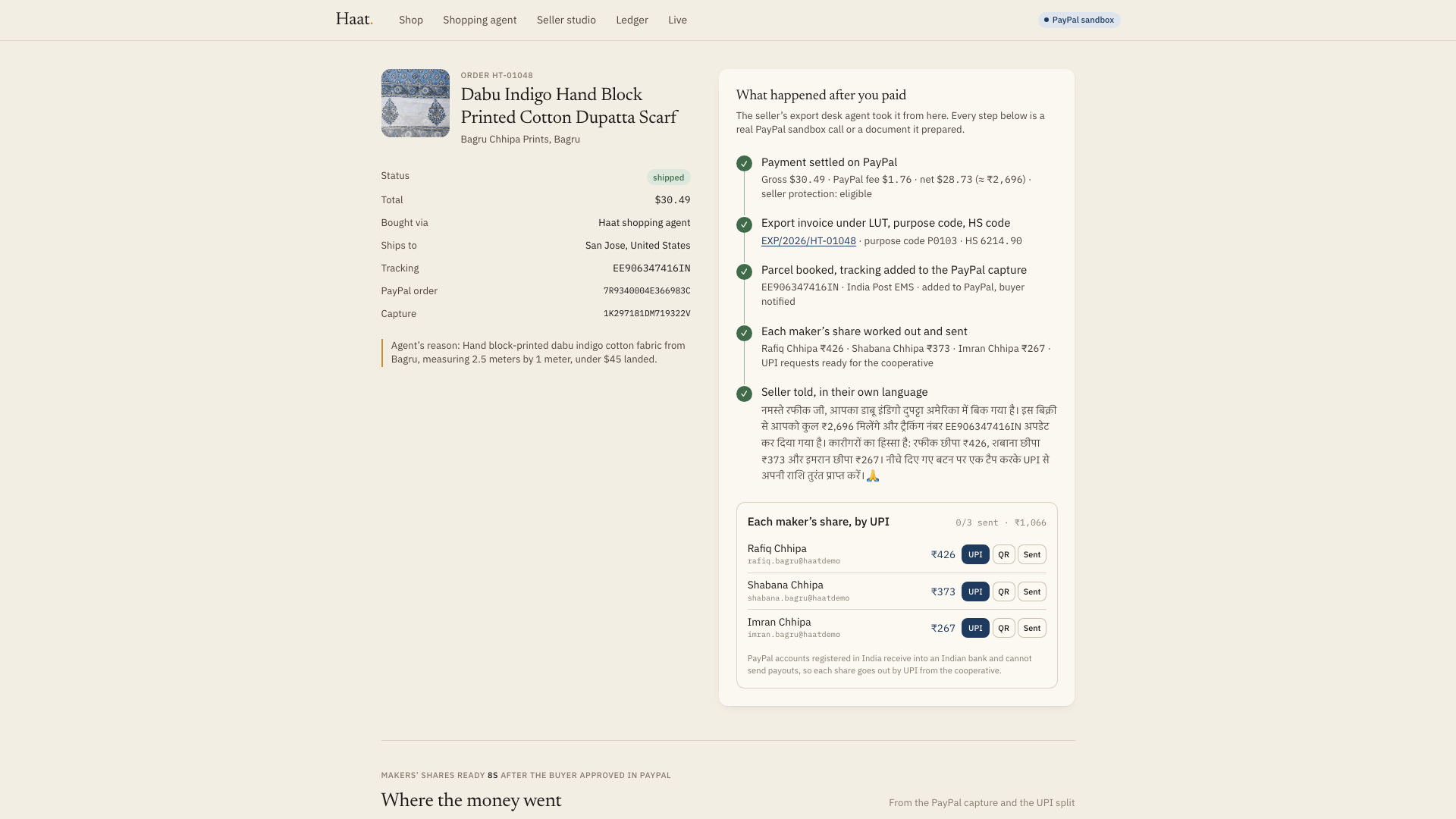
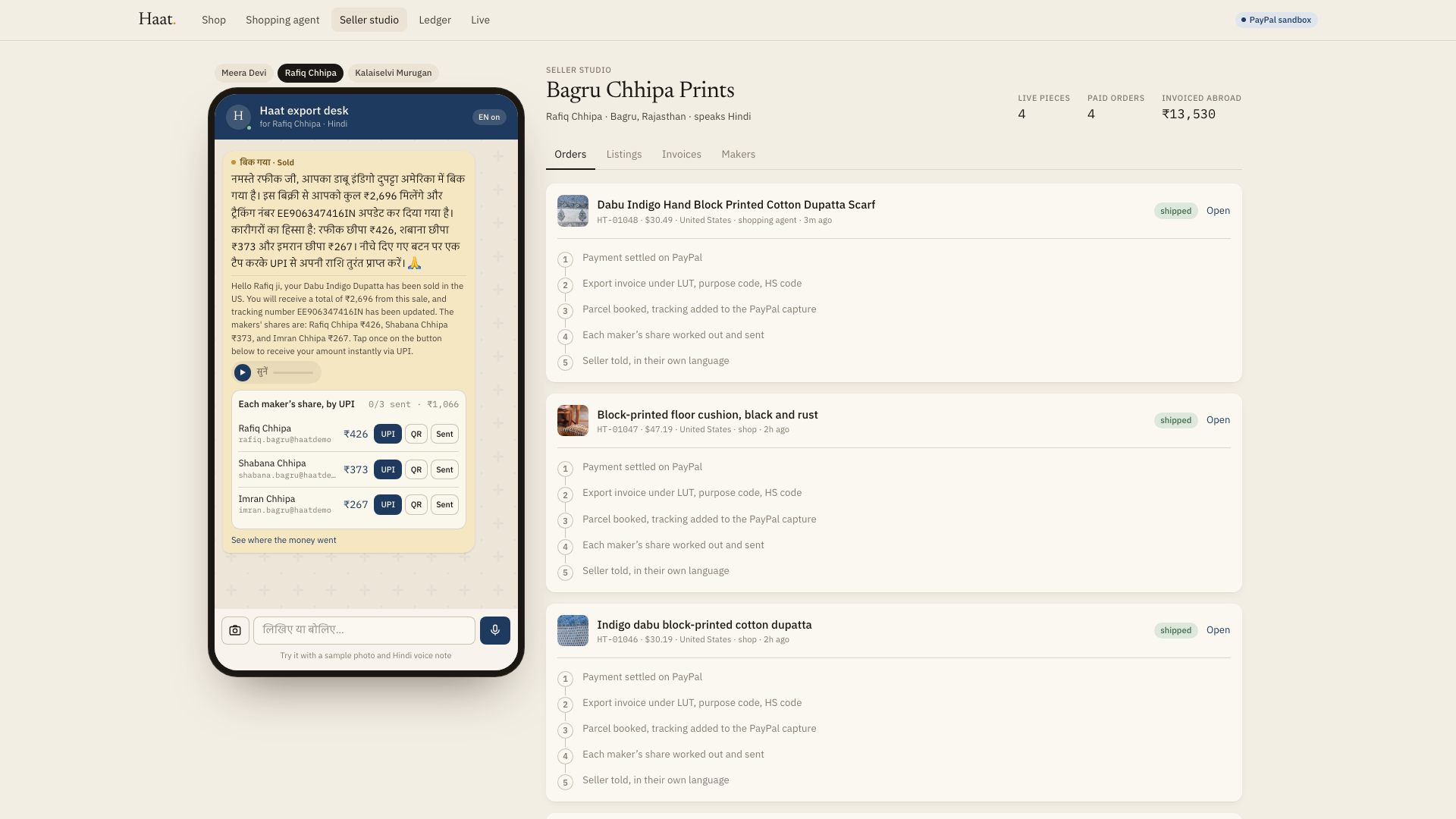
4. The desk does the rest. The moment PayPal captures the payment, the seller's agent:
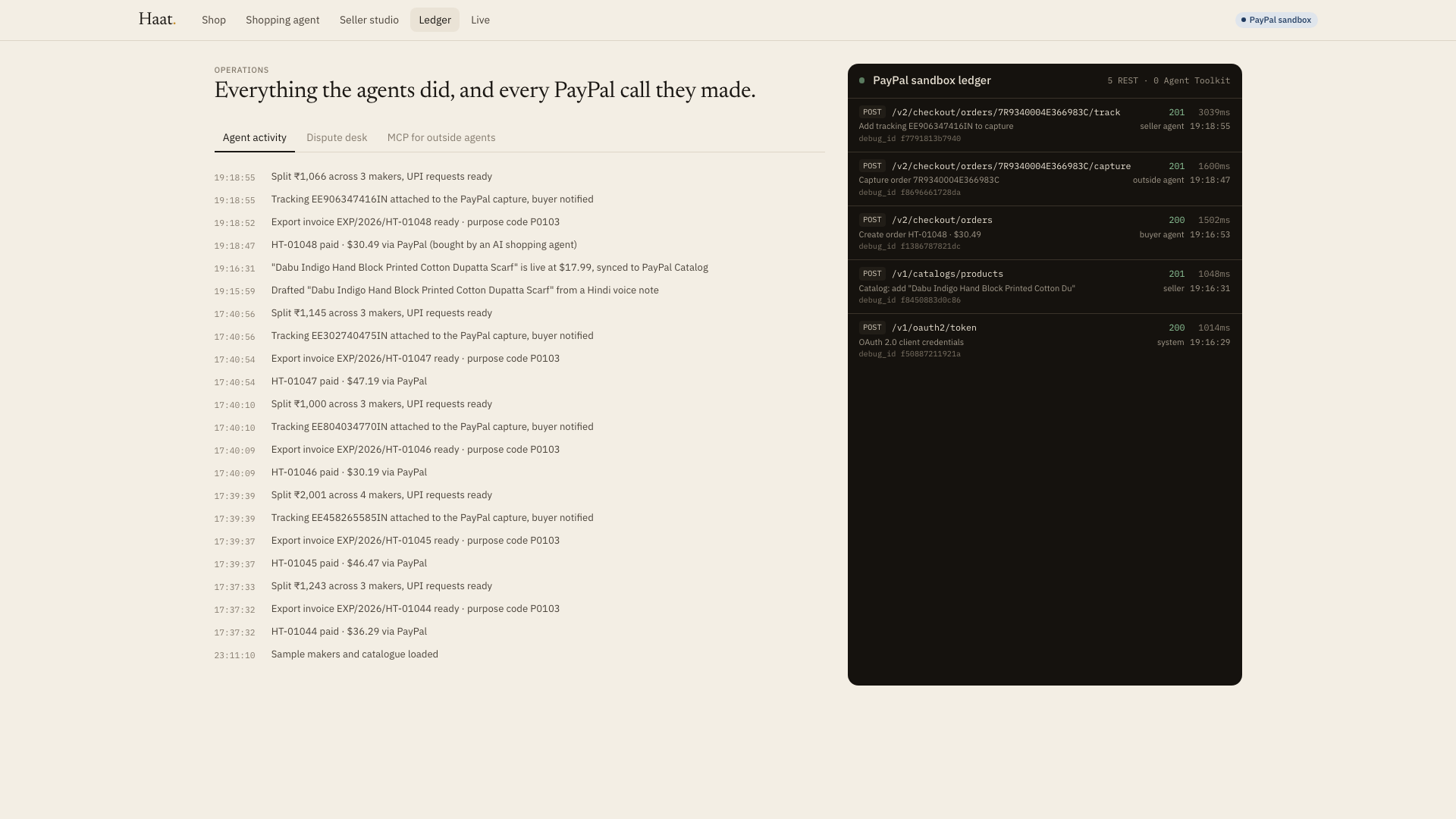
- reads what PayPal actually settled, including the fee and seller-protection status;
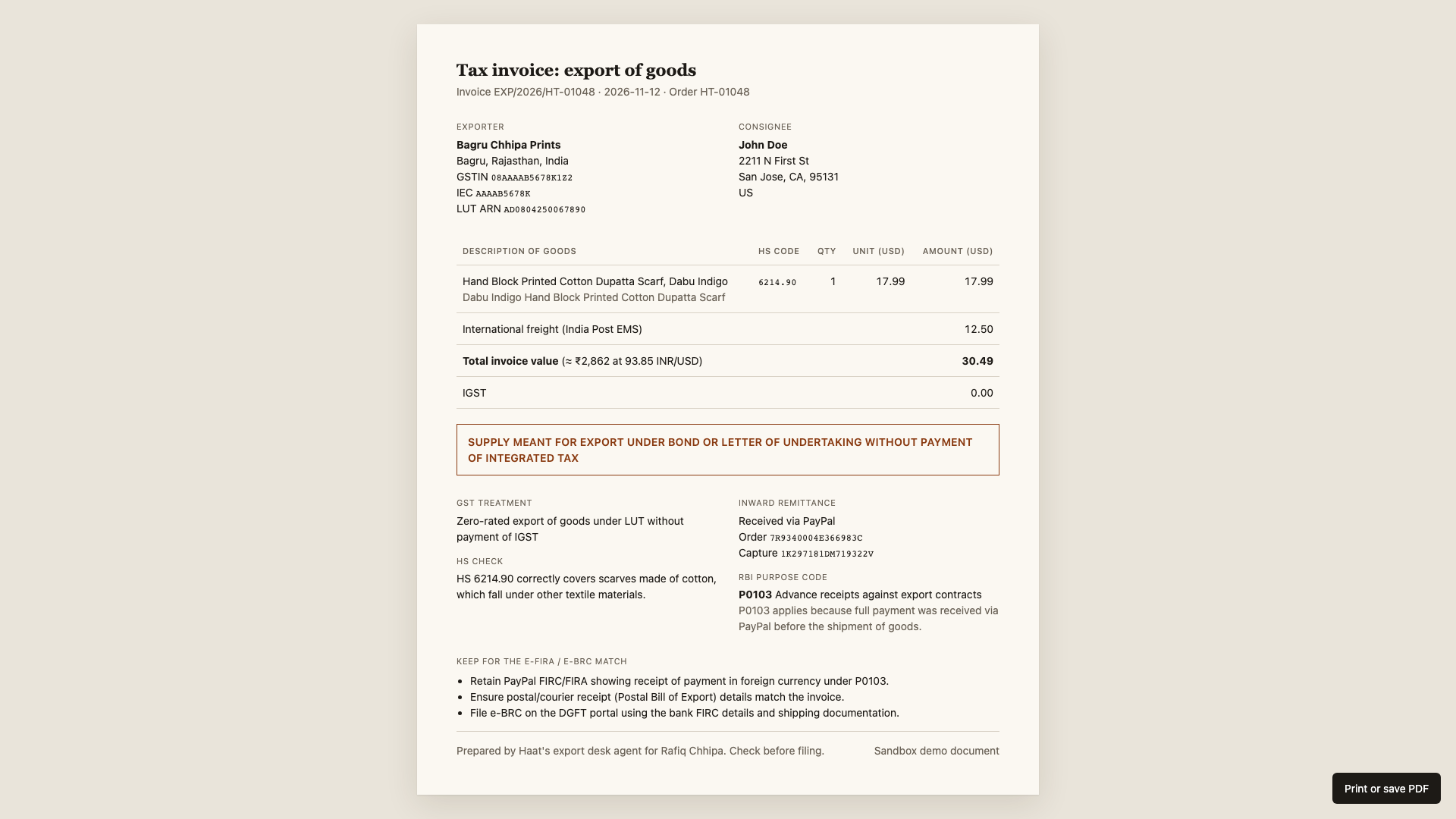
- writes the GST export invoice under LUT with RBI purpose code P0103 and a checked HS code;
- attaches India Post tracking to the PayPal capture, for seller protection;
- works out each maker's share in the cooperative and sends it;
- tells the maker what happened, in Hindi, as text and voice.
5. Every dollar, traced. Each order draws the payment as threads: the buyer's dollars peel off into shipping, PayPal's real fee from the capture, GST and conversion, and the rest runs to the cooperative and splits into one strand per maker, by name, in rupees. Every PayPal call made by our code or by PayPal's Agent Toolkit streams onto a live ledger with its debug ID.
Also built: wholesale invoices by chat ("send the Berlin shop an invoice for 20 pieces" in Hindi, sent through PayPal's Agent Toolkit after the maker confirms), and a dispute desk that drafts evidence from the tracking it already attached.
In our recorded run on the PayPal sandbox, the whole loop took 55 seconds: voice note to a paid, documented, split export sale.
How we built it
- PayPal, used deeply: Orders v2 (create, capture, tracking on the capture) with idempotency keys and exactly-once capture across three paths (JS SDK, approval link for agents, webhook); JS SDK Smart Buttons; Catalog Products; Invoicing, transactions, insights and disputes through the official PayPal Agent Toolkit; Disputes (provide-evidence, accept-claim); webhook registration with signature verification; Payouts for marketplace accounts. We wrote an adapter that turns the Agent Toolkit's tool schemas into Gemini function declarations, so our Gemini agents call PayPal's own tool implementations.
- AI: Google Gemini for multimodal structured output (photo plus audio to listing), tool-calling seller and buyer agents, export-paperwork reasoning, dispute advice, and Gemini text-to-speech for Hindi and Tamil replies, with automatic model fallback so a demo survives an overloaded model.
- Built for trust: agents prepare and explain; PayPal and people move the money. Spending limits are enforced before PayPal is ever called, every purchase ends in a human approval inside PayPal, every action is on an auditable ledger, and the listing agent is forbidden from claims the maker never made.
- Stack: Node 24, Express 5, TypeScript, SQLite, Server-Sent Events, React 19, Vite, Tailwind CSS 4, and the Model Context Protocol SDK. The design comes from the craft itself: paper and ink, natural indigo, madder and turmeric, with Newsreader and IBM Plex (including Plex Devanagari for Hindi).
Challenges we ran into
- India's payout rule. PayPal accounts registered in India can receive money from abroad but cannot send PayPal Payouts. Rather than hide it, we designed around it: PayPal brings the dollars into India, and each maker's share goes out as a one-tap UPI request from the cooperative. On a marketplace account outside India, the same step uses PayPal Payouts.
- Making the rupees survive the trip. The price has to cover a percentage fee, a fixed fee, GST on the fee and the conversion spread at once, and the reply must quote what the maker will actually receive, not what he asked for.
- Keeping agents honest. Craft listings drift towards claims nobody made ("master artisan", "natural dye"). The prompts forbid unsupported claims, and the maker's own words stay visible next to the English.
Accomplishments that we're proud of
- A full export sale, from a Hindi voice note to a paid, documented, split order, in 55 seconds, with every PayPal step a real sandbox call.
- Real purchases verified end to end with a sandbox buyer abroad: capture, export invoice, tracking on the capture, the makers' split and the Hindi voice note to the maker.
- An AI shopping agent buying from a maker who has no website, without ever being able to move money on its own.
What we learned
The hard part of cross-border commerce for small sellers is not the payment. It is everything around it, and most of that is language, judgement and paperwork: exactly what agents are good at, as long as the money stays with PayPal and a human.
What's next
WhatsApp as the seller's channel, real India Post export booking, matching e-FIRA records using PayPal transaction search, PayPal Vault so buyers can let an agent pay under a limit without a click, and pilots with weaver cooperatives.
What is real, and what is not
- Real, live: voice note to listing, spoken replies, PayPal Catalog, PayPal orders, buyer approval, capture, export invoice, tracking on the capture, the makers' split, the Hindi sale message, Agent Toolkit invoices, the MCP endpoint.
- Simulated: the India Post booking (the tracking number is attached to the real PayPal capture). The WhatsApp channel is not built; the seller chat is a web chat shaped like it.
- Estimates: GST on the fee and the conversion spread are labelled as estimates; the PayPal fee shown on an order is the real one from the capture.
- Sample makers and stock photography (credited). Sample UPI IDs use a demo handle that cannot receive money.
Built With
- express.js
- gemini
- gemini-tts
- mcp
- node.js
- paypal
- paypal-agent-toolkit
- paypal-catalog
- paypal-disputes
- paypal-js-sdk
- paypal-orders-api
- paypal-webhooks
- react
- sqlite
- tailwindcss
- typescript
- upi
- vite
