-
-
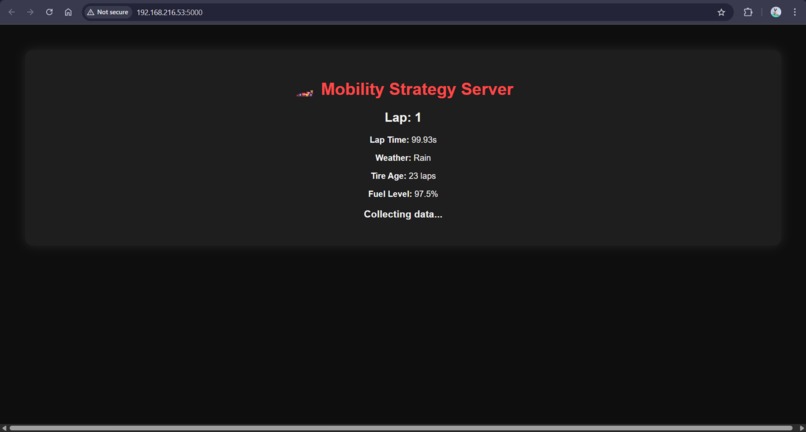
Desktop view of the Server. Displays real-time conditions: Lap 1, Rain, 23-lap tires, 97.5% fuel. Data collection in progress.
-
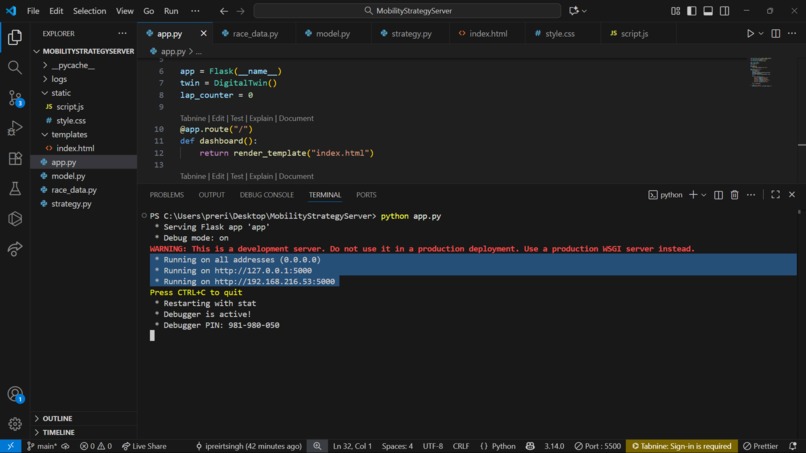
Python Flask engine running the server. Shows clean structure (model.py, strategy.py) and network readiness on 192.168.216.53:5000(can vary)
-
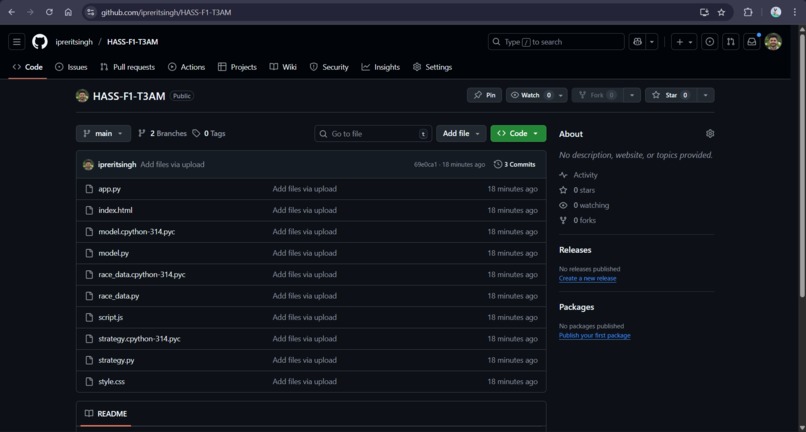
The HASS-F1-T3AM GitHub repo. All project code is here, including the core logic files (app.py, strategy.py, model.py).
-
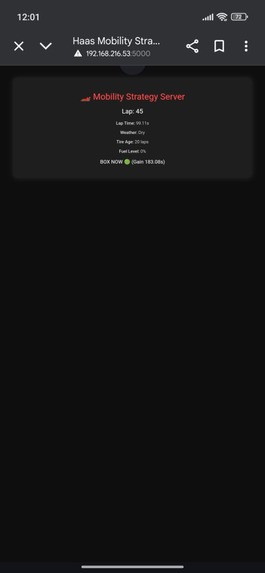
Phone view - A strategy director isn't tied to a desktop; they're moving around the garage. They can see the phone flash a life-saving alert


Inspiration
Every Formula 1 race is a story of precision, data, and milliseconds. One wrong pit call can flip a victory into a loss. We were fascinated by how teams like Haas F1 constantly balance tire degradation, fuel load, and race pace — all in real time, under extreme pressure.
That curiosity sparked an idea: What if we could build a digital race strategist — one that doesn’t replace the engineers, but helps them make faster, smarter, data-driven decisions?
That’s how the Haas Race Intelligence System (HRIS) was born — a lightweight, intelligent decision engine designed for the pit wall.
What it does
The Haas Race Intelligence System acts like a virtual strategist sitting beside the pit crew.
It:
Monitors live race data — lap times, tire wear, weather, and fuel usage.
Creates a digital twin of the car to predict performance in different conditions.
Runs real-time simulations for pit stop vs. stay-out scenarios.
Suggests optimal race strategies — when to pit, what tire to use, and how it impacts total race time.
Displays everything in a clean, mobile-friendly web dashboard accessible from any device.
In short, it turns race chaos into clarity.
How we built it
Backend: Created a data simulation system to mimic live race telemetry using Python and Flask, sending live performance data streams.
Machine Learning: Trained a Linear Regression model (scikit-learn) to predict lap time deltas and tire degradation patterns, continuously adapting as laps progress.
Frontend: Built a lightweight dashboard using HTML, CSS, and JavaScript, optimized for both laptops and phones.
Infrastructure: Runs locally without heavy servers — relying on smart design and teamwork.
Challenges we ran into
Real-time simulation: Handling updates every few seconds without lag.
Model tuning: Balancing prediction accuracy with speed.
Cross-device testing: Ensuring consistent performance on laptops, tablets, and phones.
Networking: Configuring LAN access while avoiding firewall/port issues.
Accomplishments that we're proud of
Built a fully functional live race simulation server from scratch.
Integrated machine learning and analytics into an accessible web app.
Ensured cross-device usability (phones, tablets, PCs).
Transformed raw racing data into actionable insights.
Collaborated like a real F1 pit crew — fast, precise, and focused.
What we learned
The power of data-driven decision-making in motorsport.
How real-time systems differ from static ML models.
The importance of collaboration under pressure.
Balancing innovation with simplicity — making complex insights easily understandable.
What's next for Haas Race Intelligence System (HRIS)
Integrate real F1 telemetry datasets for authentic race conditions.
Expand from pit strategy to car performance optimization, predicting lap-time improvements from setup tweaks.
Deploy HRIS on the cloud for remote pit-wall access and multi-user collaboration.
Add a voice-enabled interface — engineers could ask “What’s the best lap to pit?” and get instant AI-driven answers.
Our goal is to evolve HRIS into a full-scale race intelligence platform supporting Haas F1 engineers in real-time — enhancing strategy, speed, and smart decision-making.
Built With
- css
- flask
- github
- html
- javascript
- laptop
- phone
- python
- scikit-learn
- vscode


