Attune – AI-Powered Patient Discomfort Detection
Inspiration
Nurses are facing unprecedented strain in hospitals, leading to compromised patient care and safety. Severe nurse shortages and understaffing persist in the U.S., with projections of a shortfall of 200,000–450,000 registered nurses (RNs) for direct patient care by 2025 (McKinsey & Company, 2022; confirmed by ongoing HRSA projections).
The U.S. Bureau of Labor Statistics (BLS) projects over 193,000 RN openings annually through 2032, driven by turnover and increasing demand from an aging population.
Burnout and stress remain alarmingly high:
- A 2024 National Council of State Boards of Nursing (NCSBN) study shows that high stress and burnout continue to impact the workforce, with understaffing and workload as top contributors.
- 84% of nurses believe the shortage is worsening, leading to understaffed units and violations of safe staffing ratios (Nurse.org, 2024 State of Nursing Survey).
These challenges directly affect patient safety. Heavy workloads are linked to:
- Increased medication errors
- Higher infection rates
- More patient falls
- Elevated mortality risks
(AHRQ-funded studies; multiple PMC/NIH reviews)
This creates a vicious cycle: overworked nurses may miss subtle signs of patient discomfort, delaying critical interventions—especially in busy wards with 10+ camera views.
Limitations of Current Systems
- Nurse call buttons rely on patient-initiated actions and fail for:
- Nonverbal patients
- Sedated individuals
- Elderly or cognitively impaired patients
- Nonverbal patients
- Alerts depend on subjective reporting or observer judgment, leading to missed or delayed responses.
- Alarm fatigue further overwhelms staff:
- 72–99% of clinical alarms are false or non-actionable
- Linked to desensitization, delayed responses, and patient harm
- U.S. hospitals reported 80 deaths and 13 severe injuries (2009–2012) related to alarm failures
- Earlier FDA data recorded 560+ alarm-related deaths (2005–2008)
- 72–99% of clinical alarms are false or non-actionable
Our Motivation
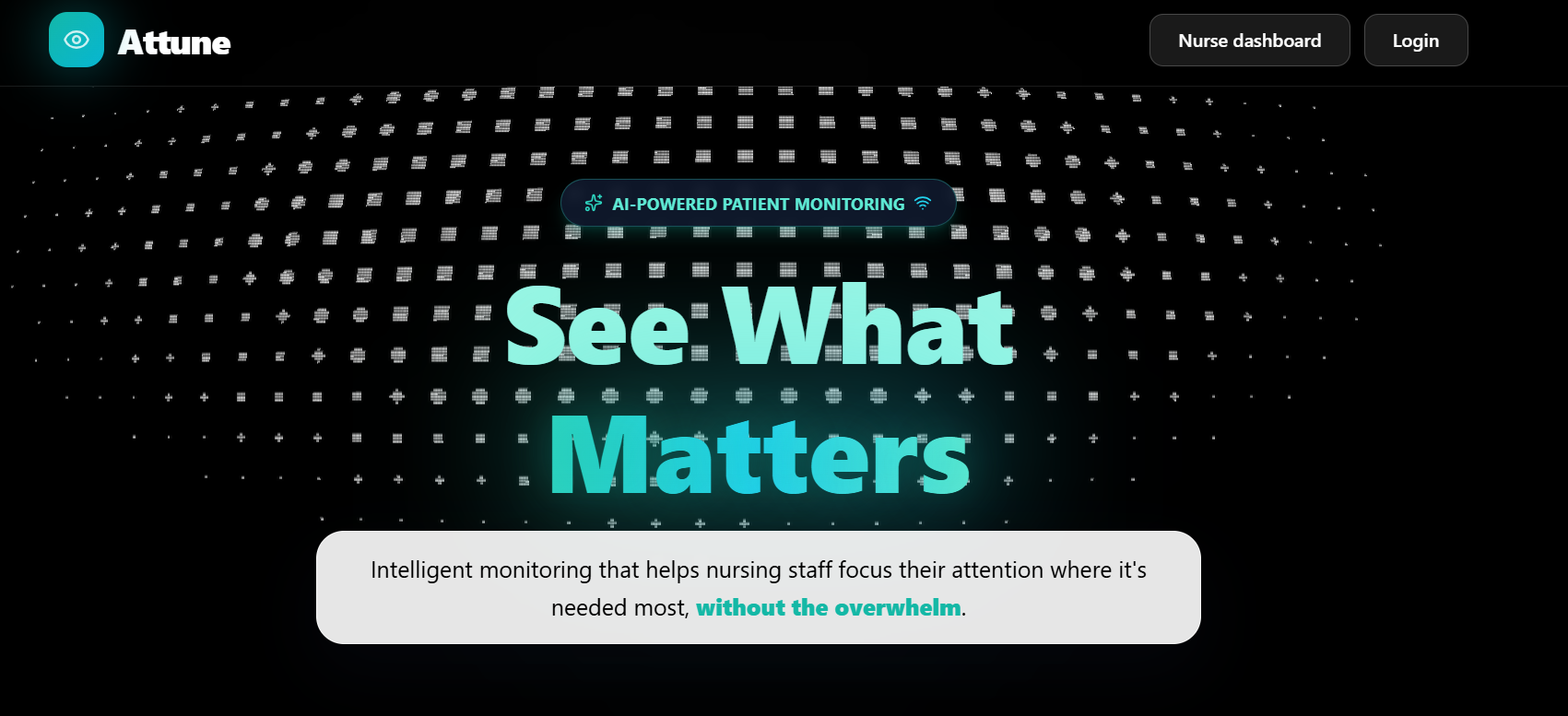
Inspired by these real-world challenges, we built Attune to serve as an AI-driven “second set of eyes” for nurses.
Attune uses computer vision and machine learning to:
- Analyze hospital camera feeds in real time
- Detect visible signs of patient discomfort
- Instantly alert nurses with contextual explanations
- Filter non-critical events so nurses can prioritize direct patient care
AI-based facial pain detection has already shown ~80–90% accuracy, correlating strongly with clinician pain scales (r = 0.82–0.88). These systems reduce reliance on subjective reporting and are especially valuable for nonverbal and postoperative patients.
Future growth includes:
- Multimodal AI (facial expressions + motion + other cues)
- Seamless real-time hospital integration
Attune aligns with NexHacks’ mission by delivering a technically robust, real-world healthcare solution with meaningful impact.
What We Learned
Developing Attune significantly expanded our expertise in real-time AI vision systems:
- Implemented object detection using YOLOv8
- Integrated live video analysis with Overshoot.ai
- Explored real-time streaming using LiveKit
- Built a modern frontend with:
- TypeScript
- Vite for fast builds
- Tailwind CSS for responsive design
- Deployed full-stack infrastructure on Vercel
- Handled asynchronous video feeds and real-time updates
- Tuned AI sensitivity to minimize false alerts—critical for ethical healthcare deployment
How We Built It
Backend
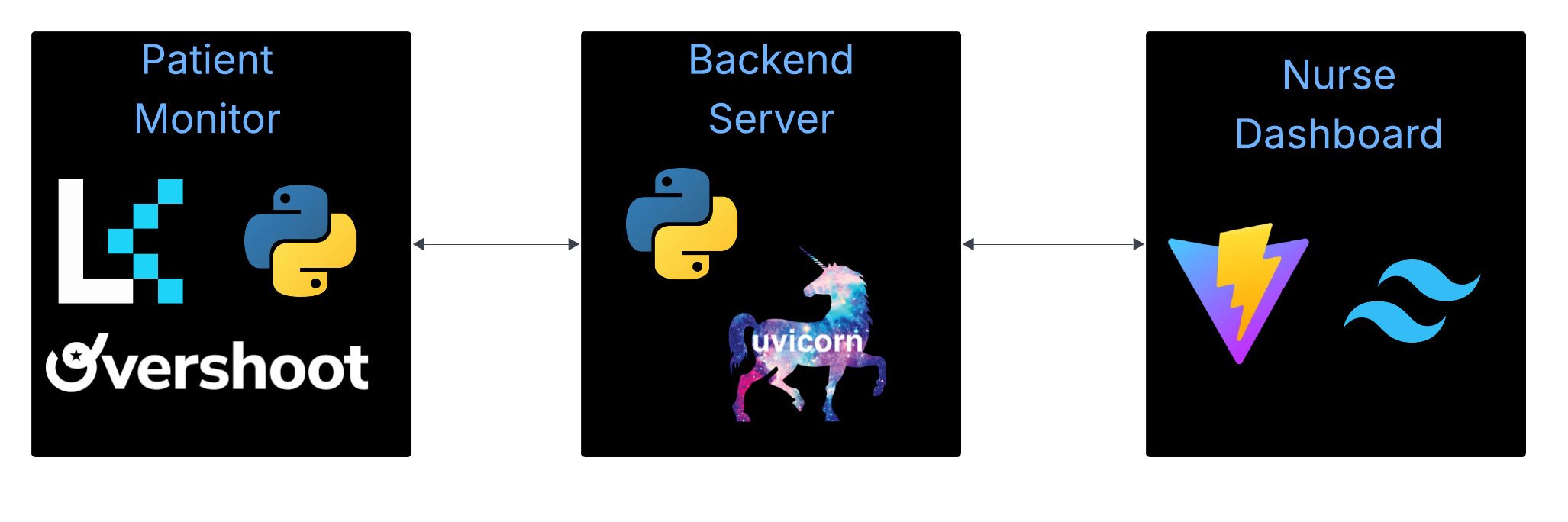
- Python-based pipeline for processing live video feeds
- YOLOv8 for initial object detection (e.g., movement, falls)
- Overshoot.ai SDK for advanced AI reasoning on live streams using natural language prompts
- Detects and explains events like bed exits or prolonged inactivity
Real-Time Communication
- LiveKit enables low-latency video streaming
- Supports multi-camera monitoring and future voice interaction
Frontend
- Built with TypeScript, Vite, and Tailwind CSS
- Multi-feed dashboard that:
- Auto-highlights critical cameras
- Displays clear, human-readable explanations for alerts
Deployment
- Hosted on Vercel for scalability and reliability
- RESTful architecture for alert propagation and system integration
Challenges We Faced
- Multi-camera simulation without specialized hospital hardware required creative use of webcams and recorded video samples.
- Balancing low latency and accuracy when integrating YOLOv8 with Overshoot.ai required extensive prompt and performance tuning.
- Privacy concerns during demo development:
- Webcam usage raised valid concerns around consent and data exposure
- Mitigated through explicit permission prompts and local-only processing
- WebRTC networking challenges:
- STUN alone was insufficient for NAT traversal
- Required exploring paid TURN server solutions, impacting timeline and budget under hackathon constraints
- Ensuring cross-browser compatibility with real-time UI updates added complexity.
- Debugging asynchronous backend events tested our modular design approach.
Despite these challenges, each obstacle strengthened Attune’s robustness and reinforced its suitability for high-stakes clinical environments.
Impact
Attune demonstrates how AI can meaningfully support nurses, reduce cognitive overload, and improve patient safety—without replacing human judgment. By acting as an always-on assistant, Attune helps ensure no patient’s discomfort goes unnoticed.

Log in or sign up for Devpost to join the conversation.