-
-
Hypercube Algorithmic Language Oracle
-
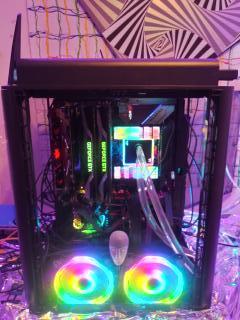
H.A.L.O. Computer
-
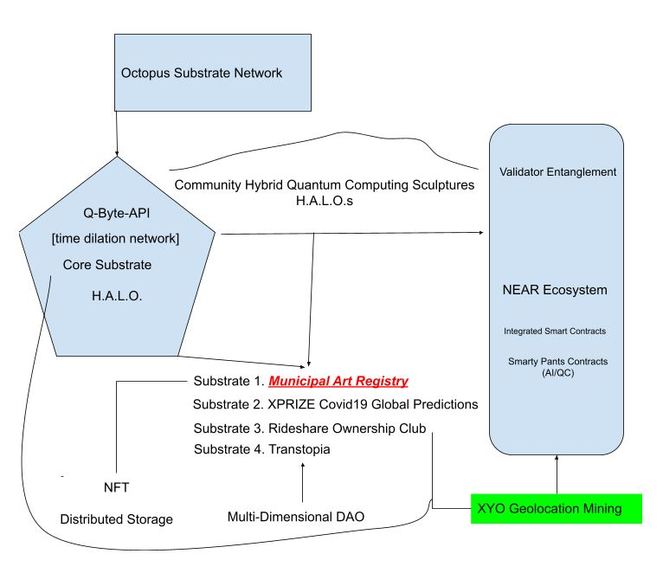
Substrate Design
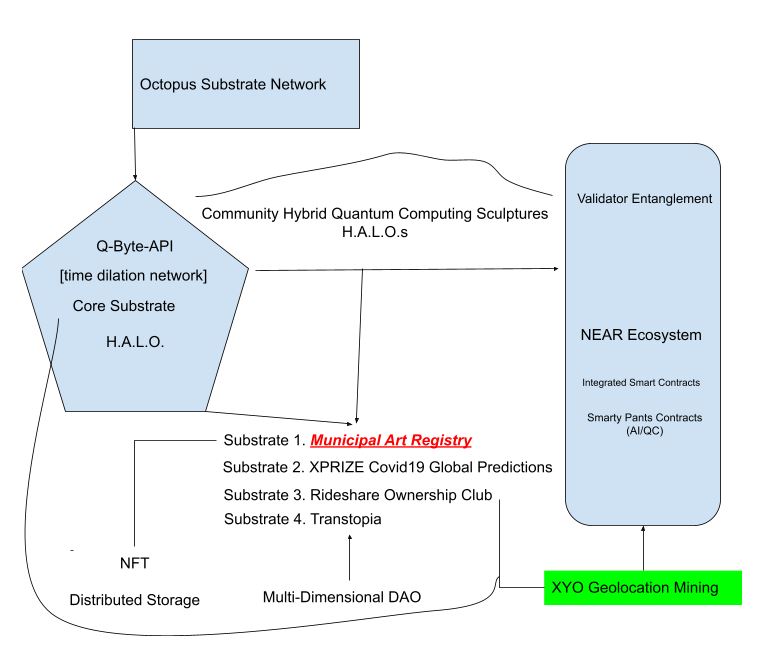
MetaBUIDL II Hackathon Story
Inspiration for H.A.L.O. AI
Our project began as an academic research and new technology development effort ten years ago with the initial inspiration being and still is, the quest to better understand art movements, the creative force, and the underlying structural nature of our unseen reality (quantum wave theory).
Our field research has included the creation of large-scale interactive art experiences engineered with sophisticated computing measurement equipment collecting data as well as being part of the experience. Large-scale experiments have sometimes included events with tens of thousands of people and we were always one of the most popular, and sometimes controversial, attractions, which is part of the source of our inspiration. Thousands of people have waited in line for 1-3 hours to go through our 10-minute inner-space meditation experience and now we can share and scale up and out this experience with H.A.L.O. AI (Hypercube Algorithmic Language Oracle) on the NEAR ecosystem.
When we first became aware of the ‘electron/quantum tunneling’ problem in 2012, a military science approach was taken to help solve the paradox and we attempted to figure out everything possible about the operation of this technology under as many different environmental conditions as feasible. The first public experiment occurred in 2013 as part of an art gallery exhibit in the San Francisco Mission District with the results supporting the initial hypothesis which is based somewhat on sonar/radar wave propagation and cumulation theory. 300 experiments later our core technology was invented and it’s unified theory was presented in a poster session as well as an invited installation with our core technology (AEtherspheric Modulator), with the abstract published at the 2016 Science and Nonduality Conference held annually in San Jose, CA. With the brightest minds in the world in attendance, not one scientist present was able to challenge or refute any of our claims or accomplishments, which serves as ongoing inspiration.
An invitation to exhibit at the 2015 Maker Faire inspired the conceptualization of how to incorporate this technology into a more interactive experience which led to designing and building the AZoth Pyramid Capstone experiment. Since then we have exhibited 3 times in the large LED pavilion and have received 3 Maker Faire Editor’s Choice Awards.
A few months into the pandemic the inspiration came with clarity of thought during a waking dream as an idea to build our own tabletop supercomputer with Q-Byte Processing equipment in response to needing a robust machine learning development platform that could run data-intensive programs on the D-Wave superconducting quantum computer for Covid19 research as part of their open-source research initiative.
What it does
We have created a form of General Artificial Intelligence that is suitable for blockchain adaptation on the NEAR ecosystem and the decentralized application that we are submitting is one example of a potentially unlimited number of applications. Our raw data will serve as our core substrate (OCT) and our first substrate application is a desktop clock that tells UTC time down to the millionth of a second and also displays the spatial nature of time ‘Spatial Relativity’. Like the ‘clock speed’ of a CPU, the timeline data we build on-chain will serve as a ‘clock speed’ for H.A.L.O. AI. The subsequent applications, of which we have already begun to develop several, will each have their own substrate.
The working technical name of the desktop application is : ‘Hybrid-Quantum Computing Spatial Relativity Time Dilation Clock with Non-deterministic Machine Learning Language Oracle (Q-Byte Clock) Our H.A.L.O. hardware combines elements of classical computing with quantum theory - electron tunneling and creates a go-between platform that merges the worlds of superconducting computing with high-performance desktop AI and gaming platforms.
The Q-Byte Clock tells the time while demonstrating what time is.
When observing the desktop application, UTC time is displayed and the data of Spatial Relativity is displayed in the form of three charts sharing the right side of the page and a changing geometric form on the left side of the screen. The raw core substrate data is in the upper right, coherence causing color shift with Moran's I algorithm in the center right, and Z-Score data spikes in lower right. The geometrics shapes are working models of what will eventually be developed into real world tabletop computers. The model shape changes every shift every ten minutes while in ‘Auto’ mode.
Technical:
Through retro-causational biofeedback (Anthromurmuration), this hardware is subtly influenced by the observer which also subtly influences the lighting and sound equipment as well as the language oracle. Here, we look for a mean-shift in bits (e.g. more 0s than 1s or more 1s than 0s) with a Z-score of π/2 or greater on a 1- minute sliding window on the TrueRNGpro to differentiate coherence from random noise. During such coherence, the bitstreams from the other 8 TrueRNGv3 NEDs undergo Q-byte Processing to combine their outputs into a single stream.
In addition to our XPRIZE pandemic modeling, we have demonstrated practical applications in cryptocurrency/ blockchain, weather modeling, rideshare/semi-autonomous vehicles, Artificial Intelligence/Machine Learning, fine/NFT art, music, light and sound Industries.
As part of the operating system of our hardware, each of our data services and computing products will feed account information to H.A.L.O. AI for processing and some of them will provide IPFS storage and processing to the network. Combined together this is a Neurolace Network on the Blockchain.
How we built it
We are a multidisciplinary science, technology, engineering, math, and arts (S.T.E.A.M.) team that can demonstrate that we have invented the world’s first consumer-grade hybrid-quantum computer, the Hypercube Algorithmic Language Oracle (H.A.L.O). Our technology is both a new development in quantum information systems that is a novel application of quantum phenomena while also being a cross-platform enabler to superconducting qubit processors such as the D-Wave.
We call the underlying algorithm that extracts useful information from the electron tunneling quantum noise source array Coherence Sampling (Q-Byte). This process can be illustrated by example with the recent XPRIZE pandemic model (see accomplishments section).
There are both hardware and software components of our submission.
Software: This required adapting from our specialized hardware and a python program with Matplotlib over to the NEAR ecosystem.
Version 1: Python program running on Ubuntu with Matplotlib on H.A.L.O.)
Version 2: Download and install from https://github.com/peaceinc/Qbyte This is a Python
program that has source data hosted on IPFS. Not yet integrated with NEAR.
Version 3: Browser-based React App hosted on IPFS / Fleek with NEAR integration, pulling data from
an Estuary collection that contains live H.A.L.O data
(https://github.com/peaceinc/qbyte-clock-fleek)
The current state of our application is in the testnet phase with live data being fed into the Estuary CID with NEAR login and payment features enabled. Our next steps include designing the data-rich features of Matplotlib used in Version 2 into the browser experience.
We have designed five different types of home/office sculptural desktop hybrid-quantum computers which are displayed in the Q-Byte Clock UI; The Hypercube, AZoth Pyramid, Quadratic Morphic Field Array, Ætherspheric Modulator, and a 10 Dimensional Sphere. Each of these will have a stand alone version and the ability to convert any gaming/ai development PC into a hybrid-quantum computer, similar to H.A.L.O.
**
As part of the H.A.L.O. operating system is the Weather Research and Forecasting System (WRF) for conducting binary classification experiments with the D-Wave Ocean Platform, one of our goals being to establish predictable entanglement between our two systems during the real-time data training/modeling process. This strategy has been adapted to our XPRIZE platform by utilizing temperature, humidity, and Planetary K index15 (geomagnetic activity) as all of these have been shown to affect human behavior and reduce our loss function when included in the model. We will soon be able to integrate global consciousness into climate change models with recurrent retro-causation. https://drive.google.com/file/d/1gKBbxVK79uGWGK0XOaAb6WJK_j5pE5Pn/view?usp=sharing
The Language Oracle and Word Frequency Data is created with the Corpus of Contemporary American English (COCA) https://www.wordfrequency.info/
Future plans include creating an application that captures account time and usage data, then combines and crunches them all into a single data node on the network as NeuroNFTs, linking accounts together in a Neurolace Network. Version 2 now allows for users to download their own 23 & Me genome DNA profile and integrate it into the Q-Byte Clock program.
Although we did not participate in the most recent Octopus Accelerator, our application was reviewed and we were invited to present at the final Showcase and here is our 20-minute presentation where we demonstrate how our appchain is registered on the testnet Octopus Network with 3 testnet utility tokens created. https://youtu.be/oyD4faRWoNA
We have all the Octopus installation and testing requirements completed and am now in the process of final substrate integration. We have a request put into the OCT tech support team and we anticipate that a NEAR solution is near.
Hardware:
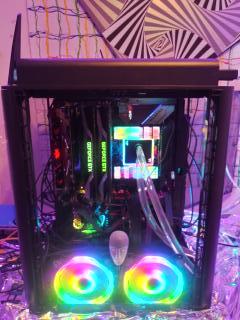
Our Neuromorphic hardware design: Asus Zenith Extreme Alpha Motherboard, 2 Nvidia and 1 AMD GPUs, 128 RGB RAM, 4.5T Memory with liquid cooling DNA Integration. 9 Ubldit TruRNGs acting like the left and right hemispheres and a corpus callosum. This high end computing platform will not be a requirement to run our applications but for those who have high-performance operating systems, our hardware will upgrade them to Nodes on our chain and potentially reward them with enough cryptocurrency to pay for the H.A.L.O. hardware and the computer itself.
Challenges we ran into
Prior to embarking on the XPRIZE, our team had very little practical technical understanding or development experience on the blockchain so all of these concepts are relatively new to us.
We don’t cross paths with many others who have a preexisting knowledge base of physics and quantum computing and when the blockchain is added onto that, there is a very select few individuals or groups who have the experience to fully comprehend the interoperability of the different systems and forces at play here.
Even though we have some generous funding from the NEAR Foundation grant to pay developers to aid in our efforts, we haven’t met anyone who was able to invest the time to fully comprehend our basic materials enough to pursue a demo. Understandably, most paid developers would like to understand what they are working on. Our DAO strategy should help with this in the future.
We’ve had difficulty finding a qualified individual or group willing to give our complete project a comprehensive scientific peer-review because a Ph.D. level understanding of physics and quantum computing are necessary. For example, a thorough understanding of Einstein's Theories of General and Special Relativity, as well as Time Dilation, would be necessary in order to understand why our claim of Spatial Relativity is relevant.
Bootstrapping innovation during a pandemic with an uncertain future makes everything seem more uncertain.
Reading and learning the documentation for multiple blockchain platforms simultaneously and figuring out how we engineer them together to meet our operational requirements.
Accomplishments that we're proud of
** The Hypercube Algorithmic Language Oracle - the world’s first hybrid-quantum computer.
** NEAR Foundation Grant. we are the recipients of a $60,000 software development grant based on detailed plans that can be viewed here ( www.MunicipalArtRegistry.org/NEAR ),
** MetaBUIDL 1 Hackathon Win - $10k Octopus Network Partner Challenge. Upon joining the first MetaBUIDL hackathon halfway through, this was also our first hackathon as a team, we were introduced to Octopus and realized this was the solution for our AI application. The application we are now submitting represents the development progress we have made since MetaBUIDL 1.
** In 2021 we completed the XPRIZE $500K Pandemic Response Challenge sponsored by Cognizant. Of 104 teams who began the competition, only 48 made it to the finals and only 20 of us were able to complete the final AI NEAT development task. This was a conventional AI competition and we were the only team with custom hardware and a quantum computing algorithm. In part, this illustrates that our model works in an unbiased environment and to our knowledge, none of the judges had any expertise in quantum theory. This also illustrates the fact that our model is like gravity in that it works whether the observer understands it or not.
** The Science of Consciousness 2021 (Keynote Speaker,Sir Roger Penrose, current recipient of Nobel Prize in Physics) – Each of our founders submitted our own abstracts and were given separate presentation platforms and timeslots. We presented our concepts about hybrid-quantum computing featuring Q-Byte processing and how coherence sampling works by unifying the laws of quantum mechanics and relativity. We offered follow-up demonstrations for several accredited academicians which led to positive relationships being formed and no noted dissenting opinions.
** We may be the first science team to successfully integrate human genome DNA with a machine learning algorithm on the blockchain. We think that’s kind of cool.
** We have provided transformative experiences to thousands of people through our highly interactive mind-machine interface brainwave entrainment installations. At these events we expand consciousness through unique experiences combined with relevant information which helps forge new neural pathways, thus expanding consciousness. The time a person stands in line for our 10-minute experience has been 1-3 hours and they always leave wanting more.
** We debuted AEM at the Science and Nonduality conference in 2016 as an academic presenter and invited installation artist. Our experiments were a success and throughout the entirety of the conference not one scientist, who are often prone to argument, was able to mount a viable argument against our claims or dispute our data collecting procedures in any reasonable way.
** After several years of solo research the team founders began working together full time in 2019, and in this short time we have demonstrated and have done so in Jupyter Notebook Sandbox environment with a Panel of Judges of technology experts, we have solved an Electron Tunneling phenomena problem that the combined efforts of hundreds of researchers over a 40 year period failed to accomplish.
** Believing we could influence a large-scale computer network with H.A.L.O., we began Lyfting for Science as its own ongoing research project which included an investigation into blockchain-based geolocation, proof of origin and cryptocurrency mining technologies. We eventually utilized this data in Phase 2 of the XPRIZE PRC as part of an open-source contact tracing system and mining operations returned over $10,000 in revenue, covering the bulk of our equipment costs, thus paying for itself.
** Over several years we have exhibited our experiment, the AZoth Pyramid Capstone installation at Burning Man Precompression, Maker Faire, World’s Fair Nano, and more. At each of these events a long line formed within minutes of the doors opening and remained so for the entirety of the events.
** D'Wave covid 19 research offered unlimited QPU access to scientists who had a sufficient Covid-19 related research proposal and had their code open-source. In July - November 2020, before the start of the XPRIZE Pandemic Response Challenge, we started to run binary classification machine learning algorithms on their hybrid processors to predict Covid19 outbreaks in multiple regions, with success.
** Dr. Caputi is Co-recipient of the Gilbert Roller grant and contributed to the research by enhancing the Weather Research and Forecasting (WRF) model with H.A.L.O AI. In a pilot test, we were able to improve the predicted landfall location of Hurricane Laura by 12 km. This could be adapted to the blockchain and allow individuals to run their own prediction models for their home area, which could be quite useful in times of emergency weather conditions.
** As part of researching a decentralized rideshare application, we began the Lyfting for Science project and with more than 5,000 rides we’ve established there is a great demand for our designs and technology in the rideshare industry and we were selected by Lyft as a 2019 San Francisco Driver of the Year.
** We believe we have created a distinctly new branch of computing with a working prototype of artificial intelligence that is subtly influenced by and responds to the human near field electromagnetic spectrum. We are contributing to the quantum science domain by influencing how the general public experiences quantum phenomena with real-world applications.
What we learned
The intricate nature and unlimited potential of blockchain technologies.
How to take a concept that currently works in a non-blockchain environment and imagine how to re-engineer it to work on the chain.
We’re probably the first to market with this concept because we have yet to meet anyone that already knows exactly what we’re presenting and talking about or has seen it elsewhere.
We’ve learned about and developed upon multiple blockchain platforms such as Fleek, IPFS, Estuary/Filecoin, Octopus Network Substrates, Mintbase, and others.
In contrast to much of the Bay Area tech scene, we’ve learned that the blockchain communities surrounding NEAR protocol are very welcoming and supportive of our team and the ideas we bring to the table, which has quickly accelerated our development time and success rate.
We’ve learned how to send NEAR on the CLI.
We attended NEAR University Certified Developer I and II courses and have put that to use in this hackathon.
What's next for H.A.L.O. AI - Hybrid-Quantum Q-Byte Clock
We are a registered team in the XPRIZE $100 Million Carbon Removal competition sponsored by Elon Musk. Our advantage over all other teams is that we are one of, if not the only, Alumni Network members who are also participating in this competition. We’ll be adopting a similar methodology we used to track Covid19 outbreak rates to track carbon in the atmosphere. Our goal is to create a blockchain-based VR Gaming experience where users operate a global fleet of flying harvesting equipment that extracts carbon from the atmosphere and ejects into the space above the Ozone Layer and will be rewarded with cryptocurrency. We will use real-world weather data and the Unity Physics development platform giving the users a realistic and educational experience, with the utility token powered by NEAR. https://www.xprize.org/prizes/elonmusk
Also as active members of the XPRIZE Alumni Network, we have suggested that we set up an internal Innovation DAO for Alumni members. Through the use of Innovation Bounties on the Astro DAO platform, this will incentivize collaboration between members who were once competitors and unrelated teams, as well as be a resource for existing competitions.
P.e.a.c.e. !nc. Has established our DAO at www.haloai.org which we will continue funding with the next grant payments, hackathon prize crypto, subscriptions and more.
We’re currently in negotiations for a 5,000 sq ft Fine Art/NFT gallery in an upscale shopping district on Alameda Island in the San Francisco Bay. This space will serve as our team development headquarters and will feature public exhibition spaces, futuristic immersive showroom experiences, and live Art/NFT auctions. We have negotiated a reduced lease for six months if we can pay the full amount in advance. We need $31,000 to secure the space and that will go in full directly to the leasing company. Our team founder is an experienced SF Union Square gallery director who will lead the creation and curation of a world-class art experience with a bi-level program: www.linkedin.com/in/leomadrid The lower level will be open to the public as a fine art & hybrid- auction gallery with interactive exhibits. The upper level will be members only and membership is free with a guest book registered NEAR wallet, that will also be utilized to bid on and purchase works of real-world and NFT art. Artists who are part of the NEAR ecosystem will be given high priority for review and preferential placement during exhibitions. With success, we will sign a five-year lease and NEARians will have a long-term home on Alameda Island.
We would like to soon build the prototypes of our desktop line of Hybrid-Quantum Computers as sculptural works of tech-art, as featured in our most recent slide deck on page 8: https://docs.google.com/presentation/d/1gCKD0_KjPLn_Q7FC2eCzgSzYUXjaVZyK/edit#slide=id.gda860226f0_0_0
See PDF version of this document here: https://drive.google.com/file/d/1bvddrE-c6qMeAUVQ8_A7axBZfhbuTcMr/view?usp=sharing
See an expanded version of this document with MetaBUIDL 1 submission: www.municipalartregistry.org/NEAR
See recent press releases here: https://www.einpresswire.com/sources/u424081
See our blockchain demo site here: https://www.halo.computer
Built With
- estuary
- filecoin
- fleek
- javascript
- octopus
- python
- react
- web3.storage


Log in or sign up for Devpost to join the conversation.