-
-
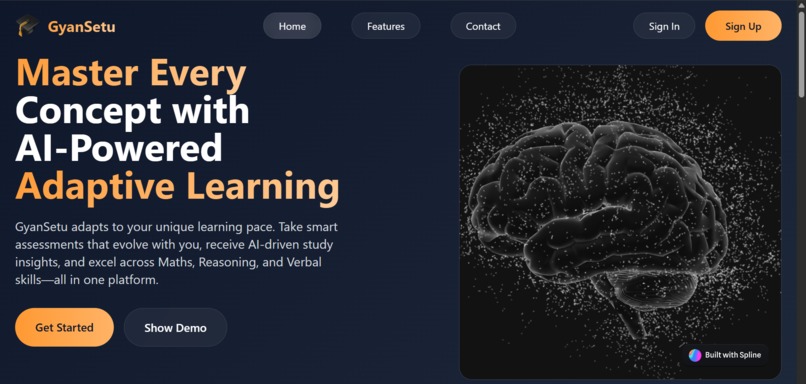
Landing Page

Inspiration
Traditional assessments treat all students the same, ignoring individual learning differences. This often results in students feeling anxious when questions are too hard or disengaged when they are too easy—leading to poor motivation and inaccurate measurement of ability. Inspired by advances in adaptive learning and psychometric research, we envisioned GyanSetu as a bridge between learners and knowledge. Our aim was to transform assessments from static judgment tools into dynamic growth accelerators that recognize every student as unique.
What It Does
GyanSetu is an AI-powered adaptive assessment platform that personalizes learning and evaluation for both students and teachers. Real-time Adaptation: Uses Item Response Theory (IRT) and Bayesian Knowledge Tracing (BKT) to dynamically select questions based on a student’s ability level. AI-Driven Insights: Leverages Google Gemini AI to analyze performance data and provide personalized study recommendations. Comprehensive Analytics: Offers topic-wise performance metrics, visual progress charts, and precise ability estimations. Multi-Subject Coverage: Supports Arithmetic, Algebra, Geometry, Number Systems, Logical Reasoning, and VARC. Student–Teacher Connectivity: Enables resource sharing (PPTs, timetables), progress monitoring, and instant feedback. Instant Results: Delivers immediate scores with detailed explanations to reinforce learning.
How We Built It Frontend Responsive UI using HTML5, CSS3, and TailwindCSS Interactive visuals with Spline 3D and performance charts via Chart.js Smooth navigation and dynamic dashboards built with JavaScript (ES6+)
Backend Node.js + Express.js for authentication, user management, and APIs Python Flask API for running IRT and BKT psychometric models JWT-based authentication, bcrypt password hashing, and Nodemailer for email verification
Database MongoDB with Mongoose ODM to store users, assessments, and performance history
AI Integration Google Gemini AI for performance analysis, study planning, and personalized recommendations
Algorithms 3-Parameter Logistic IRT Model with Fisher Information maximization for accurate ability estimation Bayesian Knowledge Tracing (BKT) to track knowledge evolution over time Scientific computing with NumPy, SciPy, and Scikit-learn
Challenges We Faced Complex IRT Implementation: Balancing mathematical accuracy with computational efficiency required extensive optimization. Real-Time Question Selection: Ensuring instant adaptation without latency demanded efficient APIs and database queries. AI Prompt Engineering: Refining Gemini prompts to produce clear, actionable study advice took multiple iterations. Data Synchronization: Maintaining consistency across Node.js, Python APIs, and MongoDB was technically challenging. UI/UX Simplicity: Presenting powerful analytics without overwhelming users required thoughtful design.
Accomplishments Successfully implemented enterprise-grade psychometric models (IRT & BKT) Integrated cutting-edge AI for meaningful, personalized learning insights Built a full-stack platform with seamless frontend, backend, and AI coordination Created scientifically calibrated question banks across multiple subjects Designed dual dashboards for students and teachers with real-time analytics Delivered a smooth adaptive testing experience unique to every learner
What We Learned Practical application of psychometric theory in real-world systems Effective AI integration and prompt engineering for education use cases Designing and scaling multi-tech full-stack architectures Importance of user-centric design—hiding complexity while delivering value Performance optimization for real-time adaptive systems The real challenges of personalizing education at scale
What’s Next for GyanSetu Advanced Features Dyslexia & Acesseblity Support Multilingual support for regional learners AI Enhancements Computer Vision for handwritten answer evaluation Voice-based assessments for accessibility and language learning Predictive analytics for exam performance and early intervention Platform Growth

Log in or sign up for Devpost to join the conversation.