Inspiration
We started with a simple complaint every hostel student has made at least once - "the mess food is really bad, I wish knew what food would suit my gut better" That frustration led us to a genuinely interesting question: what if it could? We started researching the gut-brain axis, the enteric nervous system, and the science of interoception - the body's ability to sense what's going on within. We found that one of the least understood and most suppressed sensation by modern life is the ability to hear our own hunger, fullness and gut reactions clearly. That became the foundation of Gutcha.
What it does
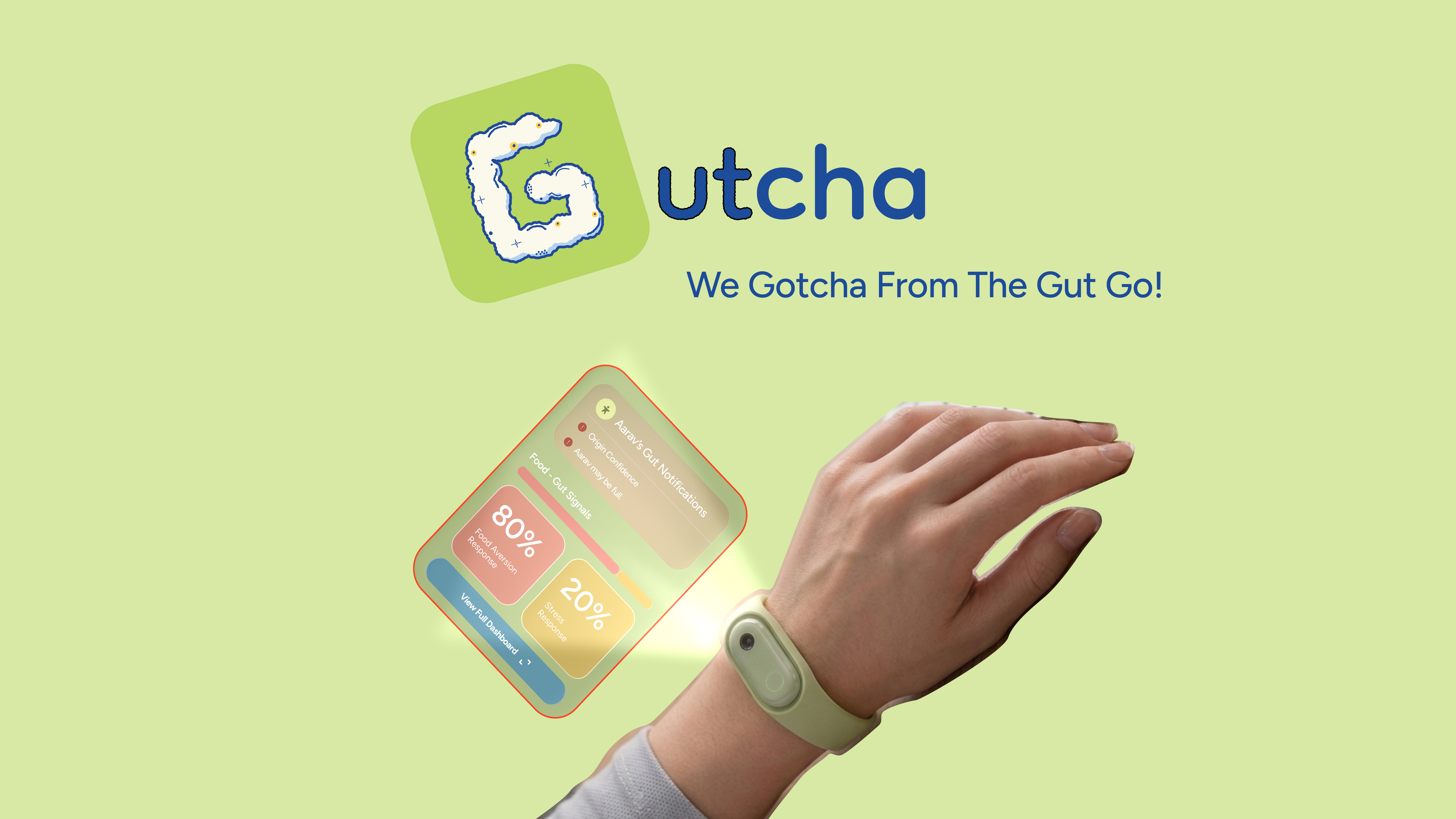
Imagine a world where your body’s quiet signals are no longer vague feelings but clear cues you can perceive and heighten. The Gutcha sachets and wearable translates subtle gut signals - hunger, hydration, electrolyte shifts and origin of theirs of their appetite into simple pulses and visuals, building long-term awareness of their gut and behaviour. What was once intuition becomes legible, helping people respond to their bodies earlier and make better everyday choices.
How we built it
We designed the full system across three layers — the sensing layer (nanosensors and wearable), the feedback layer (haptic language and dashboard) and the learning layer (pattern recognition). We mapped signals across five tiers from core instinct signals to digestive feedback, built three concrete use cases (a parent trying to understand a toddler who can't yet communicate fullness, an athlete whose stress suppresses hunger, a person whose anxiety was causing gut symptoms they were blaming on food) and designed the dashboard interface in Figma with interactive prototypes for each use case.
Challenges we ran into
The hardest part was designing something that knows a lot about your body without making you feel watched. Every small decision - how the haptic nudges work, how you exit the system and how the app communicates to you - came from asking: does this feel like a tool or a surveillance trap? The parent-child use case was genuinely tricky too. A toddler can't consent to anything. We had to think carefully about what it means to put something like this in a child's body.
Accomplishments that we're proud of
We're proud that Gutcha doesn't feel like a diet app. It took real restraint to keep calories, macros, and prescriptive advice entirely out of the product. We're proud of the harm mapping - the Black Mirror scenarios, the eating disorder safeguard, the data sovereignty architecture because we think speculative design has a responsibility to take its own implications seriously. And we're proud of the parent-child use case, which started as an extension and ended up being the most resonant story in the whole project.
What we learned
We learned that the most powerful interfaces are sometimes the quietest ones - a single haptic pulse at the right moment does more than a dashboard full of data. We also learned that speculative design is most useful when it looks into ethical considerations as seriously as visual design.
What's next for Gutcha
The immediate next step is refining the dashboard prototype and testing the haptic language with real users. Beyond that, the parent-child framework opens a much larger door - non-verbal individuals, dementia patients, anyone whose interoceptive signals are present but inaccessible to the people caring for them.
Built With
- figma


