-
-
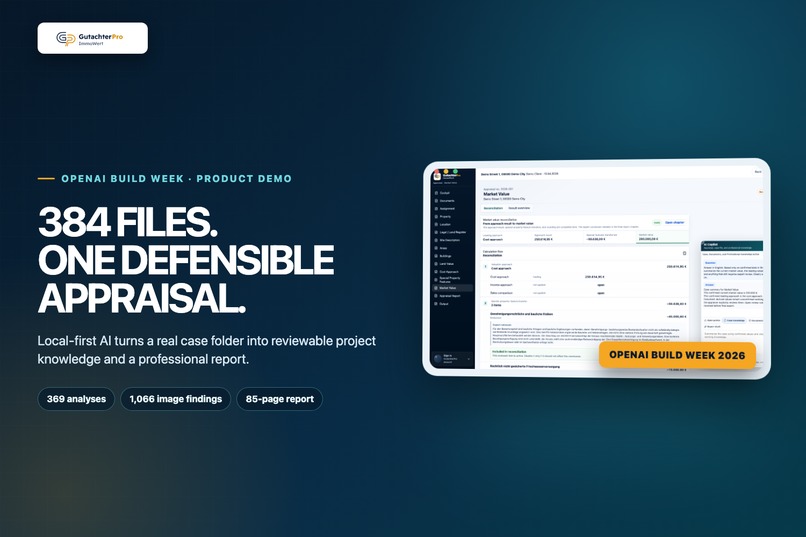
From 384 case files to one defensible appraisal: local-first project knowledge, expert-controlled AI, and professional report delivery.
Inspiration
German real-estate appraisers work across scans, photographs, land-register records, floor-area schedules, market documents, regulated calculations, and expert decisions. The hard problem is not generating more text. It is turning that evidence into reviewable case knowledge while preserving professional responsibility.
GutachterPro ImmoWert is an offline-first desktop workspace that keeps the professional case, calculations, and reporting core local while adding controlled, case-grounded AI.
The verified Build Week starting point
By 13 July 2026, the project already had a native Tauri shell, case-specific SQLite persistence, the first Cost Approach workflow, and early export proofs: a 14-page working DOCX and a 15-page PDF.
Since then, I expanded that foundation into a verified Goldcase workflow:
- An 85-page professional Goldcase report delivery in DOCX and PDF
- Complete Cost, Income, and Sales Comparison workflows with Market Value reconciliation
- Full appraisal and compact market-value assessment editions from one validated report state
- Restart-safe document and image analysis with persistent provenance
- AI-prepared land-register and floor-area modules with explicit expert confirmation
- Source-linked location-description proposals with preview and deliberate adoption
- A case-grounded Copilot that prioritizes confirmed professional values
- An English product interface for the Build Week demo while authentic German appraisal documents and report content remain German
How it works
The desktop app opens a local case folder and stores structured professional state in case-specific SQLite. Documents and images remain project files. AI analysis produces schema-validated working knowledge with compact provenance.
Confirmed expert values always take precedence. AI suggestions never silently overwrite professional data. Transfers into valuation modules or report chapters require a preview and an explicit decision.
One validated report model drives DOCX and PDF output, avoiding a second source of truth between calculations, chapters, preview, and export.
Demonstrated results
The anonymized Goldcase shown in the video contains:
- 384 project files
- 369 completed analyses
- 11 extracted facts
- 4 structured tables
- 1,066 image findings
- 24 editable area rows across three buildings
- One AI-prepared land-register sheet with two parcels, subsequently expert-confirmed
- A reviewed current Market Value of 200,000 euros
- A real 85-page final-report structure with private identifiers deterministically masked
The demo shows the workflow itself: navigating modules, reviewing AI-prepared data, opening source-linked location proposals, moving from Cost Approach to Market Value, asking the Copilot in English, and inspecting the professional report output.
How I used OpenAI Codex and GPT-5.6
GPT-5.6 in OpenAI Codex was my engineering partner throughout Build Week. I used it to understand a large React, TypeScript, Rust, Tauri, and SQLite codebase; define bounded vertical slices; implement product and domain changes; write targeted tests; diagnose persistence failures; inspect the running application; and verify visual evidence.
The work followed an evidence-driven loop: one bounded milestone, narrow automated checks, validation in the real runtime, and explicit acceptance evidence. Product decisions, publication decisions, and professional valuation responsibility remained human-controlled.
Codex and GPT-5.6 are the Build Week development technology. The current in-app AI runtime remains provider-separated; I do not claim GPT-5.6 as the deployed appraisal model.
Challenges and lessons
The most difficult problems were state integrity and trust boundaries: restoring exactly the same case after restart, separating document findings from confirmed facts, preventing stale context from overriding current professional inputs, and ensuring that a technically valid export is also visually defensible.
The key lesson is that useful professional AI is not an autonomous author. It is a disciplined collaborator inside a product that makes provenance, uncertainty, confirmation, and responsibility visible.
What's next
Next I will broaden real-case acceptance, harden additional specialist modules, and continue developing the provider-independent AI boundary while keeping the professional desktop core local and dependable.
Built With
- gpt-5.6
- openai-codex
- react
- rust
- sqlite
- tauri
- typescript

Log in or sign up for Devpost to join the conversation.