-
-
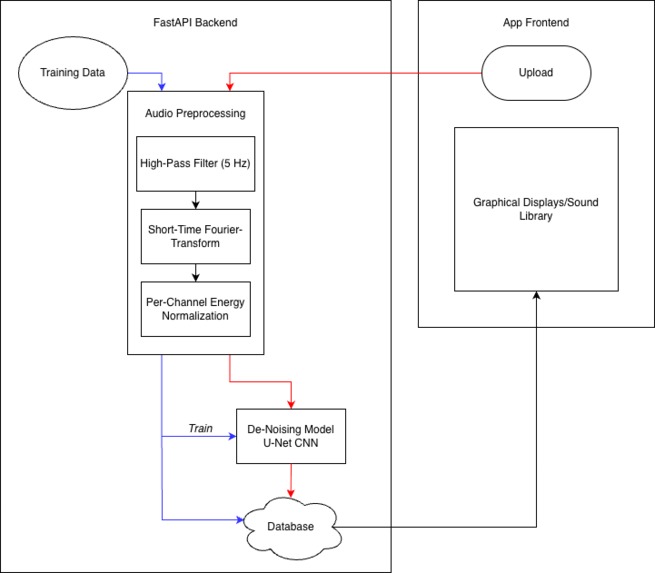
UML Diagram of application flow
Inspiration
We were very interested in the elephant denoising project from the start. Our team is comprised of officers of SMU's chapter of Theta Tau Professional Engineering Fraternity. Our chapter was founded in 1990 and at that time, the founding president acquired a ceramic elephant statue that has been passed down from president to president as a symbol of the brotherhood we're a part of. Because of this, when one of the challenges was to aid in conservation research for the elephants we admire, we had to jump on the opportunity.
What it does
Gunthar is a denoising tool designed and trained on a number of different elephant vocalizations. We trained it using pseudo-clean vocalization audio, where some of the more obvious background noise was removed, and samples of the background noise without any vocalization. The model randomly pairs noisy audio and pseudo-clean audio to train and then iterates until it converges on removing the background noise.
How we built it
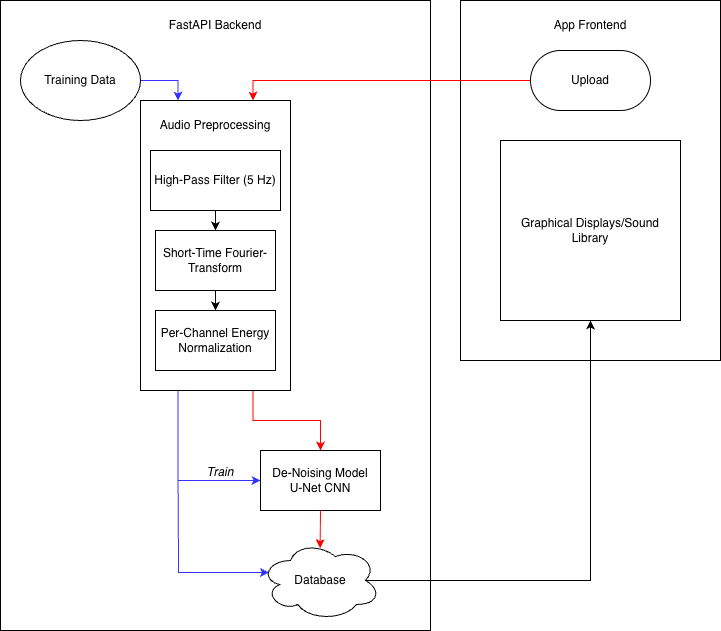
We began with a comprehensive literature review and found a paper centered on biodenoising without access to clean audio data. We applied transfer learning to finetune this model to perform well in our domain. In order to assist in fine-tuning, we implemented a preprocessing pipeline for the data:
- High-pass filter at 5 Hz to remove DC drift from the signals.
- Short-time Fourier Transform to convert to magnitude.
- Per-channel energy normalization to damp outliers.
This gives us cleaner, normalized signals to process with our model. We then integrate the data into a user-friendly UI, which will take in an uploaded .wav file and create a denoised version, as well as provide a modular workspace for data visualization.
Challenges we ran into
One of the most difficult challenges was training a model that would accurately denoise the rumble sounds. Most of the models we found in our literature review focused on denoising recording of bird calls which have a higher pitch and frequency than the elephant rumbles. This made trumpet sounds relatively simple to denoise, as they possess a pitch and frequency similar to birdsong. Rumbles, however, are so sonically similar to the mechanical noise that the model often mistook the two.
Accomplishments that we're proud of
For three of us, this was our first hackathon. The fact that we were able to create the project from start to finish was a huge success. It was especially rewarding to work in such a tight knit group because we were able to approach the project as a well-oiled machine.
Citations
M. Miron et al., “Biodenoising: Animal Vocalization Denoising without Access to Clean Data,” Mar. 10, 2025. https://arxiv.org/pdf/2410.03427
Built With
- css
- fastapi
- html
- javascript
- python
- pytorch
- streamlit


Log in or sign up for Devpost to join the conversation.