-
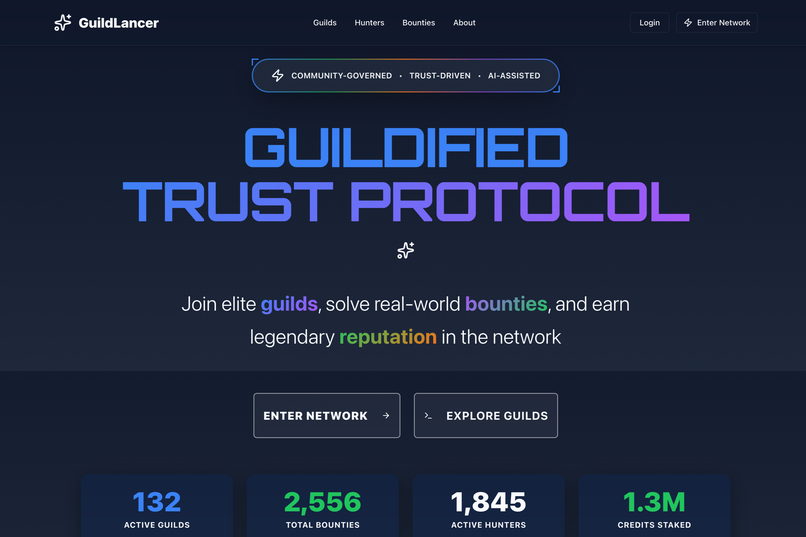
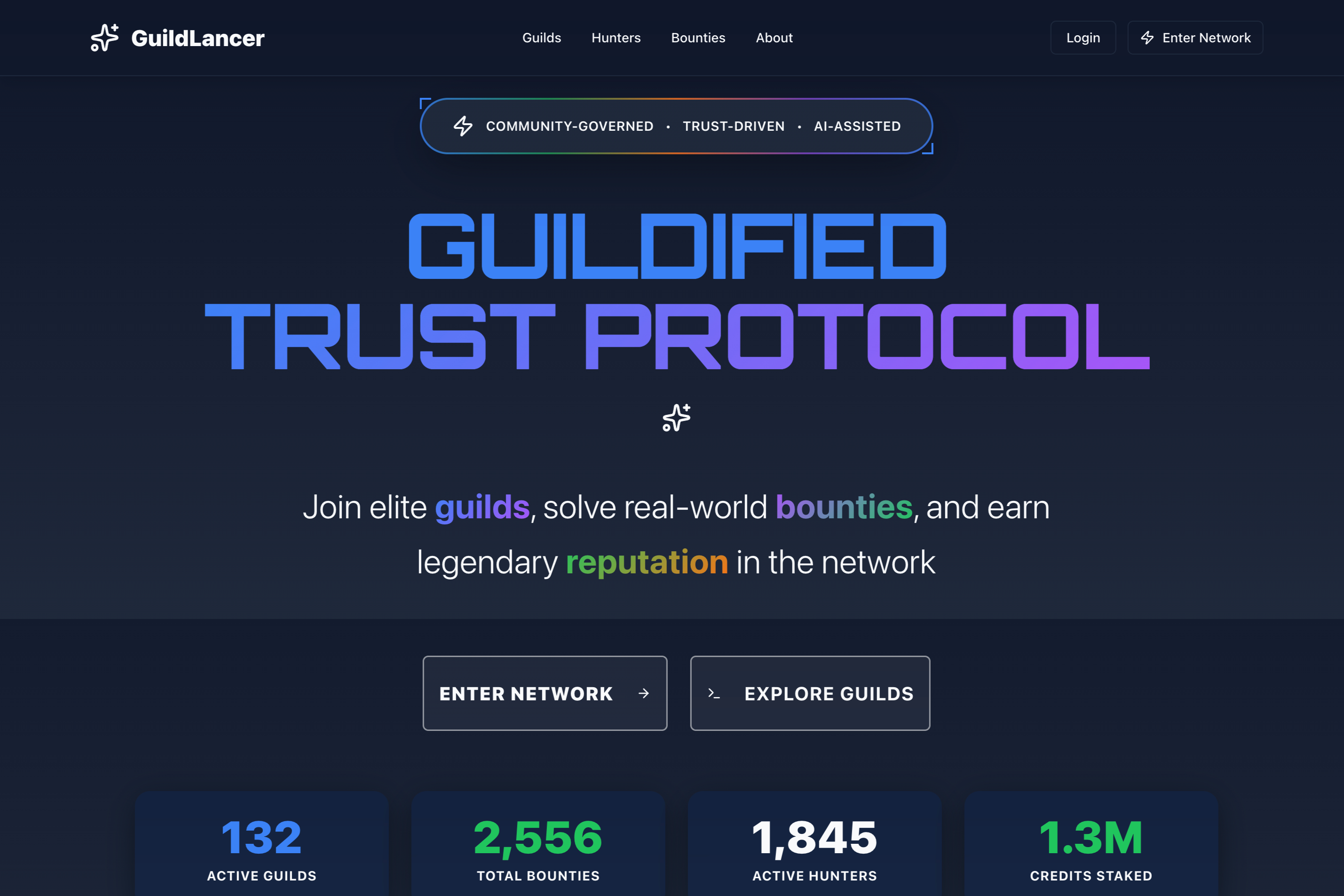
Home page
Inspiration
Modern task marketplaces and coordination platforms are optimized for speed and volume, not trust. Individual-based gig systems often fail when accountability breaks down, disputes arise, or long-term reliability matters more than short-term delivery.
We were inspired by real-world organizations that do handle accountability well—consulting firms, incident response teams, open-source communities, and professional guilds—where reputation is collective, incentives are aligned, and failure has consequences beyond a single transaction.
GuildLancer was born from a simple question: What if work was coordinated by trusted communities instead of isolated individuals—and trust was measurable, dynamic, and earned?
What it does
GuildLancer is a guild-based, trust-driven bounty resolution platform where tasks are accepted, executed, and resolved by guilds, not individuals.
Key capabilities demonstrated in this MVP:
- Clients post bounties with requirements, stakes, and evidence criteria
- AI recommends suitable guilds based on skills, trust, and history
- Guilds accept bounties by staking credits (skin in the game)
- Guilds assign hunters internally to complete tasks
- Completed work updates trust scores and rankings automatically
Disputes are resolved through a three-tier system:
- Direct negotiation
- AI-assisted analysis
- Community tribunal voting
Trust, reputation, and eligibility evolve based on real behavior—not static ratings
The system emphasizes coordination, governance, and accountability, not just task completion.
How we built it
GuildLancer was built as a logic-first MVP focused on proving system behavior rather than shipping a full marketplace.
Tech Stack
- Frontend: Next.js (App Router), TypeScript, Tailwind CSS, shadcn/ui
- Backend: Next.js Server Actions & API Routes
- Database: MongoDB Atlas with Mongoose
- AI Layer: GroqCloud (Llama 3.1 / Mixtral) for matching and dispute analysis
- Auth: NextAuth.js
- Deployment: Vercel
Architecture Highlights
- Modular data models for Guilds, Hunters, Bounties, Stakes, and Disputes
- Explicit, configurable trust and ranking formulas
- AI used strictly as decision support, with explainable outputs
- Rule-based fallbacks when AI is unavailable
- Simulated economy to validate incentives without real money
Challenges we ran into
- Scoping complexity: Designing governance, staking, and reputation systems without overbuilding
- Trust modeling: Making trust scores transparent, explainable, and resistant to gaming
- Dispute resolution: Balancing fairness, finality, and simplicity in community tribunals
- AI explainability: Ensuring AI outputs were understandable and not treated as authority
- UX vs logic tradeoffs: Prioritizing system behavior over UI polish under time constraints
Accomplishments that we're proud of
- Built a complete bounty lifecycle from posting to resolution
- Implemented a working staking mechanism with real consequences
- Demonstrated guild-level accountability, not individual-only ratings
- Designed a multi-tier dispute system combining humans and AI
- Made trust scores dynamic, decaying, and behavior-driven
- Ensured AI decisions are transparent and optional, not opaque rulings
Most importantly, the system shows cause → effect clearly: actions change trust, trust changes power.
What we learned
- Trust is more valuable than speed in complex coordination systems
- Community incentives must punish bad behavior and reward honesty
- AI works best as an assistant, not an authority
- Reputation systems fail when they are static or easily gamed
- Clear system rules matter more than visual complexity in early-stage products
What's next for GuildLancer
- Real economic integration (payments, escrow, or blockchain staking)
- More advanced anomaly and collusion detection
- DAO-style governance for platform-level decisions
- Public APIs for third-party integrations
- Mobile-native applications
- Multi-language and region-aware support
- Deeper analytics and predictive trust modeling
What's not done yet (Future Work)
Due to hackathon scope, the following were intentionally deferred:
- Real money or crypto payments (simulated economy used instead)
- Advanced ML models for fraud detection
- Full moderation and admin tooling
- Native mobile apps
- External integrations (Slack, GitHub, etc.)
- Long-term persistence and scaling optimizations
These areas represent clear expansion paths, not missing fundamentals.
GuildLancer demonstrates how trust, accountability, and coordination can be engineered—not assumed—through community governance and transparent systems.
Built With
- css
- groq
- html
- javascript
- mongodb
- next.js
- pusher
- react
- shadcn
- tailwind
- typescript
- vercel

Log in or sign up for Devpost to join the conversation.