-
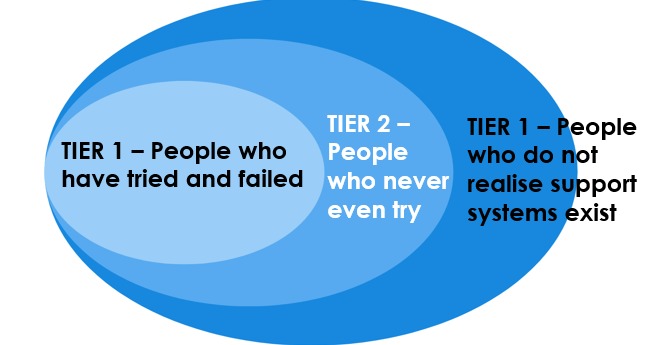
GuideMe three tiers of non-customers
-
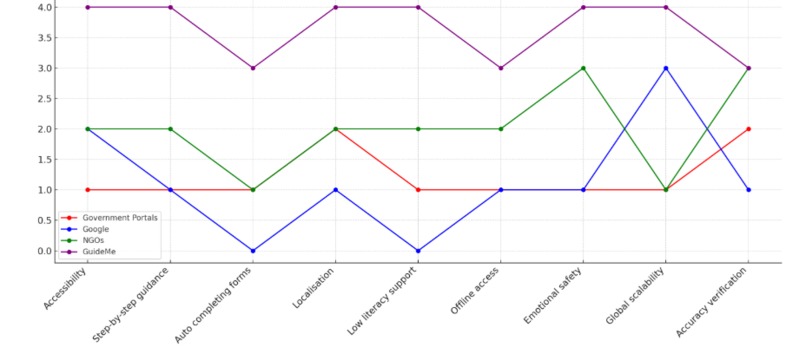
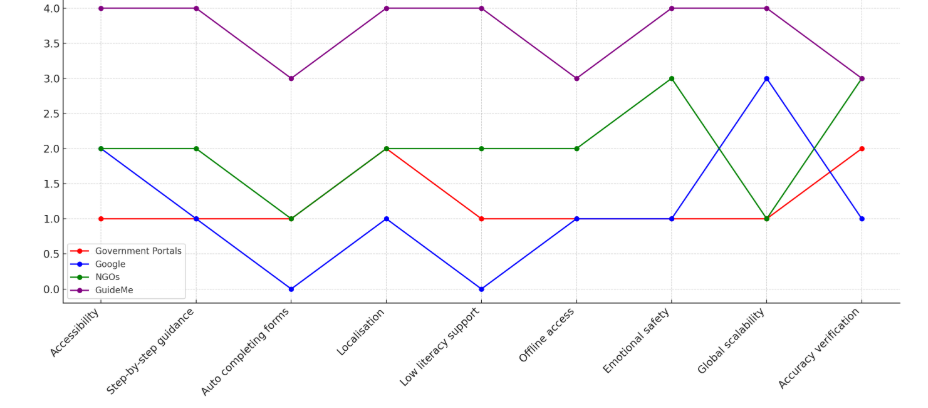
GuideMe strategy canvas
-
GuideMe logo
GuideMe
The World’s First Universal Barrier Remover
Ananya Gulati, [email protected], 17 years old and currently doing Year 12 (grade 11) and A levels of Physics, Maths, Further Maths, Spanish.
- Problem Statement
Across the world, billions of people face processes they simply cannot complete. Not because they are unwilling, but because the systems around them are built in ways they cannot navigate. Behind every rejected application is a person who goes hungry. Behind every unreadable government form is a family that loses support. Behind every confusing process is a human being who blames themselves instead of the system.
The scale of this problem is overwhelming.
1.1 Literacy and comprehension barriers
According to UNESCO’s 2024 Global Education Monitoring Report, 763 million adults cannot read or write at a basic level.
Even among literate populations, the OECD’s Survey of Adult Skills found that one in four adults in developed countries struggle to understand official documents.
This means hundreds of millions of people cannot safely read health instructions, applications for social support, or legal information.
1.2 Digital divide
The International Telecommunication Union reports that 2.6 billion people worldwide remain offline. Those online often face unstable connectivity, unaffordable data, and government portals that assume advanced digital skills.
1.3 Bureaucratic complexity
Public processes are not designed for ordinary humans. Research from the UK’s Behavioural Insights Team shows that over 40 percent of benefit applications fail due to confusing instructions, missing documents or misunderstood requirements.
In countries with weaker administrative systems, failure rates are even higher. Many people lose access to life-saving benefits simply because the process is too confusing to complete.
1.4 Vulnerable groups suffer the most
Refugees, migrants, low-income households, disabled individuals and non-native speakers face multiplied barriers.
UNHCR reports that 70 percent of refugees do not access the services they are legally entitled to due to linguistic and procedural complexity.
1.5 Immigrants face fear, shame and exclusion
Many immigrants (much like my parents when they initially came to the UK) avoid essential services because they are terrified of making a mistake, being judged, or simply “looking stupid”.
This problem is not minor. It is global.
GuideMe exists to try and remove these barriers once and for all.
- Proposed Solution — GuideMe
GuideMe is an app that converts ANY real-world process into a clear, personalised, step-by-step action journey that ANY person can follow confidently.
Not information. Not knowledge. Not summaries. Action.
It is the world’s first universal system-to-human translator.
How it works
Users select a task such as:
• Register with a GP in the UK
• Access flood relief in Bangladesh
• Understand tenant rights in London
• Enrol a child in school in Kenya
GuideMe instantly transforms the task into a structured pathway including:
• simplified plain-English steps (potential to expand to other languages)
• audio and icon versions for low literacy users
• cultural adaptations
• disability-friendly modes
• auto-filled forms
• document-photo guides
• safety warnings
• local office locations
• what to expect at each step
• common mistakes and how to avoid them
• offline micro-modules and SMS guides
This results in tasks that once caused fear, confusion or shame become simple, doable and empowering. GuideMe gives people dignity, independence and access to essential systems.
- How GuideMe Changes Lives
Case example 1 — Refugee healthcare registration
A refugee woman in Greece cannot read complex medical forms. GuideMe gives her audio-based guides and automatically prepares her documents. She registers confidently without needing someone to speak for her.
Case example 2 — Low-income family applying for housing support
A parent in Birmingham uses icon-led steps and photo instructions to complete forms correctly for the first time, avoiding a lengthy rejection cycle.
Case example 3 — Disaster victims
Families hit by floods in Bangladesh receive an offline module with (1) what proof they need, (2) where to go, (3) how to photograph damage, and (4) how to claim compensation.
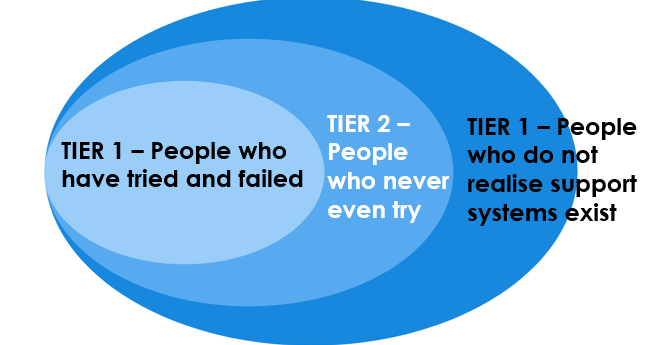
- Tiers of non-customers
1 - Those who attempted a process but quit due to confusion, errors or fear.
2 - Millions who avoid bureaucracy because they assume they cannot succeed.
3 - The most marginalised groups who do not know what they are entitled to.
GuideMe serves all three tiers.
Each proposed feature and why
Step-by-step Action Path Builder
Turns any process into small, manageable steps.
Improves completion rates and reduces fear.
- Plain-language translation
Removes jargon. Makes systems human.
Essential for low literacy users.
- Voice-based navigation
Allows people who cannot read to complete formal tasks.
Empowering for refugees, elderly people, and people with dyslexia.
- Icon-driven visual mode
Universally understood.
Accessible for all languages and literacy levels.
- Auto-filled forms
Reduces mistakes and speeds up applications.
Critical for benefits, visas and school enrolment.
- Safe explanations and warnings
Shows users how to avoid fraud, fines or documentation errors.
- Cultural and linguistic customisation
Adapts tone, examples and instructions to regional norms.
- Disability access features
Screen-reader optimised, simple layouts and high-contrast modes.
- Offline mode and SMS version
Vital for the 2.6 billion people with unstable or no internet.
- Local office finder and localised legal templates
Ensures accuracy and relevance for each jurisdiction. If scaled could be combined with governments to produce most accurate information.
- Innovation Over Current Methods
GuideMe outperforms all existing systems on every dimension that matters.
- Feasibility
GuideMe can be built realistically by:
Starting with a single domain such as housing support in one city
Creating verified templates using public data and NGO partnerships
Adding multimodal instructions and offline modules
Expanding to more regions and processes through a scalable framework
- Conclusion
In school I constantly hear the same sentence from my friends and classmates:
“When are we ever going to use this in real life? Why do they literally never teach us life stuff like taxes?”
The truth is that young people are not taught how to navigate the real world. We are not taught how to apply for healthcare, financial aid, visas, scholarships or housing support.
When my own family and immigrant community struggled with forms, application processes, the feeling was always the same: confusion, embarrassment and fear of “looking stupid”.
After some research, I realised billions of people experience the same thing and GuideME is something I want to create to make everyone feel confident and secure while accessing necessary resources.
Built With
- n/a


Log in or sign up for Devpost to join the conversation.