Inspiration AI is becoming increasingly powerful, but accessing and using that intelligence isn't always straightforward. This idea was influenced by a realization I explored in an article: not everyone has access to powerful CPUs or computing resources.
I wanted to explore a different approach, rather than expecting people to have the infrastructure to process large amounts of information themselves, what if they could simply ask questions and let an AI system help them navigate the knowledge they already have?
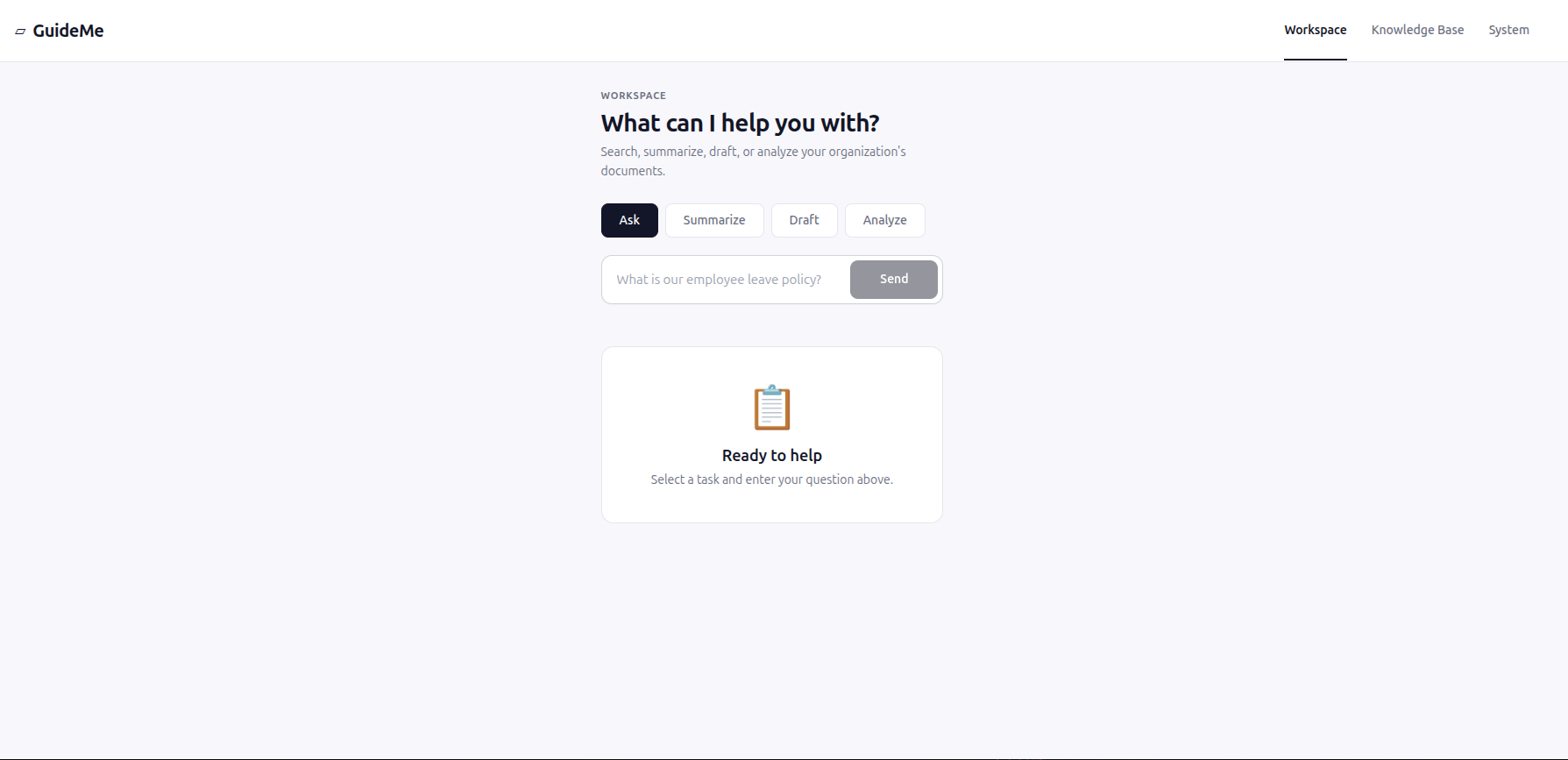
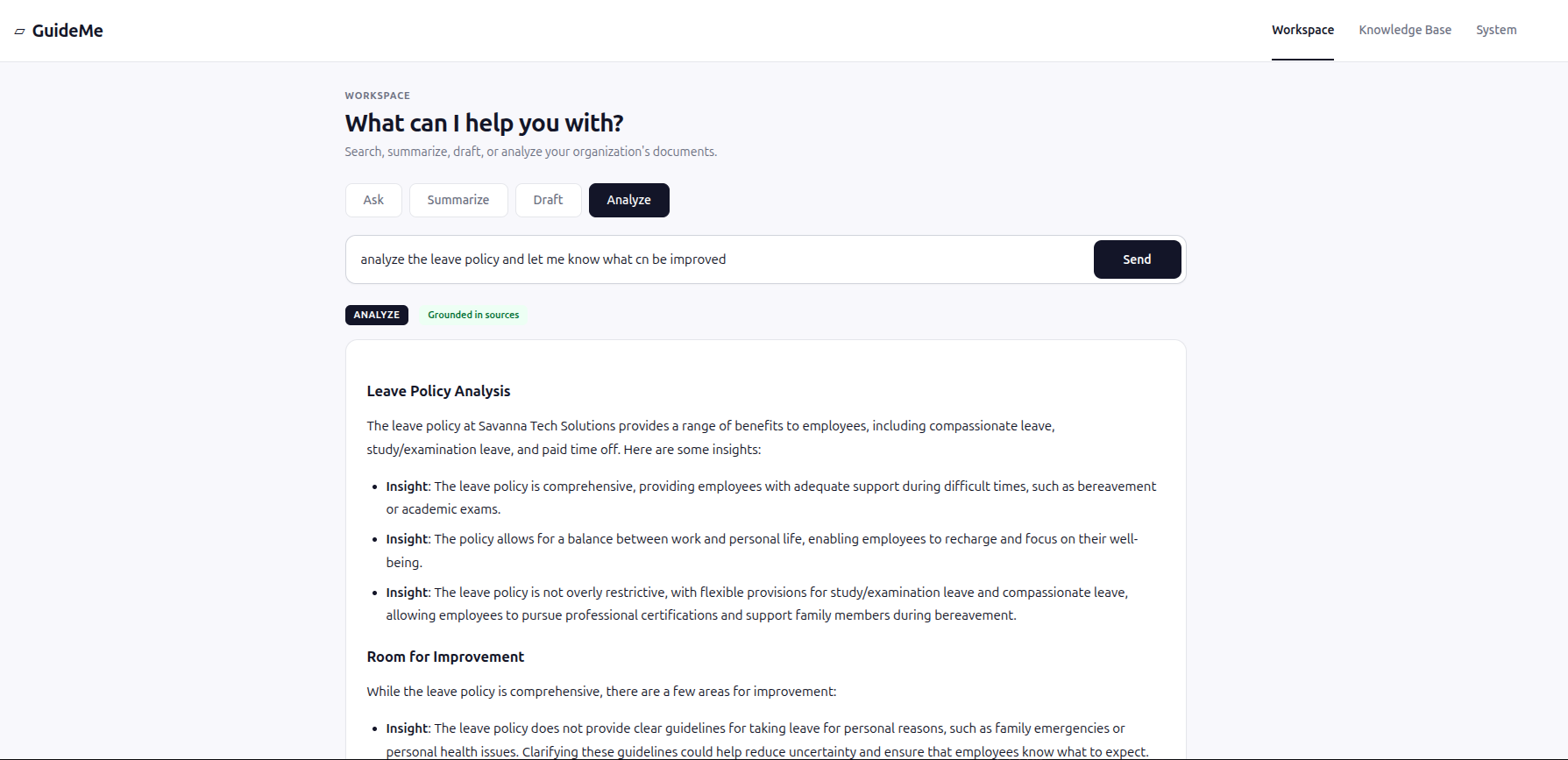
That idea became GuideMe. GuideMe is an AI-powered knowledge assistant that allows users to ask questions about an organization's documents and receive concise, relevant answers with references to the original sources.
Instead of manually searching through policies, manuals, reports, and other documents, users can simply ask GuideMe.
How we built it GuideMe uses a Retrieval-Augmented Generation (RAG) pipeline. I built the backend with FastAPI, processed and chunked uploaded documents, generated embeddings using BGE-M3, and stored them in a FAISS vector index for semantic search. When a user asks a question, GuideMe retrieves the most relevant document sections and passes that context to Google Gemini, which generates the final answer with references. The frontend was built with React and Vite.
Challenges I ran into One of our biggest challenges was building a useful AI system without relying on expensive infrastructure.
I also encountered challenges around embedding generation, vector indexing, model selection, API limits, and ensuring that generated answers were actually grounded in the organization's documents rather than hallucinated.
Getting all these components from document ingestion to retrieval and generation to work reliably as one pipeline was another major challenge.
Accomplishments that I am proud of: I am proud to have built a working end-to-end AI knowledge system that can turn unstructured organizational documents into an interactive knowledge base.
More importantly, GuideMe doesn't just generate answers it connects those answers back to the source material, making the information easier to verify and trust.
What I learned I learned that building an AI application isn't simply about connecting an LLM to a prompt.
The quality of the final answer depends heavily on everything that happens before the LLM from document processing and chunking to embeddings, retrieval, context selection, and error handling.
I also learned that building practical AI systems often means working within real-world constraints rather than assuming unlimited compute, perfect data, or unlimited APIs.
What's next for GuideMe Next, I want to make GuideMe more scalable and reliable, support more document formats, improve retrieval accuracy, and introduce features such as user-specific knowledge bases, better source citations, feedback loops, and analytics.
Built With
- faiss(faiss-cpu)
- fastapi
- llama-3.2-3b
- react-19
- sentence-transfomers
- uvicorn
- vite

Log in or sign up for Devpost to join the conversation.