Inspiration
Planning a trip often means switching between multiple platforms to research destinations, organize an itinerary, find local guides, and manage bookings. This can make travel planning time-consuming and confusing.
GuideGo was inspired by the idea of bringing these activities together in one place. We wanted to explore how AI could make travel planning more personalized while PayPal could support a convenient and secure payment experience.
What it does
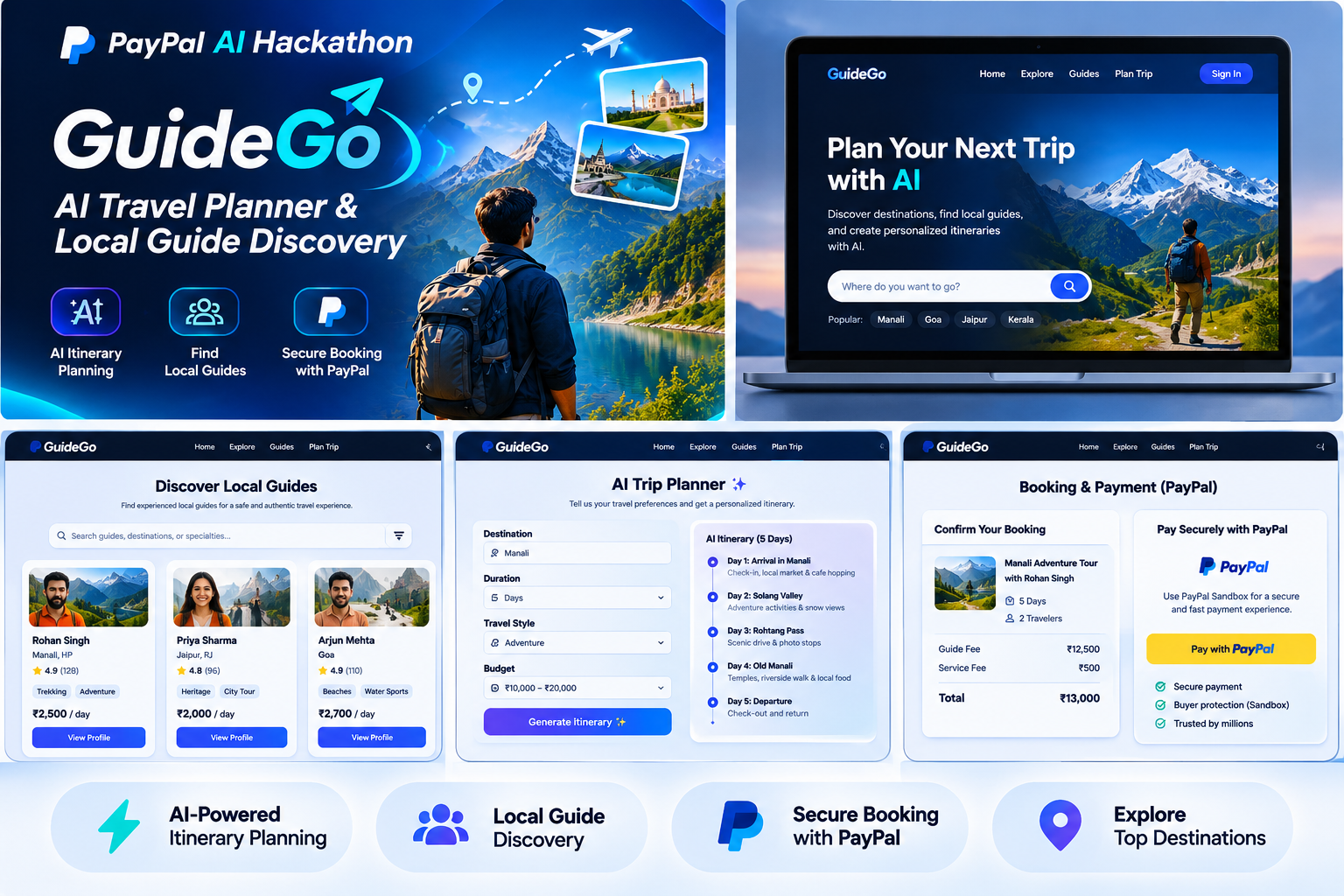
GuideGo is an AI-powered travel planning and local guide discovery project designed to help travelers organize trips more easily.
The project focuses on:
- Local Guide Discovery: Browse fictional demo guide profiles by destination, specialty, and search query.
- Destination Insights: Explore available destinations and guide catalog statistics.
- Personalized Travel Planning: Planned AI assistance for generating itineraries based on travel preferences, interests, trip duration, and budget.
- Booking Management: Backend booking records with server-side price calculation and idempotency support.
- PayPal Sandbox Integration: Development of a payment workflow using PayPal's Sandbox environment to explore order creation, authorization, and capture.
GuideGo is currently a development prototype. Guide profiles are fictional demo data, and the complete AI planning and payment lifecycle still require implementation and testing.
How we built it
We are building GuideGo with a modern web technology stack:
- Frontend: React, TypeScript, and Vite for the user interface.
- Backend: Python and FastAPI for API endpoints and application logic.
- Database: SQLite for guide data and booking records.
- Validation: Pydantic for validating API request data.
- Payments: PayPal Sandbox for developing and testing the checkout workflow.
- Version Control: Git and GitHub for source code management.
The backend includes guide catalog endpoints, destination summaries, database initialization, booking-related database functions, and a protected PayPal connectivity check.
Our next implementation priority is connecting the frontend to the booking API and completing the payment lifecycle, including buyer approval, authorization, guide confirmation, and capture.
Challenges we ran into
One of our main challenges was developing the project within limited development resources while maintaining a clear and secure architecture.
Some of the challenges included:
- Designing a backend structure that separates guide discovery, booking records, and payment operations.
- Ensuring booking prices are calculated by the backend rather than trusted from client input.
- Handling repeated booking requests through idempotency.
- Protecting PayPal credentials using environment variables instead of exposing them in frontend code.
- Working around development environment and usage limitations while preserving project progress.
- Distinguishing a successfully created payment order from a payment that has actually been authorized and captured.
These challenges helped us recognize that a trustworthy travel-booking experience requires more than an attractive interface: it also needs reliable backend logic and careful payment-state handling.
Accomplishments that we're proud of
We are proud to have established the foundation of GuideGo as a full-stack travel application.
Our progress includes:
- Building a guide discovery interface with destination and specialty filters.
- Creating fictional demo guide data and destination summary endpoints.
- Setting up a FastAPI backend with SQLite database initialization.
- Implementing booking-related database operations and server-side price calculation.
- Adding a protected PayPal Sandbox connectivity endpoint with authorization and rate limiting.
- Creating a public GitHub repository to organize and share the project.
These achievements provide a foundation for completing the end-to-end travel planning and payment experience.
What we learned
Building GuideGo has helped us understand how frontend interfaces, backend APIs, databases, and payment providers fit together in a full-stack application.
We learned the importance of:
- Validating data at the backend.
- Designing reliable database state transitions.
- Using idempotency to reduce duplicate booking operations.
- Keeping payment credentials private.
- Treating payment authorization and capture as separate steps.
- Testing integrations carefully rather than assuming that a successful health check means the complete workflow works.
We also learned to prioritize a small, reliable end-to-end flow over adding many features before the core experience is ready.
What's next for GuideGo — AI Travel Planner & Local Guide Discovery
Our next goal is to turn the current prototype into a working end-to-end demo.
Planned improvements include:
- Implementing AI-generated itineraries based on budget, duration, interests, and destination.
- Improving guide recommendations based on traveler preferences.
- Connecting the guide catalog to the booking interface.
- Completing PayPal Sandbox order approval and payment authorization.
- Adding protected guide confirmation and payment capture.
- Handling cancellation, failed payments, and appropriate refund workflows.
- Expanding automated tests and deploying a publicly accessible demo.
Our long-term vision is to make GuideGo a single place where travelers can plan personalized trips, discover local experiences, and manage bookings through a clear and trustworthy workflow.
Built With
- artificial-intelligence
- css
- fastapi
- generative-ai
- github
- html
- javascript
- paypal
- paypal-sandbox
- python
- react
- rest-api
- sqlite
- typescript
- vite

Log in or sign up for Devpost to join the conversation.