Inspiration
Today's vision accessibility apps live entirely on a glass touchscreen. To use them, a blind or low-vision user has to hold a phone in one hand, awkwardly aim the camera at hazards, and tap tiny buttons with their fingers — taking away the hand they need for their white cane or guide dog. Worse, traditional apps forget everything the moment they are closed.
We asked: What if an assistive AI could see, remember, and act for you — completely hands-free?
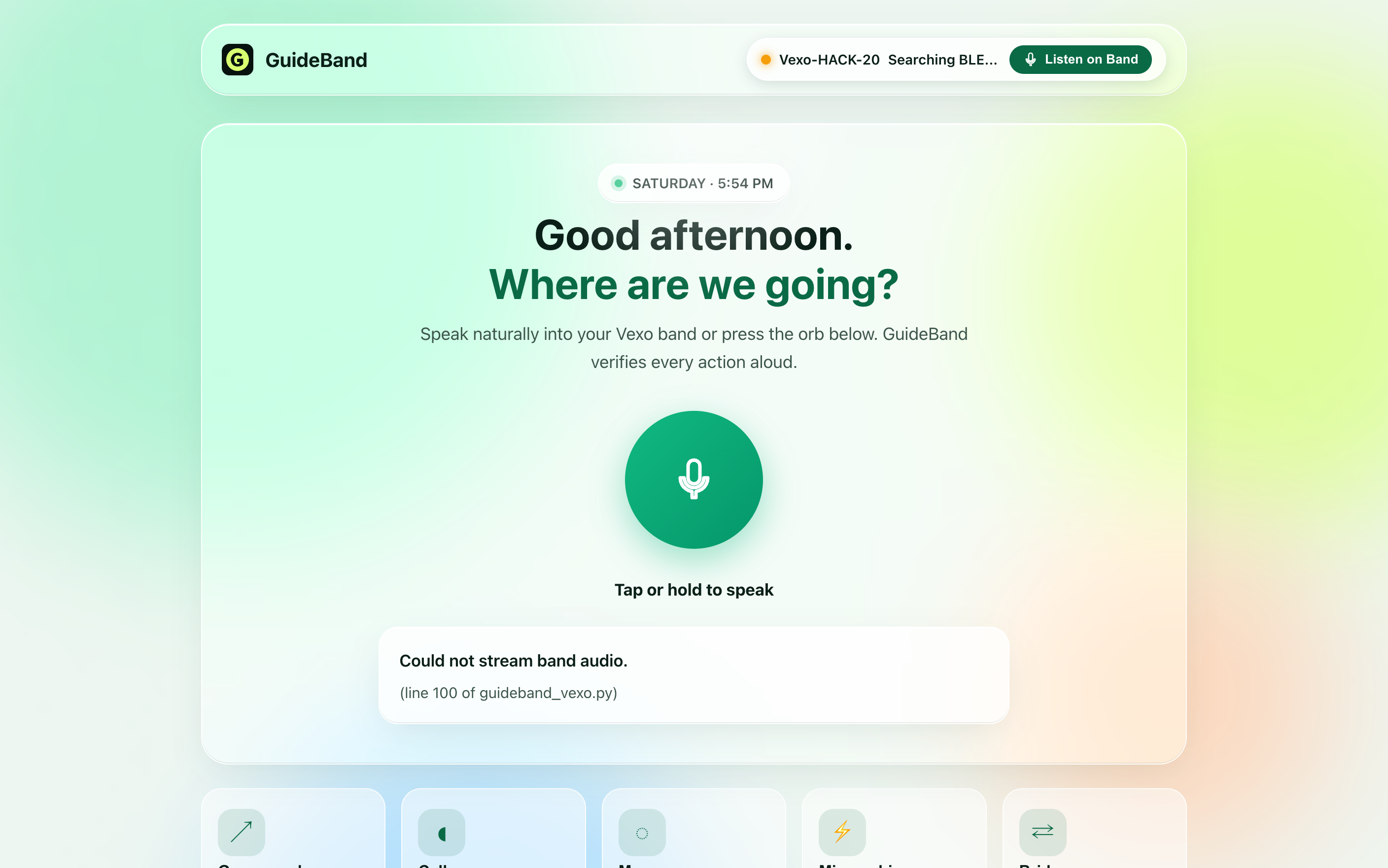
A Vexo smart wristband on your wrist becomes your natural voice interface. A chest-clipped phone or laptop webcam becomes your eyes. No aiming, no tapping screens, and no unconfirmed actions — just speak into your wrist, and GuideBand handles the rest.
What It Does
GuideBand is an all-in-one hands-free companion built around four core pillars:
- See (Real-Time Hazard Warnings): On-device neural vision detects obstacles in your walking path ("Chair ahead, left", "Stairs ahead"). Warnings are announced instantly into your ears without blocking your cane.
- Remember (Long-Term Visual Memory): GuideBand continuously maps what it sees into a private temporal memory. Later, you can simply ask: "Where did I leave my keys?" and hear: "I saw your keys on the kitchen counter next to the kettle, 15 minutes ago."
- Act (Confirmed Real-World Actions): Want to buy a coffee or alert family? Say "Buy me a cappuccino" or "Tell Mom where I am". GuideBand verifies the item, price, or text aloud and executes only after a clear spoken "Yes". Nothing is paid without your explicit confirmation.
- Bridge (Deaf-Blind Communication): Translates sign language from video into spoken English, and translates spoken replies into large, high-contrast captions on screen.
- Micro-Whisper Tactile Audio: Directional audio pacing cues ("Left", "Forward", "Right", "Stop!") providing spatial orientation feedback.
How We Built It
We engineered GuideBand with a hybrid edge + cloud architecture for maximum speed, privacy, and safety:
- Hardware & Wearable Bridge: Connects directly to the Vexo Open Band over Bluetooth Low Energy (BLE GATT) using the official
vexo-open-kitand Bleak on macOS/Linux. It captures raw 20ms Opus audio frames from the wristband's microphone. - Voice Intelligence (Deepgram Nova-3 & Aura): Streams real-time Opus packets over WebSockets directly to Deepgram Nova-3 for ultra-low latency multilingual transcription. Replies are synthesized using Deepgram Aura neural TTS.
- Multimodal AI Reasoning (Google Gemini 2.5 Flash): Processes visual frames, spatial relationships, text OCR, and complex scene queries in milliseconds.
- Local Edge Detection (YOLO11n): Zero-latency on-device hazard detection that alerts users even without an internet connection.
- Core Platform: High-performance asynchronous backend in FastAPI / Python, packaged into a native macOS desktop companion (
GuideBand.app) with Electron and liquid-glass glassmorphism design.
Challenges We Ran Into
- Low-Latency BLE Audio Streaming: The Vexo Open Band streams raw Opus packets over custom BLE characteristics. We had to ensure WebSocket streaming to Deepgram ran concurrently without dropping 20ms audio frames or blocking the event loop.
- Safety First / Zero Hallucination: An assistant for low-vision users cannot guess or hallucinate safety-critical details. We implemented deterministic regex and safety gates so payment orders and messages are never executed without an audible confirmation loop.
- Hardware Realities: Discovering that the Vexo Open band hardware does not contain an internal vibration motor led us to design Micro-Whisper — directional acoustic and host-level haptic cues that substitute seamlessly for physical haptics.
Accomplishments That We're Proud Of
- Built an end-to-end working pipeline: Wristband BLE → Deepgram Nova-3 → Gemini 2.5 Flash Vision → Deepgram Aura Voice in under 600ms latency.
- Created a fully responsive, liquid-glass accessible UI that works both as a native macOS app and a web progressive app.
- Passed 67 automated unit and integration tests covering safety, navigation breadcrumbs, and payments.
What We Learned
Building for accessibility requires radical empathy. Every millisecond of latency and every auditory prompt matters. Voice-first wearables unlock true freedom of movement for low-vision users when paired with on-device intelligence.
What's Next for GuideBand
- Porting the chest-camera client to a native iOS / Android app for outdoor navigation.
- Offline quantized vision models running directly on Apple Silicon / mobile NPUs.
- Integration with public transit APIs (bus arrivals and subway turnstile guidance).
Built With
- accessibility
- bluetooth
- computer-vision
- deepgram
- electron
- fastapi
- gemini-flash
- javascript
- macos
- multimodal-ai
- python
- speech-to-text
- stripe
- text-to-speech
- vexo
- wearable-tech
- yolo

