-
gugut security ide
Inspiration
Every security professional knows the pain of running a scanner and getting overwhelmed by thousands of lines of raw, noisy logs filled with false positives. The inspiration for Gugut Security Studio came from realizing that security testing shouldn't just be an isolated chore—it needs a modern, intelligent ecosystem. I wanted to build an AI-Native security environment that doesn't just blindly flag potential issues, but actually understands the code context, filters out the noise, and provides actionable remediation steps in real-time. What it does
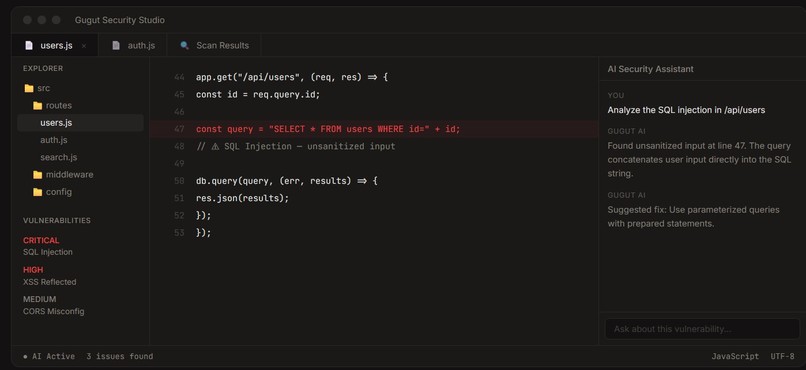
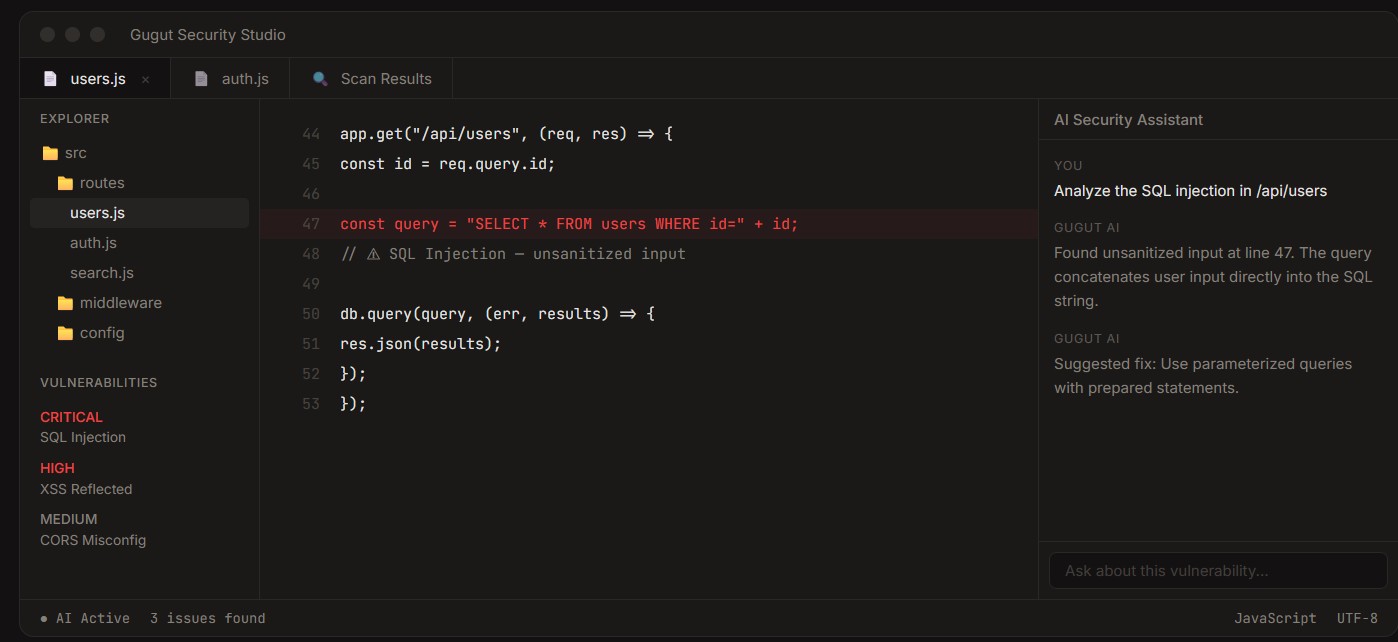
Gugut Security Studio is a comprehensive security suite tailored specifically for cybersecurity professionals and DevSecOps teams. Users can connect their codebases directly into our browser-based Gugut IDE or integrate our tools directly into their local workflows using the Gugut CLI. Under the hood, the platform orchestrates comprehensive vulnerability scans (like SAST) in isolated environments. The core magic is driven by the Gugut Bot Agent: instead of providing generic responses, this intelligent autonomous agent uses a specialized reasoning model to analyze the scan outputs, highlight true exploitable paths directly in the code editor, and generate professional, compliance-ready reports for stakeholders. How I built it
The architecture is strictly decoupled to handle the heavy computational demands. The frontend Gugut IDE is built with Next.js and integrates the Monaco Editor for a seamless, ultra-responsive browser experience. The main landing page and frontend ecosystem are deployed securely on Vercel (gugut.cloud). For backend orchestration, multi-tenant management, and routing requests from both the IDE and the Gugut CLI, I utilized Laravel. Laravel's robust queue system (backed by Redis) is crucial for dispatching heavy scanning jobs efficiently. The Gugut Bot Agent itself is powered by a custom 4B parameter reasoning model, which I fine-tuned using LoRA (Low-Rank Adaptation) configurations specifically on CVE databases and exploit code. Challenges I ran into
Bridging a fluid, state-heavy web interface with intensive backend security scanners was a significant architectural hurdle. I had to ensure that long-running vulnerability scans triggered via the CLI or IDE didn't cause connection timeouts, requiring a carefully designed asynchronous queue system. On the AI side, the biggest challenge was in the training phase. While training the 4B parameter reasoning model for the bot agent on T4 GPUs, I spent a massive amount of time overcoming overfitting and fine-tuning the parameters to successfully reduce the training loss while maintaining high accuracy on cybersecurity-specific reasoning tasks. Accomplishments that I'm proud of
I am incredibly proud of successfully building and orchestrating a cohesive, multi-faceted product ecosystem—seamlessly connecting the main web platform (gugut.cloud), the interactive Gugut IDE, the developer-friendly Gugut CLI, and the autonomous Gugut Bot Agent. Merging a responsive React frontend, a stable PHP/Laravel orchestrator, and an isolated GPU-accelerated AI microservice into one synchronized platform is a massive technical win. Above all, watching the custom bot agent accurately interpret a noisy vulnerability log and suggest a precise, correct code patch for the first time was a deeply rewarding moment.
Built With
- admin-dashboard
- and
- and-api-edge-functions)
- computing
- custom-4b-parameter-reasoning-models-specialized-in-cybersecurity
- docker-(for-containerized
- for
- github/gitlab-apis-(for-codebase-integrations)
- gpu-accelerated
- gpus
- internal-restful-apis-ai-&-other-technologies:-lora-(low-rank-adaptation)-for-fine-tuning-open-source-models
- isolated-security-scan-environments)-databases:-postgresql-/-mysql-(relational-data)
- javascript
- languages:-typescript
- laravel
- model
- php
- python-frameworks-&-libraries:-next.js
- pytorch-platforms-&-cloud-services:-vercel-(currently-hosting-the-frontend-ide
- react
- redis-(for-intensive-job-queues-and-caching)-apis-&-integrations:-monaco-editor-api-(powering-the-in-browser-ide)
- t4
- training
- utilizing


Log in or sign up for Devpost to join the conversation.