🩺 Guess The Disease – Learn Medicine, Play Doctor.
Inspiration
Access to basic medical knowledge is still limited, especially in rural or underserved regions where healthcare education is not easily available. At the same time, most people don’t truly understand how complex and uncertain the diagnostic process can be for doctors.
We wanted to build something that is both educational and empathetic — a tool that allows anyone to learn how diagnosis works through play, while also appreciating the reasoning process doctors go through every day. Our idea was simple: turn medical reasoning into an interactive AI game.
What it does
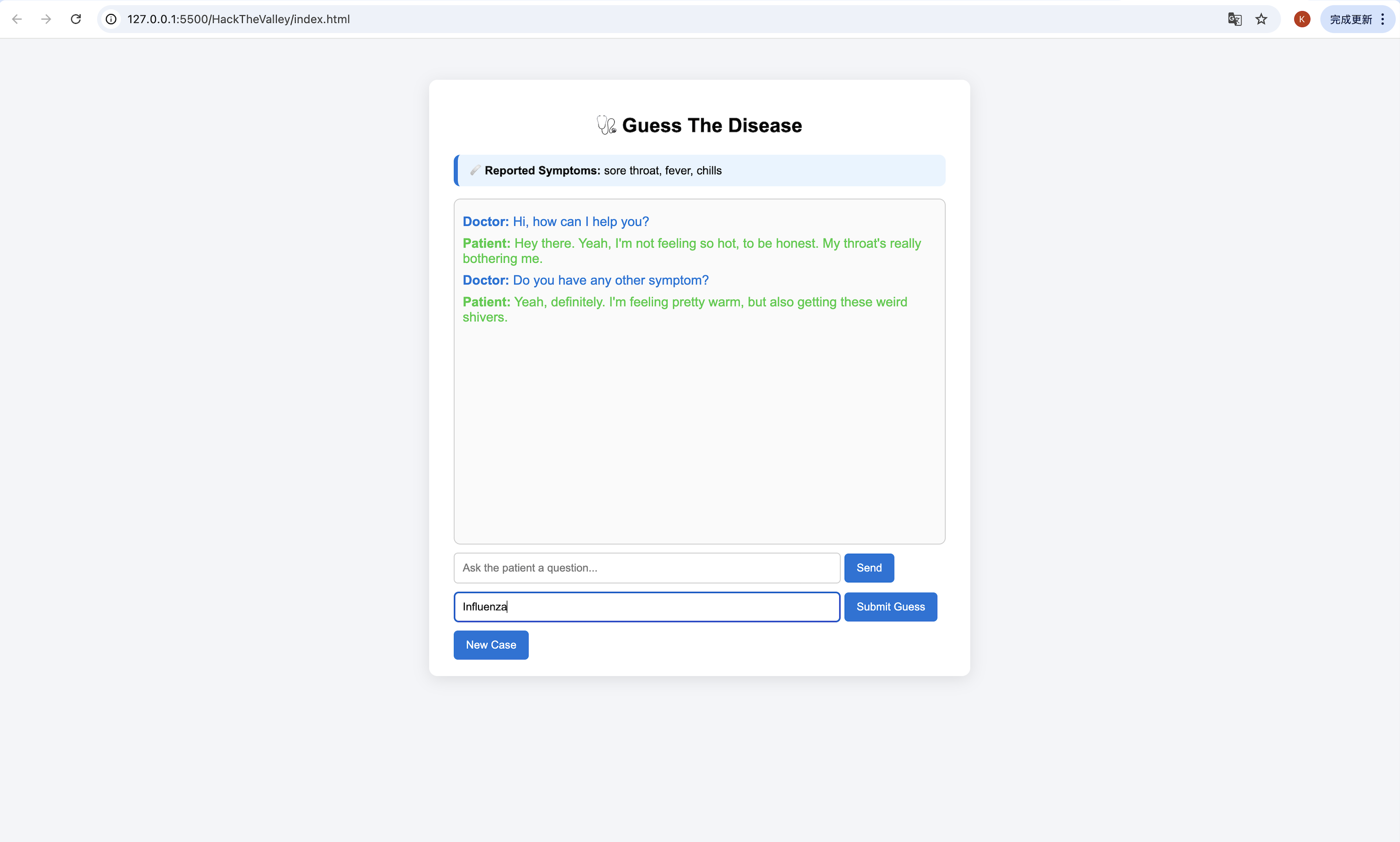
Guess The Disease is an AI-powered web simulation where players step into the shoes of a doctor. A virtual patient, powered by Gemini AI, describes their symptoms naturally and conversationally — just like in a real consultation. Players ask questions, interpret the clues, and make a diagnosis.
Each game round:
Starts with a limited set of initial symptoms.
As the player interacts, new symptoms are revealed dynamically.
When the player thinks they’ve identified the illness, they can submit a guess.
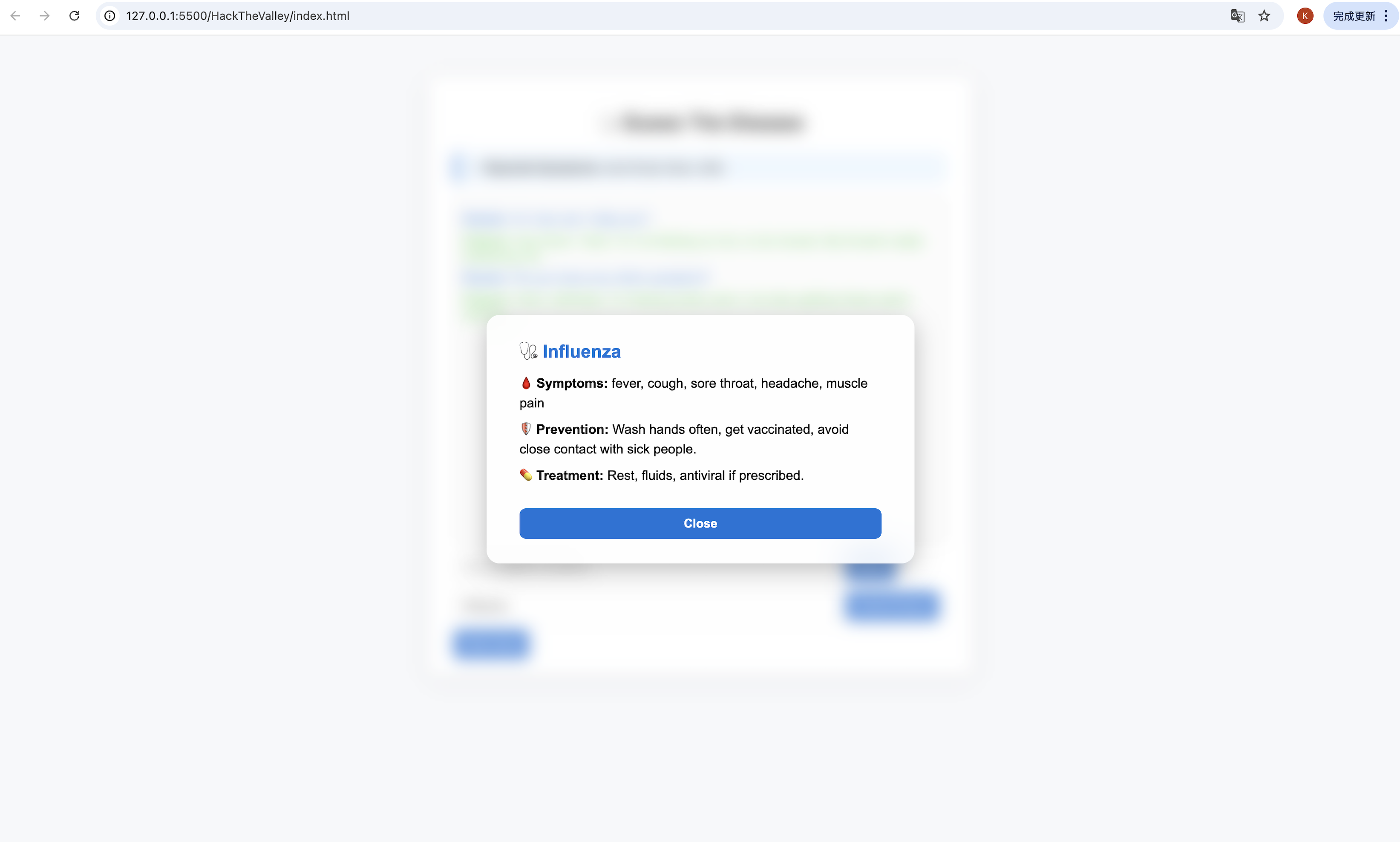
If correct, the system presents the official disease name, verified symptoms, and trusted prevention/treatment information from NHS Inform and other public medical education sources.
Through gameplay, users subconsciously learn about pattern recognition, differential diagnosis, and health literacy — all in an engaging, low-pressure environment.
How we built it
Frontend: Vanilla HTML, CSS, and JavaScript for simplicity and accessibility.
Dynamic chat interface
Animated glassmorphism-style diagnosis card with blur background
Real-time symptom updates per AI response
Backend: Python (Flask) server
Integrated with the Gemini 2.5 API for natural conversational generation
Custom prompt logic to control patient behavior (progressive symptom reveal, distractor symptoms, natural speech patterning)
Data Source:
Symptom lists for common conditions such as Influenza, Gastritis, Migraine, Diabetes, and Asthma were cross-referenced with NHS Inform and verified medical education pages.
We intentionally simplified or paraphrased medical language for public understanding.
To ensure the model didn’t “invent” unsafe medical advice, our system never lets AI generate treatment instructions directly. Instead, prevention and treatment recommendations are predefined from reliable sources and only displayed after a correct diagnosis.
Challenges we ran into
AI reliability: Large language models can hallucinate or overstate medical certainty. We mitigated this by strictly constraining the model’s prompt, preventing it from offering any real-world medical advice.
Ethical balance: We had to clarify that this is an educational tool, not a clinical assistant.
Prompt engineering: Designing the patient to sound human while revealing symptoms progressively required multiple prompt iterations.
Data trustworthiness: Cross-checking symptoms with NHS Inform datasets and verifying that descriptions were both accurate and understandable for non-medical users.
Accomplishments that we’re proud of
Built a fully functional AI doctor-patient simulator within one hackathon weekend.
Created a framework that blends medical education with empathy and gamification.
Designed a user interface that feels playful yet realistic — complete with glass-style animation and blurred modal overlays.
Achieved responsible AI alignment by combining creative reasoning with verified, human-curated medical content.
What we learned
How to balance creativity and responsibility when working with healthcare-related AI projects.
The importance of prompt discipline — even small wording changes dramatically alter AI behavior.
Learned that gamified learning can genuinely improve engagement in topics like health literacy.
Practiced multi-role thinking: designing as both software engineers and health communicators.
What’s next for Guess The Disease
Our next step is to evolve Guess The Disease into a mobile-first educational platform for schools and public health programs. We plan to:
Add regional disease modules (e.g., malaria, dengue, heatstroke) to support health education in developing regions.
Introduce multiplayer / classroom mode, where students can compete to diagnose cases faster.
Collaborate with medical educators or NGOs to tailor verified content for different populations.
Integrate voice-based interaction for accessibility in low-literacy communities.
Ultimately, we aim to make healthcare knowledge accessible, engaging, and empowering — teaching the logic behind medicine, not just the outcomes.## Inspiration


Log in or sign up for Devpost to join the conversation.