Inspiration
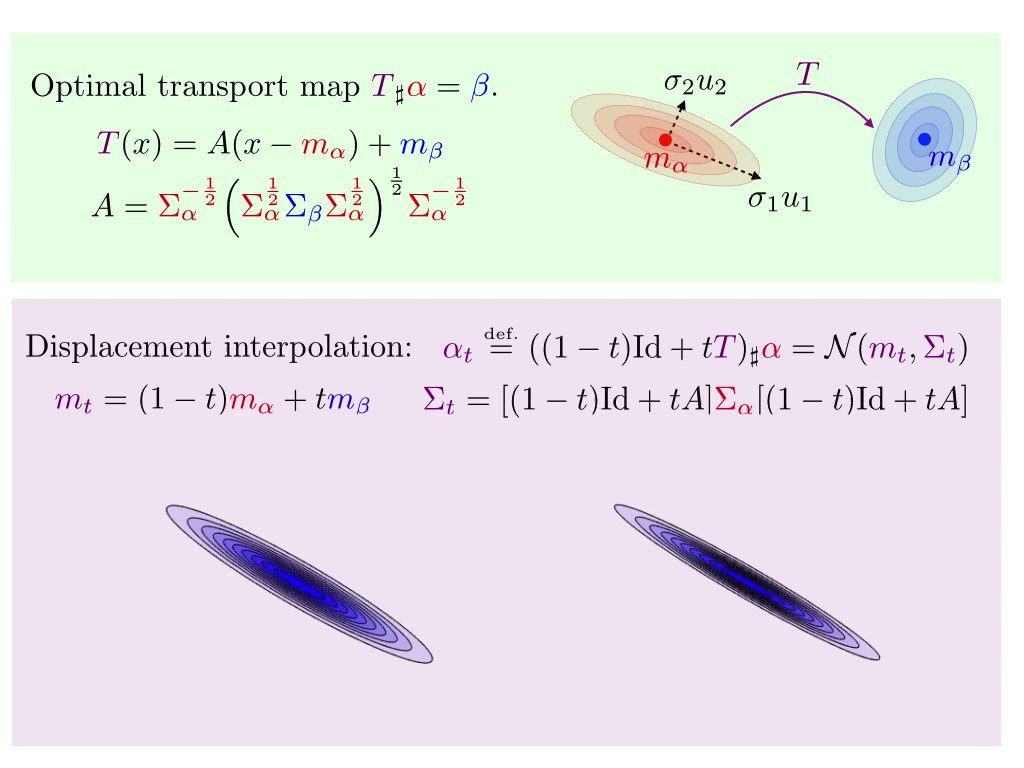
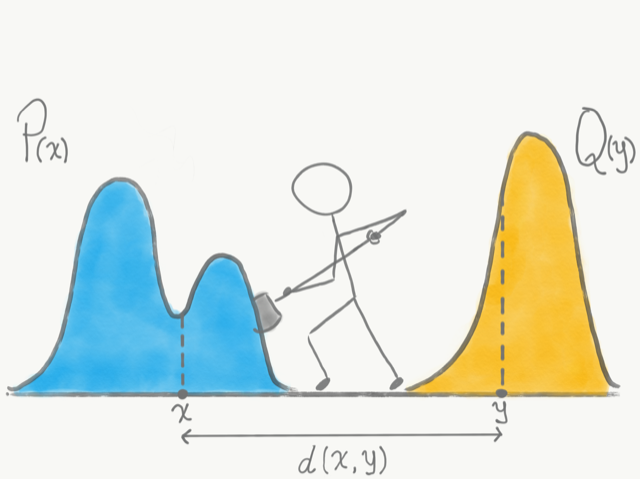
This project is inspired by the mathematical problem of Optimal Transport (OT), which seeks a mapping between two distributions that minimizes a specified transport cost.
Think about this question: "If I have a pile of stuff in one shape, and I want to rearrange it into another shape, what is the cheapest way to move it?"
And if you have ever heard of this website: https://obamify.com/, it shares a similar concept but instead, this program is 3D.
What it does
This is an experimental graphic project that mainly serves the purpose of applying the math concept of Optimal Transport into an actual computer animation pipeline.
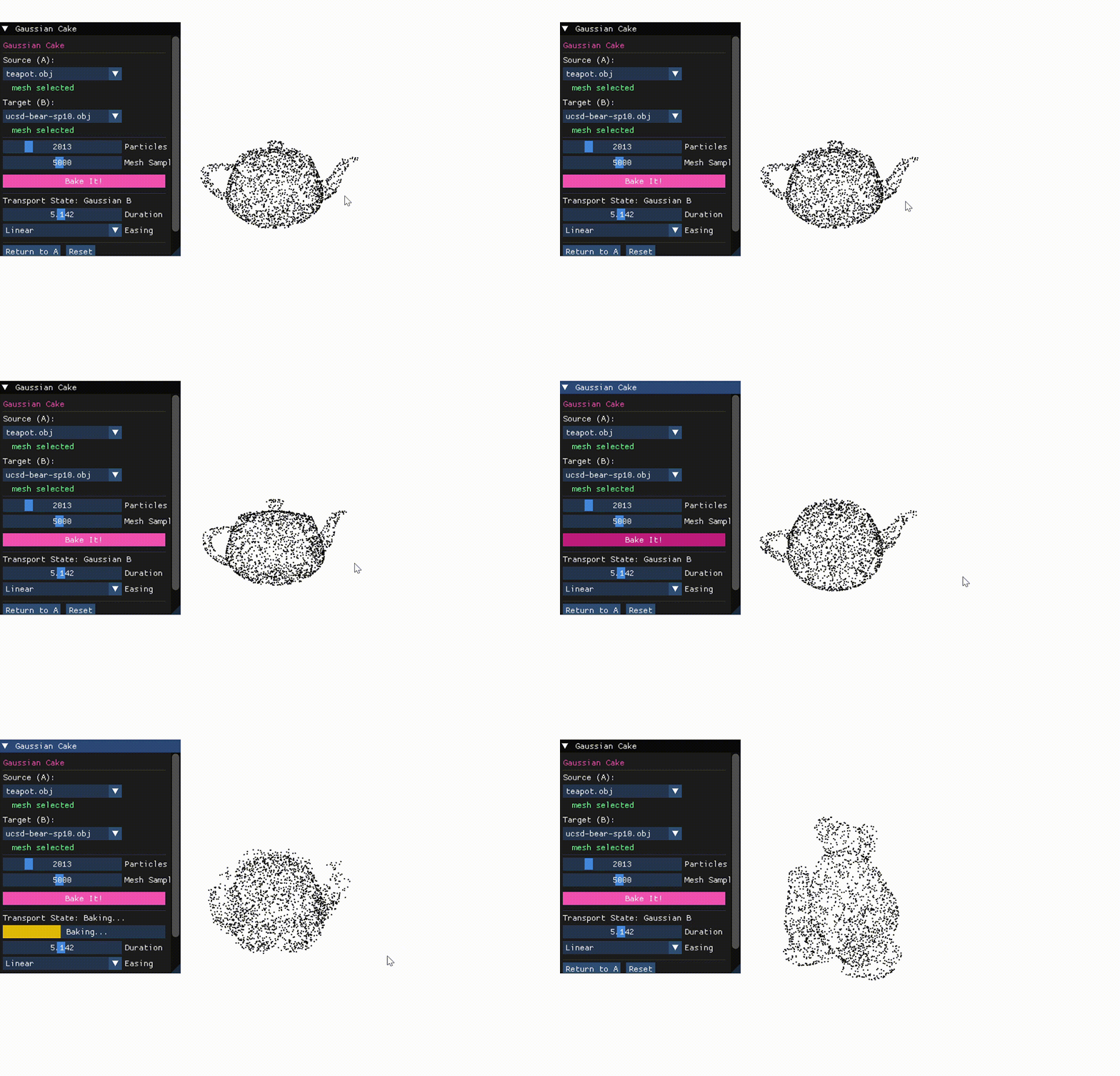
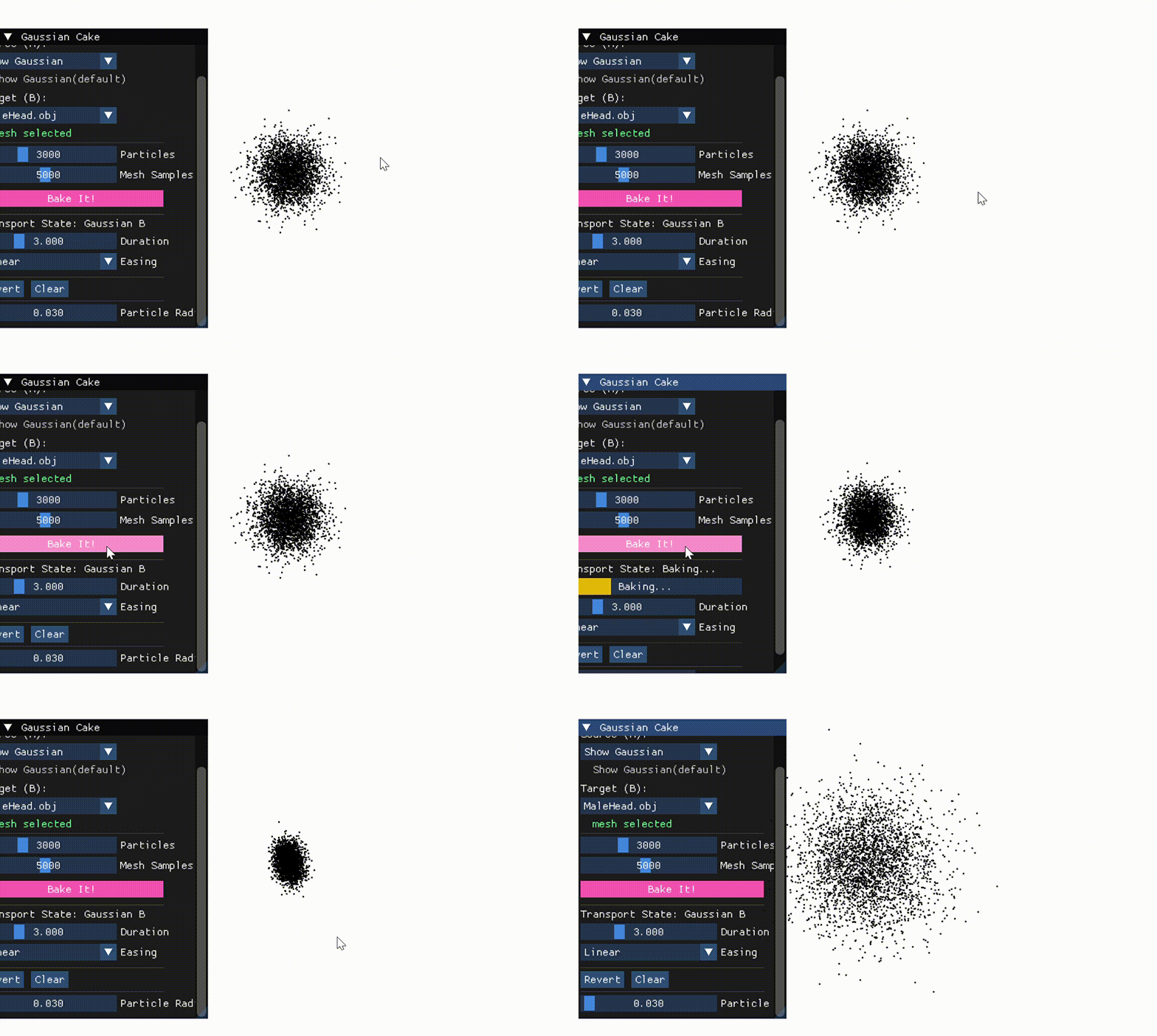
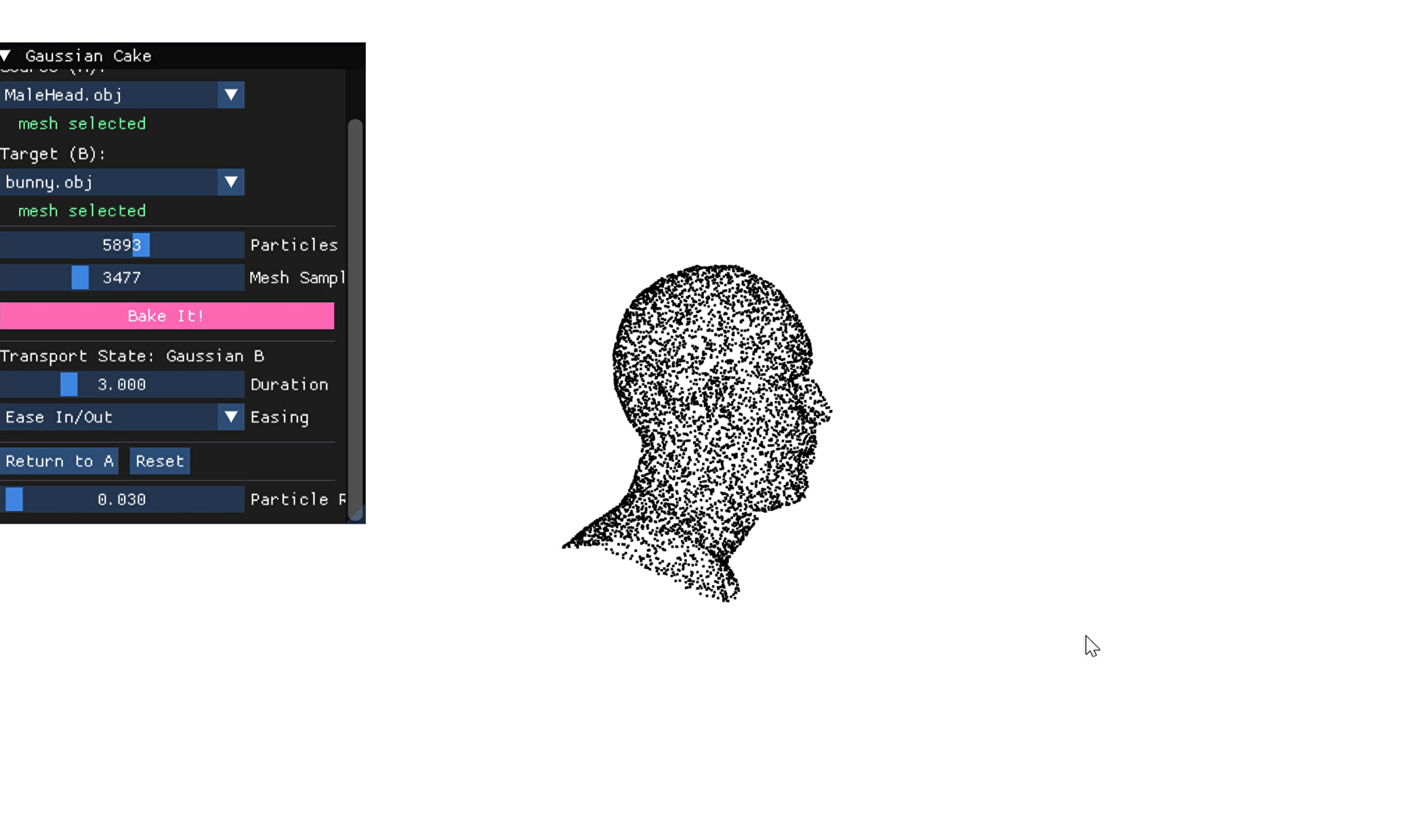
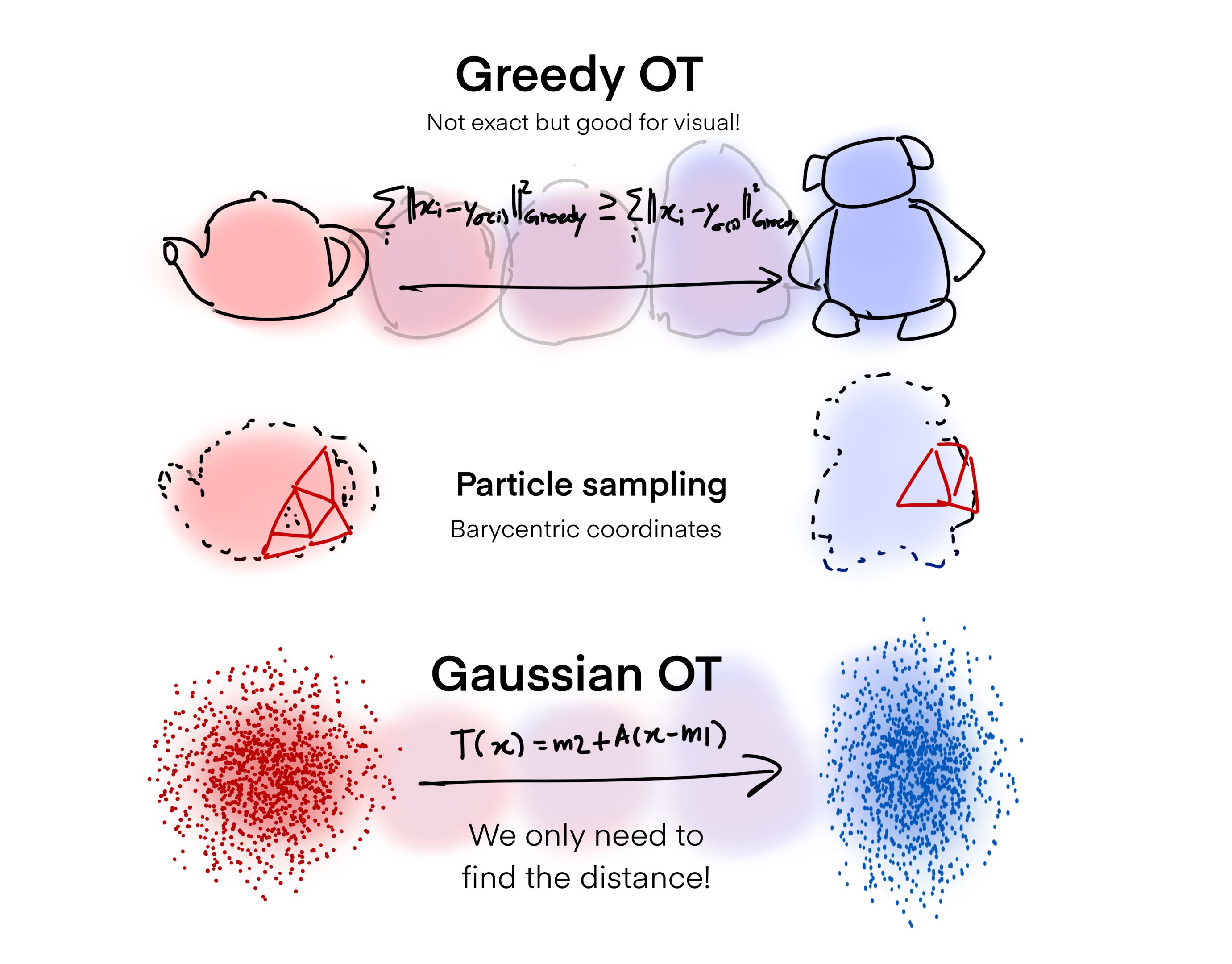
A low-level C++ OpenGL program that takes in any .obj imported models : A and B. Once you click "Bake It!", the program shows a smooth animation of the model morphing from A to B, or a morph of a distribution sampling from A to B. This is a particle system animation project that showcases the concept of optimal transport in two ways: GreedyDiscreteOT for the mesh and Gaussian OT for the distribution.
The Greedy discrete optimal transport is a simple approximation that allows the model to go from A to B.
The Gaussian optimal transport samples the mean and variance from the model, which is the particle-shaped blob that moves into another set of particle-shaped blobs.
Since the main concept has this connection with the Gaussian distribution, the morphing process is similar to "baking", the callbacks to the idea of a Gaussian cake.
How I built it
I only use raw code C++ and libraries(basic OpenGL, imgui UI, linear algebra libraries) for this project. I first initialized a shader, a window, and a basic mesh import. Then I proceeded to work on the particle system, which allows later stages of implementation for the Gaussian sampling and applying optimal transport. Then I expand it to greedy optimal transport for the actual animation of model morphing.
More about the Math:
The Gaussian optimal transport samples the mean and variance from the model, which yields better runtime and exact geometry morphing with cheap computation power: It's only linear algebra!
\(T(x)=m2+A(x−m1)\)
where m1 and m2 are the Gaussian means, and A encodes the covariance-based linear transformation.
However, the Greedy OT offers a simpler approach, looks better in animation, but it loses accuracy:
\(\sum_{i} | x_i - y_{\sigma(i)} |^2_{\text{Greedy}}\)
This mapping can then be directly used to generate smooth mesh-to-mesh morphing animations. And therefore, this transformation could be simulated with computer animation, which could be expanded to mesh-to-mesh morphing animations.
More insight about OT in general: https://alexhwilliams.info/itsneuronalblog/2020/10/09/optimal-transport/
Challenges I ran into
Debugging in C++ is painful. I had no clue why my program was not building at all-- turns out it has something to do with CMakeList.txt
Accomplishments that I'm proud of
It actually worked.
What I learned
- Different methods of Optimal Transport.
- A more solid understanding of Barycentric coordinates: how the particles are from a mesh through a triangle mesh.
- Constructing the 3D Gaussian formula using glm and eigen. (C++ libraries)
- The animation pipeline, using the OT method, is applied to the particle system.
What's next for Gaussian Cake
This is an experimental project that provides insight into 3D model morphing, and I can definitely incorporate the concept into larger game projects or animation programs.
The point of this project is to show how theoretical concepts can be applied in diverse settings and how practical applications can help visualize and understand these concepts.
Built With
- c++
- eigen
- imgui
- opengl
- visual-studio

Log in or sign up for Devpost to join the conversation.