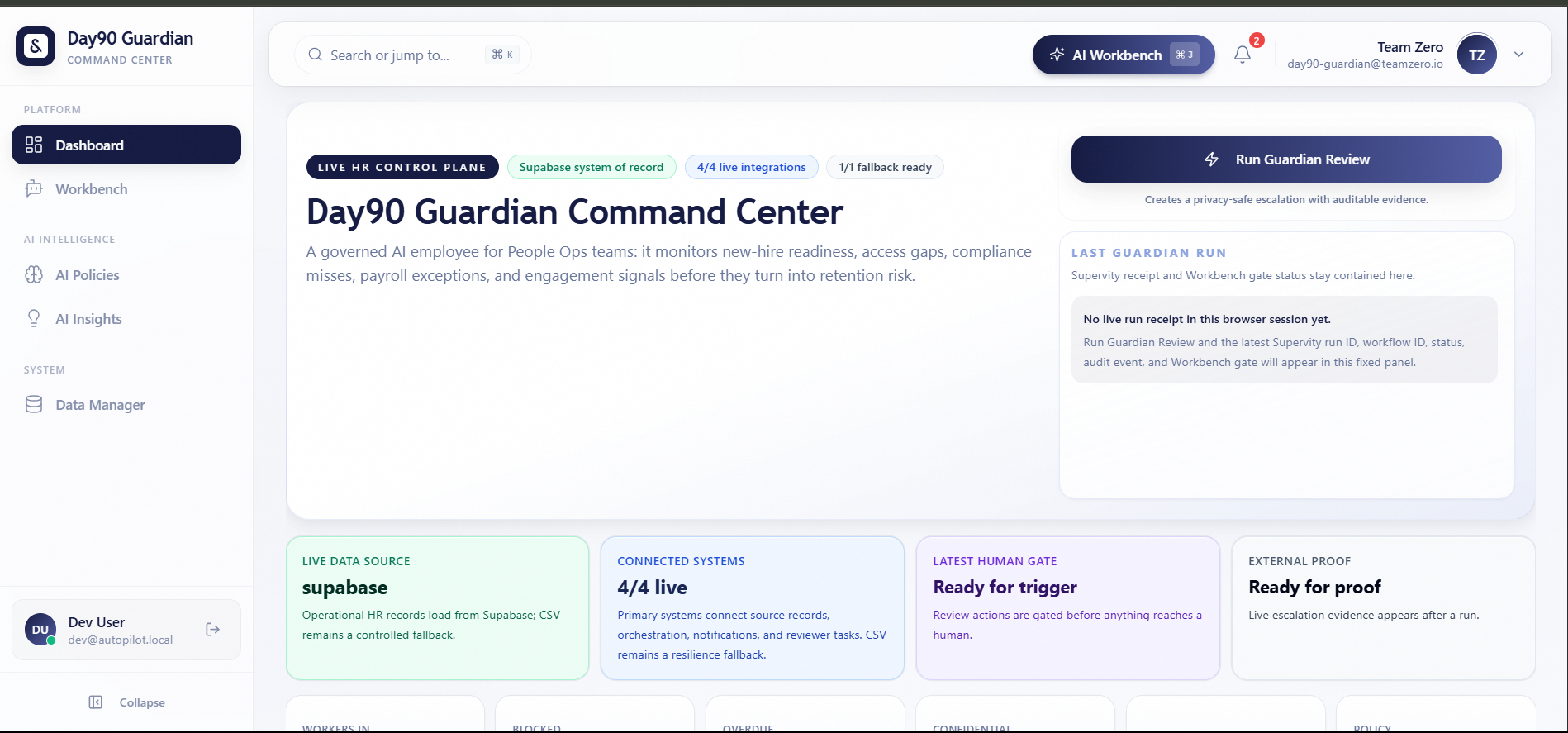
Demo Access
- Live App: https://day90-guardian-command-center-ui.vercel.app/
- Access Password:
Team_Zero
Inspiration
Modern workplace operations produce massive telemetry across project boards, communication tools, and delivery pipelines. Despite having more data than ever, leaders still face operational bottlenecks, sudden burnout, and misaligned deliverables until after deadlines slip. Simple alerts and chatbots fail because they lack context and agency. We built GuardianOS to move beyond reactive notifications—introducing an intelligent, proactive AI employee that monitors team velocity and operational health, spots blind spots, and drafts calibrated interventions with strict human oversight.
What it does
GuardianOS operates as an automated organizational command center powered by specialized AI agents:
- Continuous Operational Pulse: Ingests and evaluates real-time task streams, code commits, delivery pipelines, and ticket throughput to quantify workload distribution.
- Risk & Bottleneck Detection: Discovers invisible risks—such as delivery bottlenecks, unbalanced review burdens, and emerging burnout risk—before they derail sprints.
- Autonomous Action Proposals: Rather than creating passive alerts, it formulates concrete, context-aware action plans (e.g., auto-reassigning unblocking tasks, flagging stalled pull requests, restructuring deliverables).
- Human-in-the-Loop Safeguards: Every intervention is staged inside an intuitive Command Center dashboard requiring manager review and approval before execution, ensuring safe and controllable automation.
How we built it
- Multi-Agent Orchestration: Designed dedicated analytical agents using LangChain/Python to independently evaluate velocity metrics, communication signals, and risk thresholds.
- Backend & API Layer: Implemented a robust, asynchronous FastAPI backend to manage agent pipelines, state transitions, and audit-logged intervention triggers.
- Command Center UI: Developed an interactive dashboard in React and Tailwind CSS featuring real-time risk boards, team distribution metrics, and an approval queue for AI-proposed actions.
- Data Processing & Persistence: Handled task events and organizational state using PostgreSQL, keeping a tamper-evident audit history of all agent analyses and human decisions.
Challenges we faced
- Balancing Autonomy with Safety: Designing agent behaviors that are proactive without overstepping boundaries required creating rigid human-in-the-loop validation barriers.
- Context Harmonization: Correlating disparate signals across project workloads into actionable operational scores without producing false alarms.
- Latency in Complex Workflows: Optimizing multi-agent reasoning chains to produce instant risk summaries and recommendations suitable for live dashboards.
Accomplishments that we're proud of
- Building a full-stack, end-to-end command center that treats AI not as an conversational gimmick, but as an active operational collaborator.
- Establishing an auditable human-in-the-loop decision pipeline that keeps organizations safe while removing administrative burden.
- Achieving responsive, structured action plan generation that leaders can act on in a single click.
What we learned
- Effective workplace AI requires explainability above all—leaders need to see why an intervention is recommended before they will approve it.
- Agentic architectures require clean boundaries and strict schema enforcement to prevent hallucinated operational workflows.
What's next for GuardianOS
- Direct integrations with Slack, Jira, GitHub, and Linear for one-click native execution.
- Predictive sprint capacity modeling using historical delivery velocity.
- Role-based access control (RBAC) and enterprise-grade compliance tracking.
Built With
- asanaapi
- docker
- fastapi
- langchain
- multi-agent
- openai
- postgresql
- pytest
- python
- react
- slackapi
- supabase
- tailwindcss
- typescript
