-
-
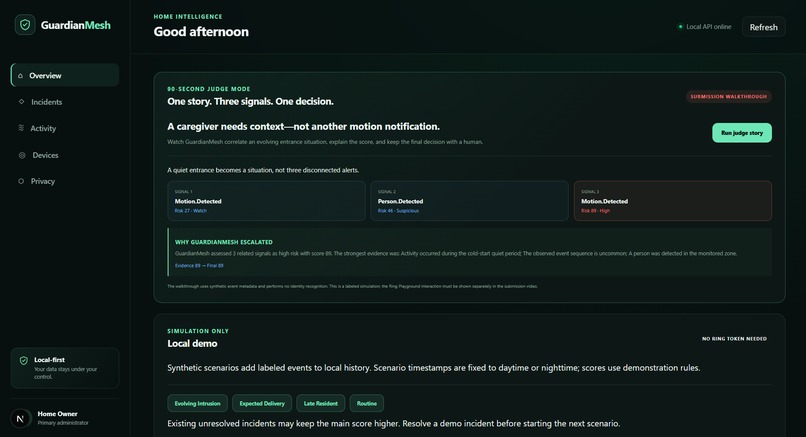
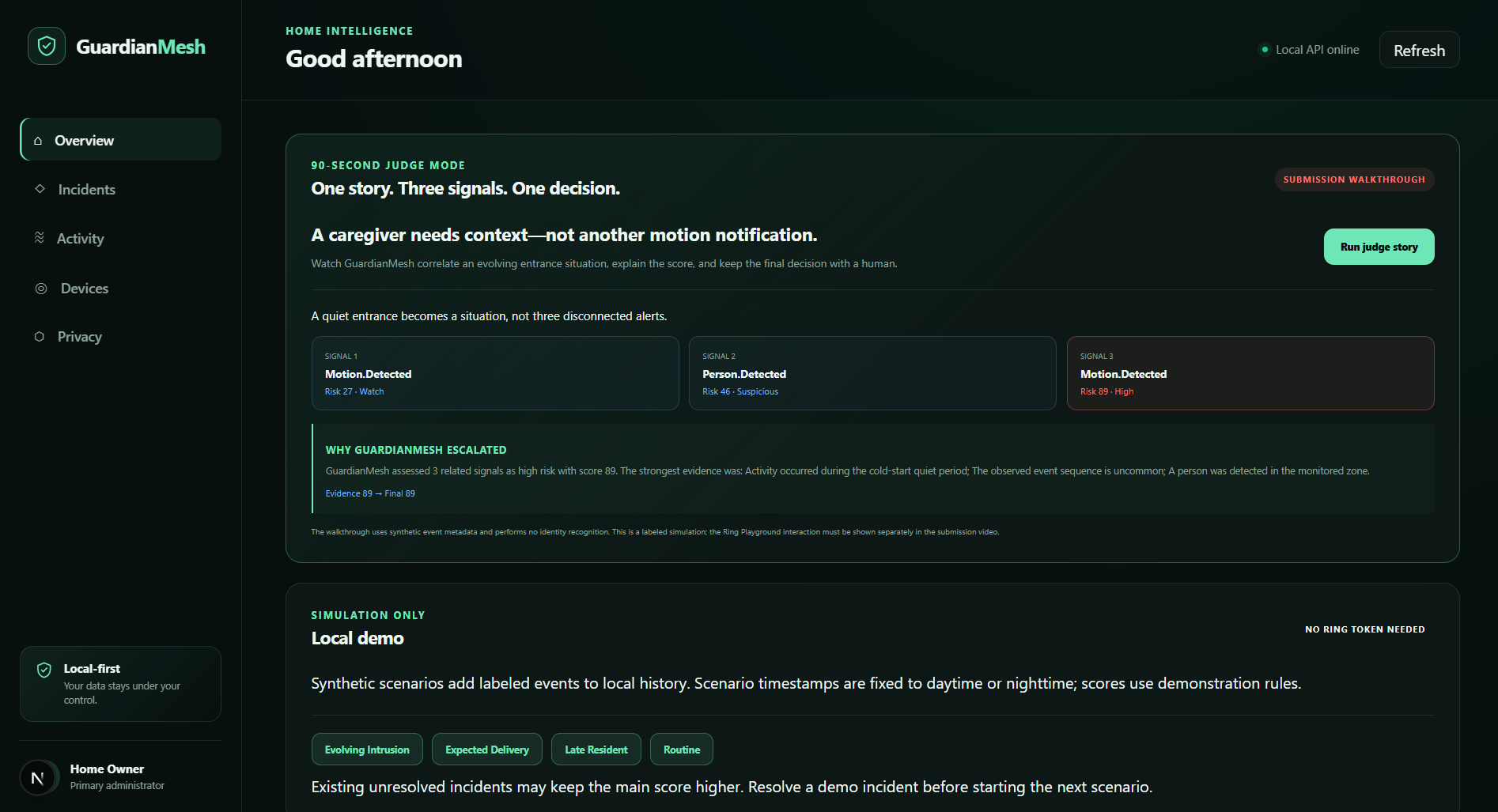
Judge Mode correlates three entrance signals into one explainable situation as risk evolves from 27 to 89.
-
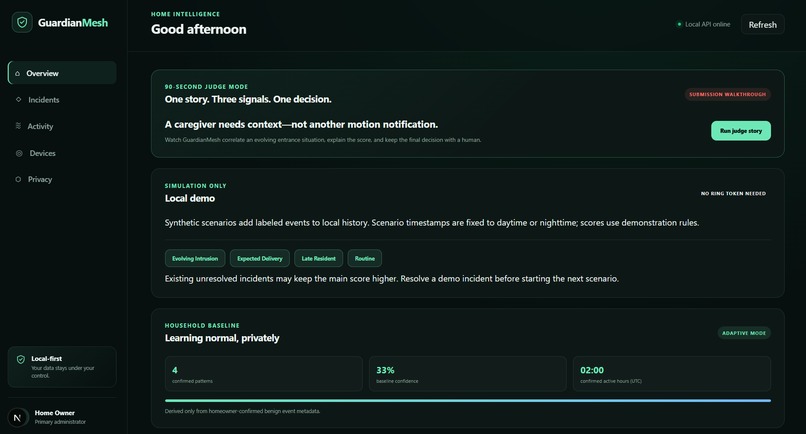
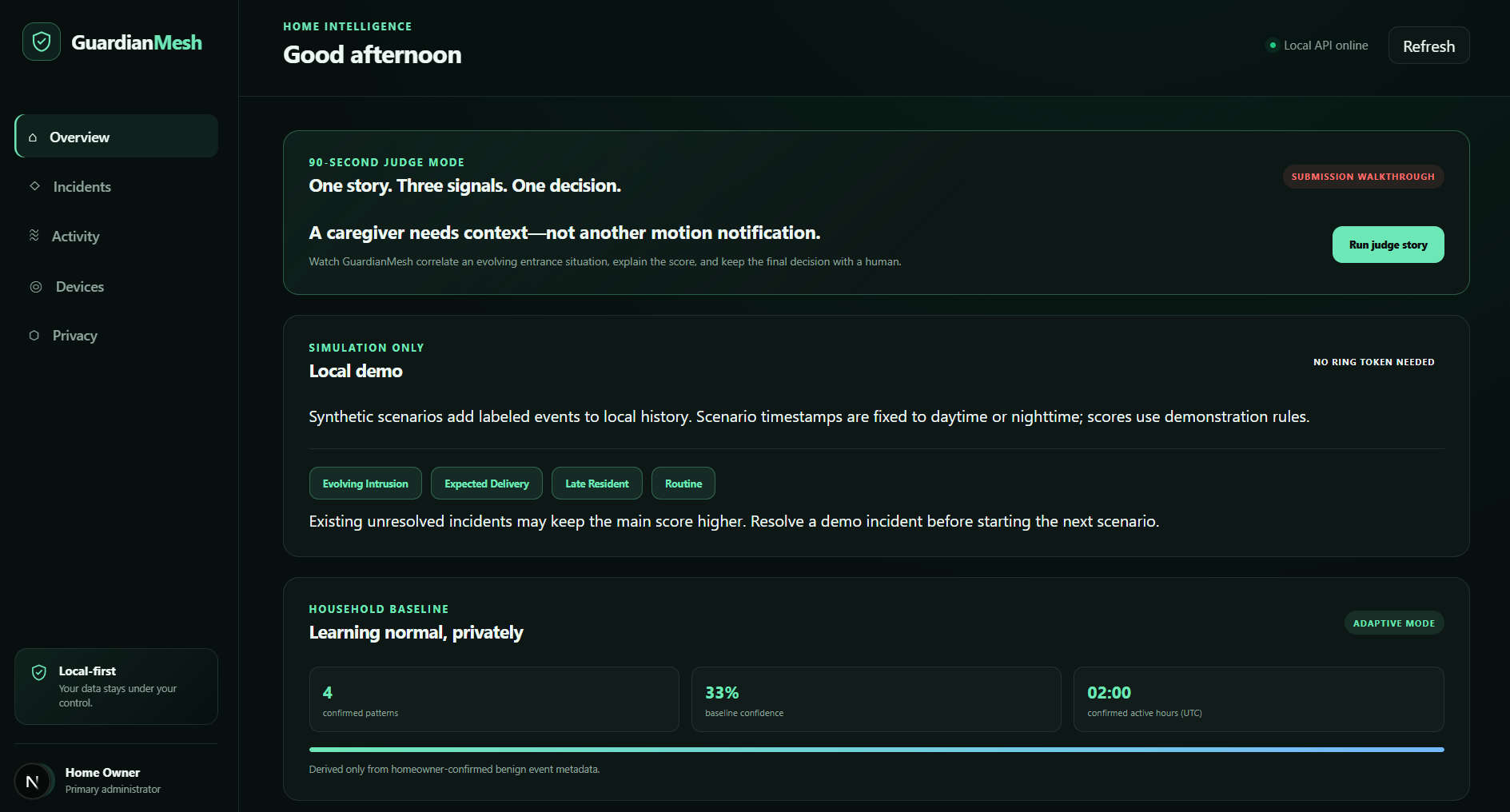
Private adaptation learns only from confirmed benign outcomes—without video, faces, or identity tracking.
-
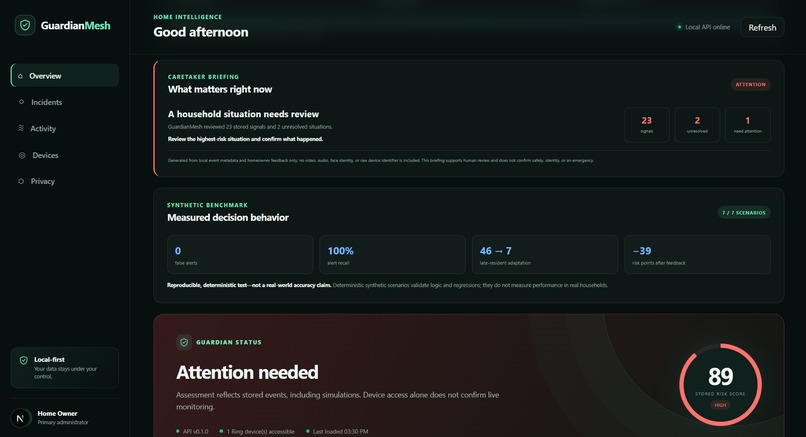
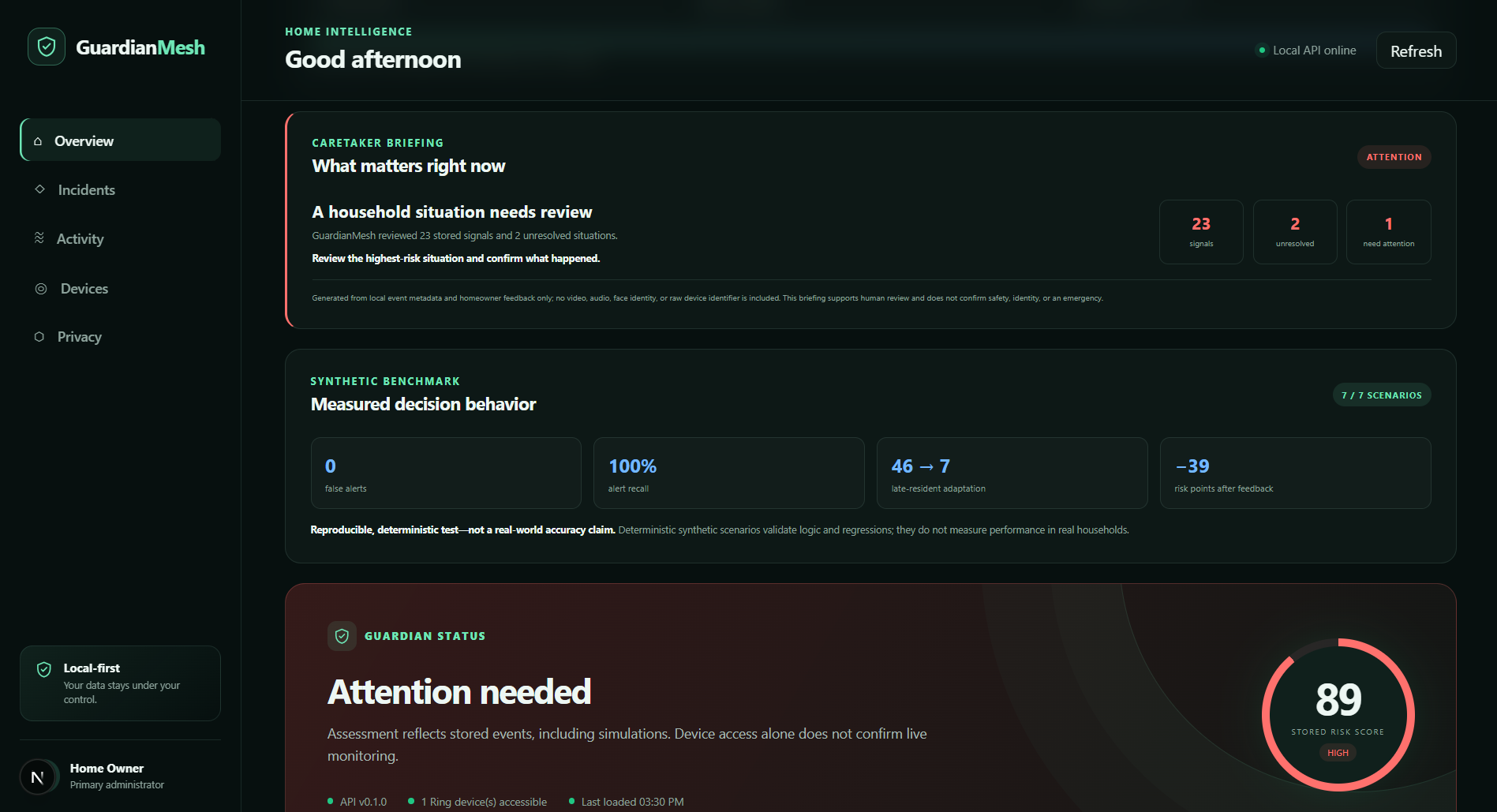
A caretaker briefing highlights what needs review beside transparent synthetic benchmark results and limitations.
-
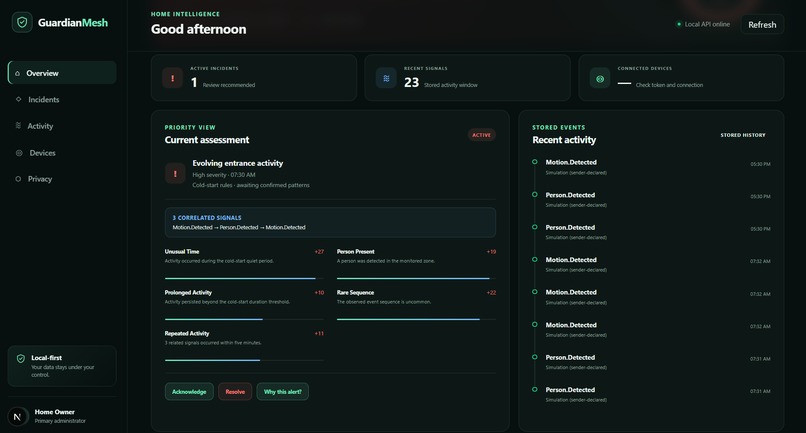
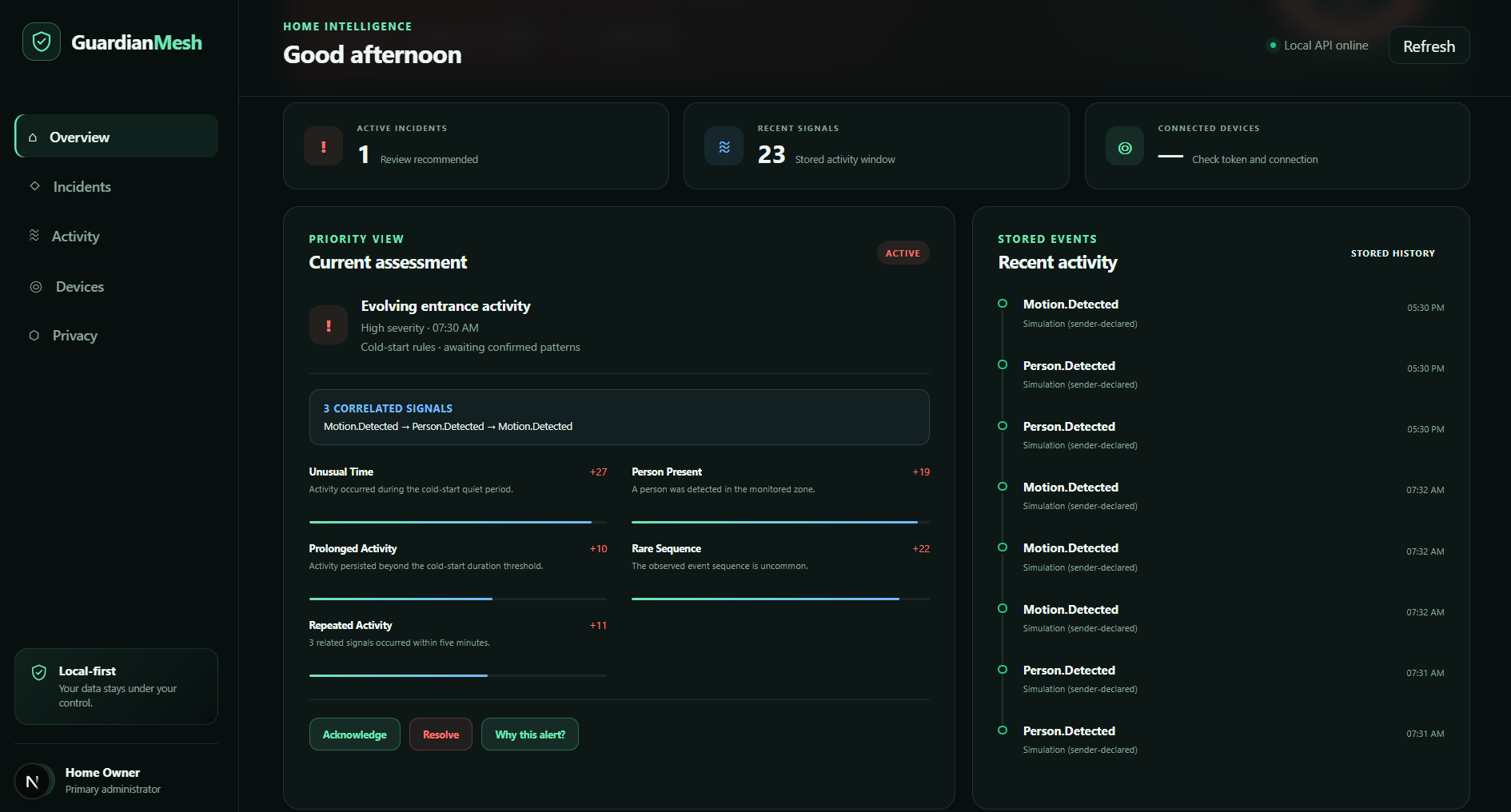
Correlated signals and deterministic evidence reveal exactly why each risk score changed.
Inspiration
A Ring notification can tell someone that motion occurred. It cannot explain whether several nearby signals represent an expected delivery, a family member returning late, or an evolving situation that deserves attention.
That missing context matters to caregivers, families supporting older relatives, and homeowners dealing with repeated alerts. More notifications do not necessarily create more safety. They can cause alert fatigue and force people to reconstruct situations manually.
I built GuardianMesh to explore a different approach:
Ring detects events. GuardianMesh understands situations.
GuardianMesh is a privacy-first, local-first household intelligence layer for Ring. It correlates isolated signals into evolving situations, adapts only from homeowner-confirmed outcomes, explains every risk contribution, and keeps consequential decisions with people.
What it does
GuardianMesh transforms Ring event metadata into an auditable household assessment:
- Connects through the official Ring device and event-history APIs.
- Normalizes events into a canonical local schema with explicit provenance.
- Correlates signals from the same area within the same fixed five-minute bucket.
- Scores situations deterministically using timing, person presence, duration, sequence rarity, and repeated activity.
- Adapts household baselines only from outcomes the homeowner explicitly confirms as benign.
- Explains every score contribution and provides counterfactual assessments.
- Requests human acknowledgement and resolution instead of autonomously declaring an emergency.
- Stores incidents, feedback, synchronization state, and audit history locally.
For example, three related notifications—motion, person detection, and repeated motion—become one evolving entrance situation. In the clearly labelled Judge Mode simulation, the risk progresses from 27 → 46 → 89 as additional evidence accumulates.
GuardianMesh does not identify people, predict crime, diagnose health conditions, contact emergency services, or claim that a home is safe.
How I built it
GuardianMesh is implemented as a local-first modular monolith:
- FastAPI and Python provide the API boundary, Ring integration, normalization pipeline, situation correlation, deterministic risk assessment, explanations, and audit operations.
- SQLite stores canonical events, incidents, feedback, learned patterns, synchronization state, and audit records locally.
- Next.js, React, and TypeScript power the household dashboard, Judge Mode, caretaker briefing, incident resolution, Ring synchronization, and privacy views.
- Ring APIs and Ring Playground provide authorized device discovery and event-history synchronization without requiring a physical Ring device.
- JSON Schema defines the canonical event and risk-assessment contracts.
- pytest validates ingestion, deduplication, provenance, correlation, adaptation, explanations, incident actions, recovery, evaluation, and recording readiness.
The risk engine is intentionally deterministic. An opaque model cannot silently modify a safety-related score. Every point must correspond to stored evidence or an explicit contextual adjustment.
Privacy boundaries are built into the architecture:
- OAuth credentials remain in the backend-only local environment.
- Raw Ring device identifiers are removed before dashboard responses.
- GuardianMesh analyzes event metadata—not video, audio, faces, or identities.
- Ring history, synthetic demonstrations, and legacy events remain visibly distinguishable.
- Every incident transition creates an audit record.
- Household adaptation occurs only after explicit homeowner confirmation.
Challenges I ran into
Correlating notifications into situations
The first challenge was deciding when separate signals belonged to the same real-world activity. I implemented temporal and spatial correlation so related signals update one evolving incident instead of producing disconnected alerts.
Handling unreliable event delivery
Real event pipelines can receive duplicates, retries, malformed payloads, and events in unexpected order. GuardianMesh uses idempotent ingestion, canonical identifiers, validated schemas, atomic persistence, and order-independent correlation within each fixed bucket.
Learning without weakening safety
Automatic personalization could accidentally normalize suspicious behavior. GuardianMesh therefore adapts only from homeowner-confirmed benign outcomes and continues using cold-start rules when evidence is insufficient.
Preserving provenance
Official Ring history and synthetic demonstration events must never look identical. I carried provenance through ingestion, storage, APIs, and the interface so reviewers can distinguish the source of every event.
Making risk understandable
A numerical score without reasoning is not useful. GuardianMesh reconstructs assessments from stored evidence, displays every contribution, and computes counterfactuals such as the score without unusual timing or person presence.
Preventing demo failures
Ring Playground tokens are temporary. I created a recording preflight that checks FastAPI, the dashboard, deterministic benchmarks, token configuration, Ring device access, and recent synchronization without exposing the secret.
Accomplishments
- Implemented Ring device discovery and deduplicated event-history synchronization.
- Converted multiple device signals into one evolving, explainable household situation.
- Implemented deterministic, feedback-driven household adaptation without facial recognition or identity tracking.
- Created a caretaker briefing that summarizes what requires human attention.
- Preserved visible provenance across Ring history, synthetic demonstrations, and legacy data.
- Added deterministic evidence arithmetic and counterfactual explanations.
- Implemented acknowledgement, resolution, feedback, and audit history.
- Created a 90-second Judge Mode that demonstrates the complete decision flow.
- Passed 104 automated tests and 7/7 deterministic benchmark scenarios.
- Completed clean-environment dependency installation and production-build verification.
- Reached 0 known npm audit vulnerabilities at verification time.
The synthetic benchmark reports zero false alerts and full alert recall across its seven labelled cases. This is a deterministic regression result—not a real-world accuracy claim.
One important result is the late-resident scenario: after three benign homeowner confirmations, its score changes from 46 to 7, while the evolving-intrusion scenario remains high at 89.
What I learned
Building GuardianMesh showed me that responsible household intelligence is not primarily about adding a larger model. The difficult engineering work is maintaining trustworthy boundaries:
- distinguishing observation from inference,
- preserving source provenance,
- making uncertainty and limitations visible,
- preventing feedback from silently weakening safety rules,
- and ensuring that a person retains the final decision.
I also learned that a simulator-based integration requires production-style discipline: secure token handling, event deduplication, explicit failure states, reproducible testing, atomic persistence, and clear separation between official platform evidence and synthetic evaluation.
Limitations
GuardianMesh is currently a local prototype validated through automated tests, deterministic scenarios, and Ring Playground access. It has not been validated across real households and does not claim production readiness or real-world detection accuracy.
The current implementation does not provide encrypted database storage, tamper-proof audit logs, autonomous emergency response, multi-user internet authentication, or continuous cloud monitoring.
These limitations are documented explicitly so that synthetic evidence is not presented as real-world performance.
What’s next
The next stage is consent-based validation across multiple households. I have documented a protocol covering sample size, event labelling, missing data, uncertainty, and privacy expectations rather than presenting synthetic results as real-world accuracy.
Future development includes:
- multi-home and multi-space support,
- longer-term household calibration,
- accessible notification delivery,
- caregiver roles and permission boundaries,
- privacy-preserving deployment options,
- broader Ring event coverage,
- and carefully constrained home-automation integrations.
The goal is to make GuardianMesh a trustworthy context layer for Ring-powered caretaking, accessibility, and home intelligence—one that explains what changed, why it matters, and when a person should review it.
Built With
- explainable-ai
- fastapi
- httpx
- iot
- json-schema
- next.js
- privacy
- pydantic
- pytest
- python
- react
- ring-api
- ring-playground
- sqlite
- typescript


Log in or sign up for Devpost to join the conversation.