-
-
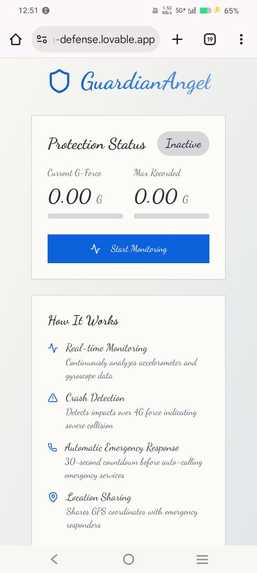
The Alert That Could Save Your Life.
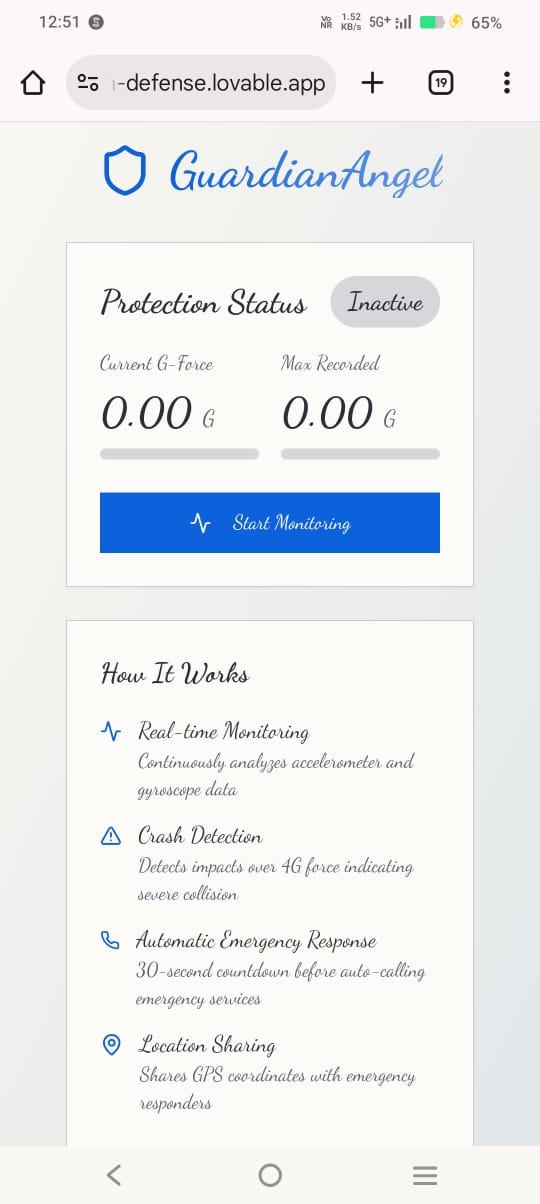
Inspiration Every year, millions of car accidents occur worldwide, and the first few minutes after a crash—the "Golden Hour"—are critical for survival. We were haunted by the statistic that many fatalities are not due to the crash itself, but the delay in emergency response. We asked ourselves: In an era of smart technology, why does emergency response still rely on a conscious victim or a bystander to make a call? We were inspired to create a solution that uses the powerful computer everyone carries in their pocket to automate this process, turning every smartphone into a vigilant guardian angel.
What it does GuardianAngel is an automated emergency response system that detects severe car crashes and alerts help without any user interaction.
Detection: It uses on-device AI to continuously analyze motion sensor data from a smartphone to identify patterns indicative of a severe crash (e.g., high-speed deceleration, rollover).
Confirmation: Upon detection, a loud, 10-second countdown alarm gives a conscious user the chance to cancel the alert, preventing false alarms.
Dispatch: If the alarm isn't canceled, the app springs into action:
Calls 911 via a VoIP connection and plays a clear, synthetic voice message stating: "Automated emergency alert from GuardianAngel. A severe vehicle crash has been detected at [precise GPS coordinates]. The user has not responded. Please dispatch services."
SMS Alerts pre-designated emergency contacts with the same location details and a link to a live map.
Provides Critical Data: The alert includes the time of the incident and the estimated severity of the impact.
How we built it Frontend: We built a cross-platform mobile application using React Native to ensure compatibility with both iOS and Android devices.
On-Device AI: The core crash detection is handled by a machine learning model trained with TensorFlow Lite. This allows for real-time, low-power analysis of accelerometer and gyroscope data directly on the phone, ensuring user privacy and offline functionality.
Backend & APIs: We used a serverless architecture with Google Cloud Functions for reliability and scalability.
Twilio API handles the automated VoIP calls and SMS messaging to emergency contacts.
Google Maps API provides precise geocoding and static map images for location data in the alerts.
Version Control: GitHub for collaboration and version control throughout the hackathon.
Challenges we ran into Balancing Sensitivity and Specificity: Tuning the ML model to distinguish between a severe car crash and everyday jostles (e.g., dropping the phone, aggressive gaming) was our biggest technical hurdle. We avoided too many false positives while ensuring genuine crashes are detected.
Integration Complexity: Seamlessly connecting the frontend sensor data to the cloud functions and then to the Twilio API required careful error handling and debugging to create a reliable pipeline.
The "Demo Problem": We couldn't simulate a real car crash on stage. We developed a specific "demo mode" that triggers the detection sequence with a specific shake pattern, allowing for a safe and convincing live demonstration.
Accomplishments that we're proud of Creating a Working Prototype: In just 36 hours, we integrated multiple complex systems into a single, seamless application that actually works from end-to-end.
Prioritizing Privacy: We are incredibly proud that our system processes all sensitive sensor data locally on the device. Personal data is only sent out after a confirmed crash and a lack of user response, making it a truly privacy-first application.
The Emotional Impact: During testing, the moment the automated call went through and the synthesized voice clearly stated the emergency, we knew we had built something with genuine, life-saving potential.
What we learned The Power of On-Device AI: We gained hands-on experience with TensorFlow Lite and learned how on-device processing is crucial for applications requiring low latency and high privacy.
Serverless is a Hackathon Superpower: Using cloud functions like Google Cloud Functions allowed us to build a scalable backend without managing servers, saving precious development time.
User Experience in Crisis: We learned that designing for extreme stress situations is unique. Every interaction, from the cancel button to the alarm sound, must be simple, clear, and impossible to miss.
What's next for GuardianAngel Refined Machine Learning Model: Collecting more real-world driving data (anonymously) to significantly improve the accuracy of our crash detection algorithm.
Smartwatch Integration: Extending the detection to wearables like Apple Watch and Wear OS to leverage heart rate sensors for added context (e.g., detecting a spike in heart rate followed by impact).
Advanced Vehicle Data: Exploring integration with vehicle telematics (via OBD-II dongles or built-in systems) for even more accurate crash data, like airbag deployment and impact angle.
Partnerships: Reaching out to insurance companies, ride-share services, and first responder organizations to pilot the technology and build a network that can act on our alerts even faster.
Built With
- 18.3
- 7.4
- accelerometer/gyroscope
- api
- authority
- build
- capacitor
- class
- component
- components
- cross-platform
- css
- currently
- custom
- design
- entirely
- for
- form
- hook
- html
- if
- integration
- lucide
- mobile
- motion
- none
- notifications)
- on-device)
- primitives
- query
- query)
- radix
- react
- ready
- router
- runs
- runtime)
- shadcn/ui
- sonner
- supabase
- tailwind
- tanstack
- toast
- tokens
- typescript
- ui
- variance
- vite
- with

Log in or sign up for Devpost to join the conversation.