-
-
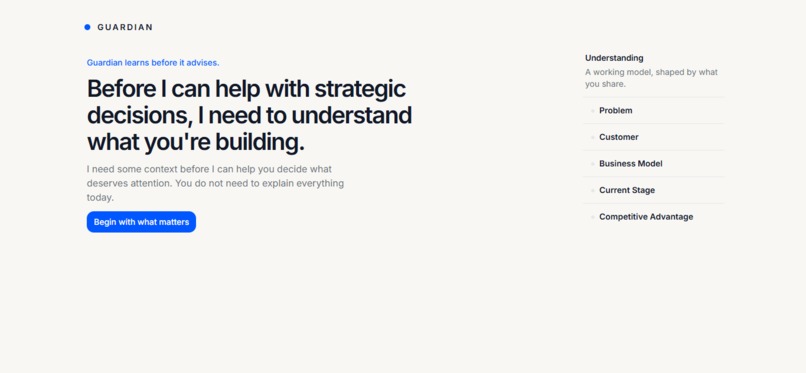
Hero
-
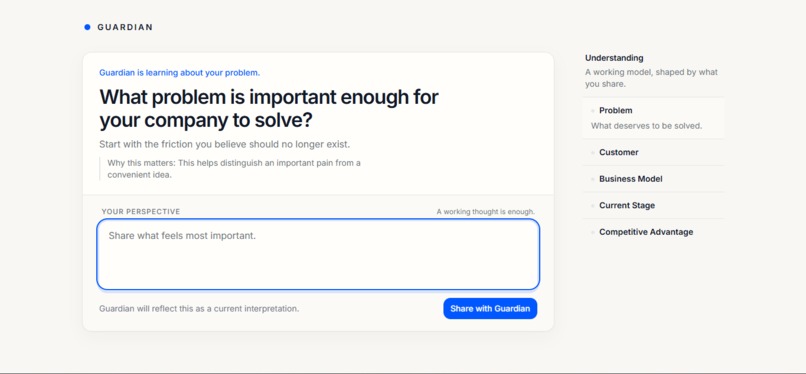
Problem Definition Screen
-
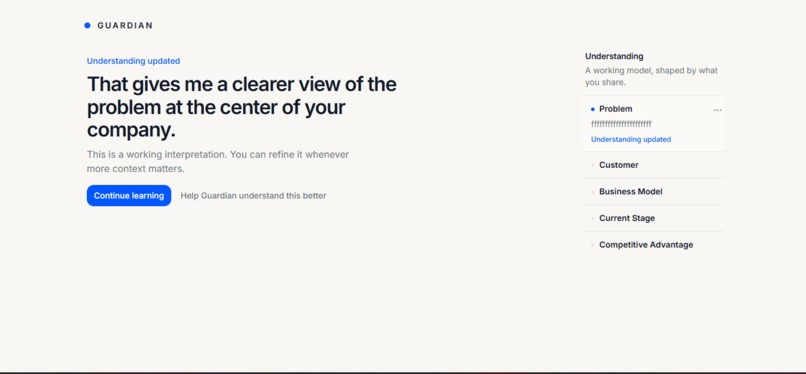
Understanding Screen
Inspiration
Founders rarely struggle because they lack information; they struggle because they don't always know when they have seen enough evidence to make the right decision.
Most AI assistants are designed to answer questions immediately. While that works well for many tasks, strategic business decisions are different. Product direction, pricing, fundraising, customer adoption, and expansion decisions should be earned through evidence rather than generated from a prompt.
That observation inspired Guardian. Instead of asking, "What answer should AI generate?" we asked a different question:
What if an AI system could determine whether enough evidence exists before publishing a strategic judgment?
That philosophy became the foundation of Guardian.
What it does
Guardian is an AI strategic reasoning system built for founders.
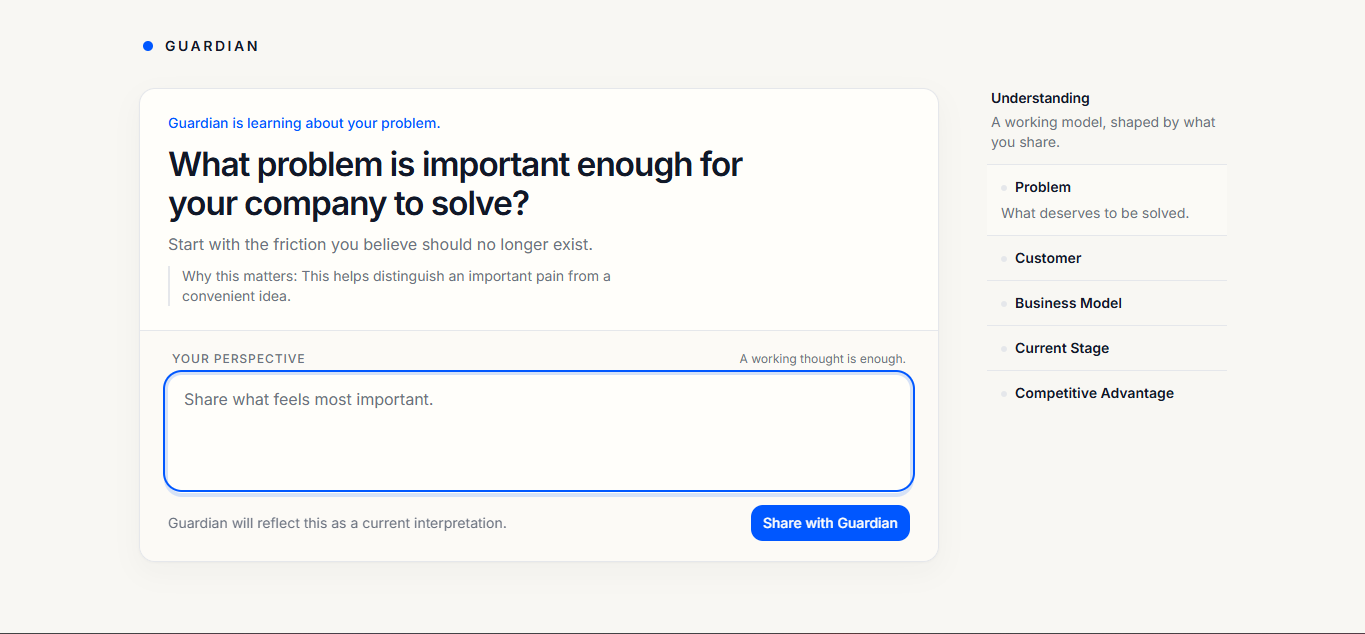
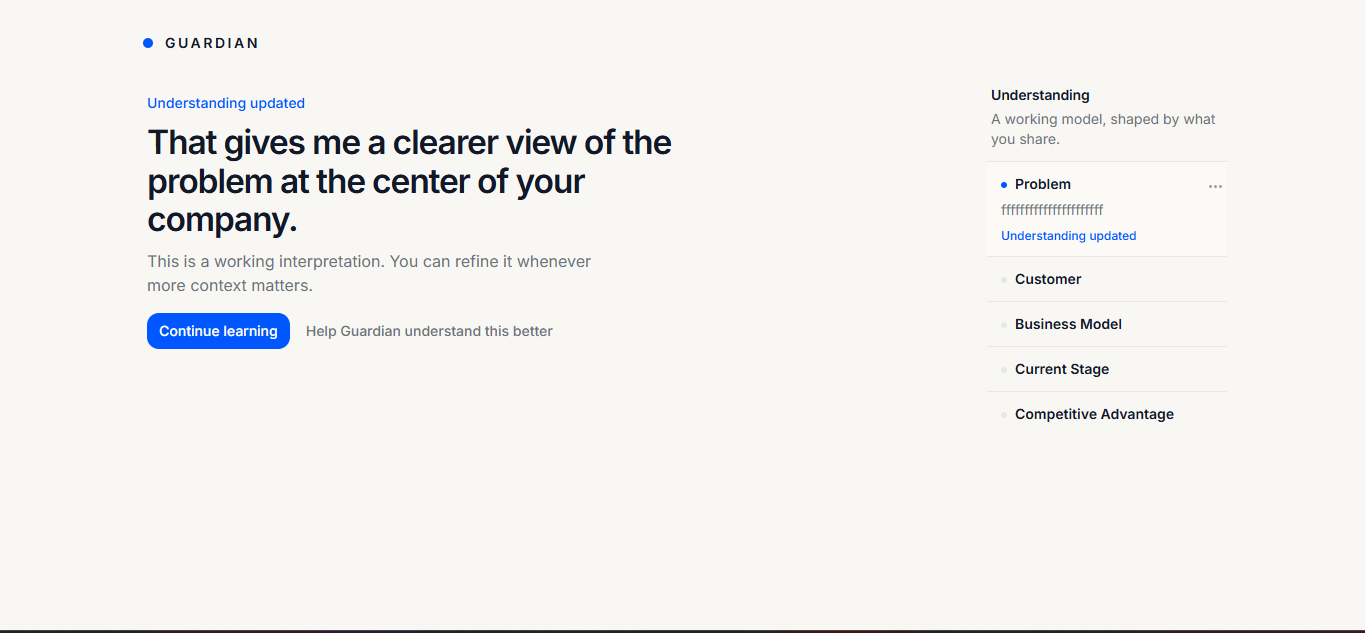
Rather than immediately generating advice, Guardian first learns about the company through a structured conversation. As founders provide information, Guardian builds an evolving Working Picture, reflects that understanding for confirmation, identifies uncertainty, compares competing explanations, and evaluates whether the available evidence is sufficient to support a strategic decision.
Only when enough evidence has been gathered does Guardian publish a Decision Brief. If the evidence is insufficient, it deliberately withholds judgment and explains what information is still needed.
The goal is simple: help founders make better decisions by ensuring those decisions are supported by evidence rather than assumptions.
How we built it
For Build Week, I intentionally focused on building Guardian's reasoning engine instead of trying to build every planned feature.
Guardian was built using GPT-5.6 and Codex throughout the development process, alongside a modern web application stack including Next.js, TypeScript, React, Tailwind CSS, Vercel, Groq, and Zod for structured validation.
The reasoning pipeline was designed around explicit evidence rather than conversational responses. Every strategic conclusion is grounded in structured hypotheses, supporting evidence, uncertainty, confidence levels, clarification questions, and Decision Brief publication rules.
Once enough evidence exists, Guardian publishes a Decision Brief and records the outcome as Version 1 of a Strategic Journal, laying the foundation for long-term strategic continuity.
Challenges we ran into
The biggest challenge wasn't building another AI interface, it was building an AI system that knew when not to make a decision.
During development, I encountered multiple production issues involving structured reasoning, provider validation, schema consistency, deterministic outputs, deployment reliability, and production debugging. One of the hardest problems was ensuring Guardian remained faithful to its evidence-first philosophy instead of forcing strategic conclusions simply because a user reached the end of a conversation.
Rather than weakening Guardian's publication gate to make the demo easier, I chose to preserve the product's reasoning principles and solve the underlying engineering problems. After several iterations, production testing, and debugging, the reasoning pipeline became stable while maintaining Guardian's original design philosophy.
Accomplishments that we're proud of
The accomplishment I'm most proud of isn't simply building an AI application, it's building one that intentionally withholds judgment until it has earned the right to make one.
During Build Week, Guardian evolved from an early prototype into a working MVP capable of:
Learning about a company through structured conversations. Building and confirming a Working Picture. Evaluating evidence instead of generating immediate advice. Publishing a Decision Brief only when the evidence supports it. Recording the decision as Version 1 of a Strategic Journal.
I'm also proud that the final production system remained true to its philosophy instead of sacrificing trustworthiness for convenience.
What we learned
The biggest lesson from this project is that trustworthy AI isn't about producing more answers.
It's about understanding when the available evidence is—and is not—sufficient to support a conclusion.
Building Guardian reinforced the idea that uncertainty should be communicated clearly rather than hidden behind confident language. In many situations, the most valuable response an AI system can provide is an honest explanation of what still needs to be learned before moving forward.
I also learned the importance of designing reasoning systems around explicit evidence, structured validation, and transparency rather than relying solely on language generation.
What's next for Guardian
This Build Week submission represents the first milestone rather than the finished product.
The current MVP demonstrates Guardian's complete strategic reasoning workflow, including learning, evidence evaluation, Working Picture generation, Decision Brief publication, and Strategic Journal creation.
The next phase of Guardian includes:
Secure user authentication and accounts. Durable strategic continuity across sessions. Team collaboration and shared workspaces. Richer Strategic Journal capabilities. Broader founder workflows and reasoning models. Additional integrations with founder tools and data sources.
Guardian's long-term vision remains unchanged: to become an evidence-first strategic reasoning partner that helps founders make better decisions—not by replacing their judgment, but by strengthening it.
Because the best founders aren't the ones who know everything. They're the ones who know when they've seen enough evidence to move forward with confidence.
Built With
- api
- codex
- css
- gpt-5.6
- groq
- next.js
- node.js
- openai
- react
- tailwind
- typescript
- vercel


Log in or sign up for Devpost to join the conversation.