Guardian: An AI-Powered Call Firewall for Older Adults
Inspiration
A phone call can be a lifeline for an older adult. It can also be the beginning of a scam.
We imagined Linda, a 78-year-old recently widowed woman who answers every call because it might be her doctor, pharmacy, or bank. Her family wants to protect her, but blocking every unfamiliar number could mean missing something important. Caller ID offers little reassurance when scammers can impersonate trusted institutions.
We asked a different question: What if suspicious callers had to prove their legitimacy before they could reach their target?
That idea became Guardian, an AI-powered call firewall designed to protect older adults without cutting them off from the people and services they depend on.
What It Does
Guardian screens unfamiliar callers before connecting them to an older adult. Instead of relying solely on caller ID or asking recipients to recognize scams themselves, it uses an AI voice agent to investigate suspicious calls in real time.
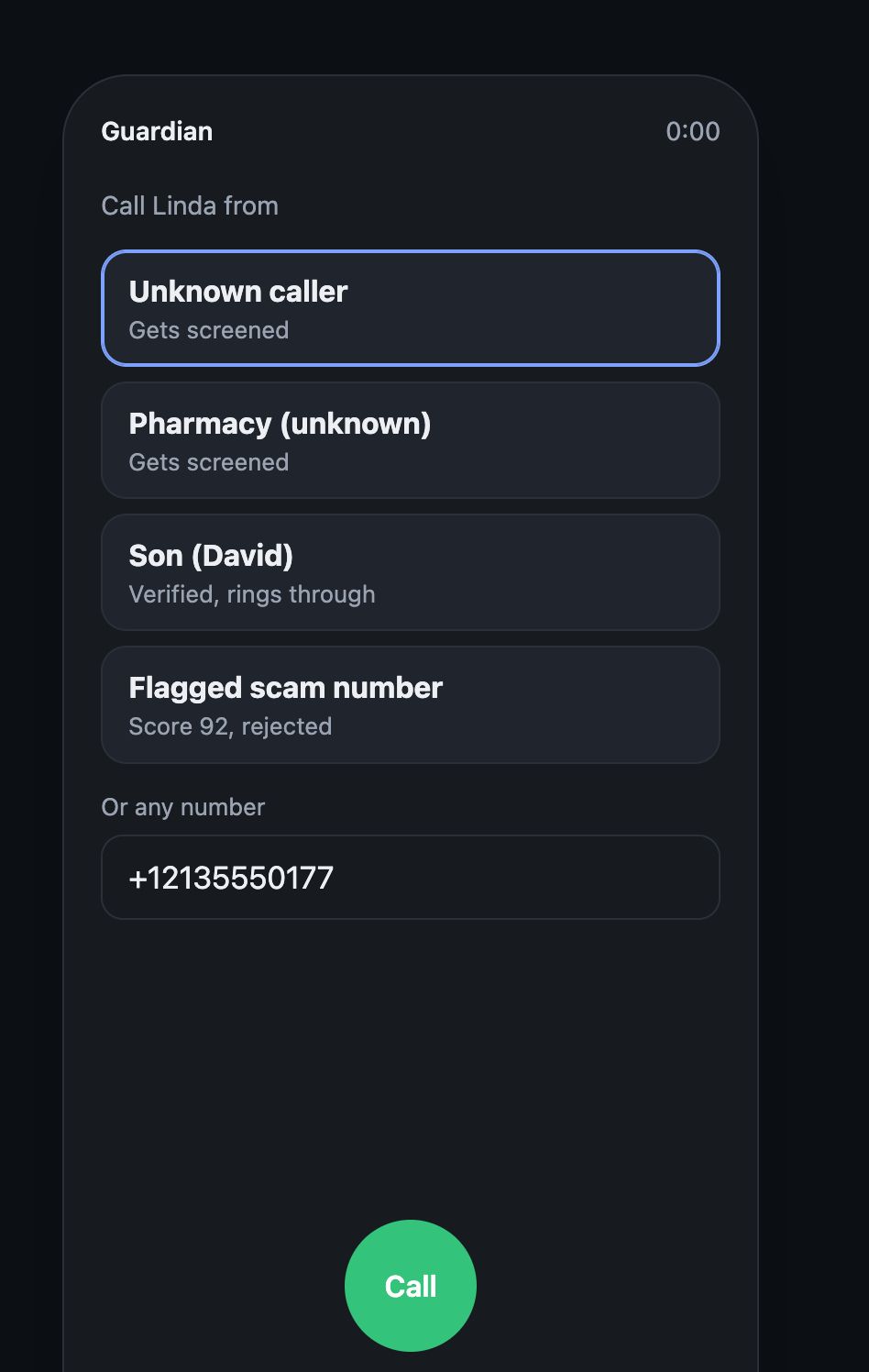
Trusted callers get through. Family members, doctors, pharmacies, and other approved contacts can be added to a verified list, allowing their calls to bypass screening.
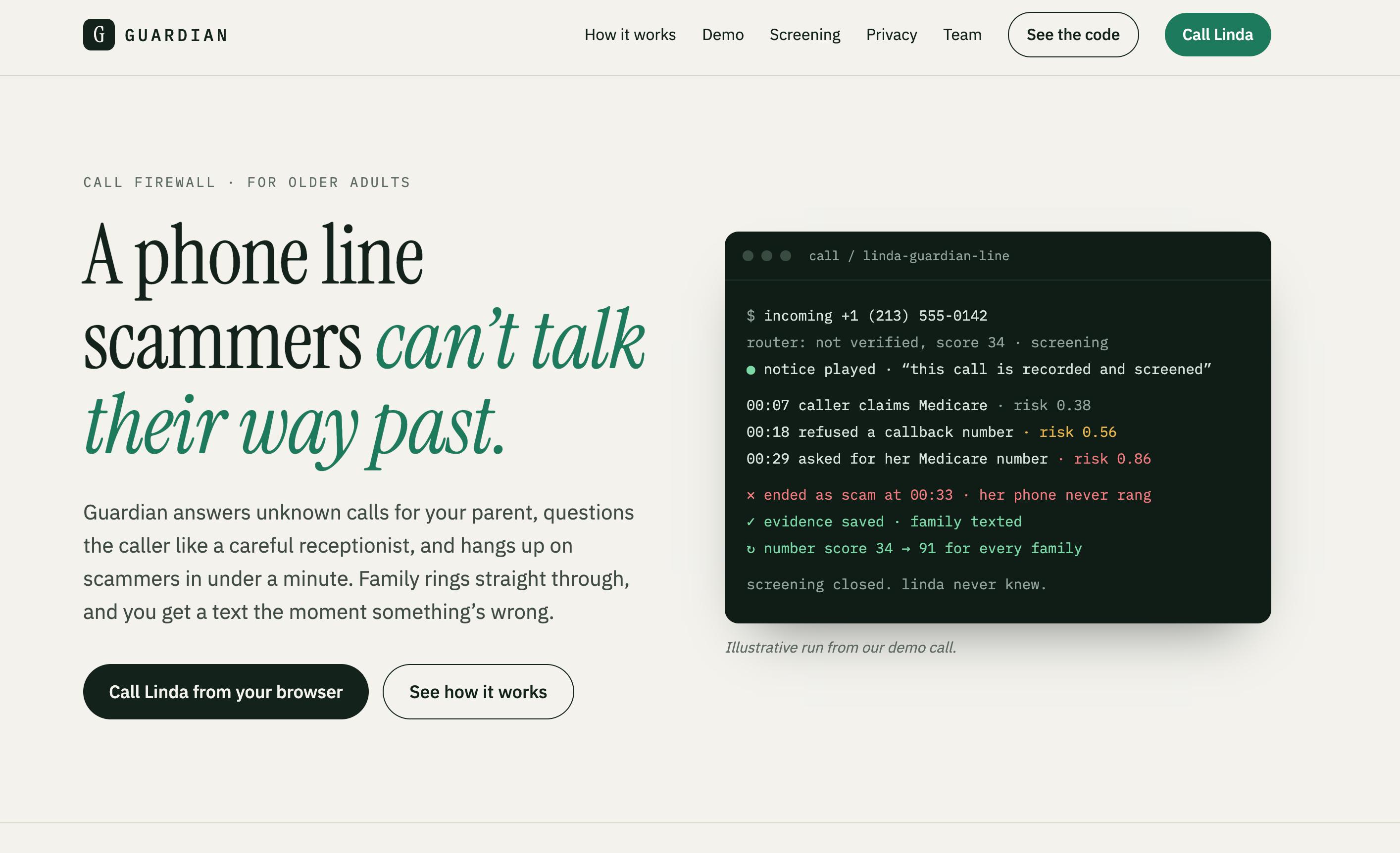
Unknown callers are screened by AI. Guardian introduces itself transparently as the recipient's assistant, announces recording before screening, and asks callers to identify themselves, their organization, a callback number, and the reason for their call.
Suspicious behavior triggers action. A real-time risk engine analyzes partial transcripts for warning signs such as impersonated authority, artificial urgency, evasive answers, and requests for sensitive information. Based on the assessed risk, Guardian can end the call, direct the caller to voicemail or a message flow, or allow the call to connect. Screening is limited to 90 seconds.
Families stay informed. Trusted family members can receive alerts containing caller details, a risk score, detected red flags, a call summary, and an evidence link. Call histories and number profiles provide additional context, helping identify suspicious patterns across multiple interactions.
Guardian also includes a family-facing dashboard, verified-contact management, a simulated banking-app signal for urgent fraud alerts, and a conversational family agent for querying call histories and managing blocked numbers.
How We Built It
Guardian combines real-time voice interaction, conversational risk assessment, call-history analysis, and a family-facing dashboard.
Our planned architecture uses Python and FastAPI for call routing and risk decisions; Photon or Twilio for telephony and messaging; ElevenLabs Conversational AI for natural voice interactions; Tiger Data with PostgreSQL for call histories and number profiles; and React, Vite, and Tailwind CSS for the dashboard. A Fetch.ai agent enables family queries and actions through ASI.
During screening, Guardian evaluates partial transcripts rather than waiting for the entire conversation to finish. The risk engine combines conversational signals with available number-level history to determine whether to connect the caller, take a message, or end the call.
We also designed a model-evaluation experiment using synthetic transcripts of both scam and legitimate calls. Scam scenarios include Medicare impersonation, fraudulent bank alerts, tech-support scams, and utility shutoff threats. Legitimate examples include calls from doctors, pharmacies, and delivery drivers.
To test generalization, the evaluation would hold out entire scam-script categories, measuring whether a model can recognize unfamiliar scam scenarios rather than simply memorize known examples. We planned to compare a prompted baseline against a fine-tuned model.
Our evaluation focuses on three practical questions: How early can Guardian detect a scam? How often does it incorrectly flag a legitimate caller? Can it make decisions quickly enough for a natural phone conversation?
We measure detection at 30, 60, and 90 seconds, false-positive rates on legitimate calls, and inference latency. We intend to report measured results rather than assume that fine-tuning necessarily improves performance.
Challenges We Faced
The central challenge was balancing protection with accessibility. An unfamiliar number is not necessarily dangerous: a doctor's office might call from a new line, while a scammer might sound professional and provide convincing details.
This makes Guardian more than a simple classification problem. It must assess incomplete conversations, distinguish suspicious behavior from ordinary uncertainty, minimize latency, and translate risk assessments into timely, appropriate actions.
We also had to consider privacy at every stage. Guardian is designed to announce recording before screening, impose a strict 90-second limit, avoid recording verified calls, and retain evidence from suspected scams rather than keeping every conversation indefinitely.
The simulated banking-app signal follows the same principle: it indicates that the app was opened without exposing the user's screen or financial information. Before real-world deployment, Guardian would require further legal, security, accessibility, and consent validation.
What We Learned
Guardian reinforced a lesson that extends beyond scam detection: AI safety is a system-design problem, not just a classification problem.
A prediction is only useful if it arrives in time, leads to an appropriate decision, respects privacy, and gives the right person a clear next step.
The trade-off between missed scams and false alarms is especially important. Missing a scam can cause serious financial harm, but incorrectly blocking a legitimate doctor or pharmacy could isolate someone from essential services. Effective protection must account for both risks.
Our goal is not to make older adults better at detecting scams. It is to move that burden upstream, giving them and their families a protective layer before a suspicious caller ever reaches them.
Guardian turns an unfamiliar phone call into something that can be investigated before a vulnerable person has to decide whether to trust the voice on the other end.
Built With
- css
- elevenlabs
- fastapi
- fetchai
- gemini
- godaddy
- html
- javascript
- llm
- photon
- postgresql
- publicdev
- python
- react
- typescript
- uagents

Log in or sign up for Devpost to join the conversation.