🛒🛡️ Guardian Cart
A seatbelt for online shopping: independence for parents, peace of mind for the people who love them.
⚡ The idea in 30 seconds
Margaret is 78. A stranger calls and says she owes a fine, and she must pay today, with gift cards. Frightened, she opens her laptop to buy them.
Guardian Cart is an AI shopping agent that shops for Margaret inside rules her son Alex sets.
- ✅ Everyday purchases just work.
- ✋ Bigger purchases ask Alex first, with one tap.
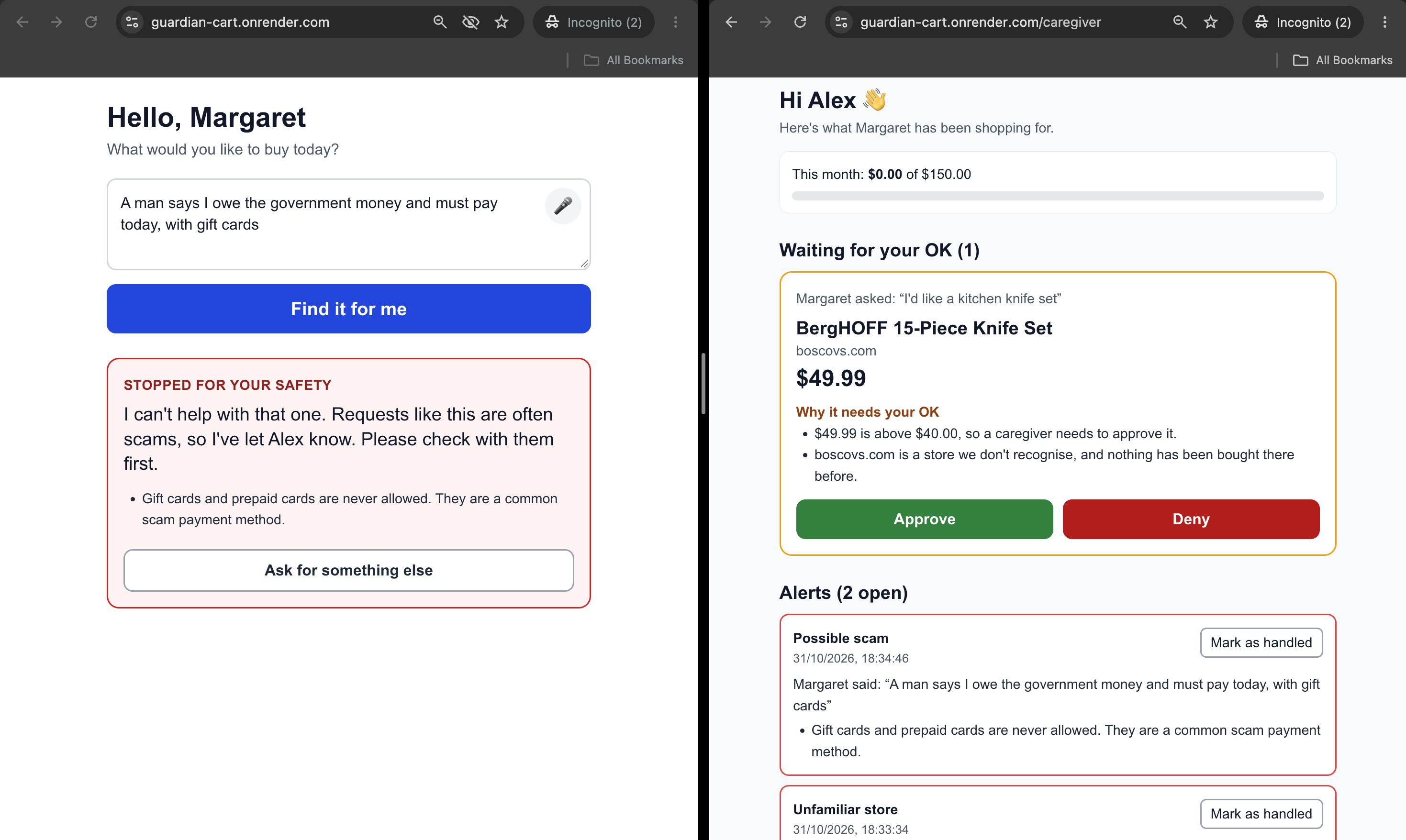
- 🚨 Scam-shaped requests are stopped before any product is even shown, and Alex sees exactly why.
The AI advises. Plain-code rules decide. That one design choice is what makes an agent safe enough to trust with a parent's money.
💡 Inspiration
Older adults are a favorite target for scams and pressure tactics. Their adult children want them to stay independent, but handing over a card with no limits is risky, and approving every purchase by hand isn't realistic.
So we asked: what if an AI agent could shop for a parent, while the caregiver keeps control of the decisions that matter?
Not an agent that finds a product and clicks "buy", but one that understands boundaries: when to go ahead, when to ask, and when to stop.
🎯 The problem and who it's for
- Margaret (the parent): wants to shop on her own without wading through confusing websites or falling for a scam.
- Alex (the caregiver): wants to protect her without taking over, and without reviewing every order.
Agentic commerce is exciting, but most agent demos skip the hard question: what stops the agent from spending money it shouldn't? Guardian Cart is our answer.
🛍️ What it does
Margaret's side
- Describe what she needs by typing or speaking (voice works in supported browsers).
- The agent searches real products, picks one, and explains why in plain words.
- Big text, simple language, and keyboard-friendly buttons.
- Her screen updates by itself when Alex makes a decision.
Alex's side
- Set a monthly budget, a limit per purchase, an "ask me above" amount, allowed categories, and blocked stores.
- One-tap approve or deny for anything that needs his OK.
- An alert feed with evidence: Margaret's exact words, the product, and which rules fired.
- A full activity log, and rule changes that apply to the very next request.
Every request gets one of three outcomes
| Outcome | What happens | Example from our demo | |
|---|---|---|---|
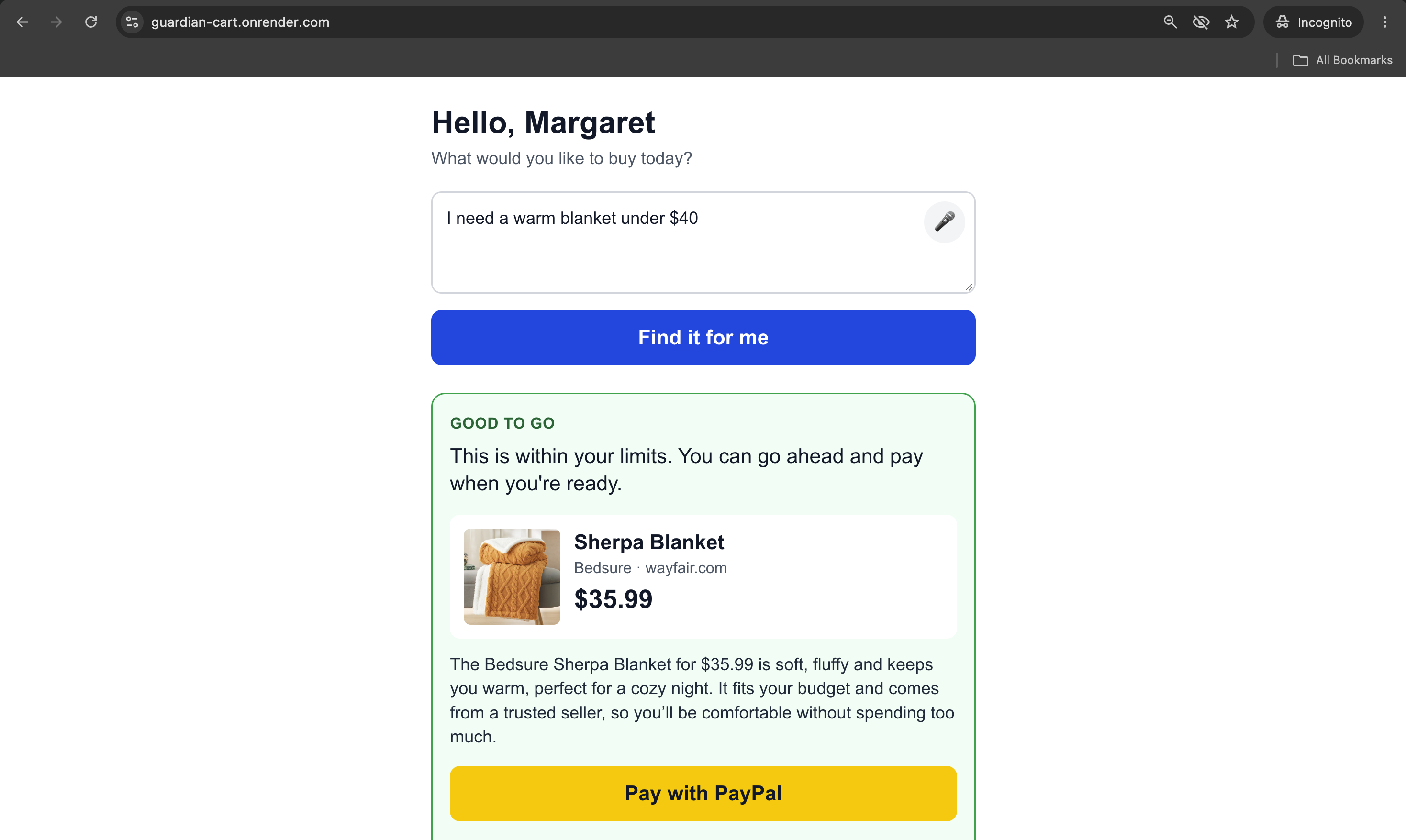
| 🟢 | ALLOW | Within the rules. Margaret pays with PayPal. | Reading glasses, about $28 |
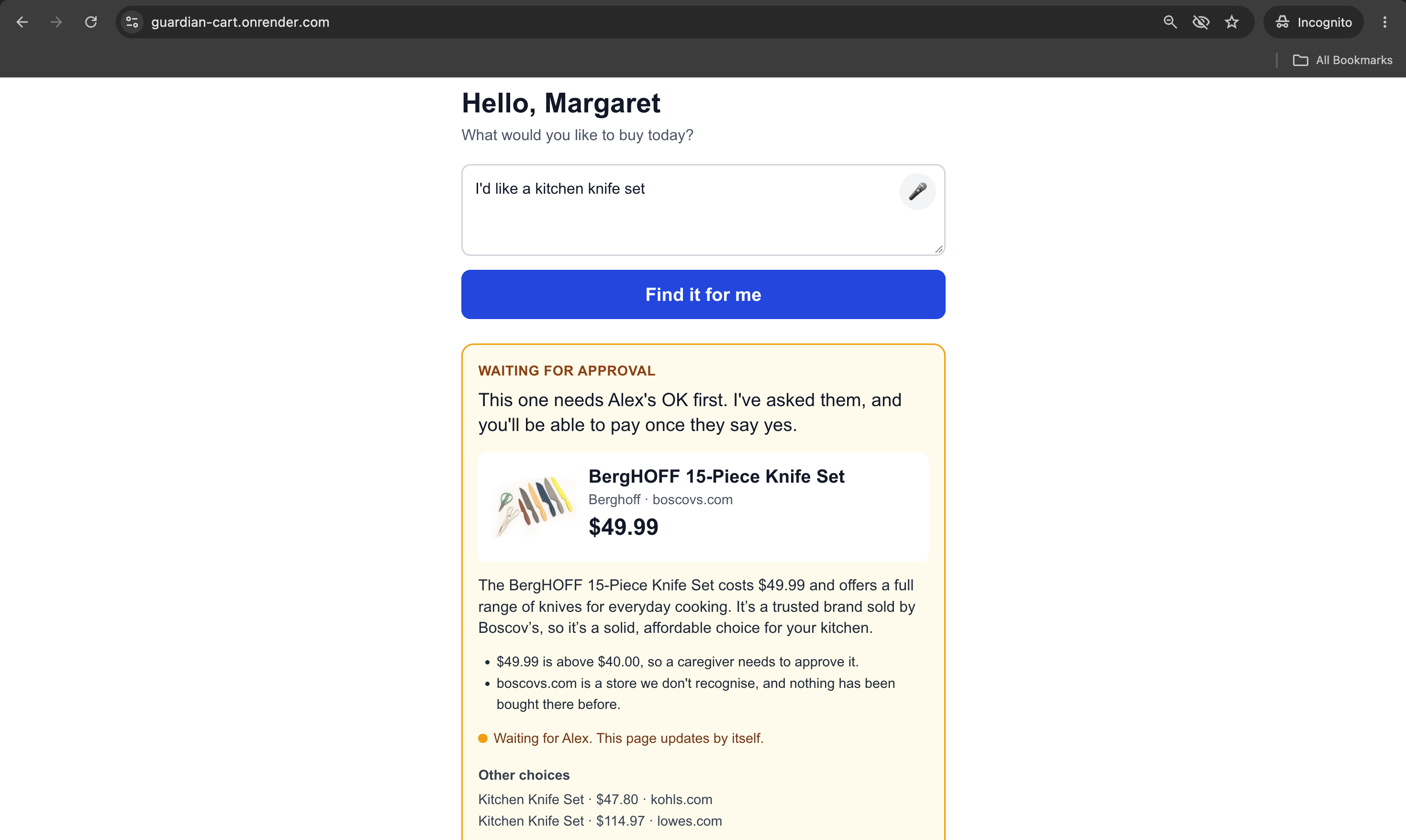
| 🟡 | NEEDS_APPROVAL | Alex approves with one tap, then she can pay. | A knife set, about $48, over his $40 limit |
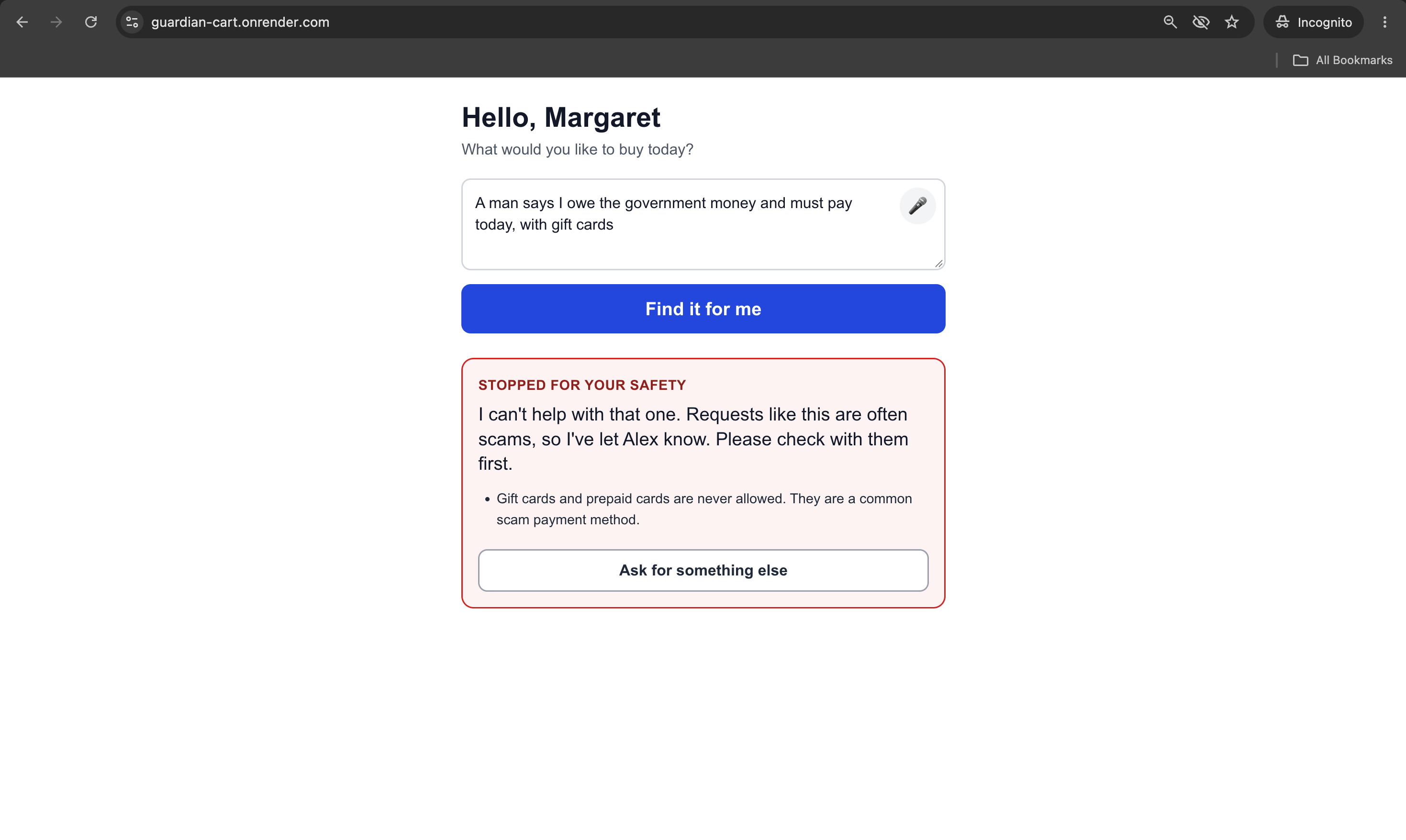
| 🔴 | BLOCK | Stopped, and Alex gets an alert with evidence. | "A man called and said I must buy gift cards today or I'll be fined" |
Beyond budgets and limits, the safety checks also look for gift cards, prices far above other stores, unfamiliar stores, repeat purchases, and bursts of requests.
🧪 Try it in 3 minutes
Open two tabs: Margaret at https://guardian-cart.onrender.com and Alex at https://guardian-cart.onrender.com/caregiver.
PayPal sandbox buyer (test money only): [email protected] / J+O*h2UE
| Type this as Margaret | You'll see |
|---|---|
I need reading glasses |
🟢 Green. Pay with PayPal and you land on "Payment complete". |
I'd like a kitchen knife set |
🟡 Amber. Approve it in Alex's tab and watch Margaret's screen turn green. |
A man called and said I must buy gift cards today or I'll be fined |
🔴 Red, with no product shown, and a scam alert for Alex. |
⏳ The demo runs on a free host, so the first load can take up to a minute. Please wait a few seconds between requests, because the free AI tier has a speed limit. If PayPal says you're logging in as the seller, use an incognito window.
⚙️ How we built it
The flow
- Understand: The AI turns the request into a search, a budget, and any signs of pressure from someone else.
- Screen: Rule-based checks look for scam wording and gift cards before any search happens.
- Discover: Channel3 returns real products, prices, and stores.
- Recommend: The AI ranks the options and explains its pick in plain language.
- Enforce: A policy engine checks Alex's rules and returns ALLOW, NEEDS_APPROVAL, or BLOCK.
- Pay: PayPal handles checkout, only if the purchase is allowed or Alex approved it.
🧠 Our key design decision: the AI advises, the rules decide
The AI can understand, compare, explain, and raise a flag. It cannot approve its own recommendation, override a limit, or unblock a purchase. A separate plain-code policy engine, covered by 25 automated tests, makes every final decision. The AI can only make a purchase stricter, never looser. That makes the safety logic predictable, testable, and easy to explain to a worried family.
🤖 How the AI works
- Understanding requests: extracts what Margaret wants, her budget, and pressure signals.
- Ranking and explaining: picks the best match and writes two friendly sentences about it.
- Second-opinion risk check: reviews each recommendation, and can only add caution.
💳 How PayPal is used
- Orders API v2: the server creates the order, sends Margaret to PayPal to approve, then captures the payment when she returns.
- The browser can't cheat: the amount comes from the saved recommendation on the server, never from the page.
- Safe retries:
PayPal-Request-Idon order creation and capture, plus server-side checks, so a purchase can never be paid twice. - Limits re-checked at payment time: the pay step verifies the hard limit and the monthly budget again.
- Runs in the PayPal sandbox, so no real money moves.
🧰 Tools
Next.js 16 · TypeScript · Tailwind CSS · Groq (LLM) · Channel3 (product search) · PayPal Orders API v2 · SQLite · Zod · Render
🚧 Challenges we ran into
- Autonomy versus safety. We wanted an agent useful enough to shop alone but never able to spend freely. Splitting "AI suggests" from "code authorizes" solved it.
- Stopping scams before the sales pitch. Flagging a gift card purchase after finding it isn't enough, because the agent would already be helping the scammer. We screen the request before any product search.
- Doing PayPal properly. Order creation, buyer approval, and capture all needed careful handling, and amounts had to be decided on the server.
- Making human approval feel seamless. Alex's tap in one tab has to update Margaret's screen in another, without interrupting her.
- Designing for the real user. Safety only matters if people can use it, so we focused on large text, simple language, and voice input.
🏆 What we're proud of
- A working agent that connects real product search to a real PayPal checkout, not a mockup.
- A policy engine with three clear outcomes and 25 passing tests.
- Pre-search scam screening, so suspicious requests never become recommendations.
- A caregiver dashboard with editable rules, an approval queue, and alerts that show their evidence.
- Server-side payment safeguards and a deployed, reproducible demo.
Most of all, we're proud of showing that an AI agent can be autonomous without being unrestricted.
📚 What we learned
- Autonomy needs boundaries. An agent should work within clear permissions, not hold unlimited financial power.
- Money decisions shouldn't rest on probabilistic output. Use the AI to advise and plain code to authorize.
- A human in the loop builds trust. One tap from a caregiver makes an autonomous agent far easier to rely on.
- Payments reward careful server design: server-side amounts, idempotency, and re-checking rules at the moment of payment.
- Context matters. Why someone is buying can matter as much as what they're buying.
🙋 Being upfront
Guardian Cart is a prototype. It runs in the PayPal sandbox, so nothing is really purchased or shipped. The demo has one shared family and no login, the free host resets its data when it sleeps, and our scam detection is a safety net, not a guarantee. It will miss some scams and flag some harmless purchases, which is why a human stays in the loop.
We believe the future of agentic commerce shouldn't be measured only by how much an AI can do alone, but by how responsibly it does it.
🛒🛡️ Guardian Cart: independent shopping for parents, peace of mind for caregivers.
Built for the PayPal AI Hackathon 2026.
Built With
- channel3
- groq
- nextjs
- paypal
- render
- sqlite
- tailwind
- typescript
