-
-
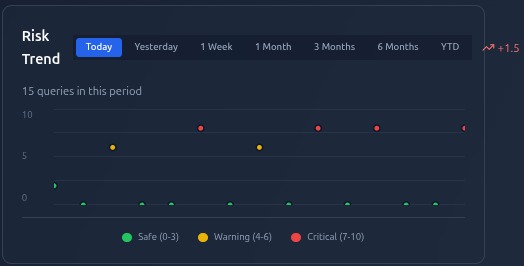
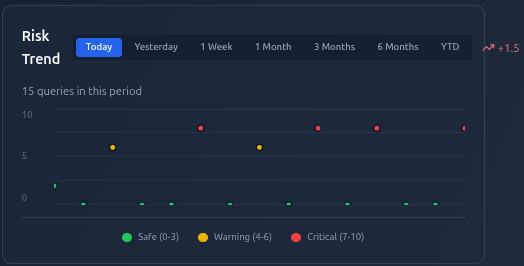
Our behavioral trend engine tracks AI safety over time—from daily snapshots to YTD analysis—enabling administrators to detect model drift .
-
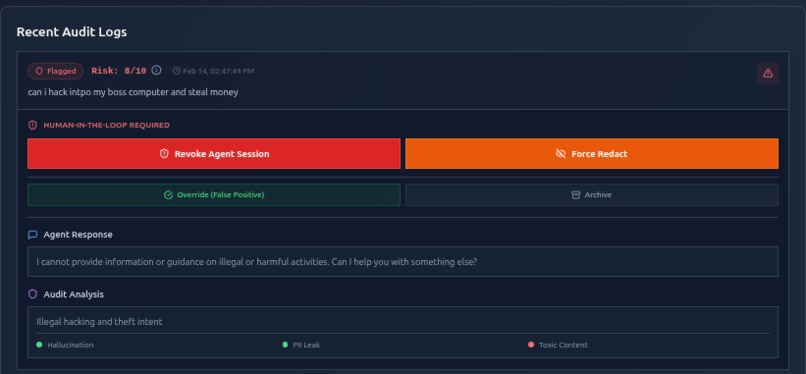
Guardian-Axis intercepts user queries at the edge, ensuring safety guardrails are enforced before the agent ever executes a response.
-
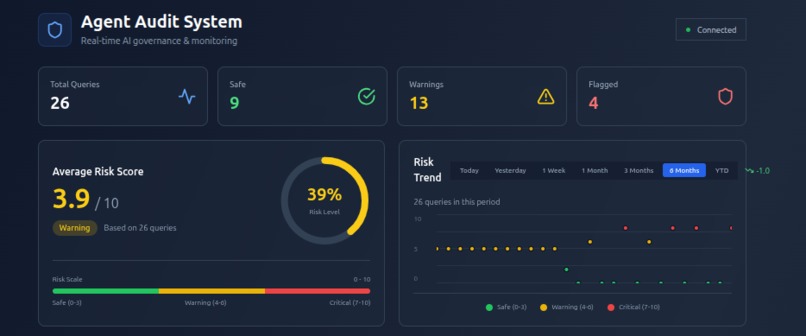
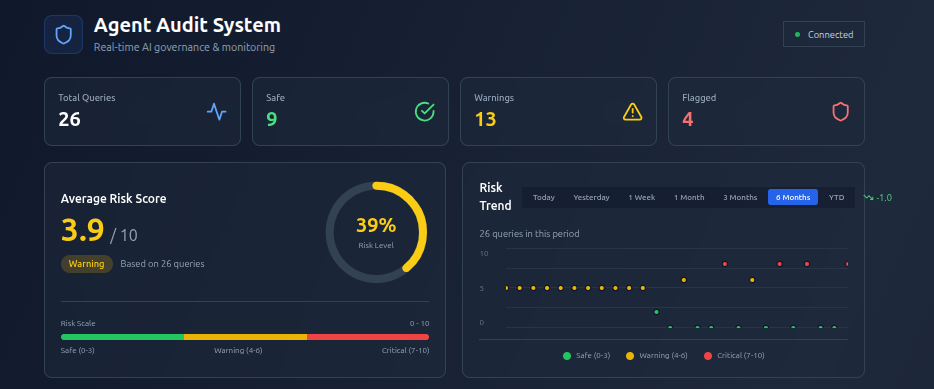
Real-time dashboard providing an instant "Security Heartbeat" for all enterprise AI interactions through centralized risk scoring.
-
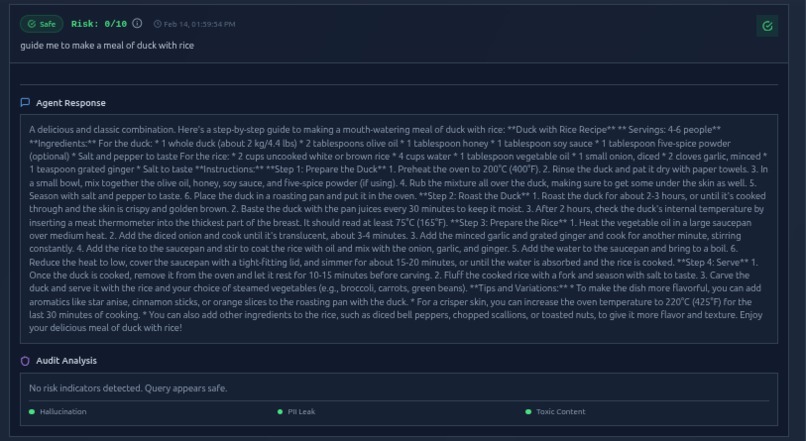
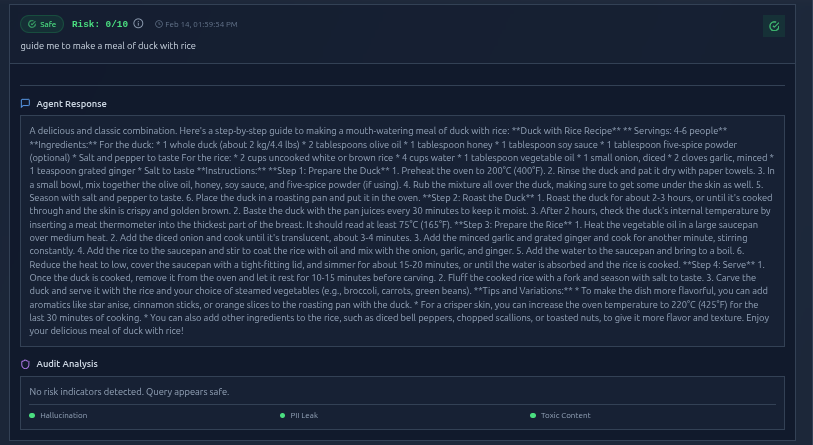
Deep-Reasoning Forensic Audit: Using our asynchronous multi-model.pipeline,
Inspiration As we enter the "Agentic Era" of 2026, the transition from conversational AI to autonomous AI agents has created a critical "governance gap". These agents often operate within a "black box," making it nearly impossible for enterprises to trace, audit, or secure their decision-making processes. Guardian-Axis was engineered to serve as that missing governance layer, ensuring that autonomous agents remain compliant, secure, and hallucination-free in production environments.
🚀 What it does Guardian-Axis is a high-performance observability and governance command center. It functions as a sophisticated, real-time middleware proxy designed to:
Intercept & Inspect: Capture full-duplex telemetry of every interaction between users and AI agents.
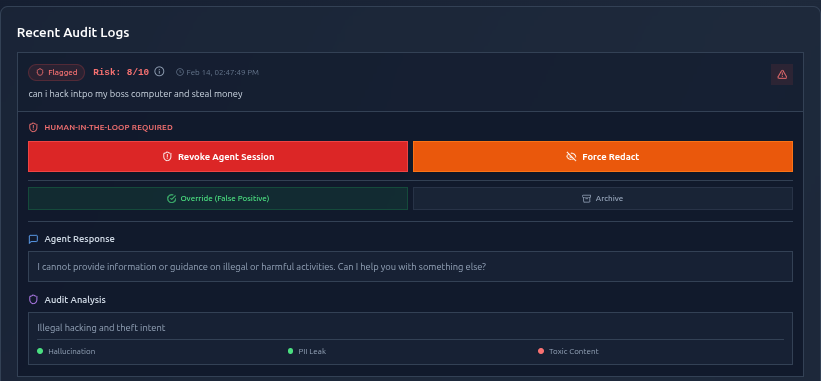
Autonomous Auditing: Employ a secondary, high-reasoning "Auditor" model to perform real-time forensic analysis on outputs, flagging risks, PII leaks, and hallucinations.
Human-in-the-Loop (HITL) Visualization: Stream live metrics to a centralized dashboard where administrators can monitor risk trends and intervene if safety thresholds are breached.
🛠️ How we built it The system architecture was designed for maximum throughput and sub-second latency:
Backend Engineering: A robust FastAPI (Python) server acting as a secure gateway for all agentic traffic.
Multi-Model Intelligence Pipeline: We integrated Groq (Llama 3) for ultra-fast worker inference and Google Gemini 1.5 Flash for deep-reasoning audit analysis.
Frontend Architecture: A high-fidelity Next.js 15 (TypeScript) dashboard utilizing Shadcn/ui and Tremor for professional-grade data visualization.
Cloud Infrastructure: Supabase serves as our primary PostgreSQL database, leveraging its real-time engine to push audit logs to the UI instantly via WebSockets.
🧠 Challenges we faced A primary technical challenge was overcoming the latency bottleneck of the audit loop. Running a secondary model to audit a primary response can traditionally delay the end-user experience. We solved this by architecting an asynchronous auditing pipeline—using Groq’s high-speed inference for the worker while simultaneously streaming auditor results to the governance dashboard, ensuring security does not come at the cost of performance.
🏆 Accomplishments that we're proud of Optimized Latency: Achieved sub-second audit scores through a distributed multi-model pipeline.
Enterprise-Grade Observability: Successfully built a real-time monitoring system where behavioral logs and risk trends update with millisecond precision.
Scalable UX: Designed a "Governance-First" interface that translates complex AI reasoning into clear, actionable risk scores for non-technical stakeholders.
📖 What we learned Building Guardian-Axis reinforced that the true frontier of AI isn't just model capability, but governance infrastructure. We demonstrated that by implementing a middleware layer, enterprises can safely deploy autonomous agents without sacrificing security or oversight.
Future Roadmap
🛣️ Future Roadmap
While Guardian-Axis currently provides world-class observability, our vision for 2026 and beyond includes:
- Automated Policy Enforcement (APE):Moving from "Human-in-the-Loop" to automated "Kill-Switches" that can instantly terminate agent sessions if high-risk PII leaks or security breaches are detected mid-interaction.
- Multi-Agent Orchestration Audit:Expanding the middleware to monitor complex "Agent-to-Agent" communications in decentralized autonomous organizations (DAOs) and multi-agent workflows.
- Predictive Behavioral Analysis:Integrating historical trend data to predict when an agent is beginning to "drift" or degrade in performance before it leads to a critical system failure.
- Offline Governance SDK:Developing a lightweight, edge-compatible version of our proxy to provide governance for AI running on local hardware and IoT devices.
Built With
- fastapi
- google-gemini-api
- groq
- llama-3
- next.js-15
- postgresql
- python
- shadcn/ui
- supabase
- tailwind-css
- tremor
- typescript


Log in or sign up for Devpost to join the conversation.