Inspiration
Our inspiration for Guardian Angel came from real life. We know seniors and people with mobility challenges who have fallen and needed medical assistance, and in many cases, the most dangerous part wasn’t just the fall itself, but the delay before someone realized they needed help. That gap in response time can turn a survivable incident into a serious emergency.
We wanted to build something that could act immediately: detect a fall, capture what happened, and notify caregivers right away. Our goal was to use technology not just to build something impressive, but to build something useful, practical, and impactful.
What it does
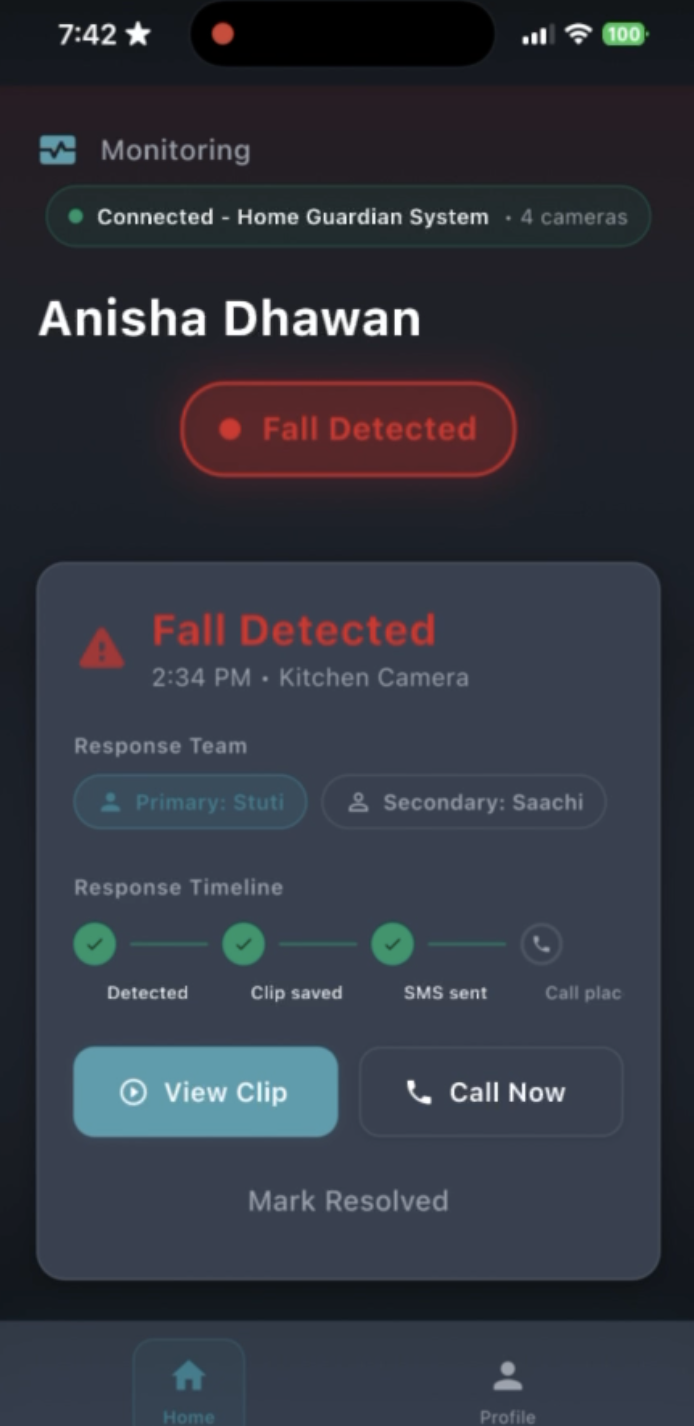
Guardian Angel is a real-time fall detection system built to protect seniors and people with mobility challenges when they’re most vulnerable. When a fall happens, our system detects it instantly on-device, records a short video for context, and alerts caregivers through a mobile app, a phone call, and even through Alexa in the home. Caregivers can immediately see what happened and respond faster, turning uncertainty into action when every second matters. It’s like having a digital guardian watching over your loved ones, 24/7.
How we built it
Our system is built around a few core components:
Computer Vision & Edge Processing: We built a Fall Detection System using MediaPipe Pose for extracting 17 human body keypoints per frame, a custom-trained TensorFlow Lite (TFLite) Transformer model for classifying fall vs. non-fall sequences, and OpenCV for video processing and real-time inference on edge devices.
Backend (FastAPI + MongoDB): We built a backend using FastAPI in Python to receive events from the edge device, store them in MongoDB, and serve them to the mobile app. Each event includes a timestamp, confidence score, and a path to the recorded video clip.
Mobile App (Flutter): The mobile app, built with Flutter, allows caregivers to view fall events, watch the recorded clips, and quickly understand what happened so they can respond appropriately.
Voice Assistant Integration (Alexa + AWS Lambda): We integrated AWS Lambda to trigger Alexa voice alerts, so notifications can happen even when a caregiver isn’t actively checking their phone.
Challenges we ran into
System Integration: Getting the computer vision device, backend, database, mobile app, and Alexa to all talk to each other reliably.
Networking & Connectivity: Making sure different machines on the same network could communicate correctly and consistently.
Real-Time Performance: Balancing accuracy with speed so detection works fast enough on edge devices.
Model Reliability: Reducing false negatives (missing real falls), which is critical for safety.
Data Processing Complexity: Handling missing frames, normalizing skeletons, and generating clean sequences for training.
UI/UX Design: Creating an interface that’s simple for caregivers, shows video clearly, and still provides enough useful information without overwhelming them.
Many Moving Parts: Debugging issues when something could break in the CV pipeline, backend, app, or cloud integration.
Accomplishments that we're proud of
Built a fully end-to-end system: from real-time computer vision on an edge device, to a FastAPI backend, to a Flutter mobile app, to Alexa voice alerts.
Successfully ran real-time fall detection on an edge device using a TFLite model + MediaPipe, proving the system works outside of just a notebook or demo.
Integrated automatic alerts across multiple channels (mobile app + Alexa), turning detection into real-world action.
Designed a caregiver-friendly UI that shows both the fall video and clear status information.
What we learned
How to design and implement an IoT-style, multi-device system with many moving parts.
How to build and connect a computer vision pipeline with a production-style backend and mobile frontend.
How temporal deep learning models (LSTM, Bi-LSTM, Transformer) differ, and why attention-based models are better for long-range motion patterns.
How to evaluate models using safety-critical metrics like recall and F1, not just raw accuracy.
How to deploy machine learning models on edge devices using TensorFlow Lite.
What's next for Guardian Angel
Multi-person detection so the system can work in shared spaces like nursing homes or assisted living facilities.
Larger and more diverse datasets to improve robustness across different body types, camera angles, and environments.
Better fall severity classification (e.g., hard fall vs. slow collapse) to prioritize emergency responses.
More integrations with emergency contacts, SMS, and healthcare systems.
On-device optimization to further reduce latency and power usage for always-on monitoring.



Log in or sign up for Devpost to join the conversation.