Guardian Angel
An Android safety companion combining discreet voice commands, journey tracking, and on-device audio tools, with a Nebius-hosted NVIDIA Nemotron planning feature in development.
Inspiration
“Text me when you get home” asks someone to remember one more thing when they may already be distracted, uncomfortable, or navigating an unfamiliar place.
I built Guardian Angel around that moment: preparing for a journey, staying connected to trusted people, and accessing support without repeatedly unlocking a phone.
The goal is practical: give users more control over how they prepare, activate support, and manage their information.
What it does
Guardian Angel brings journey planning, personal codewords, and session review into an Android prototype.
Before leaving, users can compare routes using available incident context, lighting information, and travel time. These estimates provide context rather than guarantees of safety.
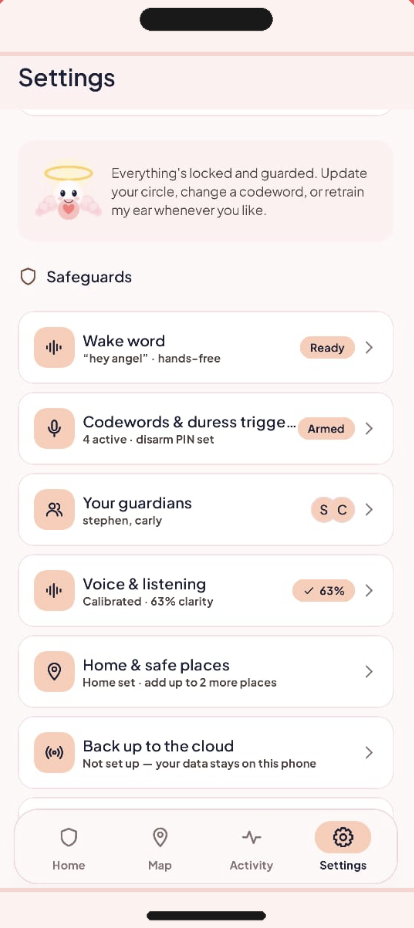
During a journey, Walk with Angel supports ongoing tracking while the phone is locked or another app is open. Personal codewords support actions such as starting a recording, alerting trusted contacts, initiating a guardian call, and sending an all-clear.
Afterward, users can review a session timeline containing transcripts, detected sound events, and route information, then choose whether to export or delete it.
For this hackathon, I added a backend for AI-assisted trip preparation using NVIDIA Nemotron through Nebius Token Factory. The intended workflow turns a general trip description into a concise preparation and check-in plan.
Current status: The backend successfully received a model response during local testing, but the output was incomplete. Completing the response and integrating the feature into the Android interface remain unfinished.
How I built it
The Android application uses Kotlin, Jetpack Compose, Material 3, and Room. Google Maps Compose and Android location services support journey features, while Berkeley Police Department and UCPD open data provide incident context.
The audio pipeline combines:
- sherpa-onnx with Zipformer for wake-word detection.
- CAM++ for voice identification.
- Moonshine Tiny and Silero VAD for transcription.
- YAMNet through LiteRT for sound-event detection.
Audio processing runs on the device, keeping that workflow separate from cloud-based trip planning.
The hackathon addition uses Python and FastAPI to send user-entered trip descriptions to NVIDIA Nemotron 3.5 Lightning through Nebius Token Factory. This entered text leaves the device for processing; it is distinct from the local audio pipeline.
Why Nebius and NVIDIA
A useful preparation plan should reflect the trip someone describes. The intended role of Nemotron is to translate that description into a short, understandable checklist and suggested check-in arrangements that the user can review.
Nebius Token Factory provided the inference endpoint for testing this capability without hosting the language model myself.
The integration is currently an initial backend connection. I have not yet demonstrated a complete AI planning experience inside the Android app.
Challenges
The hardest challenge was coordinating voice commands, location tracking, recordings, and trusted-contact actions in an interface someone could understand under stress.
On-device models also introduce tradeoffs in application size and performance. Wake-word behavior needs further testing across speakers and background noise.
The Nemotron test exposed another important issue: a successful API response does not necessarily produce a usable result. The model exhausted its available output before completing the plan. My next technical priority is to adjust generation settings and response structure, then verify that plans consistently finish.
Accomplishments
I built an Android prototype that connects journey features, voice-activated interactions, and local audio processing in one experience.
During the hackathon, I also added a FastAPI backend and tested a Nebius–Nemotron inference connection. That established the starting point for AI-assisted preparation and identified the output-completion problem that must be resolved before integration.
What I learned
Building a safety companion requires precision about what each feature actually does. Starting a recording, preparing a message, and successfully delivering an alert are different outcomes—and the interface should make those distinctions clear.
I also learned to evaluate the full model response rather than treating a successful request as proof that an AI feature works.
Privacy decisions need the same care. Local audio processing reduces cloud exposure, but stored transcripts still need encryption, and users need clear information about the trip descriptions sent to the AI backend.
What’s next
My immediate priorities are to:
- Produce complete, concise Nemotron plans.
- Connect the planning backend to the Android interface.
- Test the full workflow across varied trip descriptions and measure response time and completion rate.
- Validate codeword and trusted-contact behavior in controlled scenarios.
- Encrypt stored transcripts and gather feedback from potential users.
Guardian Angel remains a prototype. It has not been validated for emergency use. Its purpose is to explore how discreet interactions and thoughtful trip preparation can help users stay connected to people they trust.
Built With
- android
- cam++
- fastapi
- google-maps
- jetpack-compose
- keystore
- kotlin
- litert
- material-3
- moonshine
- nebius-token-factory
- nvidia-nemotron
- python
- room
- sherpa-onnx
- silero-vad
- yamnet
- zipformer

