-
-
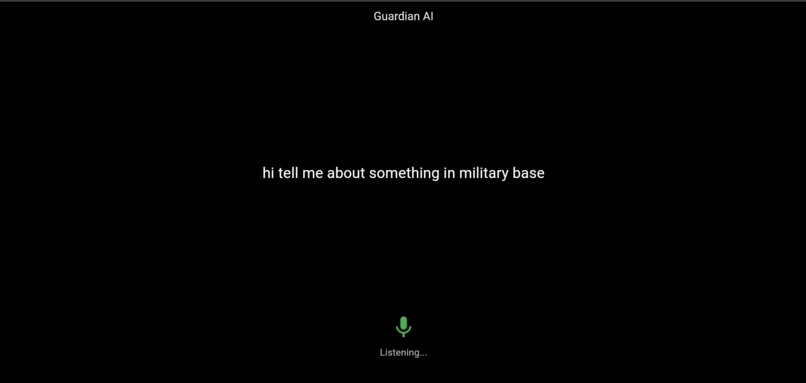
voice input
-
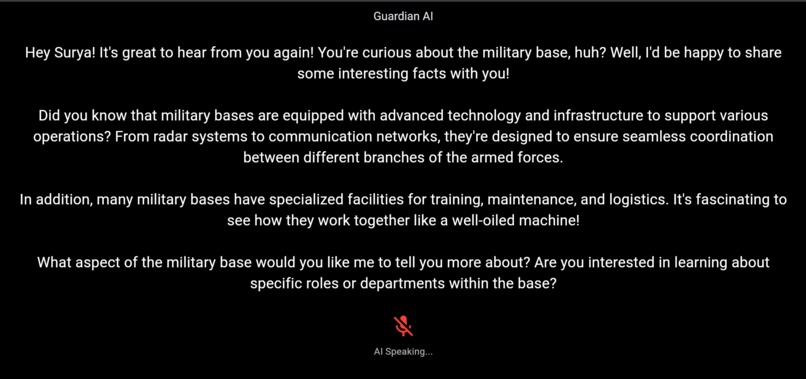
AI output in voice audio
Guardian AI began as a vision to create a truly human-like digital companion inspired by futuristic assistants like JARVIS. Instead of building just another chatbot, the goal was to design an intelligent AI system that could listen, remember, learn, adapt, and interact naturally with users while also controlling real computer applications through voice commands.
The inspiration came from the growing need for personalized AI systems that can assist users emotionally, academically, and professionally. Most assistants today can answer questions, but very few can actually understand habits, remember personal details, automate workflows, and continuously improve themselves over time. Guardian AI was created to bridge that gap between conversational AI and autonomous AI agents.
What Guardian AI Can Do
Guardian AI is capable of:
- Continuous voice interaction
- Emotional understanding
- Personalized memory storage
- Self-learning habit analysis
- Desktop automation
- Workflow execution
- Voice-based application control
- Adaptive AI behavior
- Proactive suggestions
The assistant can open applications like Chrome, VS Code, Spotify, and YouTube, automate tasks, remember user preferences, and even build personalized routines based on repeated interactions.
How We Built It
The project was built using a combination of modern AI and software technologies:
Frontend
- Flutter Web
- Speech Recognition
- Text-to-Speech
- Real-time voice interaction UI
Backend
- Python
- FastAPI
- MongoDB
- Ollama with Llama 3
- Desktop automation libraries
- AI workflow agents
The architecture was designed in multiple intelligent layers:
Voice Input
   ↓
Speech Recognition
   ↓
Intent Detection
   ↓
AI Agent Routing
   ↓
Memory & Emotion Engine
   ↓
Automation / AI Response
   ↓
Voice Output
Guardian AI also includes:
- long-term memory systems
- emotion tracking
- habit learning
- proactive behavior prediction
- adaptive personality modes
Challenges We Faced
One of the biggest challenges was building stable continuous voice interaction without freezing or repeated triggering issues. Managing speech recognition and AI voice output together required multiple debugging iterations and careful synchronization.
Another major challenge was creating a reliable memory system. The AI initially struggled with correctly remembering names and contextual information. We redesigned the memory architecture using MongoDB collections and layered memory retrieval logic.
Voice synthesis compatibility across browsers also created several technical issues, especially during real-time AI conversations. Multiple fixes were implemented to stabilize speech output and maintain continuous listening.
Automation presented another challenge because desktop control requires accurate intent routing and safe execution logic. We solved this by separating:
- AI conversation handling
- system commands
- automation tasks
- autonomous agent workflows
into different execution layers.
What We Learned
Through this project, we learned:
- AI agent architecture design
- voice AI engineering
- memory-driven conversational systems
- desktop automation
- workflow orchestration
- proactive AI behavior modeling
- real-time speech processing
- adaptive user interaction systems
Most importantly, we learned how AI can evolve beyond simple question-answer systems into intelligent companions capable of understanding human behavior and assisting proactively.
Future Vision
Guardian AI is evolving toward becoming a fully autonomous AI operating companion capable of:
- visual screen understanding
- intelligent desktop operation
- predictive assistance
- smart workflow automation
- personalized learning
- multi-device synchronization
The long-term vision is to create an AI companion that feels natural, adaptive, emotionally aware, and genuinely helpful in everyday life.
Built With
- autonomous
- chrome-platforms:-windows
- dart-backend:-python
- emotion-detection
- fastapi-ai-model:-ollama
- frontend:-flutter-web
- git
- habit-learning-development-tools:-vs-code
- llama-3-database:-mongodb-voice-technologies:-speech-recognition
- memory-systems
- screen-analysis
- text-to-speech-(tts)-automation:-pyautogui
- ui
- web-application-future-integrations:-computer-vision
- web-automation-desktop-control:-python-system-commands-&-automation-scripts-architecture:-ai-agents

Log in or sign up for Devpost to join the conversation.