-
-
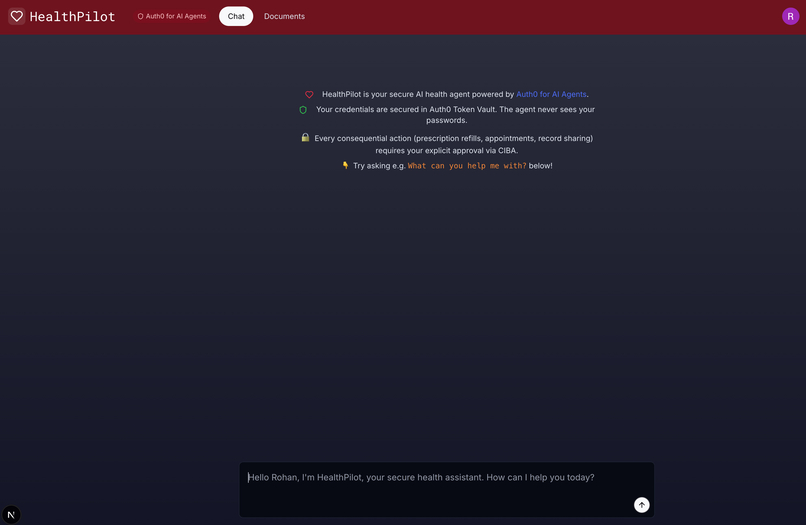
Healthpilot chat interface
-
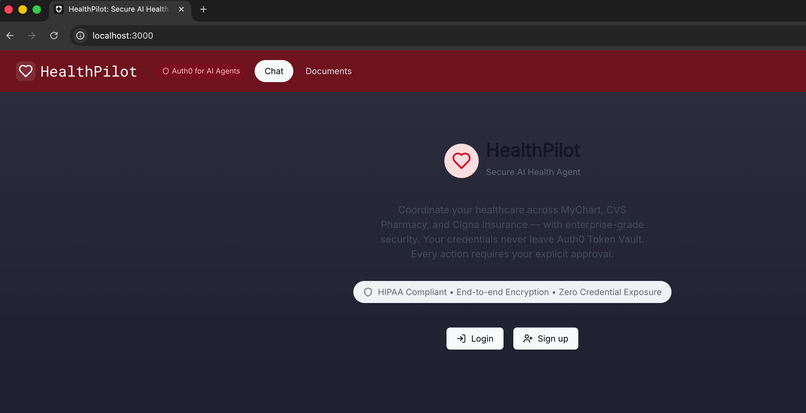
Login/Signup HealthPilot
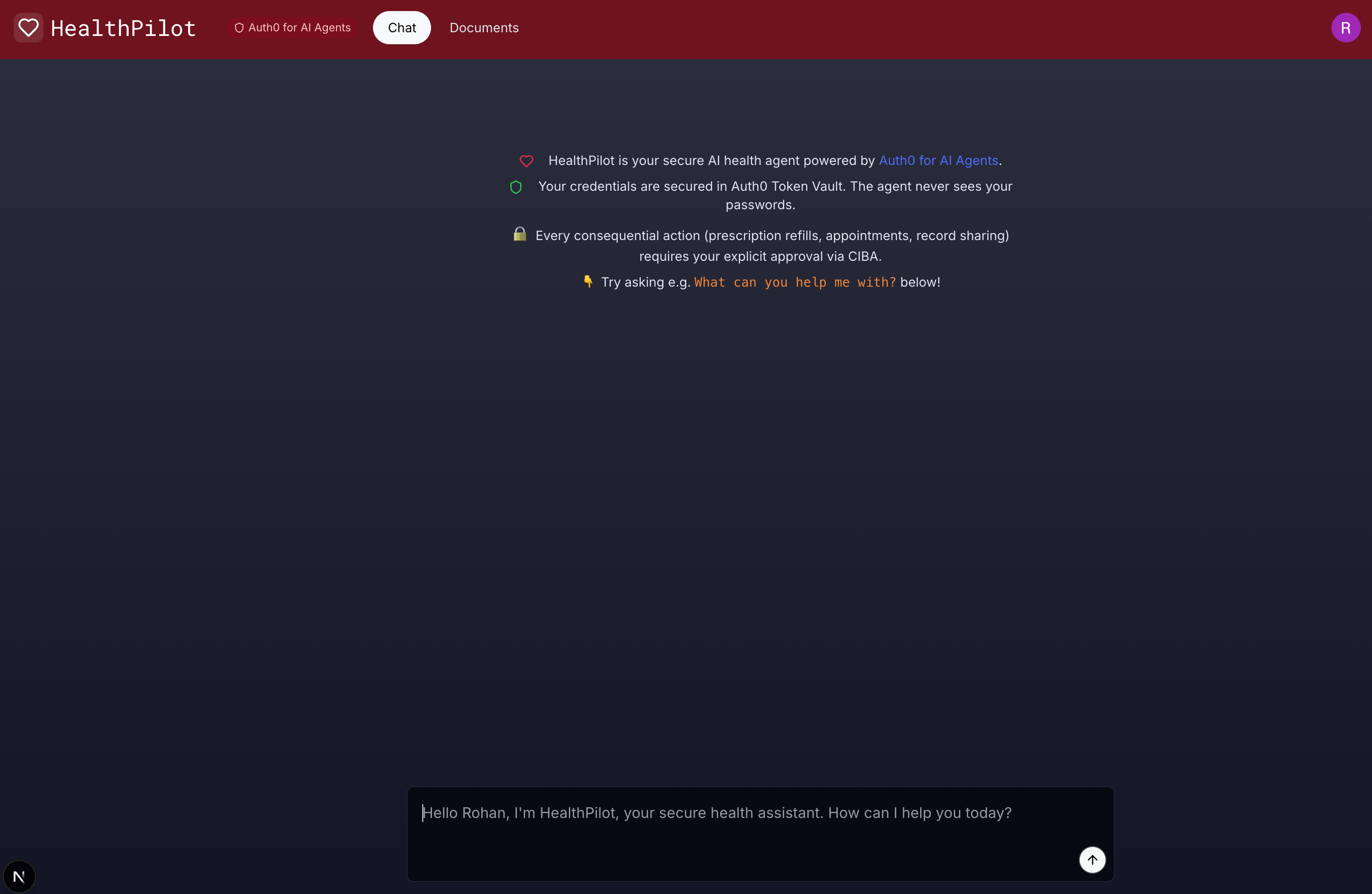
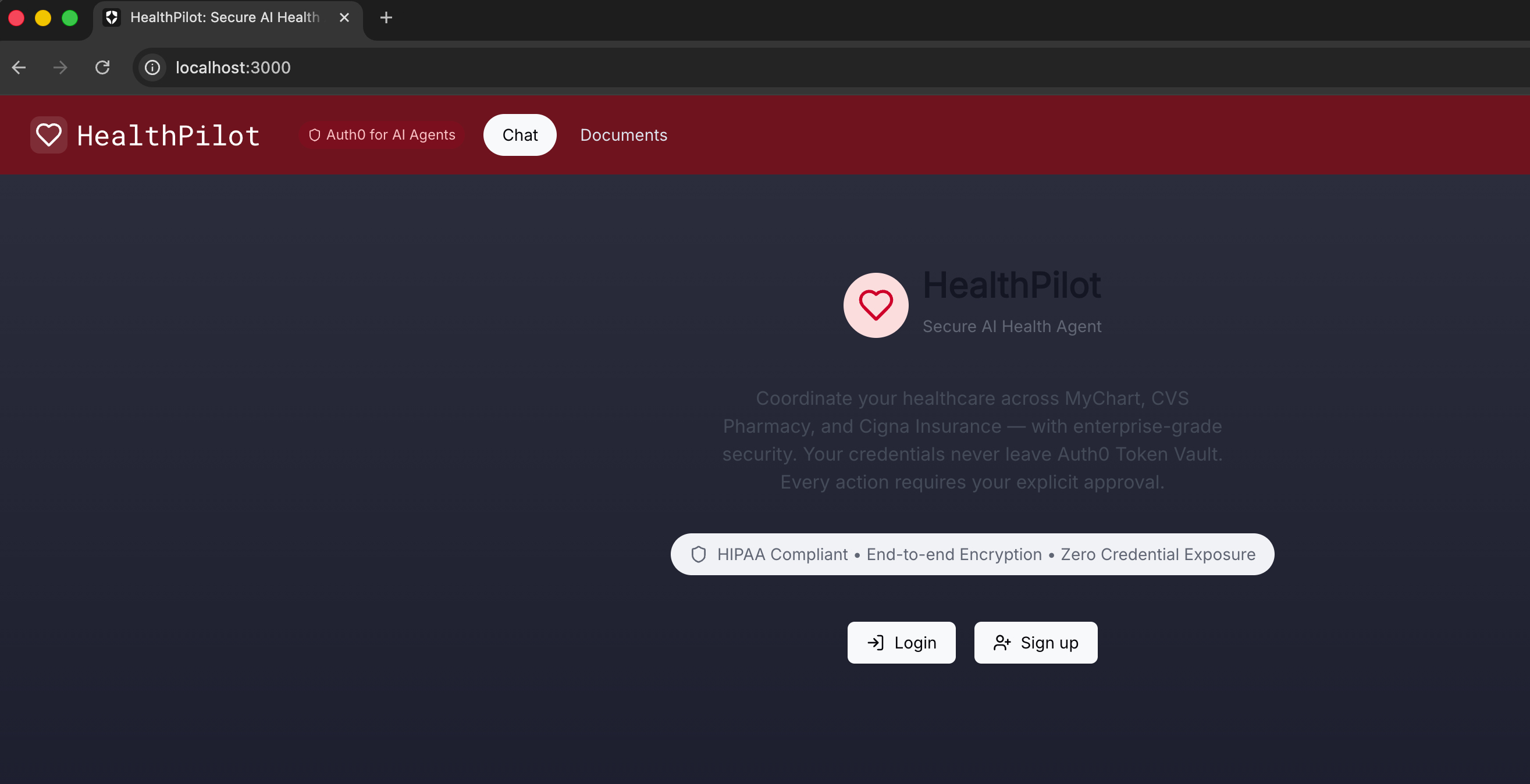
HealthPilot: Secure AI Health Agent
Blog Post: https://medium.com/@rohan4gphics/healthpilot-what-responsible-ai-healthcare-actually-looks-like-1510e0029240
The Problem
Healthcare is the highest-stakes domain for AI agents. A coding assistant that hallucinates is annoying. An AI health agent that leaks your lab results to the wrong person, requests a prescription refill without your knowledge, or shares your cardiac records with an unauthorized provider is a HIPAA violation, a safety incident, and a trust catastrophe all at once.
We kept seeing the same pattern in AI agent demos:
- Credentials hardcoded in
.envfiles - No user consent before irreversible actions
- RAG pipelines that blindly feed every document to the LLM regardless of who's asking
These aren't edge cases. They're the default.
The Solution
What does a production-ready AI agent look like when you take security as seriously as capability?
The answer turned out to be Auth0 for AI Agents as the actual architecture.
- Token Vault meant our agent could coordinate across Epic, CVS Pharmacy, and Cigna Insurance without ever touching a credential
- CIBA meant a patient's phone had to be physically approved before a refill was requested
- FGA meant the LLM was structurally incapable of reading another patient's records
HealthPilot is a secure AI health agent that coordinates a patient's care across multiple healthcare systems, hospital portals, pharmacies, and insurance providers using natural language. Every Auth0 for AI Agents feature is exercised with genuine, high-stakes justification.
What It Does
1. Token Vault · Coordinates Across Real External Systems, Never Touching a Credential
The patient connects MyChart (Epic), CVS Pharmacy, and Cigna Insurance once. The agent accesses each using short-lived, user-scoped OAuth tokens managed by Auth0 Token Vault.
Three separate vault entries — a breach of one pharmacy token does not compromise insurance tokens.
2. CIBA · Rich Authorization Requests Requires Explicit Approval
When the agent decides a prescription refill is needed, or wants to book a cardiology appointment, or is about to share records with a new provider, it stops. It sends a CIBA request to the patient's device with a RAR payload showing exactly what is being done and why.
{
  "action": "refill_prescription",
  "medication": "Lisinopril 10mg",
  "pharmacy": "CVS Pharmacy - Main St",
  "refills_remaining": 2
}
The agent cannot proceed until the patient approves from their phone.
3. Auth0 FGA · Retrieval-Layer Filtering
Auth0 Fine-Grained Authorization checks every document against the patient's permission tuples before passing anything to the LLM.
Not prompt-level filtering — retrieval-layer filtering. The model is structurally incapable of generating a response using data the patient isn't authorized to see.
Technical Architecture
Stack
- Frontend: Next.js 15, Tailwind CSS
- AI: LangGraph.js, LangChain.js, OpenAI GPT-4o-mini
- Auth: Auth0 for AI Agents (Token Vault, CIBA, FGA)
- Database: PostgreSQL with Drizzle ORM
Key Features Implemented
Token Vault Connections (
src/lib/auth0-ai.ts)withMyChart()- Epic MyChart EHR accesswithCVSPharmacy()- Prescription managementwithCignaInsurance()- Claims and coverage
CIBA Authorization (
src/lib/auth0-ai.ts)withAsyncAuthorization()wrapper for consequential actions- Rich Authorization Request (RAR) payloads
- Interrupt handling with phone-based approval
FGA-Enabled RAG (
src/lib/tools/health-docs.ts)- Document-level access control
- Retrieval-layer filtering before LLM context
- HIPAA-compliant document permissions
Healthcare Tools (
src/lib/tools/)mychart.ts- Medical records, appointmentscvs-pharmacy.ts- Prescriptions, refills, pharmacy findercigna-insurance.ts- Claims, coverage, eligibilityhealth-docs.ts- FGA-filtered health documents
Security Model
| Feature | Protection |
|---|---|
| Token Vault | Credentials never leave Auth0; short-lived OAuth tokens only |
| CIBA | Patient must physically approve every refill/appointment |
| FGA | Model cannot access unauthorized documents at any layer |
| RAG Filtering | Retrieval-layer rejection before LLM sees content |
Demo Scenarios
"Do I have any prescriptions that need refilling?"
- Agent retrieves prescriptions from CVS
- Shows which need refills
- If user asks to refill → CIBA approval required
"Book me a cardiology appointment"
- Agent collects specialty, date, reason
- Sends CIBA request to phone
- Only proceeds after explicit approval
"What were my last lab results?"
- Agent retrieves from MyChart via Token Vault
- FGA verifies document permissions
- Returns only authorized results
"What's my deductible?"
- Agent queries Cigna via Token Vault
- Displays coverage details
- No credentials exposed
Why This Matters
This is what responsible AI agents should look like.
The difference between a flashy demo and a production-ready system isn't capability — it's security architecture that treats healthcare data like what it is: someone's life, depending on you getting it right.
HealthPilot demonstrates that with the right security primitives, AI agents can genuinely help patients without compromising their most sensitive information.
Future Directions
- Real FHIR API integration for MyChart
- Multi-provider record sharing with granular consent
- Insurance prior authorization automation -Voice-based CIBA approval
- Audit logging for HIPAA compliance
Built with Auth0 for AI Agents, LangGraph.js, and Next.js
Built With
- auth0
- bun
- javascript
- nextjs
- react
- tailwind
- typescript


Log in or sign up for Devpost to join the conversation.