-
-
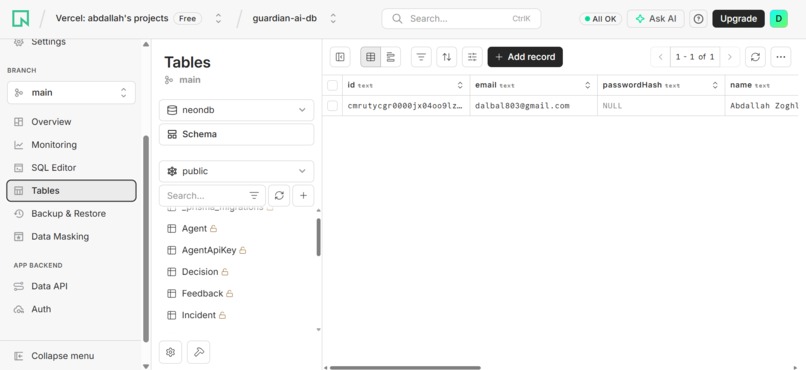
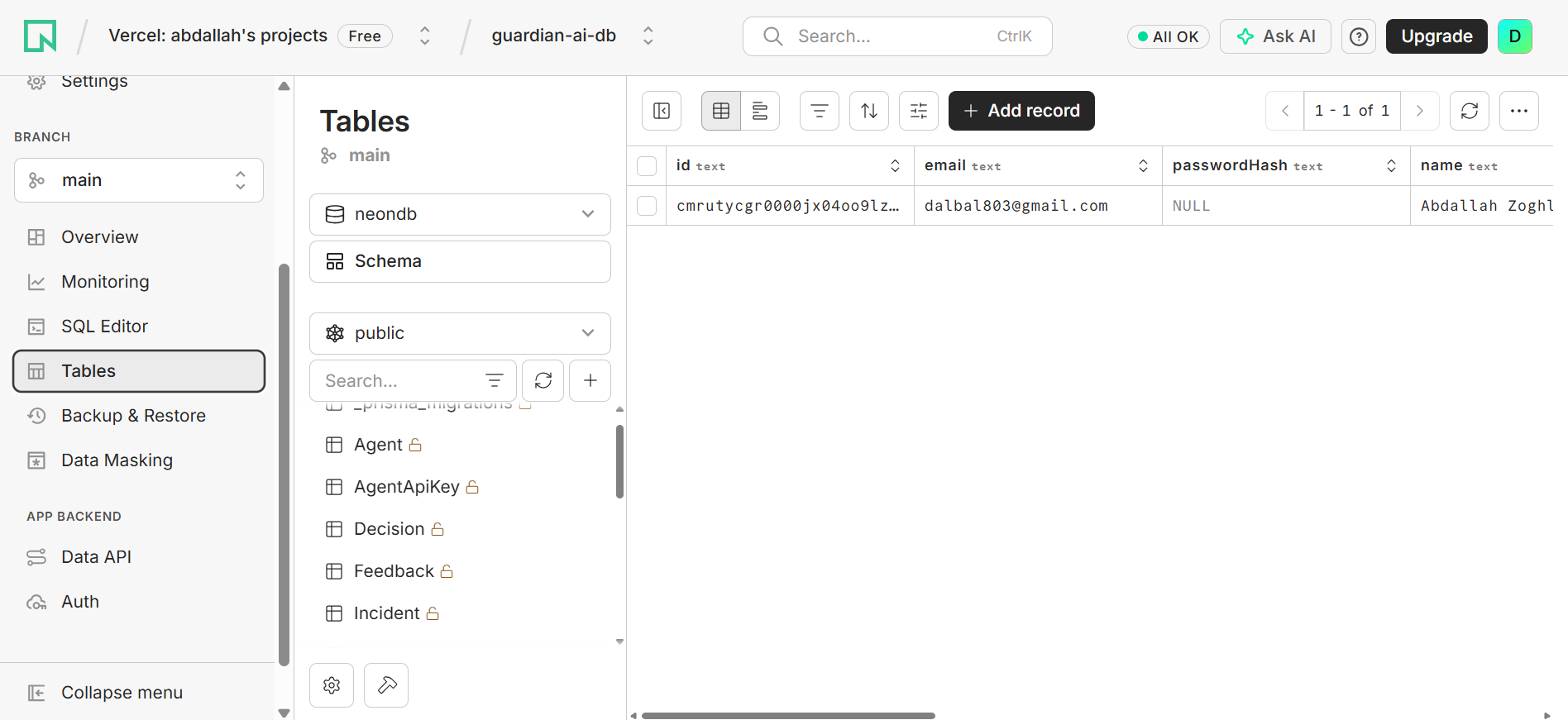
Neon_DB
Inspiration
AI applications are evolving rapidly, but managing them in production has become one of the biggest challenges in modern software engineering.
Teams deploying LLMs, AI agents, and autonomous workflows often struggle with rising API costs, unpredictable latency, hallucinations, infrastructure failures, and inefficient resource utilization. Existing monitoring platforms can show metrics, but they rarely explain why problems happen or how to fix them.
We built Guardian AI to become the intelligence layer between AI applications and their infrastructure—transforming raw telemetry into actionable decisions that help developers build faster, operate more efficiently, and reduce costs.
What it does
Guardian AI is an AI Infrastructure Intelligence Platform that continuously analyzes AI workloads and provides actionable insights for production systems.
Instead of simply displaying dashboards, Guardian AI investigates the behavior of AI applications, identifies bottlenecks, explains failures, and recommends optimizations before they become expensive problems.
The platform combines three intelligent engines:
💰 Cost Intelligence Engine
Analyzes AI spending across models, agents, users, and requests. Detects abnormal cost spikes, identifies inefficient prompts, and recommends strategies such as model routing, caching, batching, and context optimization to reduce operational expenses.
🔍 Failure Investigation Engine
Automatically reconstructs execution timelines of AI requests to determine the root cause of failures, including API errors, latency, hallucinations, model timeouts, or orchestration issues.
⚡ Resource Optimization Engine
Monitors CPU, RAM, GPU, and latency utilization to identify performance bottlenecks and suggest optimizations such as quantization, workload balancing, request batching, model selection, and context compression.
Together, these engines help organizations build AI systems that are more reliable, faster, and significantly less expensive to operate.
How we built it
Guardian AI combines modern cloud infrastructure with OpenAI models to transform infrastructure telemetry into meaningful engineering insights.
Our architecture includes:
Next.js for the interactive dashboard and analytics interface and for the backend services and intelligent analysis engine (TypeScript) AWS Aurora PostgreSQL for structured analytics and historical metrics AWS DynamoDB for high-volume telemetry and event storage Vercel for deployment and frontend hosting
During development we used Codex extensively to accelerate implementation, generate backend components, refactor APIs, and speed up repetitive engineering tasks.
GPT-5.6 powers the intelligent interpretation layer by analyzing infrastructure events, explaining failures in natural language, identifying optimization opportunities, and transforming complex system telemetry into actionable recommendations that engineers can immediately apply.
Challenges we ran into
Designing Guardian AI required solving several difficult engineering problems.
One challenge was converting millions of low-level infrastructure events into concise, human-readable insights instead of overwhelming users with raw metrics.
Another challenge was correlating AI requests across multiple execution stages in order to accurately reconstruct failure timelines and identify the true root cause instead of only reporting symptoms.
Finally, balancing a simple user experience with sophisticated backend analytics required multiple iterations of the system architecture.
Accomplishments that we're proud of
Built a complete AI infrastructure intelligence platform rather than a simple chatbot. Designed an architecture capable of monitoring production AI workloads. Integrated intelligent cost analysis, failure investigation, and resource optimization into one unified platform. Created an extensible foundation that can evolve into a fully autonomous AI operations platform.
What we learned
Building AI applications is no longer the hardest problem.
Operating AI systems efficiently, understanding their behavior, controlling costs, and maintaining reliability at scale has become the next major challenge.
We learned that developers don't need more dashboards—they need systems that understand their infrastructure and explain what actions should be taken.
What's next for Guardian AI
Our vision is to transform Guardian AI into a complete AI Operating System for production AI infrastructure.
Future versions will automatically optimize model routing, predict failures before they occur, dynamically allocate compute resources, reduce operational costs without human intervention, and continuously learn from production telemetry to improve every AI workload over time.
Ultimately, Guardian AI aims to become the intelligent control plane for the next generation of AI-native applications.
Built With
- ai
- codex
- gpt-5.6
- ml
- nextjs
- postgresql
- prisma
- restapi
- typescript
- vercel
