-
-
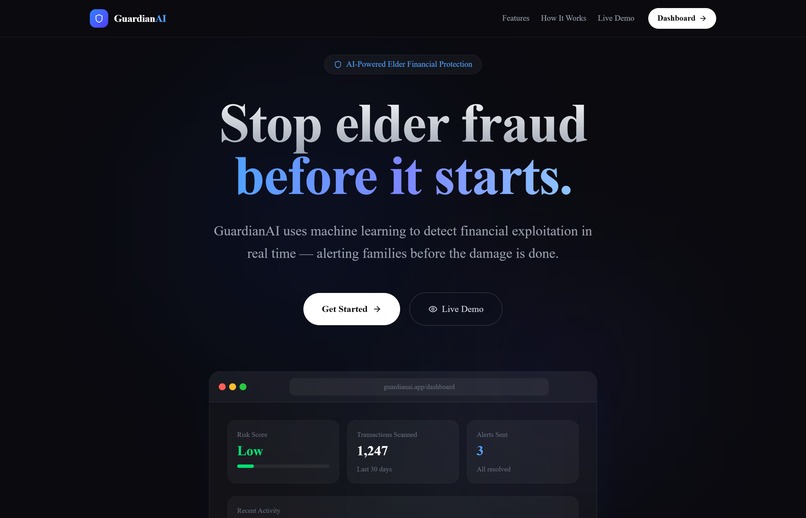
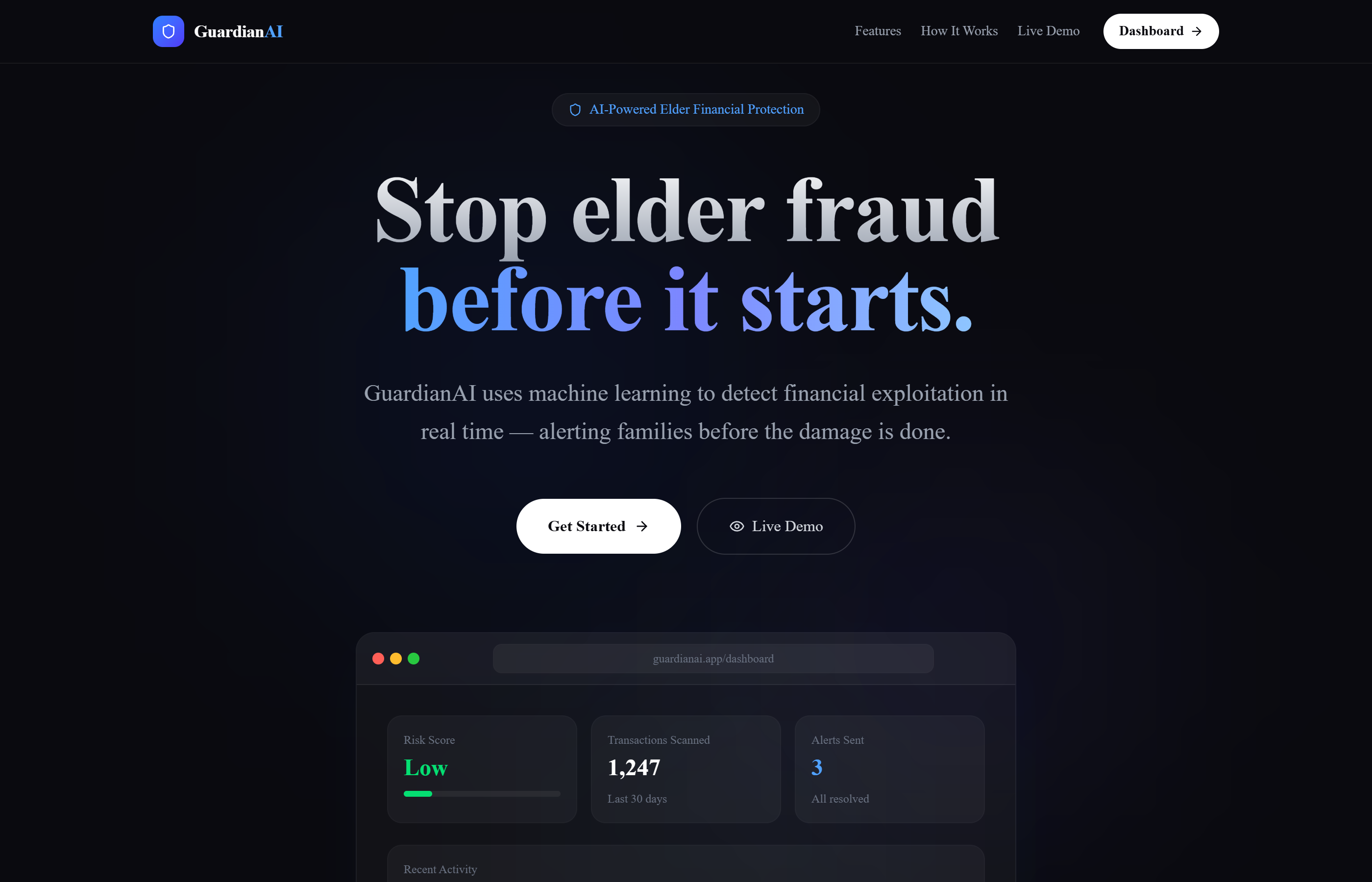
Landing page
-
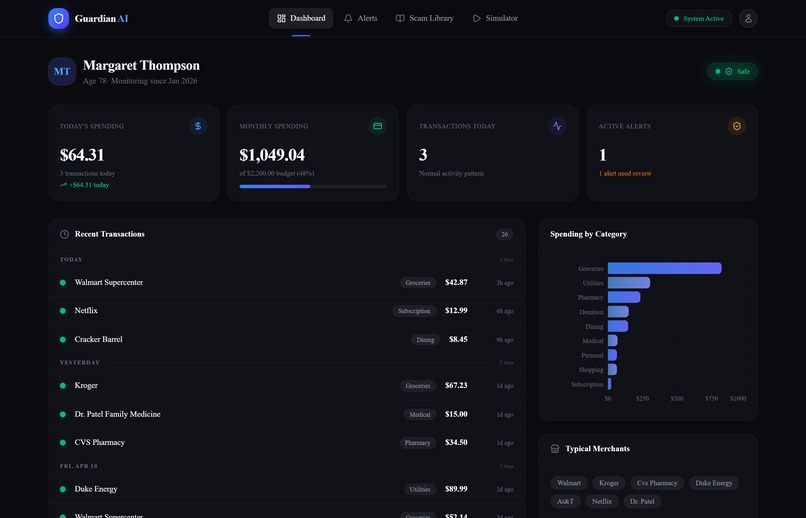
Dashboard
-
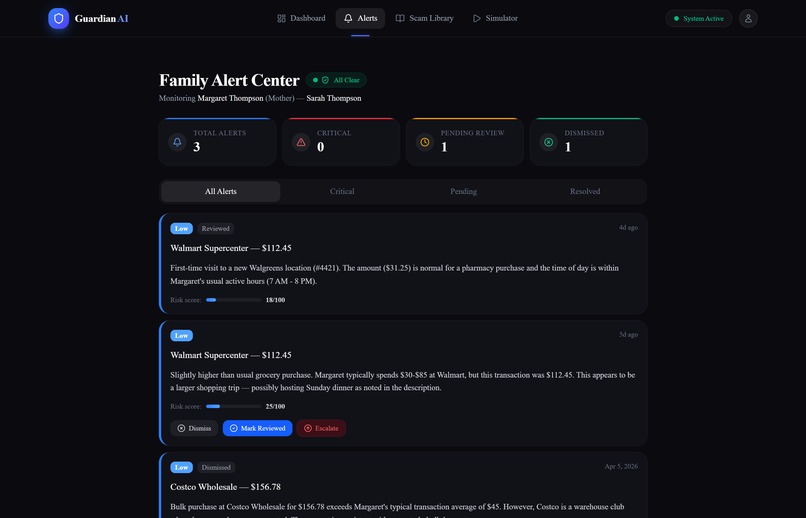
Family alerts
-
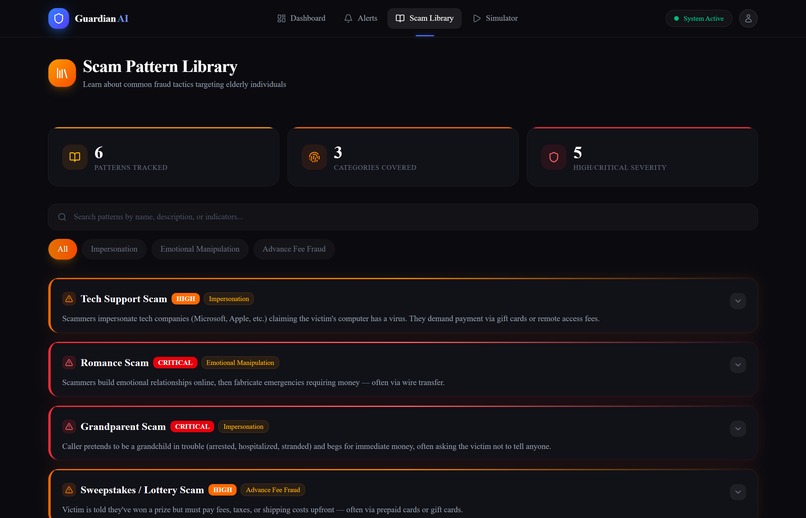
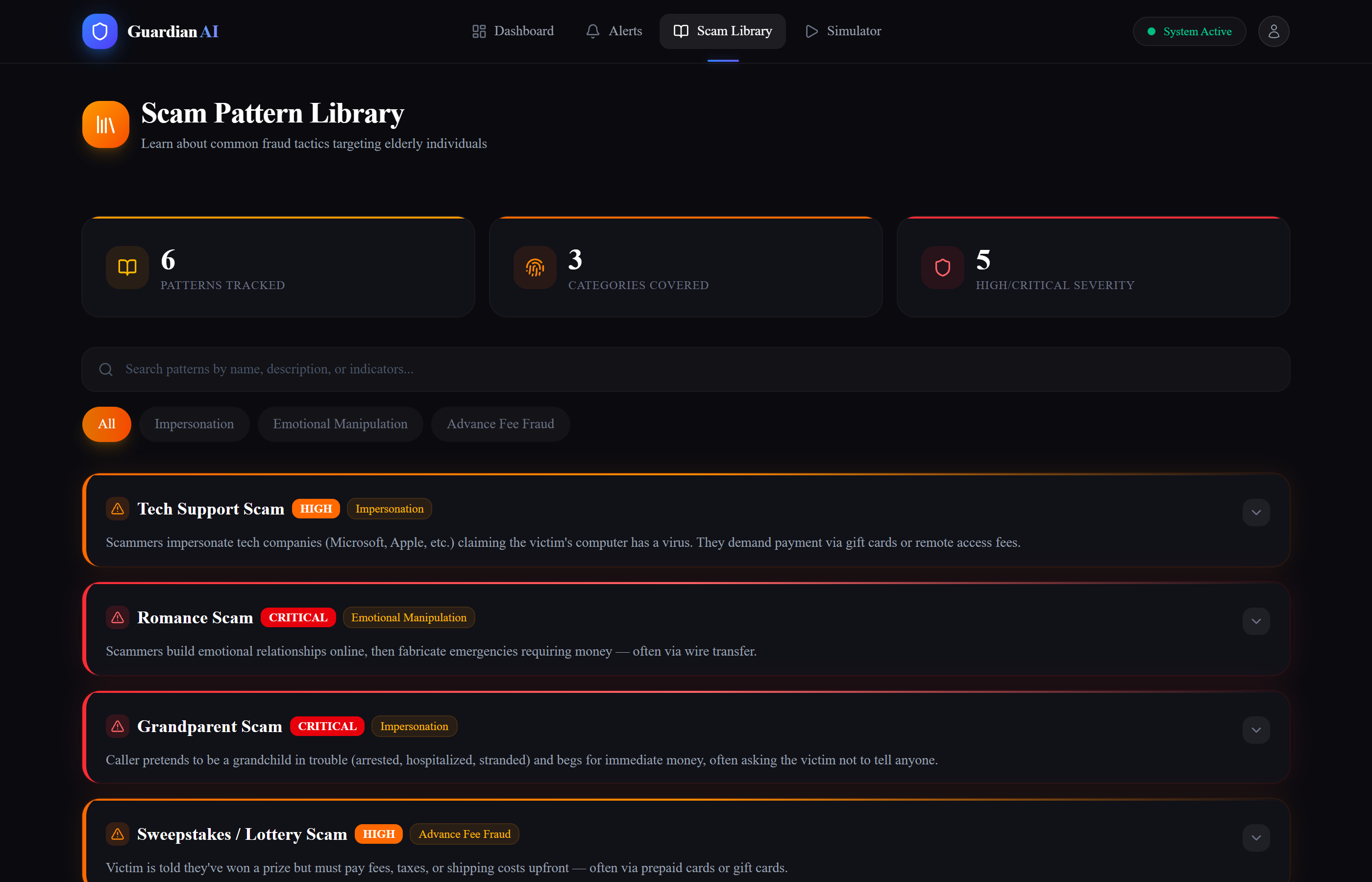
Scam Patterns
-
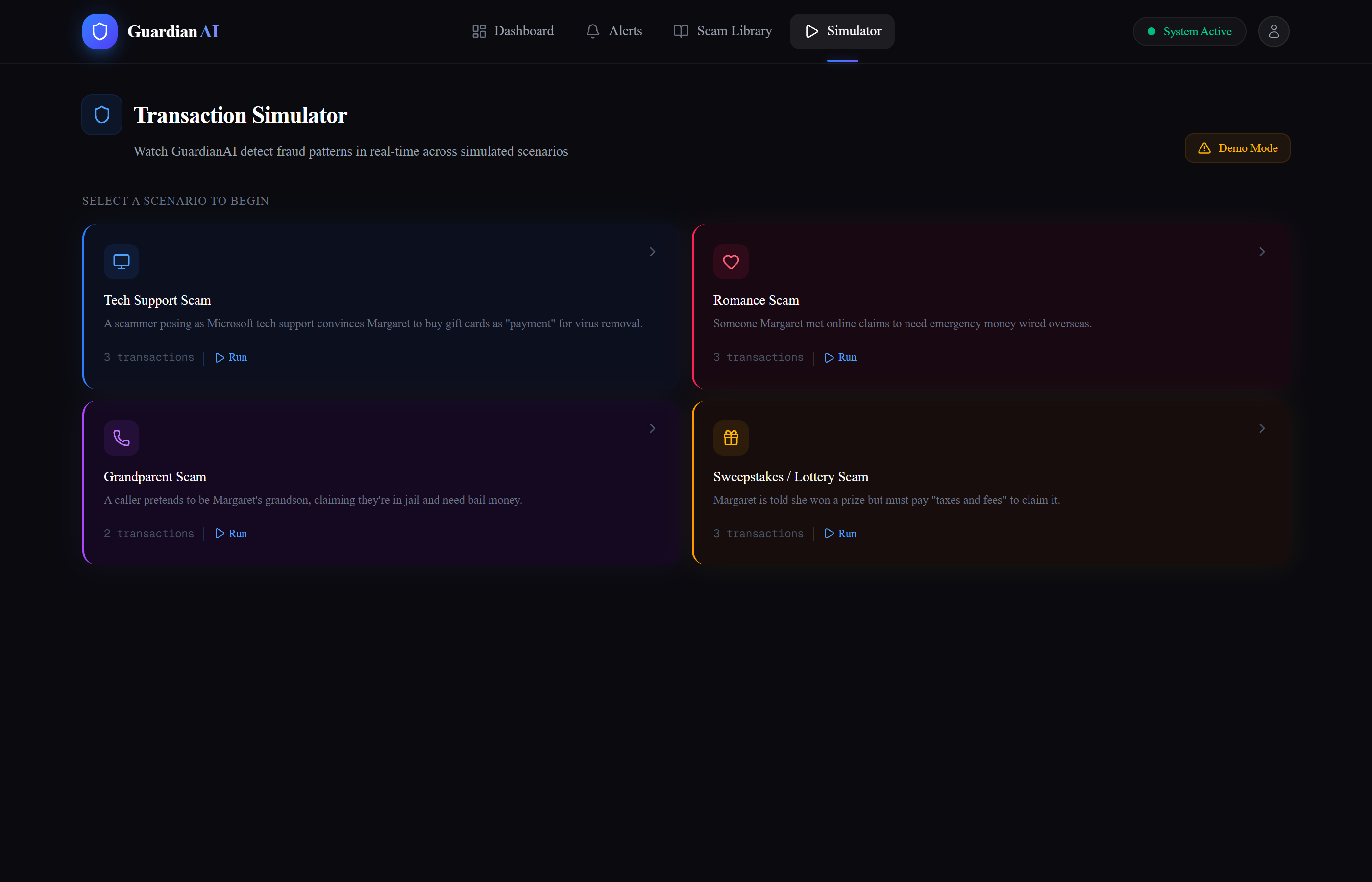
Transaction Simulator
Inspiration
My grandmother lost $4,200 to a phone scammer pretending to be from Medicare. By the time our family found out, the money was gone and so was her confidence. She stopped answering the phone entirely -- even when her doctor's office called.
She is not an outlier. According to the FBI's 2023 Internet Crime Complaint Center (IC3) report, Americans over 60 reported $3.4 billion in fraud losses -- an 11% increase year over year. The true number is far worse: an estimated $28.3 billion is lost annually to elder financial fraud, because only 1 in 44 cases ever gets reported. One in five seniors will be targeted. The victims are often isolated, embarrassed, and unlikely to tell anyone what happened.
The financial industry's response? Retroactive fraud flags that arrive days later, buried in jargon that seniors cannot parse and family members never see. By the time a suspicious charge is noticed, the damage is done -- not just financially, but emotionally. Seniors lose trust in themselves, withdraw from independence, and the family relationships that could have helped are left out of the loop entirely.
I built GuardianAI because the people who love our elders should not have to wait for a crisis to find out something is wrong. Early detection and plain-language communication can turn a devastating loss into a prevented one.
What it does
GuardianAI is a real-time financial fraud detection and family alert system designed specifically for protecting elderly individuals. It bridges the gap between suspicious financial activity and the family members who can intervene -- before the money is gone.
7-Rule Anomaly Detection Engine Every transaction runs through seven distinct detection rules, each targeting a specific fraud pattern documented in elder abuse research:
- Amount Spike Detection -- flags transactions that deviate significantly from a senior's established spending baseline
- Velocity Monitoring -- catches rapid-fire small charges (a hallmark of card testing and drip fraud)
- New Merchant + High Amount -- identifies first-time merchants requesting unusually large payments
- Scam Category Matching -- cross-references transaction categories against known elder fraud verticals (gift cards, wire transfers, cryptocurrency, tech support)
- Merchant Keyword Analysis -- scans merchant names for red-flag terms associated with common scams
- Time Anomaly Detection -- flags purchases made at unusual hours, since many phone scams pressure seniors into late-night transactions
- Escalation Pattern Recognition -- detects the classic fraud trajectory where small "test" charges escalate to large withdrawals
Claude AI Plain-English Explanations When the engine flags a transaction, Claude AI generates a clear, jargon-free explanation of why it is suspicious, what the potential scam type is, and what steps the family should consider. No fraud codes, no acronyms -- just language that a concerned daughter or grandson can read and act on immediately.
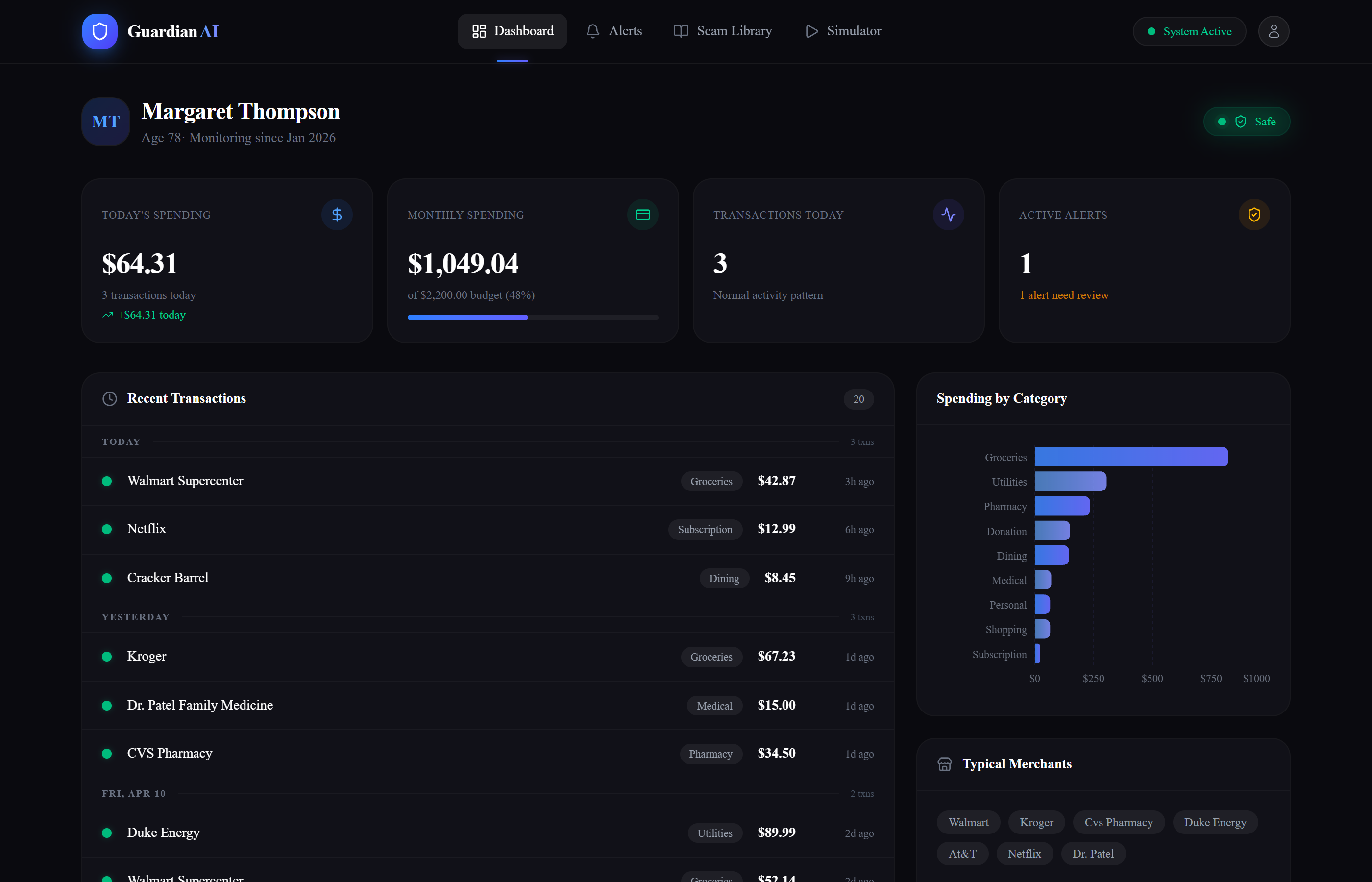
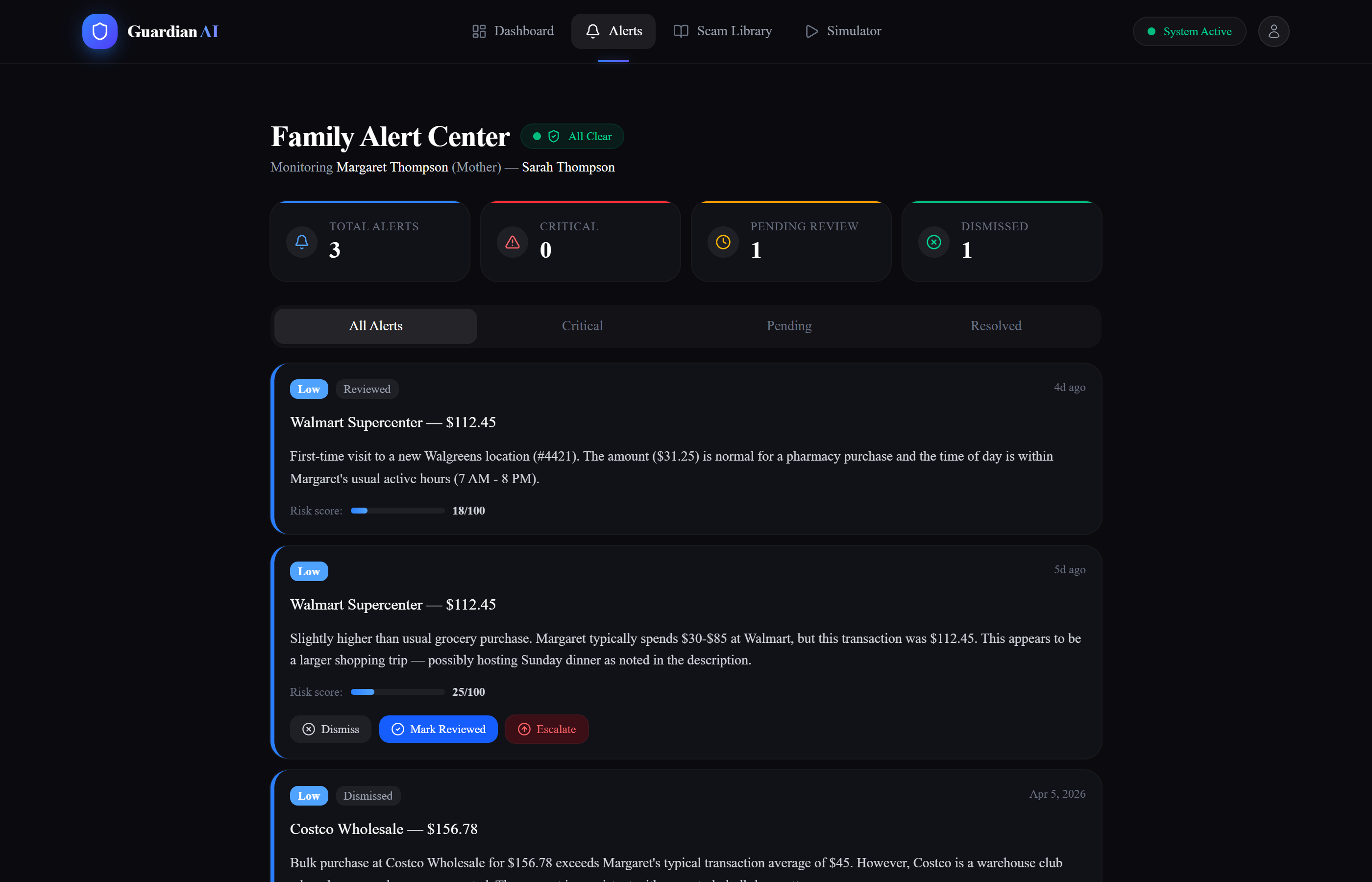
Real-Time Family Alert Dashboard Family members get a live dashboard showing flagged transactions, risk scores, trend visualizations via Recharts, and the AI-generated explanations. Supabase Realtime ensures alerts appear the moment a suspicious transaction is detected -- not hours or days later.
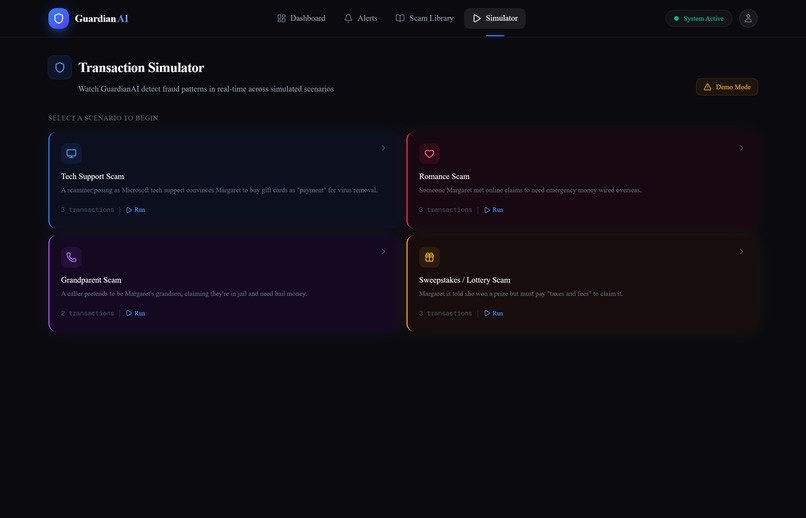
Interactive Scam Simulator Four realistic scam scenarios (grandparent scam, tech support fraud, romance scam, fake charity) let families experience how these schemes unfold. This is not a passive educational page -- users make decisions at each stage and see how the fraud escalates, building real pattern recognition.
Scam Pattern Education Library A curated reference of common elder fraud tactics, warning signs, and prevention strategies, organized for quick lookup when a family suspects something is off.
Email Notifications via Resend Critical alerts are pushed via email so family members do not need to be watching the dashboard 24/7.
How we built it
Architecture: GuardianAI is a full-stack Next.js 16 application deployed on Vercel, with Supabase providing the data layer and Claude AI powering the intelligence layer.
- Frontend: Next.js 16 with TypeScript and Tailwind CSS 4. The App Router handles server-side rendering for the dashboard and API routes for the detection engine. Recharts powers the interactive risk trend visualizations.
- Database & Realtime: Supabase (PostgreSQL) stores transaction records, user profiles, family relationships, and alert history. Row Level Security (RLS) policies ensure family members can only access data for their linked seniors. Supabase Realtime pushes flagged transaction alerts to connected dashboard clients instantly via WebSocket subscriptions.
- AI Layer: Anthropic's Claude API generates the plain-English fraud explanations. Each flagged transaction is sent to Claude with the detection rule context, the transaction metadata, and the senior's spending profile. Claude returns a structured explanation covering the risk assessment, probable scam type, and recommended actions -- all written at a reading level appropriate for stressed family members.
- Detection Engine: The 7-rule anomaly detection system runs server-side in Next.js API routes. Each rule operates independently and produces a confidence score. Scores are aggregated with weighted averaging -- category matching and escalation patterns carry higher weight because they have higher precision in elder fraud specifically.
- Email Alerts: Resend handles transactional email delivery for high-severity alerts, ensuring family members get notified even when they are not actively checking the dashboard.
- Deployment: Vercel handles CI/CD with automatic preview deployments on every push. Environment variables manage Supabase keys, Anthropic API keys, and Resend credentials securely.
Challenges we ran into
Calibrating detection sensitivity without real transaction data. The hardest problem was not building the rules -- it was tuning them. Too sensitive and every grocery trip triggers an alert, causing alert fatigue that defeats the entire purpose. Too loose and actual fraud slips through. I built a synthetic transaction generator that models realistic senior spending patterns (fixed income, pharmacy visits, grocery stores, occasional online purchases) and layered in known fraud patterns from FTC and IC3 case studies to test against.
Making Claude's explanations genuinely useful under pressure. Early prompts produced explanations that were accurate but clinical. When your parent's account has a suspicious charge, you do not want a textbook explanation of velocity monitoring -- you want to know "Your mom was charged $300 at a gift card kiosk at 11 PM, which does not match her normal spending. This looks like a common gift card scam. Here is what to do right now." Getting Claude to consistently produce that level of specificity and empathy required extensive prompt engineering and output validation.
Row Level Security for family relationship graphs. Supabase RLS is powerful but designing policies for a many-to-many family-to-senior relationship model where permissions cascade correctly took more iteration than expected. A daughter should see her mother's alerts but not her neighbor's, even if they share a family member in the system.
Balancing education with urgency.The scam simulator needed to be engaging enough that people actually complete it, but serious enough that they internalize the patterns. Finding that tone -- informative without being preachy, realistic without being traumatizing -- required multiple rounds of user feedback.
Accomplishments that we're proud of
- The 7-rule detection engine catches the specific fraud patterns documented in FBI IC3 elder fraud reports, not generic anomaly detection repurposed from a different domain. Every rule maps to a real attack vector.
- Claude AI explanations that a non-technical family member can read at 2 AM when they get an alert and immediately understand what is happening and what to do. This is the feature I tested most with real people.
- The scam simulator with 4 interactive scenarios. Most fraud education is a wall of text nobody reads. The simulator makes people feel the psychological pressure that scammers apply, which is far more effective at building resilience.
- Full Supabase Realtime integration -- alerts appear on the family dashboard within seconds of detection, not on the next business day.
- A working, deployed product at https://guardian-ai-beige.vercel.app -- not a slide deck, not a mockup. You can interact with every feature right now.
What we learned
Elder fraud is a systems failure, not a user failure. Seniors are not getting scammed because they are gullible. They are getting scammed because financial institutions detect fraud in ways that exclude the family safety net, communicate in jargon that obscures urgency, and treat alerts as liability protection rather than actual protection. The gap between "fraud detected" and "family informed and empowered to act" is where billions of dollars disappear.
AI explanations need emotional intelligence, not just accuracy. The technical accuracy of a fraud alert is table stakes. What actually matters is whether the person reading it at midnight can make a good decision in the next five minutes. That requires Claude to understand not just what happened, but who is reading the explanation and what they need to do.
Supabase + Next.js + Vercel is a genuinely powerful rapid-prototyping stack. Going from database schema to deployed real-time application in days -- with RLS, auth, and WebSocket subscriptions -- would have taken weeks with a traditional backend setup.
The scam simulator was the feature people talked about most. When I showed early versions to friends and family, the detection engine impressed them technically, but the simulator is what changed their behavior. Experiencing a scam's psychological pressure firsthand -- even in simulation -- is fundamentally different from reading about it.
What's next for GuardianAI
- Bank API Integration -- Connect to real financial data via Plaid or Open Banking APIs to monitor actual transactions instead of simulated ones
- SMS/Push Alerts -- Add Twilio SMS and mobile push notifications for family members who do not check email frequently
- Multi-Senior Support -- Expand the family dashboard to manage alerts for multiple elderly family members from a single account
- Configurable Sensitivity -- Let families adjust detection thresholds based on their senior's actual spending patterns and risk tolerance
- Voice Call Monitoring Integration -- Partner with phone carriers or smart home devices to flag suspicious incoming calls in real time
- Community Reporting -- Let families flag confirmed scam merchants to improve detection accuracy for all GuardianAI users
- Institutional Partnerships -- Work with elder care facilities, senior centers, and Area Agencies on Aging to deploy GuardianAI as a standard protective tool
- Mobile App -- Native iOS/Android companion app for family caregivers who need alerts on the go
Built With
- next.js
- resend
- supabase
- tailwind
- vercel

Log in or sign up for Devpost to join the conversation.