-
-
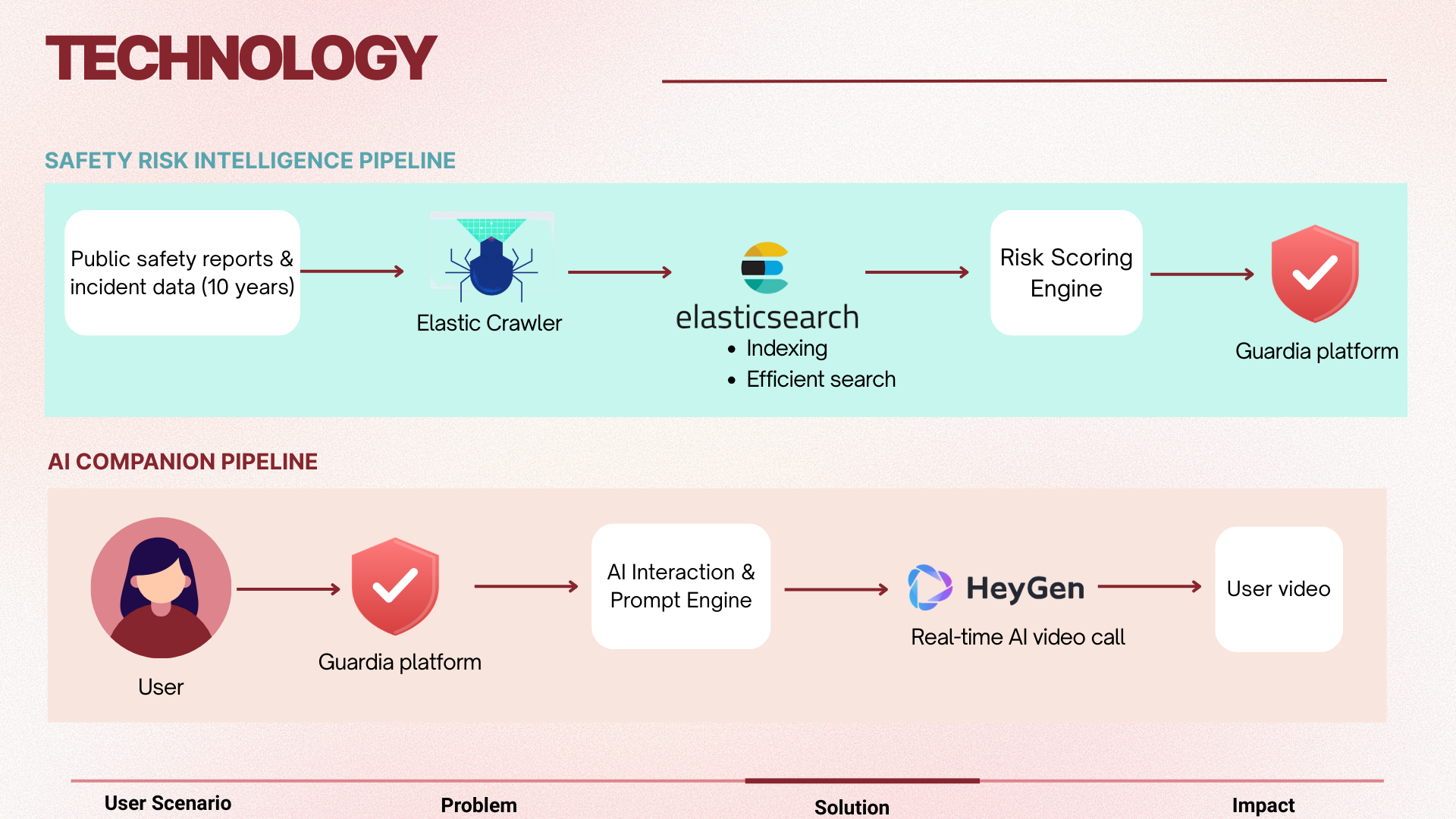
Technology
-
Solution Overview
-
Solution Demo
-
Problems
-
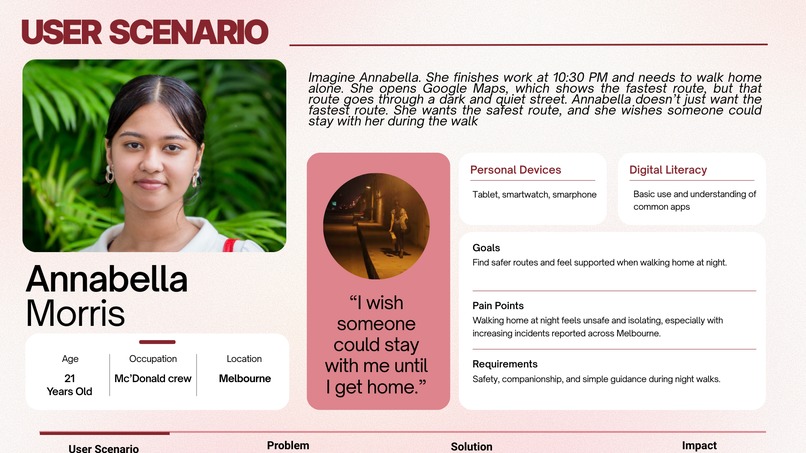
User Scenario
-
Intro
-
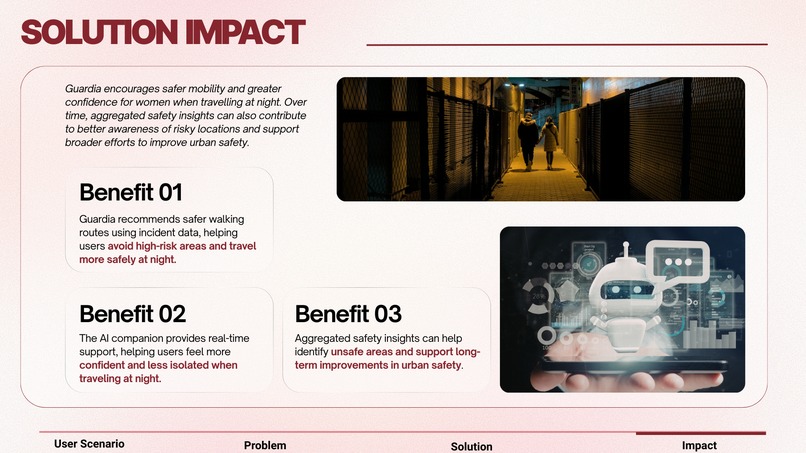
Solution impact
-

Ending

Guardia
$$ \textbf{Walk Home Safer — A real-time safety companion for women walking alone at night} $$
Inspiration
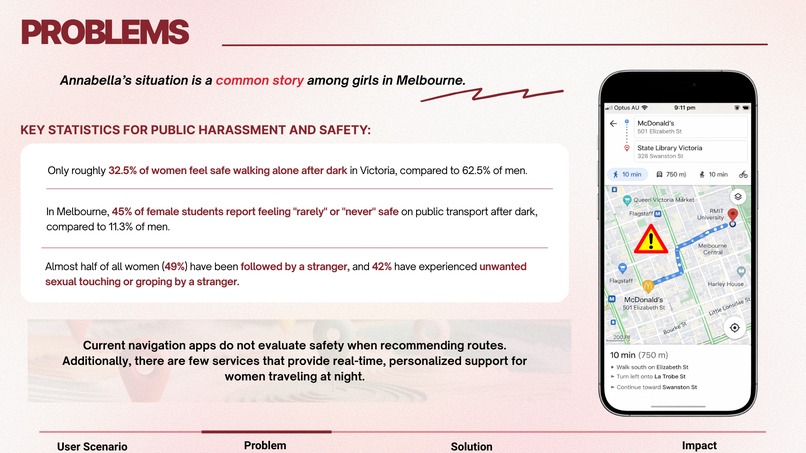
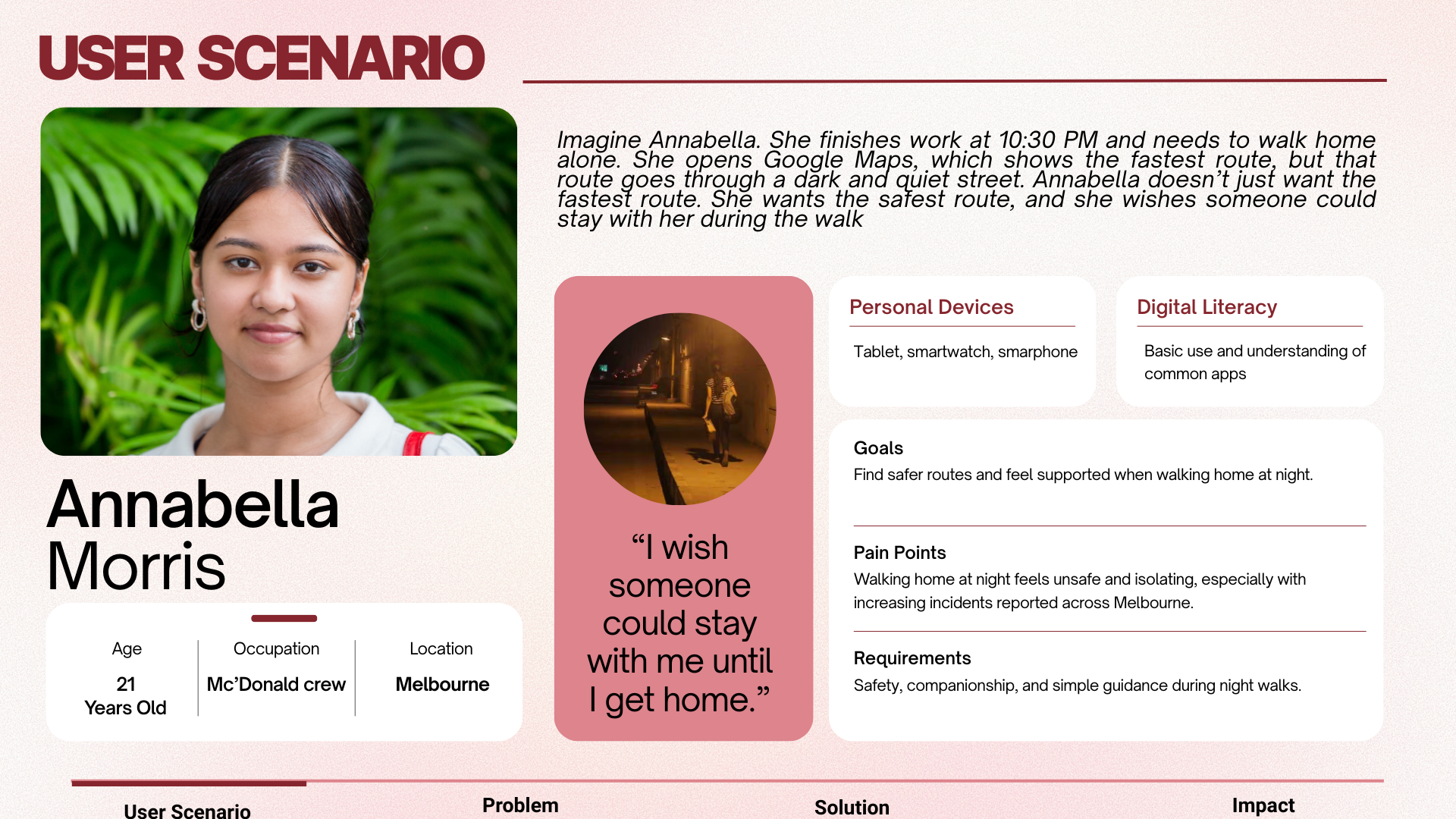
One of our teammates shared her experience of walking home alone at night. Even though the distance was short, it often felt uncomfortable and stressful. She had heard many news reports about crimes happening at night and had experienced situations where strangers seemed to follow her on the street.
Those moments created a constant feeling of fear and uncertainty. She would sometimes change her route, walk faster, or pretend to be on a phone call just to feel a little safer.
This conversation made us realise that this is not just one person's experience — many women face the same fear when walking alone at night.
We began asking ourselves a simple question:
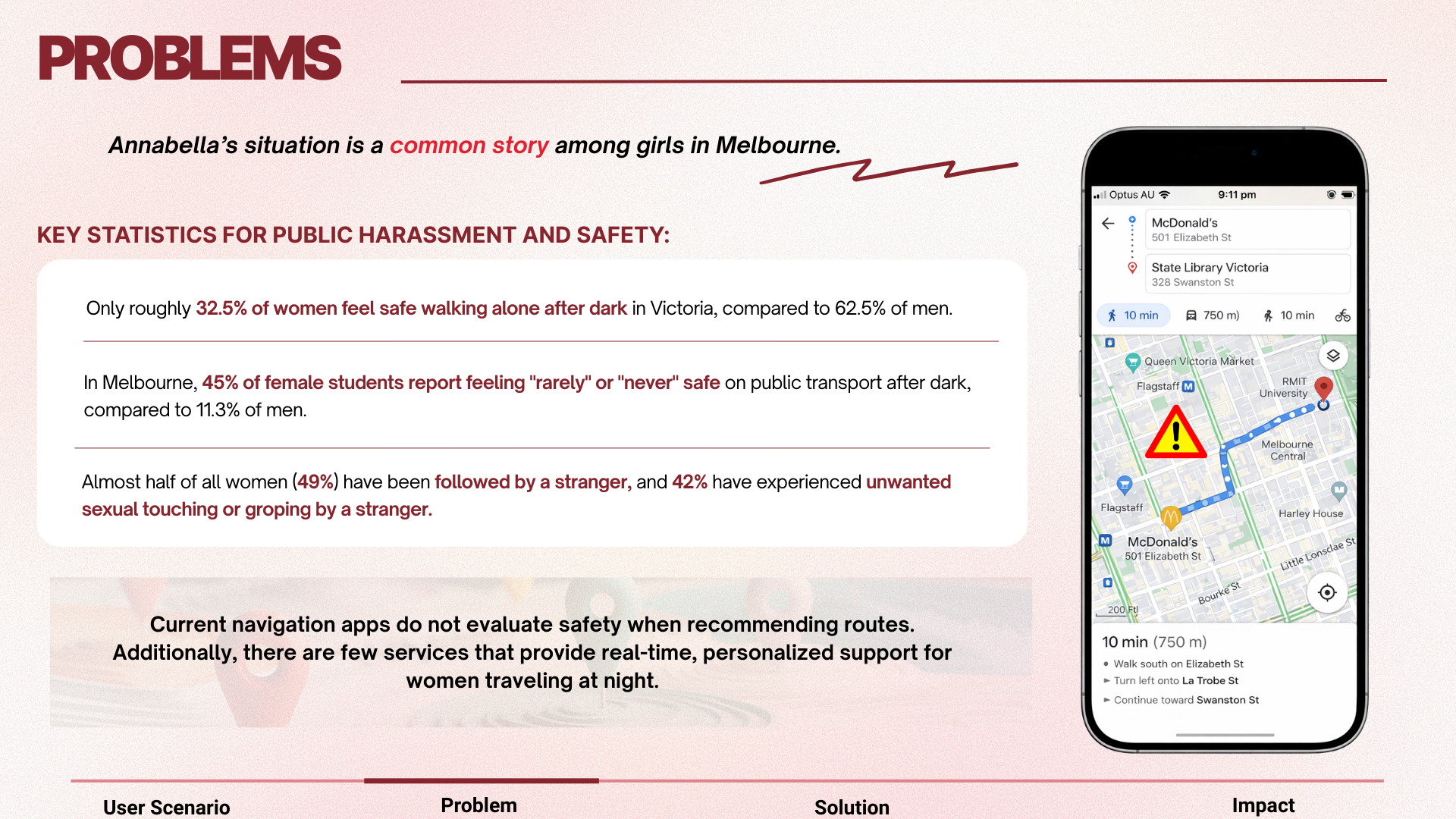
What if navigation apps didn't only show the fastest route, but also the safest one?
From that idea, Guardia was born — a navigation system designed to help women feel safer, more informed, and less alone during their journey home.
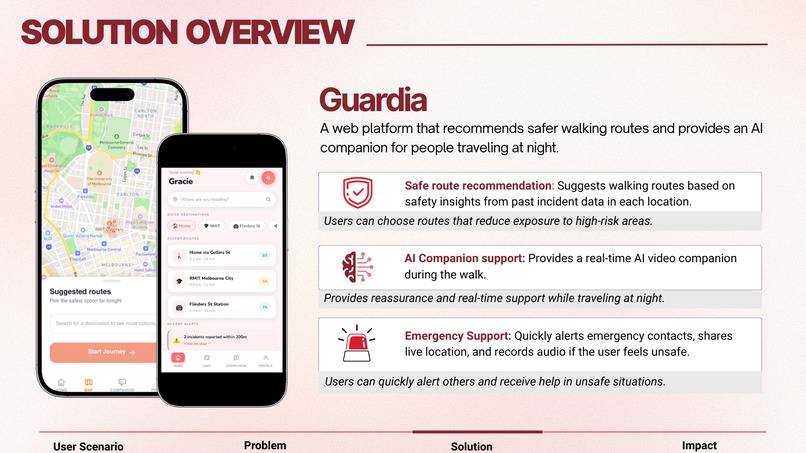
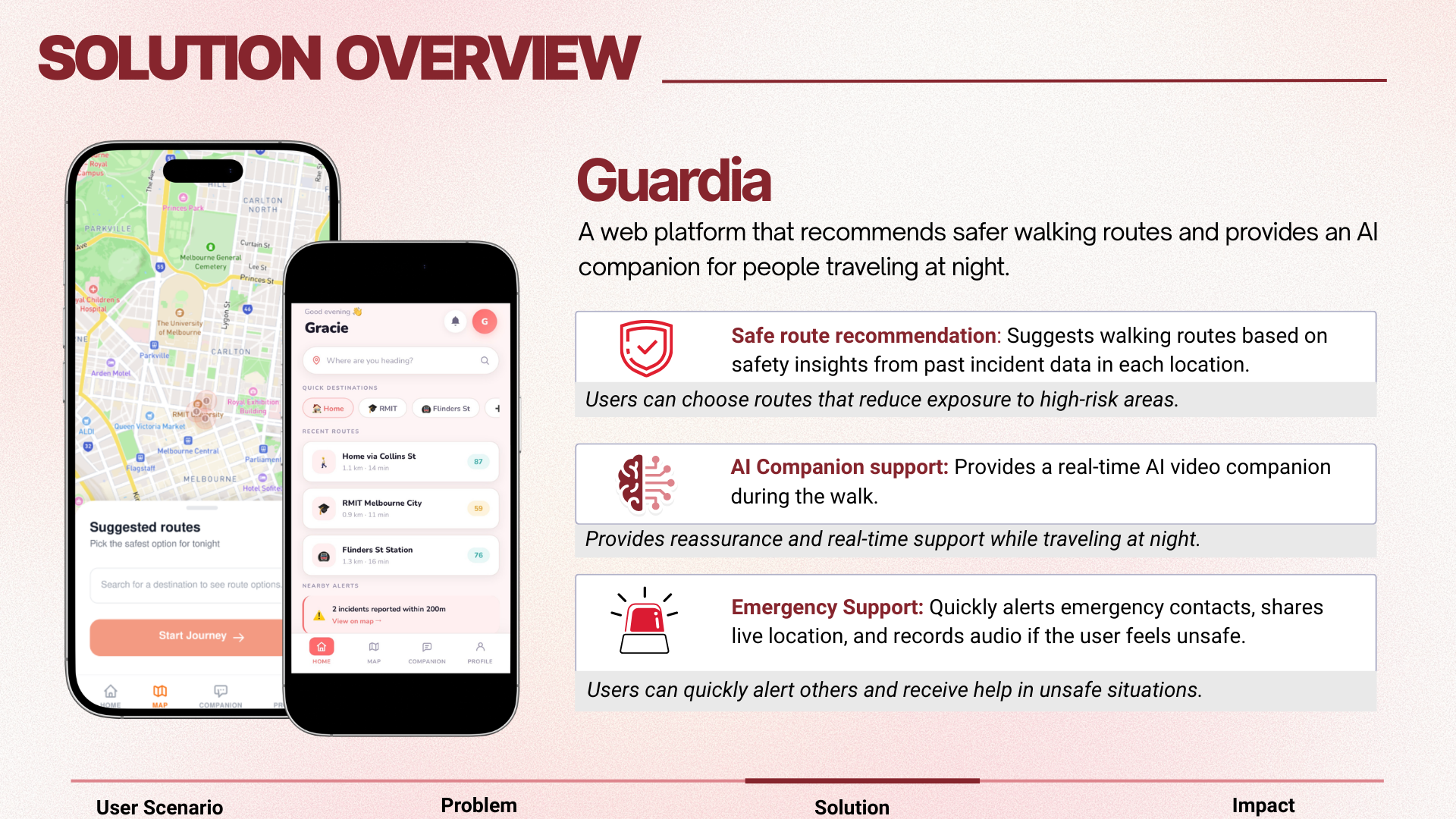
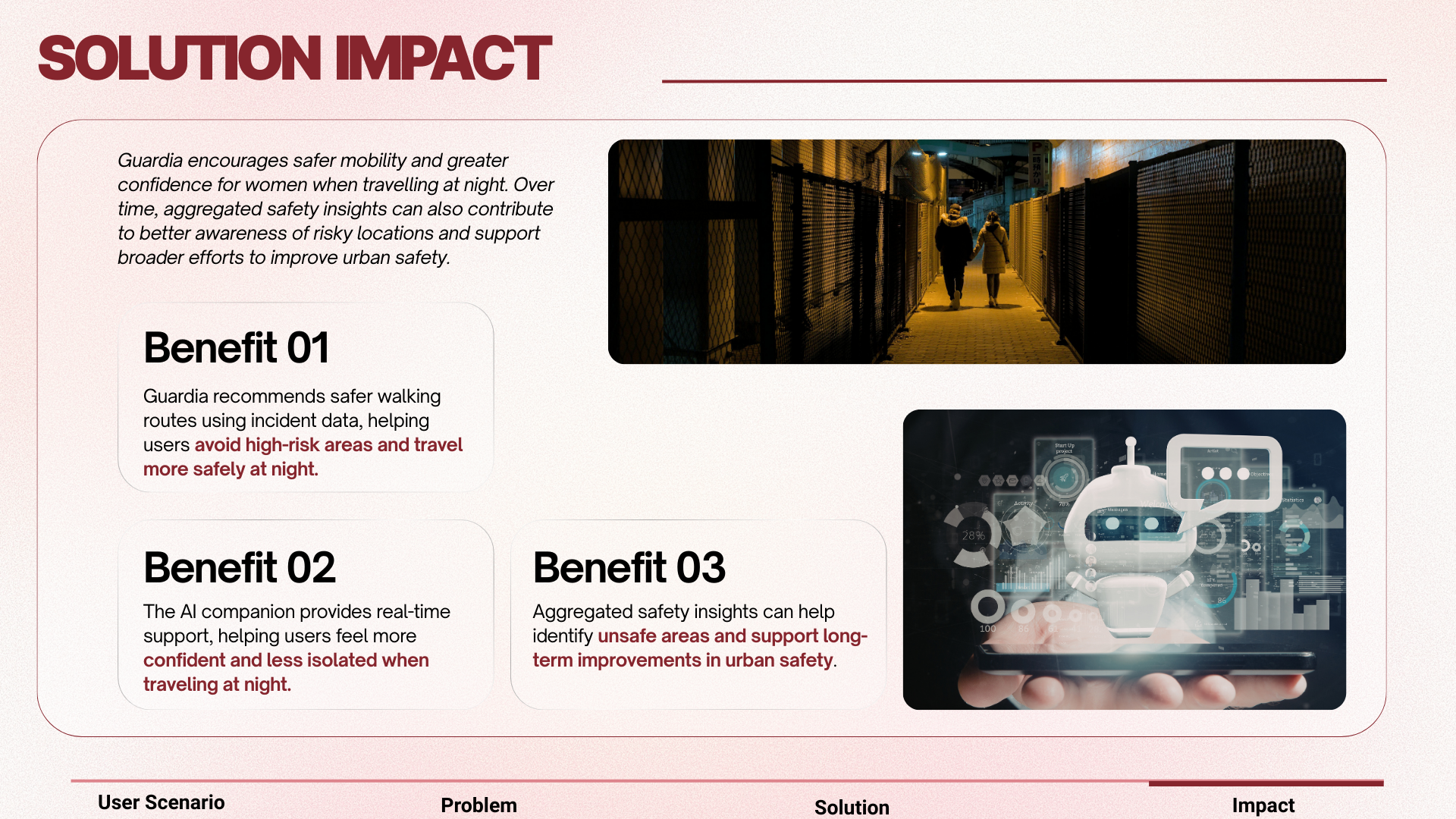
Guardia prioritises safety-aware routing, helping users navigate through paths with lower crime risk instead of simply choosing the fastest route.
What it does
Guardia helps women walk home safer by turning everyday navigation into a safety-first experience.
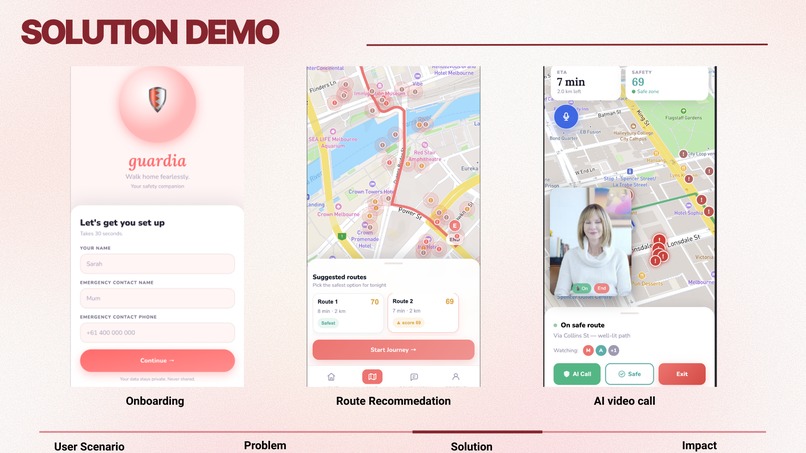
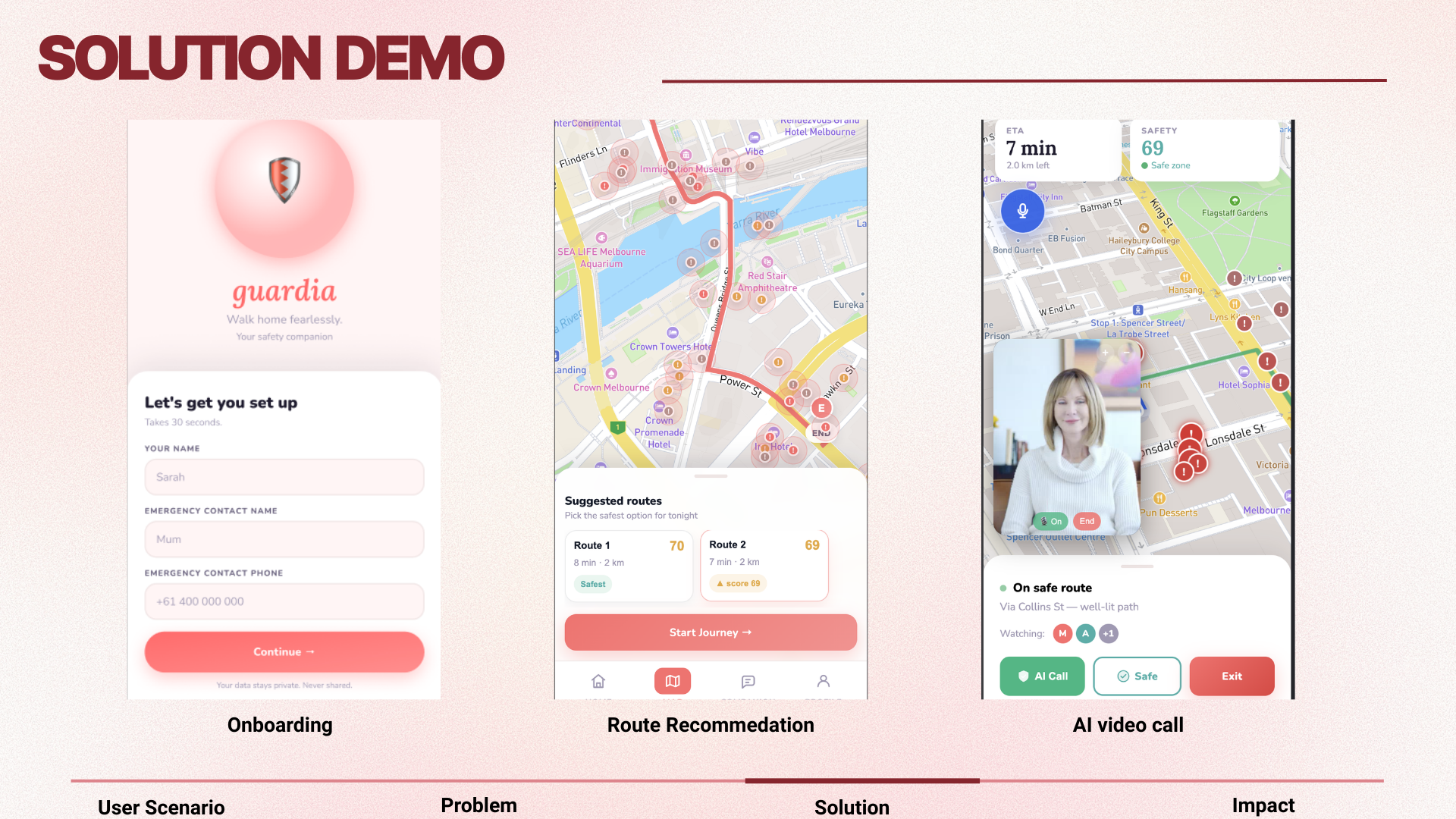
Instead of simply showing the fastest route, Guardia analyses multiple possible paths and recommends the one that is likely to be the safest. By considering past safety incidents and nearby risk areas, the app helps users make more informed decisions before they even start their journey.
Once a route is chosen, Guardia stays with the user throughout the walk.
The map highlights nearby incident areas and provides real-time voice alerts when the user approaches locations where incidents have previously occurred. This allows users to stay aware of their surroundings without needing to constantly check their phone.
To provide additional reassurance, Guardia also includes an AI safety companion. With one tap, users can start a live call with the companion who stays with them throughout the journey, offering guidance and emotional support — like having a friend on the phone while walking home.
If the user ever feels unsafe, a one-tap SOS button allows them to quickly access help.
Guardia’s goal is simple:
help people feel more confident, informed, and supported when walking home at night
How we built it
We began by dividing the project into clear areas so the team could work in parallel and move quickly during the hackathon.
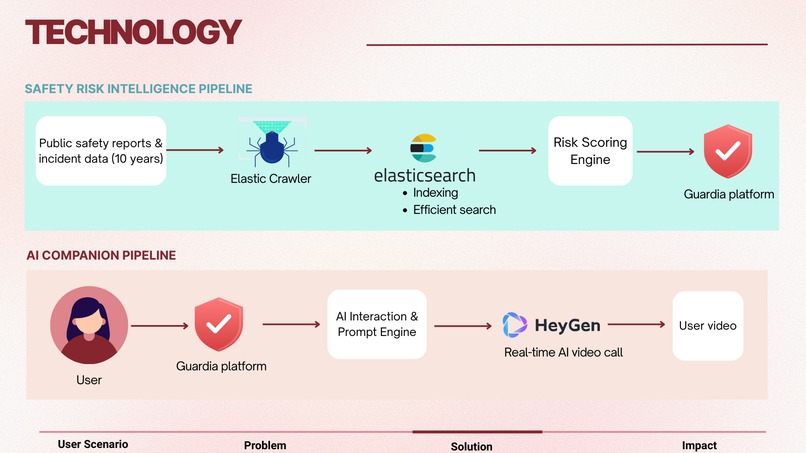
Each team member focused on a specific part of the system. Some worked on building the frontend interface and user experience, ensuring the app was simple and intuitive to use. Others focused on the backend services, implementing the route processing and safety scoring logic. Another part of the team worked on collecting and structuring safety incident data using the Elastic framework, which allowed us to efficiently search and analyse large amounts of location-based information.
As the project progressed, collaboration became essential. Whenever someone finished their assigned task earlier, they jumped in to support other parts of the system — helping integrate features, debug issues, and improve the overall experience.
By working in parallel and continuously helping each other, we were able to quickly connect all components of the system and turn the idea of safety-first navigation into a working prototype within the hackathon timeframe.
Challenges we ran into
One of the biggest challenges we faced was communication and coordination at the beginning of the project. Since each team member was responsible for a different part of the system, we initially spent more time than expected aligning our understanding of the project and how each component should work together.
Because of this, some early development time was spent clarifying responsibilities, discussing how features should interact, and making sure everyone was building towards the same goal.
Another challenge was integrating different parts of the system once development progressed. The frontend, backend, routing logic, and safety data all needed to work together smoothly. Connecting these components and ensuring data flowed correctly between them required additional debugging and adjustments.
However, overcoming these challenges helped our team collaborate more effectively. Once communication improved, we were able to move much faster and bring the different parts of the project together into a working prototype within the hackathon timeframe.
Accomplishments that we're proud of
One accomplishment we are particularly proud of is creating a friendly and accessible design. We focused on building a clean interface and intuitive user experience so that anyone — especially women walking alone at night — can easily understand and use the app without confusion. Making the navigation simple, clear, and reassuring was an important goal for our team.
We are also proud of successfully integrating real-world safety data into the system. Using the Elastic framework, we were able to crawl and process more than 10,000 incident records from public sources. This allows the app to analyse real safety information and use it to support safer route recommendations.
Another achievement was bringing all the different parts of the project together within the limited hackathon timeframe. Each team member worked on different areas of the system, and seeing the design, data processing, and navigation features come together into a working prototype was incredibly rewarding.
Finally, we are proud of our team collaboration. Despite some early challenges, our team worked closely together, supported each other, and turned our idea into a real product within a short period of time.
What We Learned
This hackathon was a new experience for our team because most of us had never worked together before. Learning how to collaborate effectively in a short amount of time became one of the most valuable lessons from this project.
The Importance of Communication
One of the first things we realised was how important clear communication is in teamwork. At the beginning, some misunderstandings about tasks and system design slowed us down. As the project progressed, we improved our communication by discussing ideas more openly and regularly updating each other about progress. This helped us align our work and move forward much faster.
Working in Parallel
Since the hackathon time was limited, we learned to divide work efficiently and develop features in parallel. Each team member focused on a specific area such as frontend design, backend logic, or data processing. By working on different parts simultaneously, we were able to build the project much faster and later combine all the pieces together.
Learning New Technologies Quickly
Another important lesson was learning how to adapt to new tools and technologies quickly. Some of us had limited experience with certain frameworks used in the project, but the hackathon pushed us to learn fast, experiment, and solve problems together.
Turning an Idea into a Real Product
Finally, we learned how to move from an idea to a working prototype in a very short time. From brainstorming the problem to building a functional system within the hackathon timeframe was a challenging but rewarding experience.
This experience helped us better understand team collaboration, rapid problem solving, and building impactful solutions under pressure.
What's Next for Guardia
Guardia began as a hackathon prototype, but we believe the idea has the potential to grow into a real safety tool that can help people in everyday life.
One of our first goals is to expand the safety data coverage beyond Melbourne. By incorporating incident data from more cities, Guardia could provide safer navigation to a much larger community.
We also want to introduce a community reporting system, where users can anonymously report incidents in real time. This would allow the dataset to continuously grow and reflect the most up-to-date safety information.
Another important feature we would like to develop is smart safety check-ins. If a user does not reach their destination within an expected time, Guardia could automatically notify trusted contacts or send a safety check notification.
In the future, we also hope to build native iOS and Android applications, making the experience faster and more accessible for everyday use.
Finally, we would explore potential integration with emergency services, such as pre-filling emergency calls (Triple Zero in Australia) or user's emergency number to help users reach assistance as quickly as possible when they feel unsafe.
Our long-term vision is to make Guardia a trusted safety companion that helps people feel more confident when navigating cities at night.
$$ \text{Guardia — because getting home safe should never be an afterthought.} $$
Built With
- aws-app-runner
- elasticsearch
- elasticwebcrawler
- fastapi
- heygen
- python
- react
- typescript
- vercel


Log in or sign up for Devpost to join the conversation.