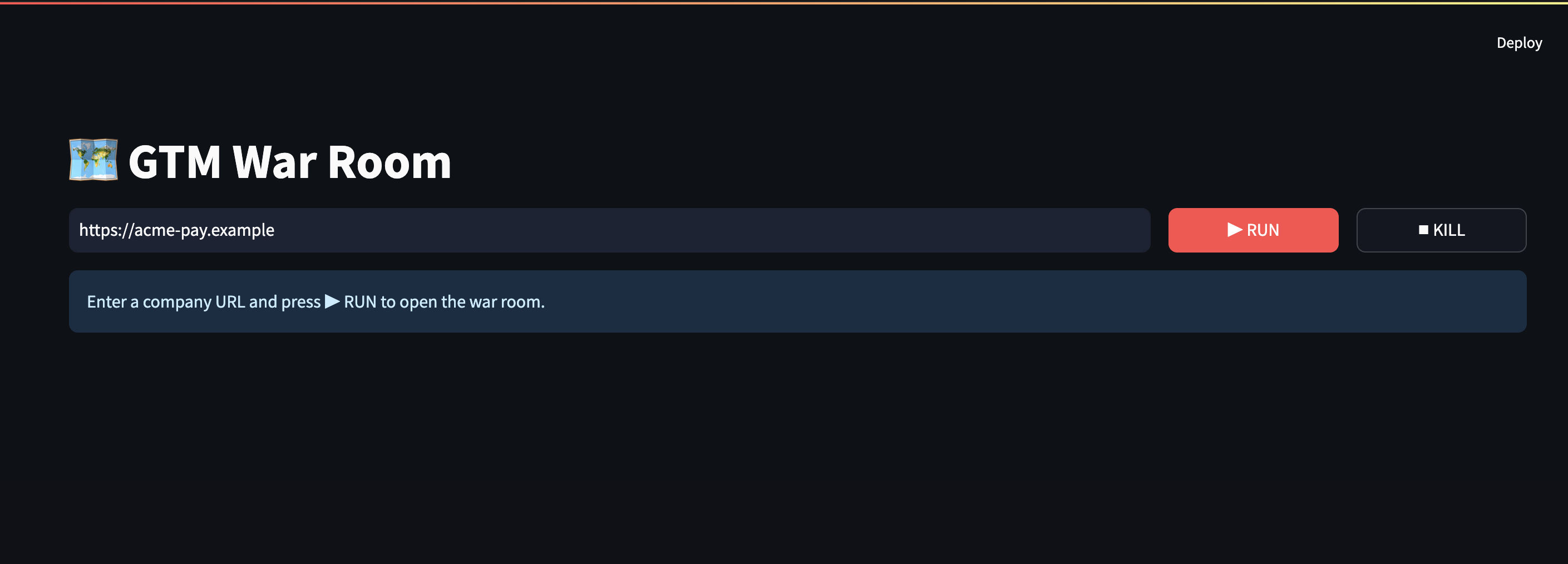
GTM go-to-market planning is usually one pricey consultant, or a founder guessing at 2am. Most "AI marketing tools" don't help : they're a single prompt spitting out generic copy nobody ships. So we built the opposite: a room of agents that argue with each other the way a real GTM team does. Paste a company URL and in about 90 seconds you get a staged campaign. Tavily researches the live site, four specialist agents (Pipeline, Positioning, RevOps, Scale) debate which channels actually fit this business, and a referee picks the winners - and names the losers, with reasons. You stay in command at every gate: approve the strategy, edit the ICP and watch the debate re-run, override channels, sign off before anything fires. Winning channels then build real assets with real named prospects pulled in, all staged for launch. Nothing sends without a human.
The part we're proudest of is that the feedback loop is real, not faked - every run writes its plays to ClickHouse, and the next run reads "what worked for companies like this" and doubles down, so run N+1 literally cites run N. Under the hood it's a 13-node LangGraph pipeline running on Gemini, with a contract-first setup (we froze the shared state shape so five of us could build in parallel without merge chaos easily our best decision). The hard part wasn't the agents, it was the plumbing: 13 integrations, 13 different auth schemes, plus a silent Python 3.9 trap that would've quietly killed the whole feedback loop if we hadn't caught it. We learned to probe live endpoints instead of trusting the docs.
The payoff: our Langfuse LLM-judge scored the swarm at an 88% win rate against a single-prompt baseline.
Built With
- clickhouse-connect
- composio
- elevenlabs
- gemini3.5
- google-generativeai
- langfuse
- langgraph
- mcp
- prometheux
- prometheux-chain
- reportlab
- requests
- sql
- streamlit
- tavily
- twilio
- typescript
- vadalog

Log in or sign up for Devpost to join the conversation.