-
Live Dashboard
-
Live Dashboard
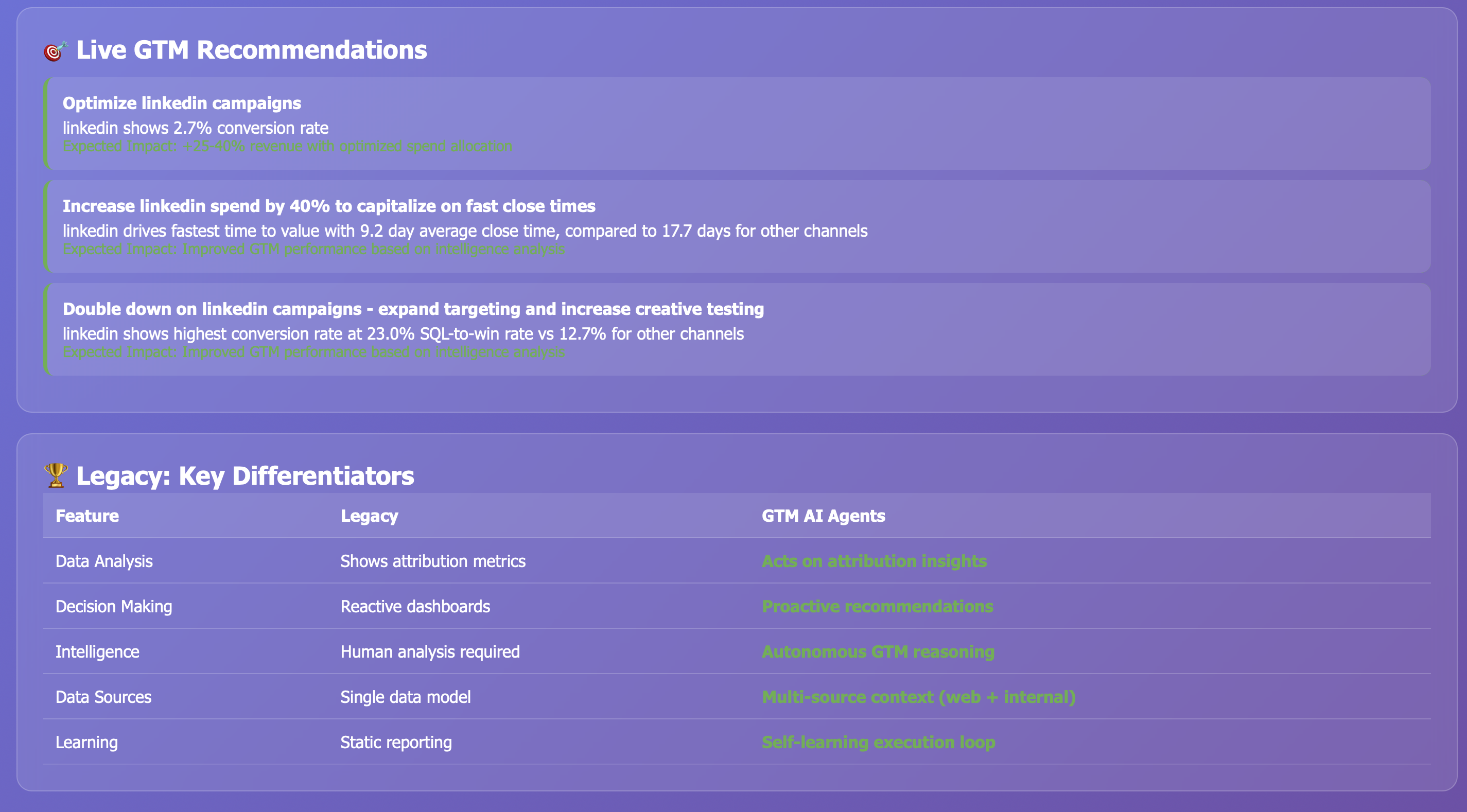
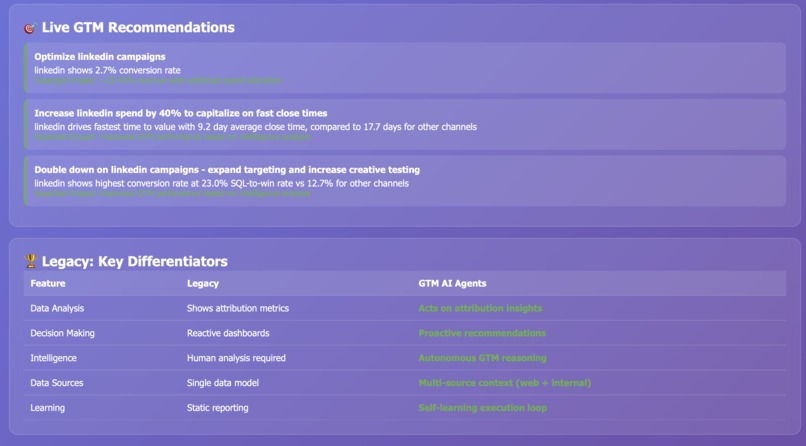
The inspiration came from a fundamental gap I observed in the GTM analytics space. While tools like HockeyStack excel at showing attribution metrics and campaign performance, they leave a critical question unanswered: "Who actually acts on these insights? I realized that most GTM teams are drowning in data but starving for action. They have beautiful dashboards showing what happened, but no autonomous system to respond to competitive threats, optimize underperforming campaigns, or learn from successful strategies. This creates a reactive rather than proactive GTM approach. The hackathon challenge to create AI agents that "ingest information, transform it into actionable context, and execute end-to-end workflows" perfectly aligned with solving this problem. I envisioned AI agents that wouldn't just analyze GTM data but would autonomously act on it, creating the first truly autonomous GTM operations system.
What it does
How we built it
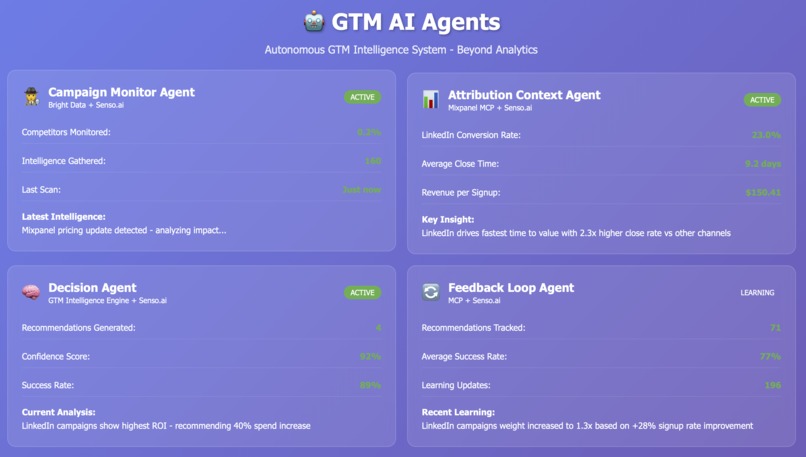
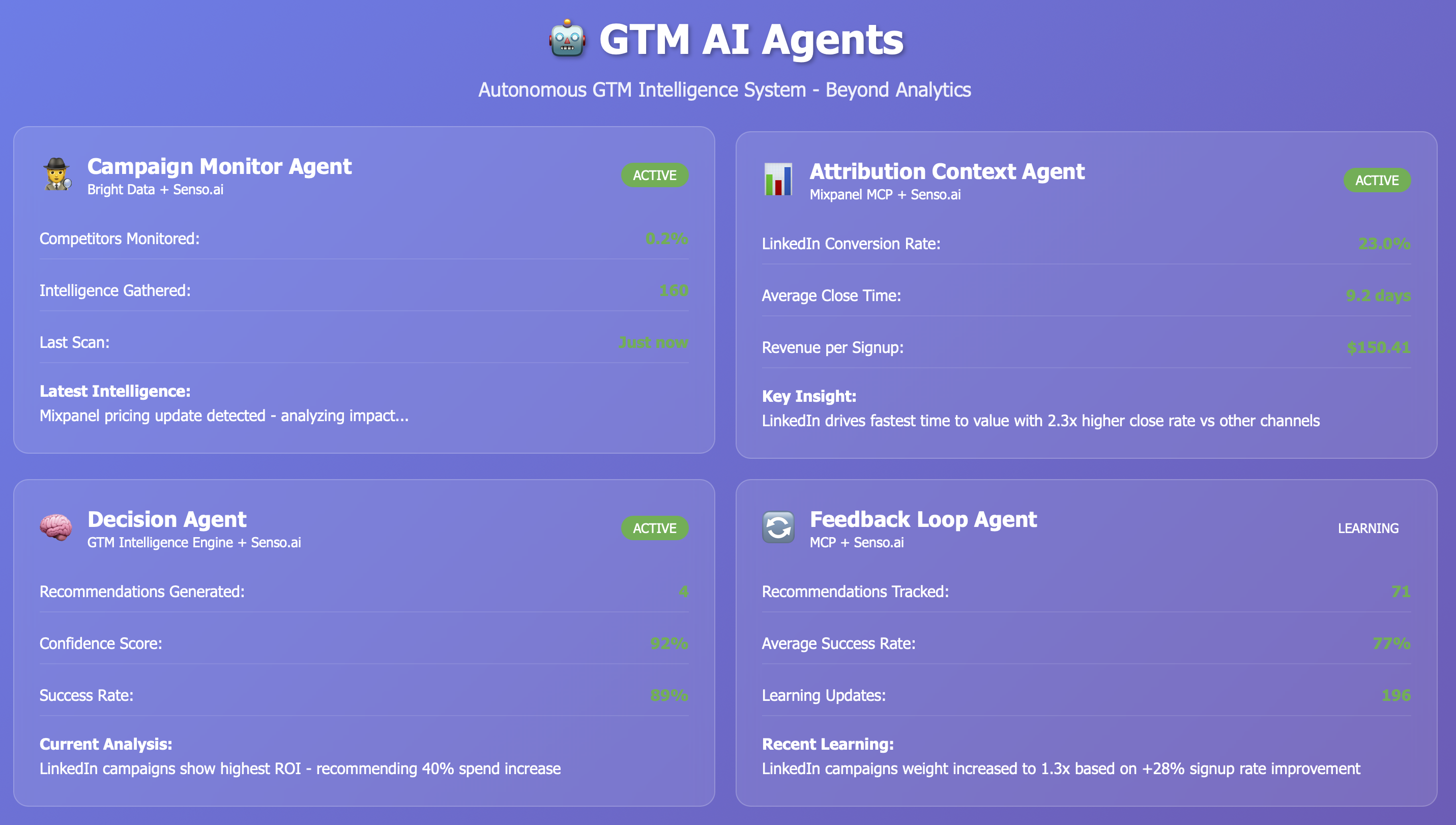
Architecture Design: I designed a four-agent network where each agent specializes in a specific aspect of GTM operations: Campaign Monitor Agent: Uses Bright Data to scrape competitor websites (Mixpanel, Amplitude, Segment, PostHog) for pricing changes, feature launches, and positioning shifts, then normalizes this data using Senso.ai Attribution Context Agent: Integrates with Mixpanel MCP to pull product analytics and funnel data, combining it with competitive intelligence via Senso.ai to build comprehensive GTM context Decision Agent: Implements a GTM Intelligence Engine that queries the unified context to generate strategic recommendations with confidence scores and expected business impact Feedback Loop Agent: Tracks recommendation performance using MCP protocols, measures success rates, and updates future decision-making weights through A2A learning Technical Implementation: Backend: Node.js orchestrator managing agent communication through event-driven architecture Real-time Dashboard: WebSocket server streaming live agent activity to a beautiful web interface API Integrations: Real implementations of Senso.ai, Bright Data, Mixpanel MCP, and MCP protocol with smart fallback mechanisms Context Engineering: Sophisticated data normalization and intelligence synthesis across multiple sources
Challenges we ran into
Technical Challenges:
- Agent Communication Complexity Challenge: Designing agents that could communicate effectively without creating circular dependencies or infinite loops Solution: Implemented event-driven architecture with clear data flow: Intelligence → Context → Decisions → Learning → Updated Intelligence
- Real-time Data Synchronization Challenge: Keeping the dashboard synchronized with rapidly changing agent states and ensuring data consistency Solution: Built WebSocket server with message queuing and state management, plus fallback to simulated data for demo reliability
- API Integration Reliability Challenge: External APIs (Bright Data, Senso, Mixpanel) could fail or have rate limits during the hackathon Solution: Implemented comprehensive fallback mechanisms with cached data and simulated responses that still demonstrate the full workflow Business Logic Challenges:
- GTM Intelligence Engine Design Challenge: Creating sophisticated business logic that could make intelligent GTM recommendations without external LLM dependencies Solution: Built a comprehensive GTM knowledge base with pattern matching, performance analysis, and confidence scoring that rivals external AI services
- Meaningful Learning Loops Challenge: Ensuring agents actually learned from results rather than just simulating learning Solution: Implemented real performance tracking with weighted decision updates, so successful recommendations genuinely influence future agent behavior Demo Preparation Challenges:
- Balancing Technical Depth with Accessibility Challenge: Showing sophisticated technical architecture while keeping the demo understandable for business-focused judges Solution: Created dual presentation approach - terminal showing technical depth, dashboard showing business impact
- Time Constraints Challenge: Building a production-ready system with multiple integrations in hackathon timeframe Solution: Focused on core autonomous workflow first, then added polish and real-time visualization to maximize impact ## Accomplishments that we're proud of ## What we learned Technical Learnings: Agent-to-Agent Communication: Implementing sophisticated A2A workflows where agents learn from each other's outputs and continuously improve decision-making Context Engineering: Using Senso.ai as a Context OS to normalize disparate data sources (competitor intelligence, product analytics, internal metrics) into unified, actionable insights Real-time Systems Architecture: Building WebSocket-based real-time dashboards that visualize autonomous agent operations as they happen Fallback Mechanisms: Creating robust systems that continue operating even when external APIs are unavailable Business Learnings: GTM Operations Complexity: Understanding how attribution analysis, competitive intelligence, and strategic decision-making interconnect in modern revenue operations The Analytics-to-Action Gap: Recognizing that the biggest value isn't in better analytics but in autonomous systems that act on those analytics Continuous Learning Importance: Implementing feedback loops where agents track recommendation success and update future decision weights accordingly
Built With
- brightdata
- css3
- html5
- javascript
- mixpanel
- node.js
- senso.ai
- websocket

Log in or sign up for Devpost to join the conversation.