-
-
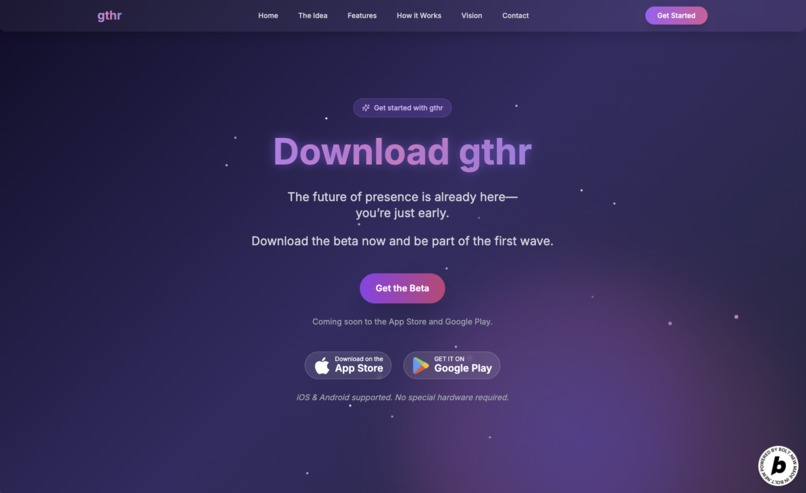
gthr
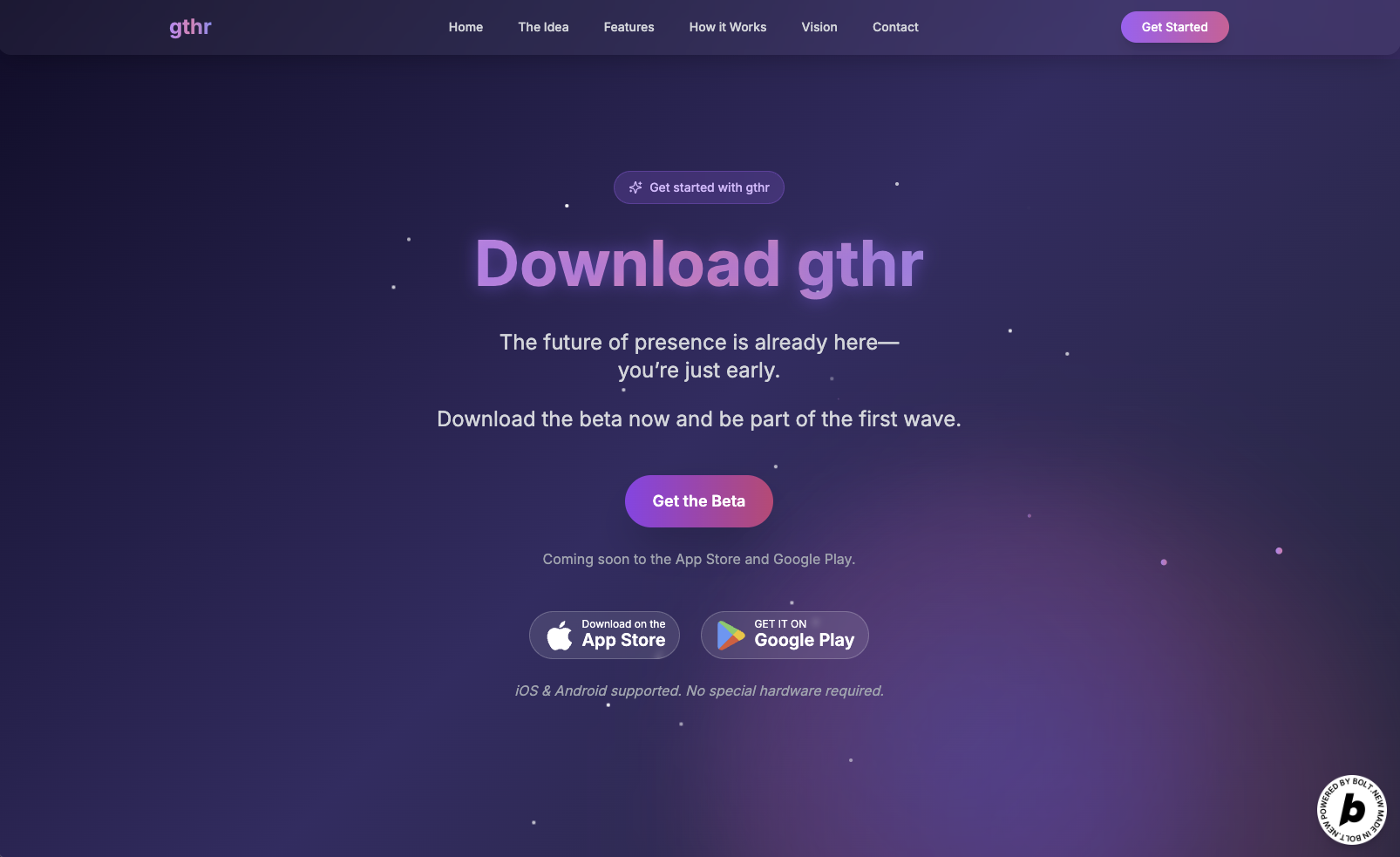
Inspiration
We walk through crowded cities, share cafes and buses, yet feel more alone than ever. Social media promised connection but traded intimacy for influence—filling our days with endless feeds, likes, and pressure to perform.
We wanted to build something quieter. Something that brings back the magic of the village square—the subtle awareness that you are not alone. gthr was born from a question: what if we could use technology not to capture attention, but to restore presence?
What it does
gthr is an ambient social presence layer for the real world.
It uses AR to display floating status cards—short, subtle signals like "Sketching" or "Open to chat"—anchored in physical space. There are no feeds, no followers, no performance. Just presence.
It's a new kind of interaction: quiet, real, and rooted in the world around you. Like passing through a town square and feeling the pulse of human activity without saying a word.
How we built it
Front-end: Built in Next.js with Bolt.new and ARCore to simulate AR glasses in the browser.
AR experience: Leveraged ARCore and experimental ARCore features to anchor cards in real-world space.
Design system: Inspired by social cues—notifications are ambient, glanceable, and fade with distance.
Status engine: Users can set or rotate through minimal presence states with short tags and icons.
Teamwork: We paired a designer and a developer to rapidly prototype both experience and interface in parallel.
Challenges we ran into
Android integration: Creating a seamless Android APK with ARCore meant bridging native camera logic with a WebView that handled the status input UI. Linking that interaction smoothly was a major technical hurdle.
Design restraint: Avoiding traditional social UI (likes, comments, profiles) pushed us to rethink every interaction.
Glanceability vs. clarity: Balancing subtlety with legibility was a constant design challenge.
Accomplishments that we're proud of
Built a working, cross-platform prototype that blends physical presence with ambient digital signaling.
Created a design language that feels calm, respectful, and non-invasive—a rare vibe in tech.
Proved that AR can be used to foster connection without demanding attention.
Successfully bridged native ARCore logic with a WebView-based UI on Android.
What we learned
People crave presence, not performance. By stripping away likes, follows, and endless feeds, we created space for more human interactions.
Building for the real world introduces all kinds of wild variables—from browser support to ambient light. We learned to adapt fast and design with constraints.
Cross-platform AR is possible—but it’s still messy. WebXR is promising, but native tools are essential for stability and user trust.
Sometimes the simplest UX ideas—I'm here, and open—are the hardest to get right technically, but the most rewarding.
What's next for gthr
Smart status inference: Auto-update your status using context clues—like your calendar, ambient sound, or motion—so you’re always passively present without effort.
AR glasses integration: Native support for devices like Apple Vision Pro, Meta Quest 3 and AR glasses to make the experience truly hands-free and immersive.
Privacy-first discovery: More granular controls over visibility, timing, and location—so users decide when and where they want to be seen.
Live notifications: Get a nudge when someone nearby activates their presence—like a friend going live in the same coffee shop.
Drop notes in space: Leave ambient digital notes for people you care about, tied to real-world places—a love note on a park bench, a book tip in your favorite aisle.
Connection memory: Save the people you’ve encountered and liked—build a quiet, personal network of shared moments, not followers.
Micro-moments: Enable temporary “flares” like “Need a chess opponent” or “Hosting a poetry reading”—low-friction, real-world interactions.
We're building toward a future where technology helps us feel more human—not less. gthr is the beginning of that shift.
Built With
- bolt.new
- java
- kotlin
- netlify
- next.js
- swift
- tailwindcss
- typescript

Log in or sign up for Devpost to join the conversation.