-
-
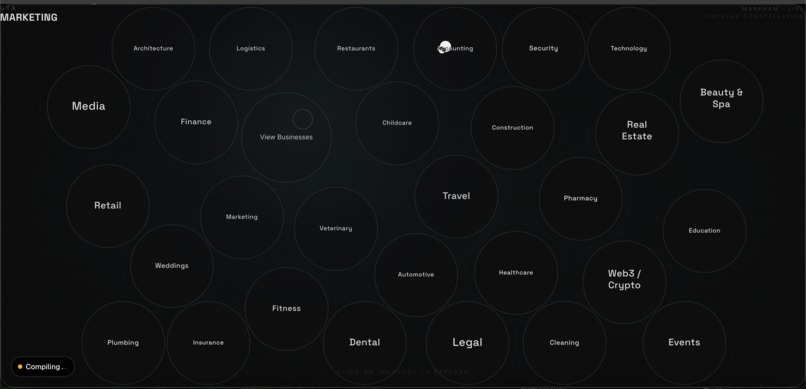
Example of Business Page
-
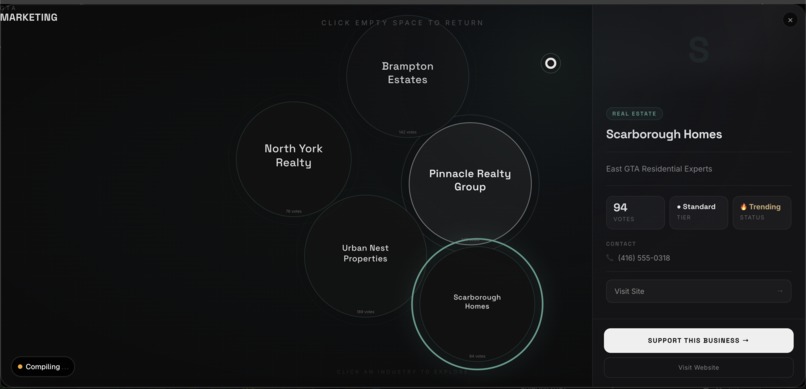
Website Map
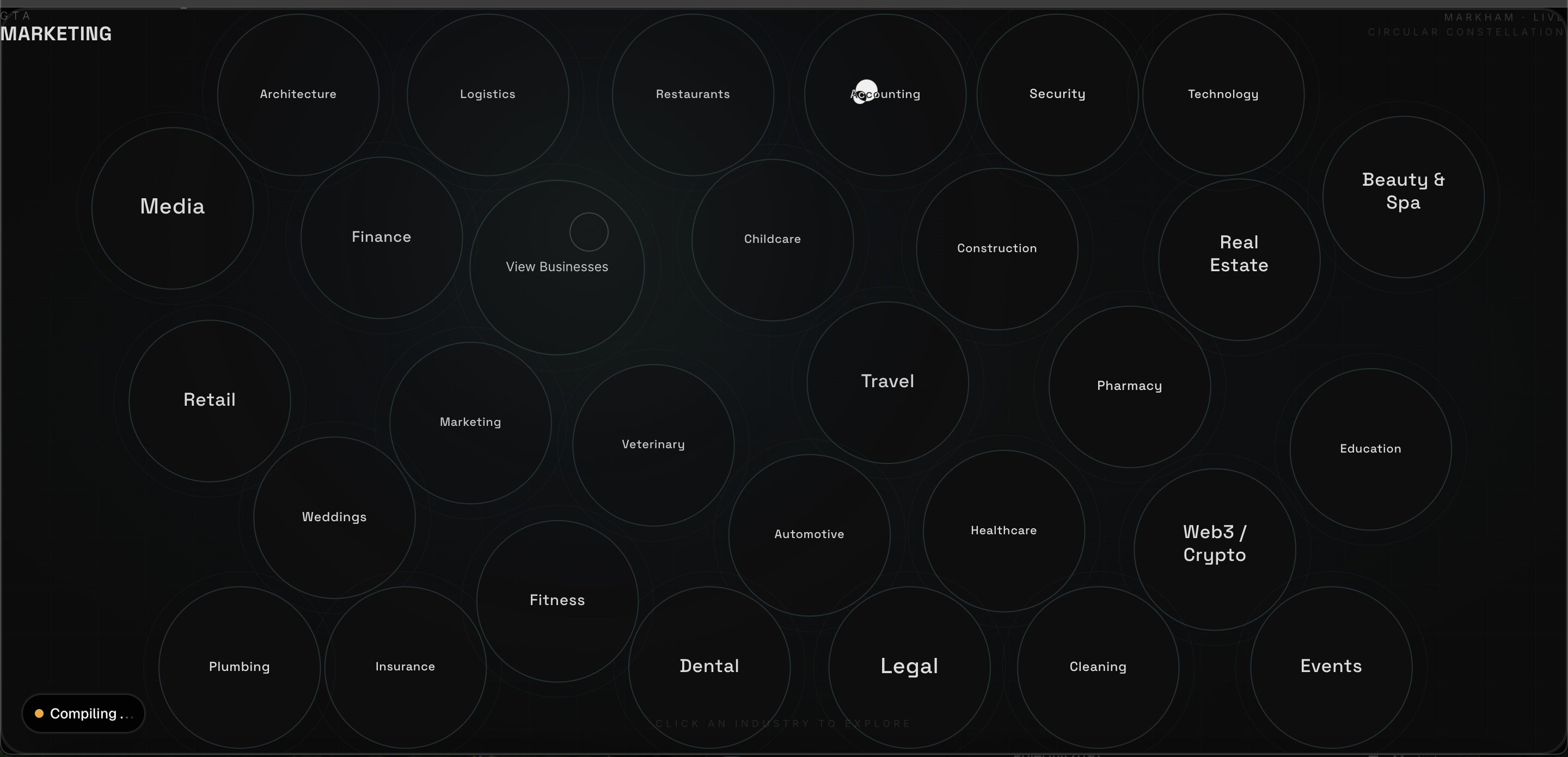
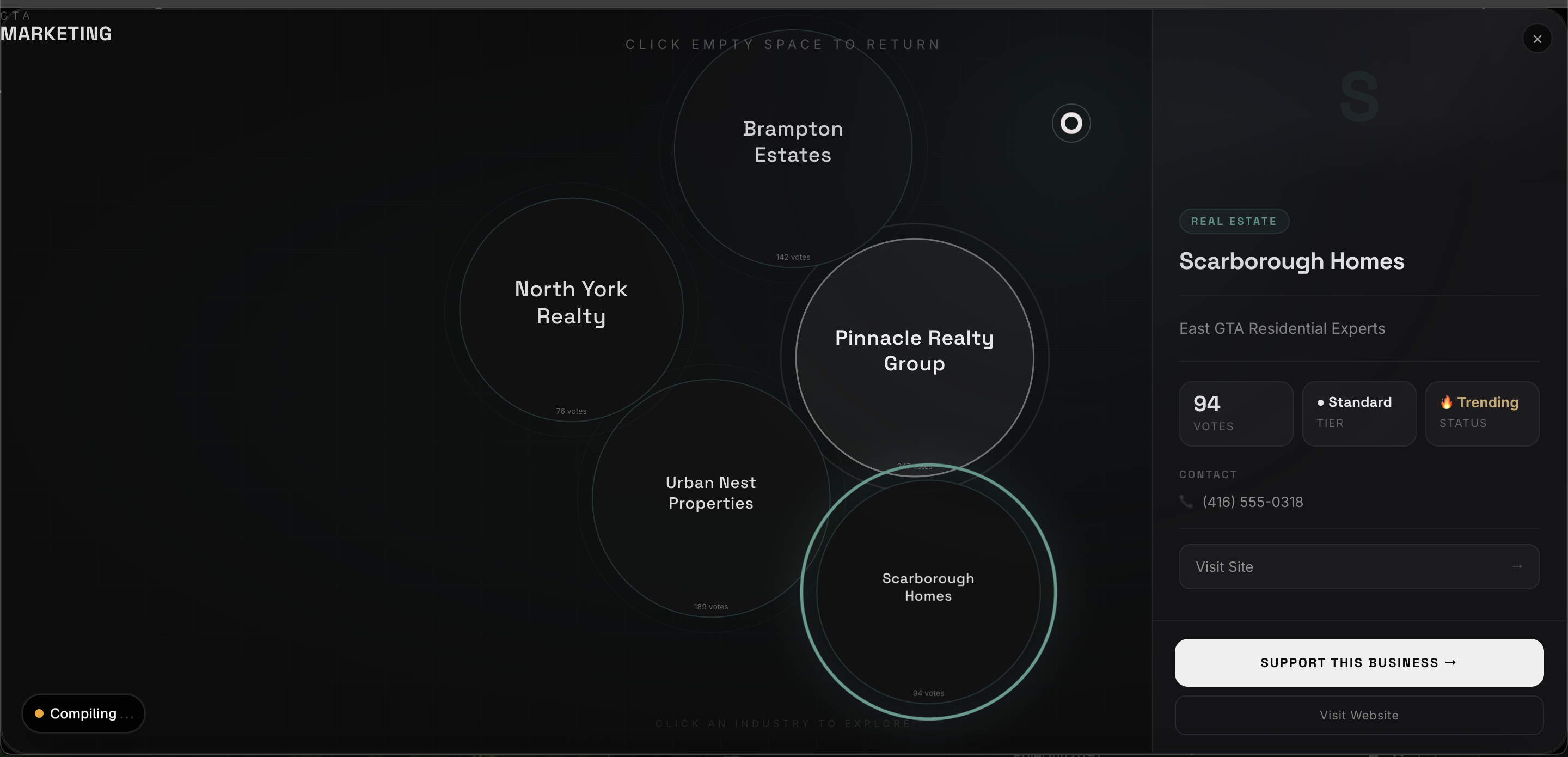
Inspiration
We were inspired by a simple problem: a lot of great local businesses still struggle to get discovered, while customers have to jump between flyers, Google searches, Instagram pages, and outdated directories just to find good places nearby. We wanted to build something that felt more modern, more interactive, and more community-driven.
Instead of creating another static listing site, we designed GTA Marketing as a local economic engine. The idea was to connect physical marketing with a digital experience, then close the loop by rewarding people for supporting local businesses and reinvesting part of the value back into the community. :contentReference[oaicite:0]{index=0}
What it does
GTA Marketing is a hyper-local marketing platform designed to help businesses in Markham and across the GTA get discovered, attract more customers, generate leads, and build repeat traffic. It combines physical advertising, a premium digital discovery platform, gamified customer engagement, and community reinvestment into one system. Instead of being just another business directory, it connects offline promotion with an interactive online experience that makes supporting local businesses more engaging for both consumers and merchants.
For businesses, GTA Marketing offers two main ways to grow. First, businesses can be featured in physical flyers distributed to thousands of households across the GTA, with QR codes that drive people directly to the platform. Second, businesses can be listed on the Digital Hub, where users discover them through a premium interactive map experience. Each business profile can show key information such as the business name, description, category, location, phone number, website, images, and special offers. Depending on the plan, businesses can also get more visibility, better placement, extra customization, and access to additional services like AI call agents, website creation, social media management, and Google Maps or local SEO optimization.
For consumers, GTA Marketing creates a more rewarding way to discover local businesses. Users can scan a QR code from a flyer or access the platform online, then explore nearby businesses through an interactive map. They can click on different businesses, read a short description, and choose which ones they want to support. Users are then able to vote for businesses, which helps those businesses climb a live leaderboard and gain more visibility. In exchange, customers can unlock deals, discounts, or rewards, giving them a direct incentive to visit or return. This makes the experience feel more interactive and useful than simply browsing a normal list of businesses.
The platform also connects digital engagement with real in-store action. Businesses can place custom NFC cards or QR displays at their physical locations so customers can instantly access that business’s page, vote, and claim rewards while they are actually in the store. This helps turn real visits into trackable engagement and encourages repeat participation. To keep the system fair, voting is designed with anti-abuse protections such as limiting votes per device within a certain time period, so businesses compete based on real customer interest rather than manipulation.
Behind the scenes, GTA Marketing also works as a lead generation system. Customer interactions can capture useful business data such as contact information and engagement activity, which can then be organized for follow-up marketing, reporting, and future campaigns. Businesses on higher tiers can also receive performance insights and reports showing how much attention, traffic, and engagement they are getting through the platform.
What makes GTA Marketing different is that it is not just built to advertise businesses, but to strengthen the local economy around them. Part of the value created through the platform is designed to flow back into the community through rewards, promotions, and local business support. By combining physical marketing, digital discovery, customer incentives, and community impact, GTA Marketing gives local businesses a more modern, trustworthy, and results-driven way to grow.
How we built it
We built the project around a modern web stack focused on speed, scalability, and interaction. The digital hub uses Next.js with the App Router for the frontend, Tailwind CSS for styling, D3.js for the interactive bubble/map layout, Supabase for real-time data, and Vercel for hosting and scaling. We also planned lead capture through the Google Sheets API and custom QR/NFC endpoints so each business can have direct in-store and flyer-based traffic paths.
A big part of the build was designing the full journey, not just the interface: flyer to QR scan, QR scan to map, map to vote, vote to unlockable deal, and then business-side lead capture and reporting. We also included anti-fraud thinking with one vote per device per 24 hours so the leaderboard stays fair. :contentReference[oaicite:2]{index=2}
Challenges we ran into
One of the biggest challenges was combining offline and online behavior into one smooth system. It is easy to design a website, but much harder to make physical flyers, in-store NFC/QR touchpoints, business onboarding, voting logic, and rewards all feel like one connected product.
Another challenge was balancing fairness and business value. We wanted paid tiers for visibility and features, but we did not want businesses to be able to buy their way to the top of the leaderboard. That forced us to think carefully about ranking logic, user incentives, and anti-abuse rules. :contentReference[oaicite:3]{index=3}
Accomplishments that we're proud of
We are proud that this project goes beyond a normal directory or ad platform. GTA Marketing is designed to be interactive, gamified, and community-focused. The combination of a premium map interface, voting system, unlockable deals, physical QR/NFC touchpoints, and a reinvestment model gives the project a clear identity.
We are also proud of the bigger idea behind it: local businesses are not just being advertised, they are part of a system where customer engagement can drive real foot traffic and where part of the platform's success flows back into the local community. :contentReference[oaicite:4]{index=4}
What we learned
We learned that local discovery is not only a design problem or a marketing problem. It is a trust problem, an incentive problem, and a user-experience problem all at once. Small businesses need something simple, credible, and clearly worth paying for. Customers need a reason to engage beyond just “support local.”
We also learned that physical touchpoints still matter. By connecting flyers and in-store QR/NFC interactions to a digital product, we could make the platform feel much more real and usable than a website alone. :contentReference[oaicite:5]{index=5}
What's next for GTA Marketing
Our next steps are to continue refining the website experience, finish the remaining design and animation details, finalize outreach to early business partners, and test the launch strategy in Markham. We also want to keep improving the leaderboard, rewards flow, and business onboarding so the system is easy to use for both consumers and merchants.
The long-term goal is to prove that local marketing can be more transparent, more engaging, and more beneficial to the community than traditional advertising models. :contentReference[oaicite:6]{index=6}
Built With
- custom
- d3.js
- fingerprinting
- google-sheets-api
- next.js
- qr/nfc
- supabase
- tailwind-css
- url
- vercel

Log in or sign up for Devpost to join the conversation.