-
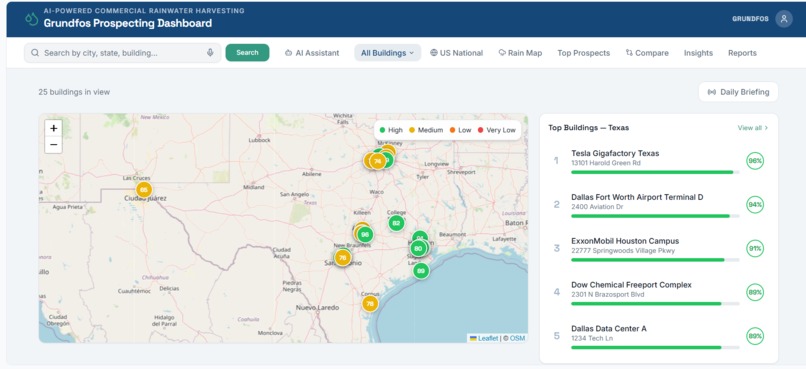
Dashboard
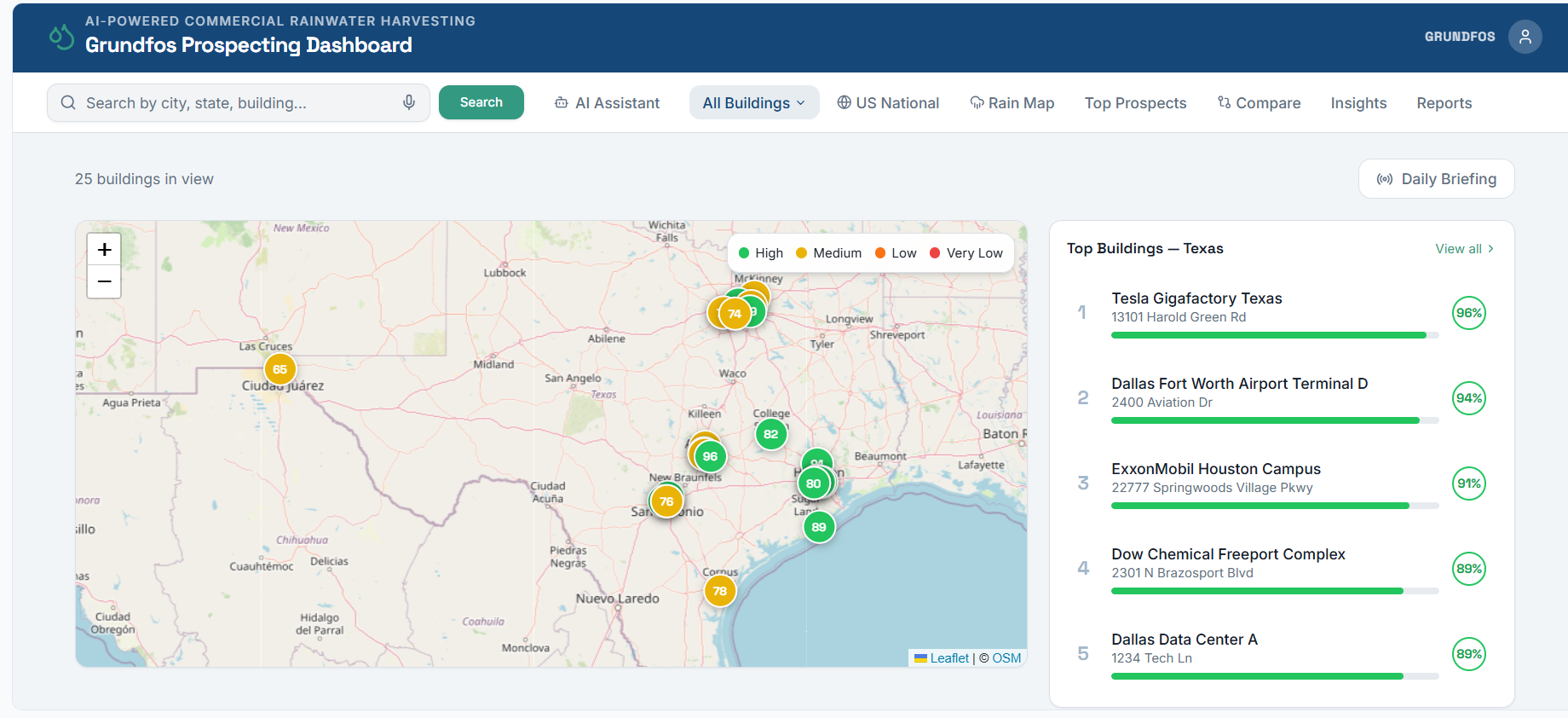
Inspiration
Water is one of the most overlooked sustainability opportunities.A single large building can generate hundreds of thousands of gallons annually from rainwater alone.
“In regions like Dallas, large roofs can yield over 180,000 gallons per year.”
What it does
The Grundfos AI Prospecting Engine is an intelligent, data-driven platform that automatically identifies, scores, and ranks commercial buildings for rainwater harvesting potential so your sales team walks into every conversation armed with numbers, not guesses.
How we built it
We developed our solution as a full-stack web application that combines data analysis, AI-inspired logic, and an intuitive user interface.
Frontend (UI/UX) I built a responsive dashboard using React, focusing on clean design, interactive components, and smooth animations to help users easily explore and analyze buildings. Backend (API & Logic) We used FastAPI to create a lightweight and scalable backend that processes building data and calculates viability scores in real time. Data Integration We combined multiple data sources, including simulated satellite data (roof area and cooling tower detection), environmental data (rainfall), and financial indicators to evaluate each building. AI & Scoring Engine We implemented a custom scoring model that analyzes physical, environmental, and financial factors to generate a single Viability Score, helping prioritize the best opportunities. Product Design We structured the platform as a “box product,” including industry categorization, top prospect ranking, and AI-generated insights for end users.
Challenges we ran into
Commercial and industrial buildings are facing rising water costs, stricter regulations, and increasing climate risks.Grundfos already has the technology to solve these challenges but identifying the right buildings at the right time is extremely difficult.
The challenge was to recognize the rooftop and cooling towers using the satellite information.
Accomplishments that we're proud of
- Built a fully functional AI-powered prospecting platform from scratch within a limited hackathon timeframe
- Designed a complete “box product” experience, including dashboard, scoring engine, and user interface
- Successfully integrated multiple data dimensions — physical (roof size, cooling towers), environmental (rainfall), and financial indicators
- Developed a Viability Scoring System that simplifies complex decision-making into a single actionable metric
What we learned
How to translate a real-world business problem into a technical solution. The importance of combining data, AI, and UX to create meaningful products. I also learned how to work with simulated and real-world datasets to build scalable systems. The role of computer vision and IoT concepts in solving sustainability challenges was also helping with how to design for end-users (like Grundfos analysts and contractors) rather than just building features. Moreover, I gain experience in clear storytelling and product thinking in presenting technical work and how sustainability and water management can be both an environmental and financial opportunity.
What's next for Grundfos AI Prospect
What I built in 24 hours is the MVP. Here's where this goes:" Phase 2 _— Integrate real satellite imagery (Google Earth Engine / Sentinel-2) for actual roof detection CV _Phase 3 — Expand to all 50 states using Open Buildings Dataset (Google) Phase 4 — CRM integration (Salesforce) — push top prospects directly to sales pipeline Phase 5 — Live NOAA rainfall API + real-time EPA water pricing Phase 6 — Customer-facing portal — let building owners self-qualify
Built With
- ai
- api
- base44
- chat
- entity-framework
- fastapi
- google-maps
- google-web-authentication
- invokellm
- javascript
- leaflet.js
- react
- recharts
- tailwind
- text
- three.js
- voice-delivery-system
- web2pdf
- webspeech

Log in or sign up for Devpost to join the conversation.