Inspiration: About 1 in 2,869 US babies is born with an upper-limb reduction defect [1]. A body-powered prosthesis averages $4,000–$8,000, and a child's prosthesis has to be repaired and replaced every few years as they grow [2]. Free 3D-printed hands help, but they're sized as one overall percentage of the original design [3], and kids the same age have very different hands: among 8-year-olds in a US government survey, the middle 90% of hands range from 57 to 70 mm wide [4]. One scale percentage is set from a single number, so a hand that is wide or narrow for its length ends up with a poor fit. We wanted a hand that fits the child in front of you and keeps up as they grow.
What it does: GrowGrip is a wrist-powered prosthetic hand for a child with a partial hand. Bending the wrist pulls tendons that close the fingers. The whole hand is generated from two measurements of the child's other hand, its length and its width, so length and width scale independently; a third measurement, the forearm, sizes the cuff. Hardware, tolerances and wall thickness stay fixed so it stays strong and printable at any size. A three-position wrist hinge, a thinner cuff liner and a cord tensioner absorb small growth. When the child outgrows it, you type the new numbers and reprint the plastic parts, reusing the pins, straps, thumbscrews and cord.
How we built it: We modeled GrowGrip in Autodesk Fusion with 42 User Parameters in three groups: measurements, derived sizes and fixed engineering limits. A Fusion Python generator script, written with help from Claude and ChatGPT, builds the whole hand from those parameters:
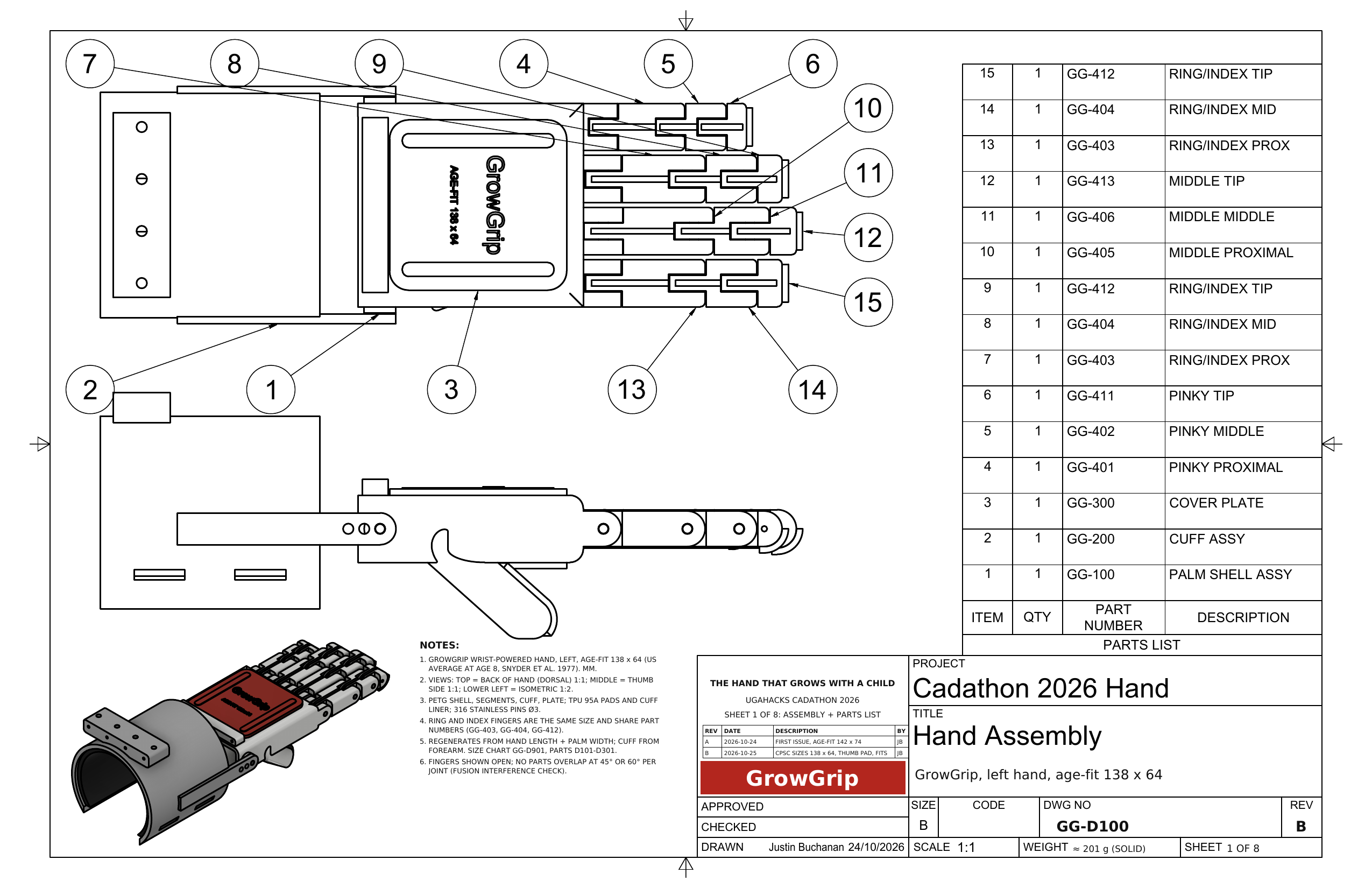
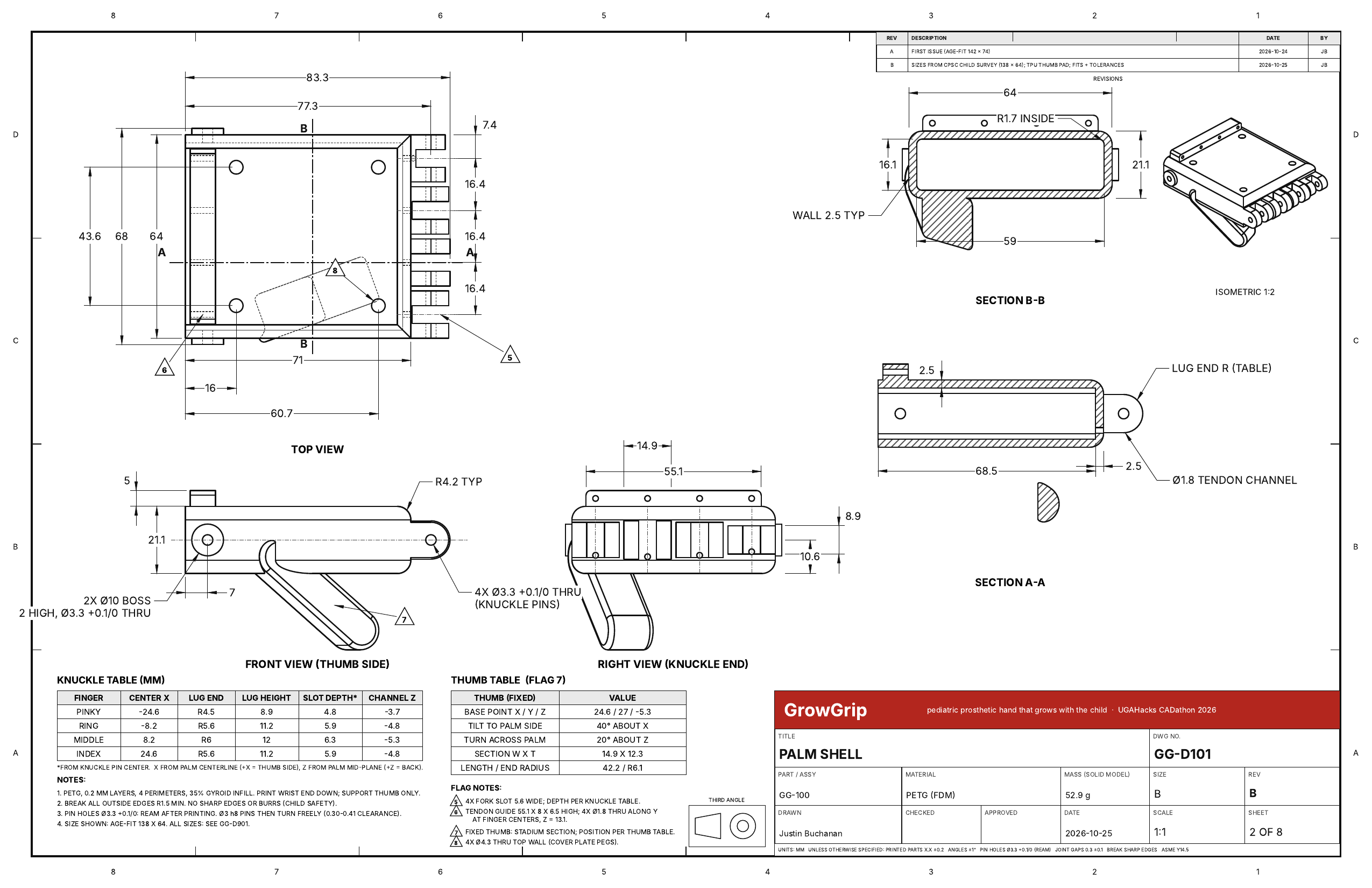
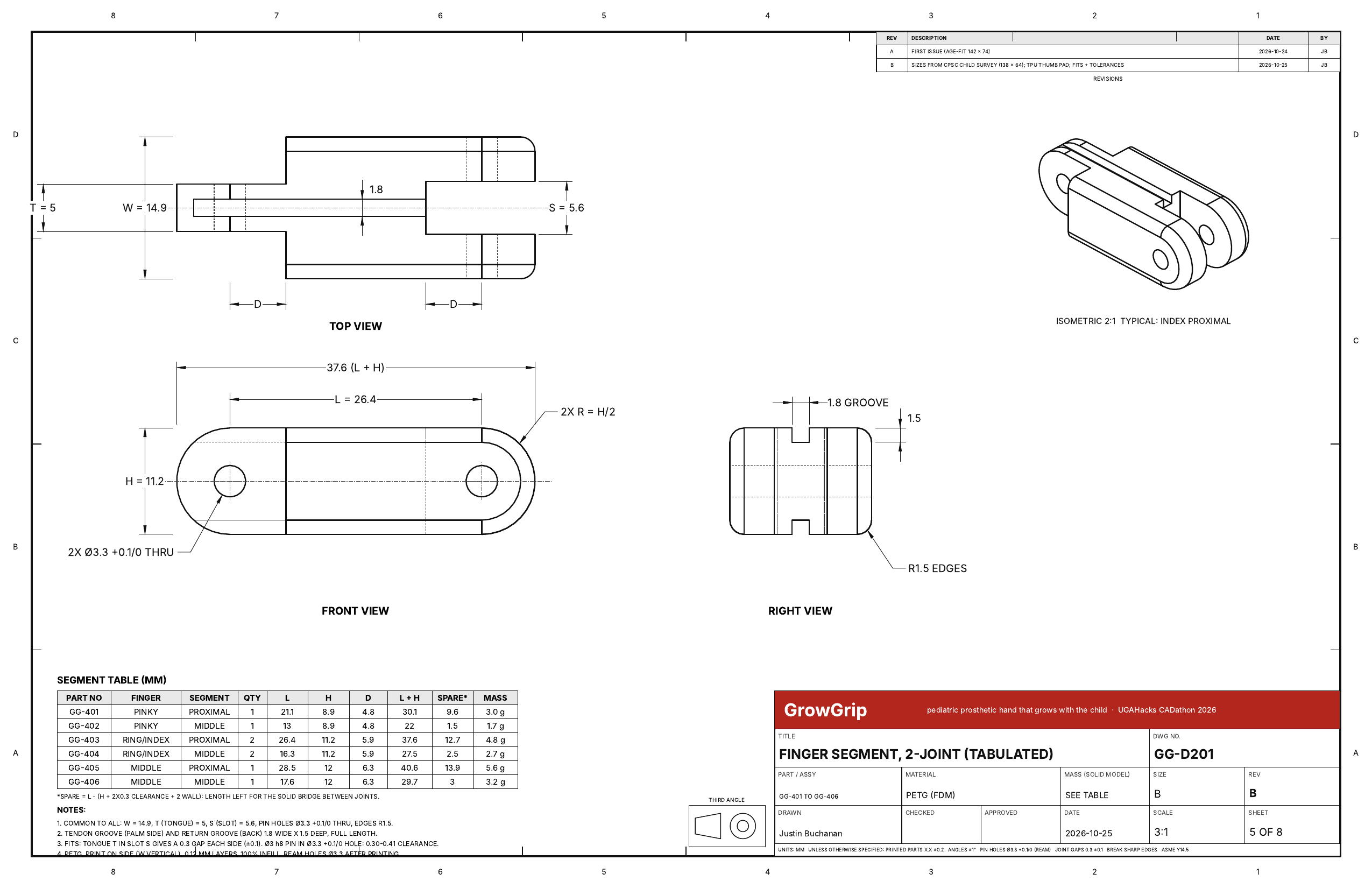
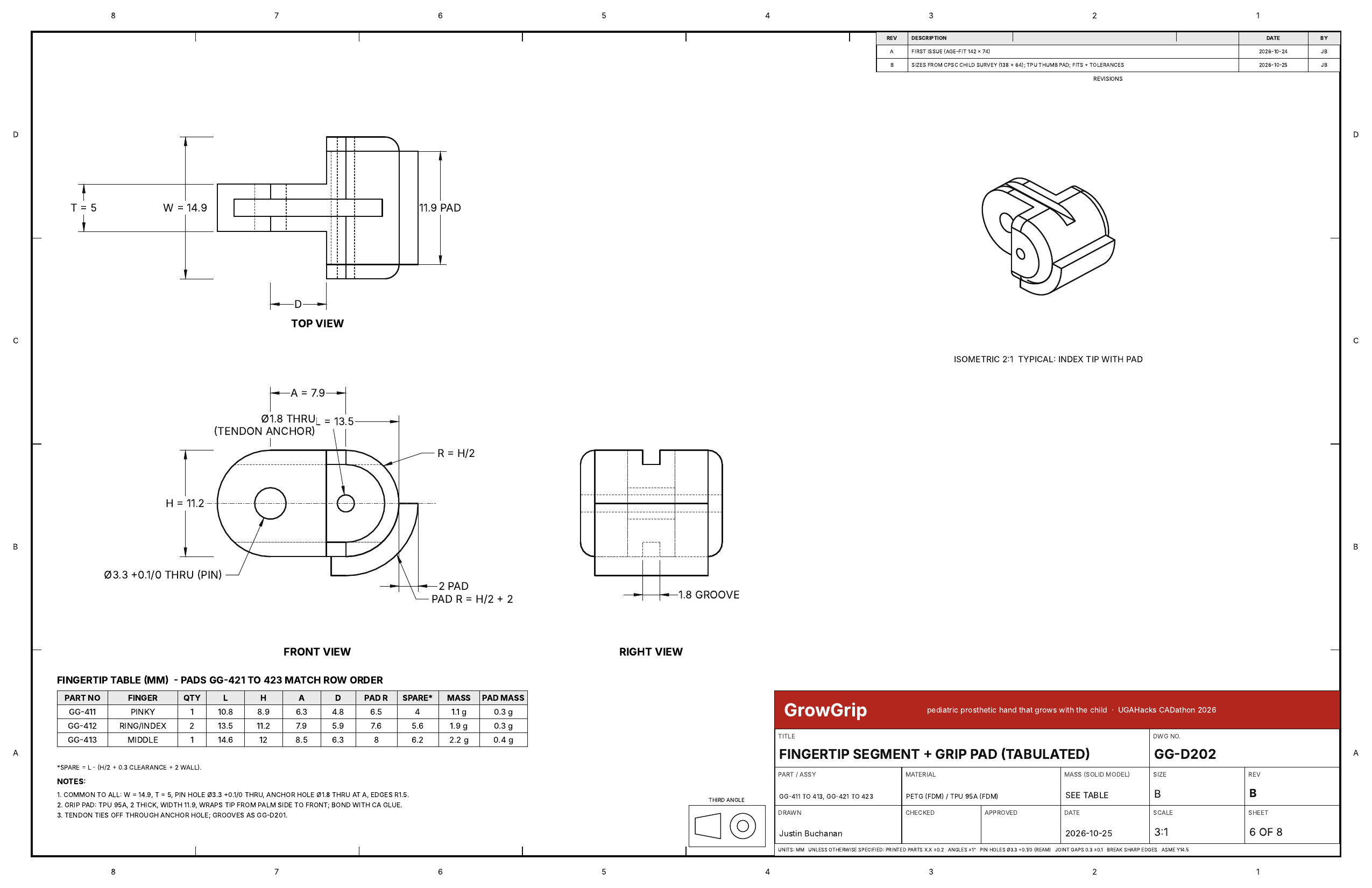
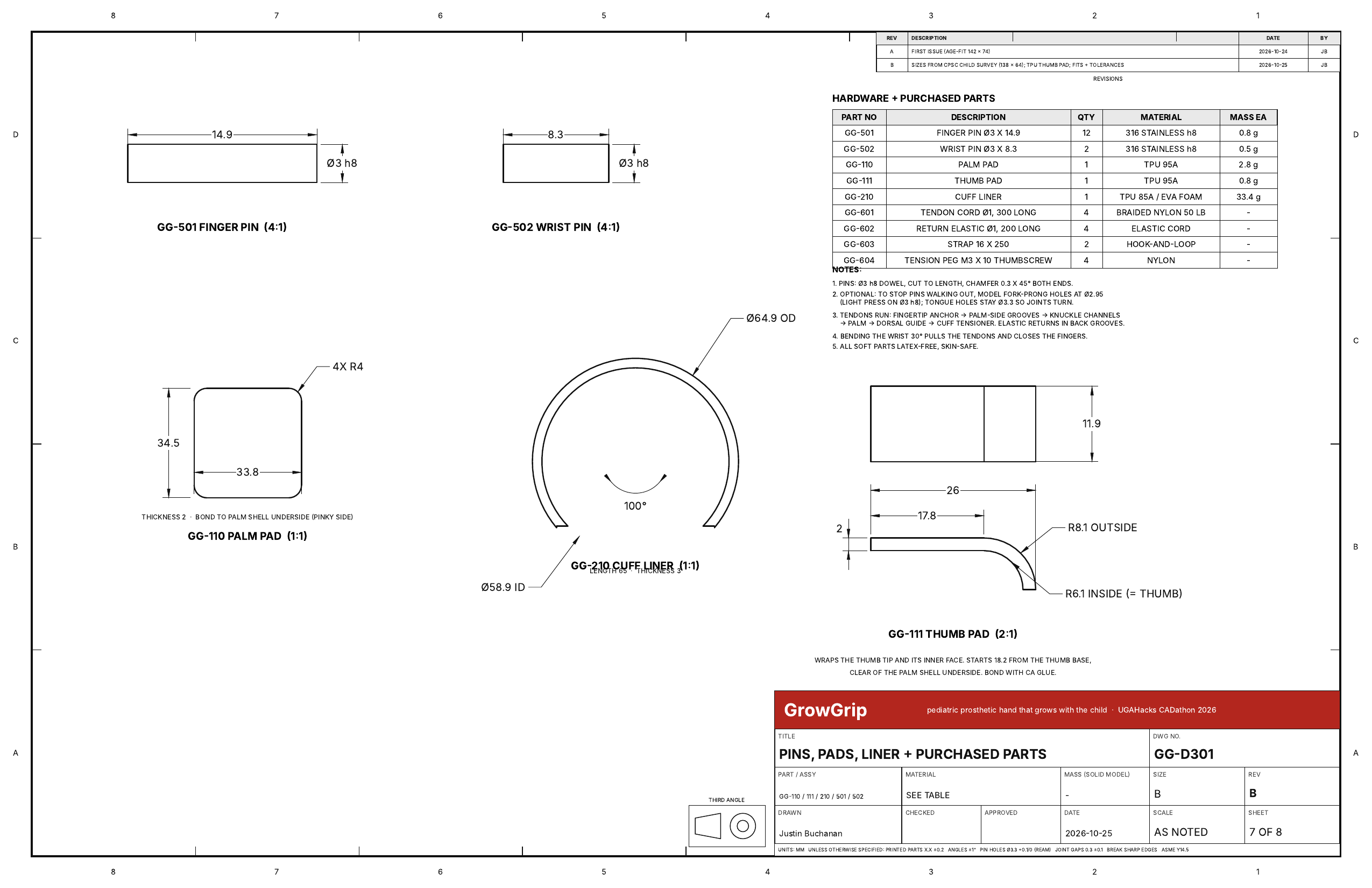
- a hollow palm shell with a fixed thumb facing the fingers, a TPU thumb pad and a TPU palm pad 12 finger segments joined by fork-and-tongue pin joints, with 0.3 mm clearances, tendon grooves and TPU fingertip pads
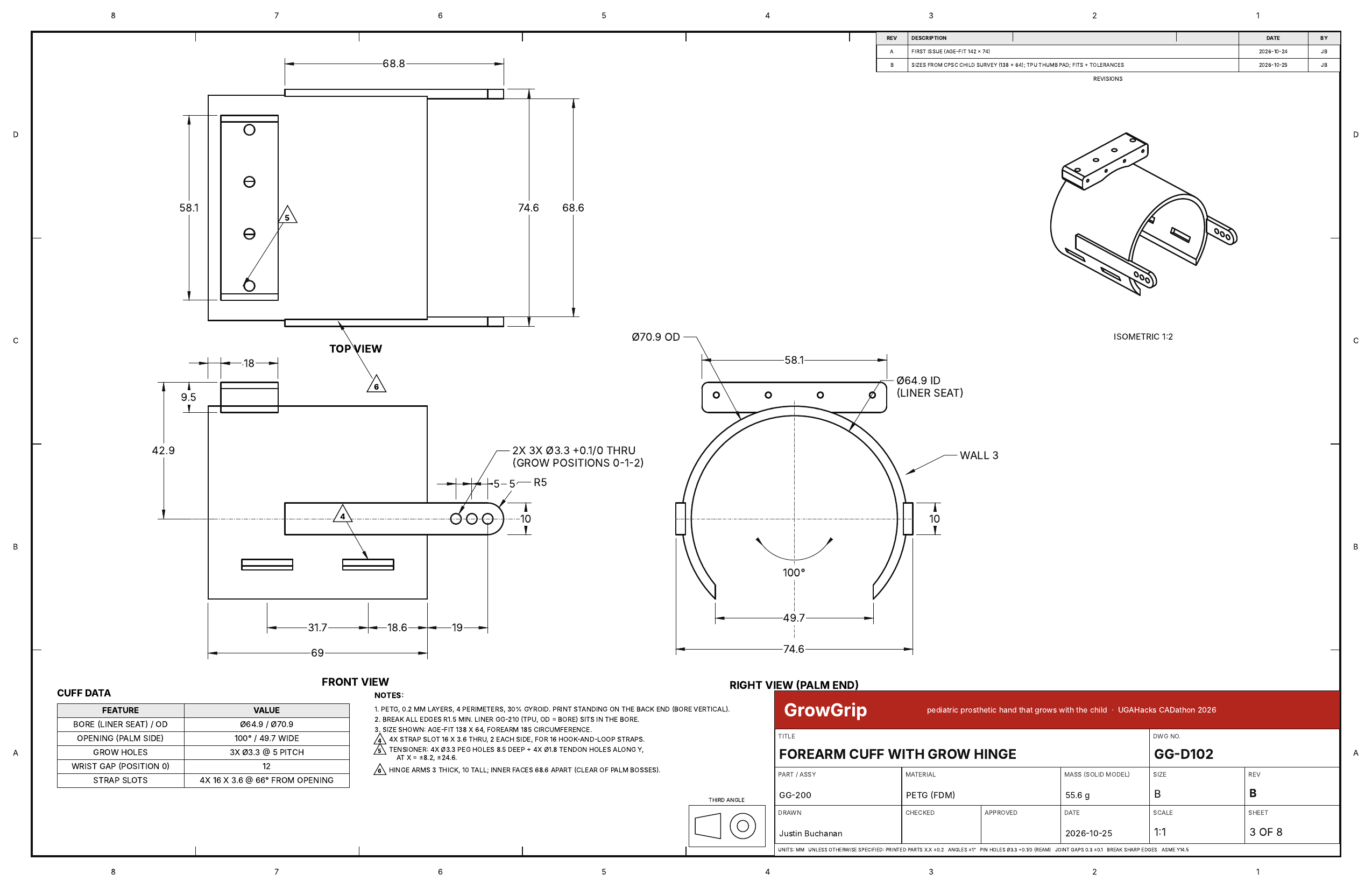
- an open-front forearm cuff with a TPU liner, strap slots and a 3-position grow hinge (5 mm steps)
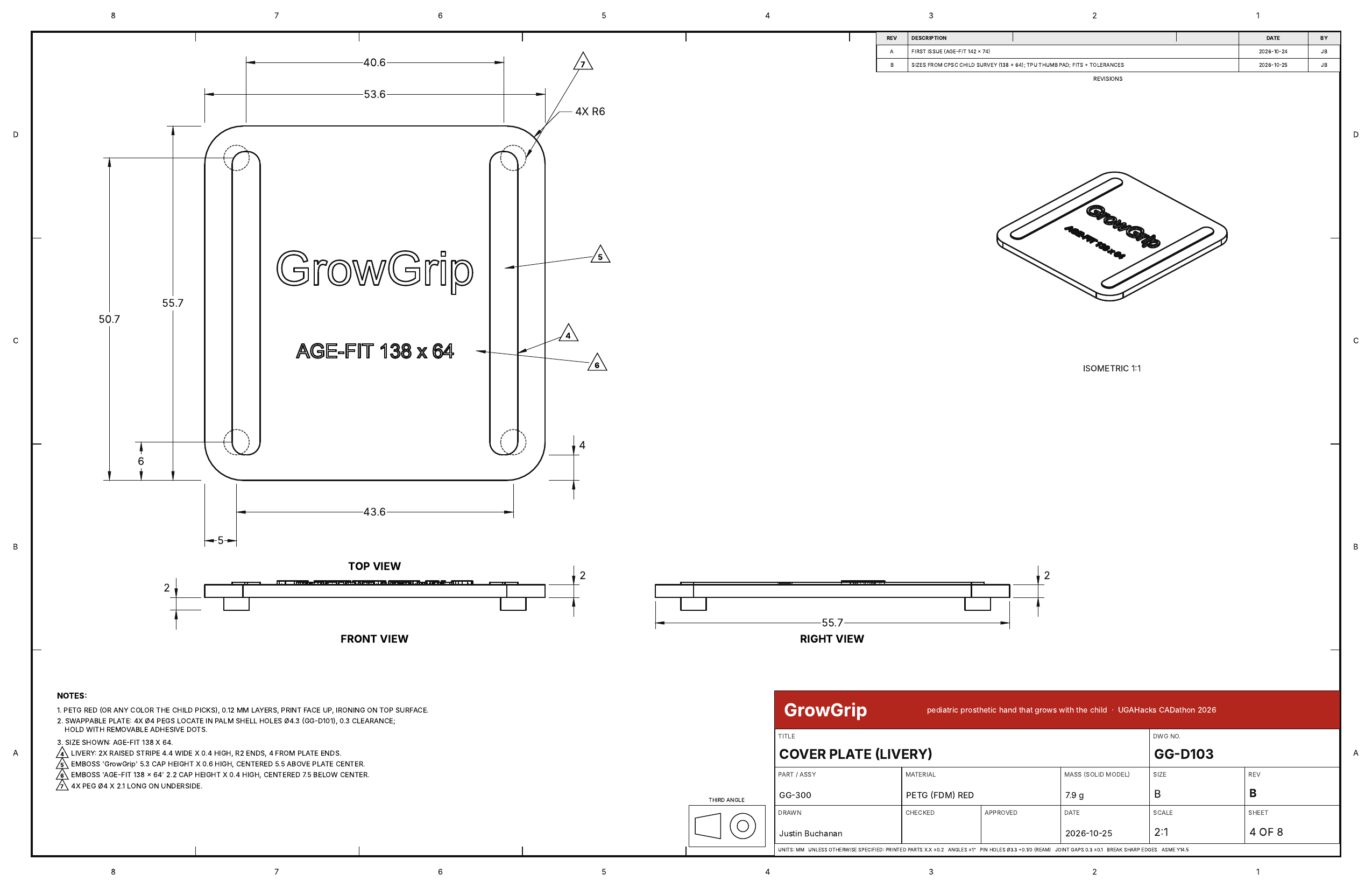
- a swappable livery cover plate embossed with the size it was built for
- a wrist joint and 12 finger joints
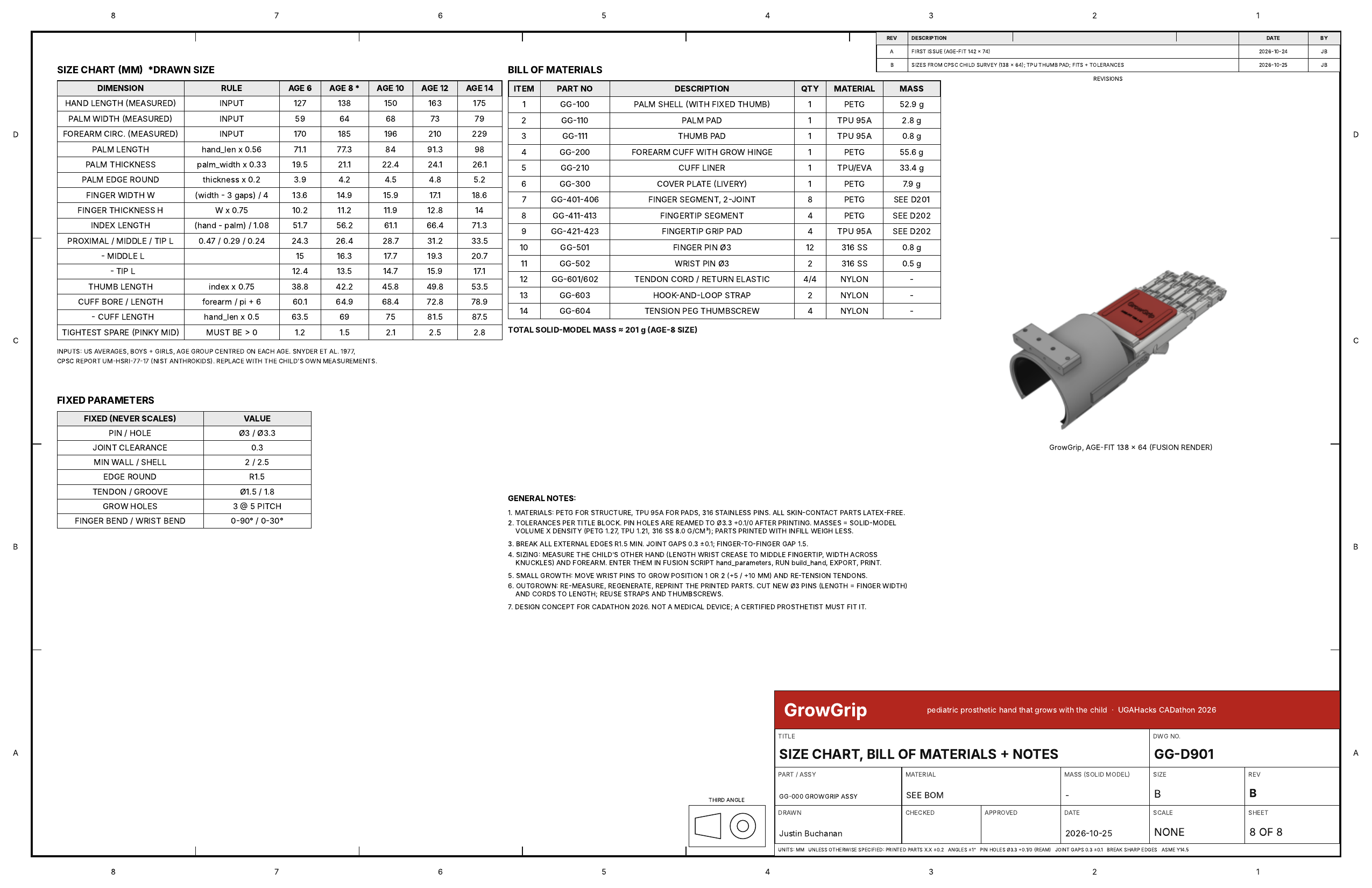
A second script assigns part numbers (GG-100 to GG-413) and materials: PETG shells, TPU 95A pads and 316 stainless Ø3 pins. The estimated mass is about 201 g at the age-8 size (solid model; printed with infill it weighs less).
Changing the child's measurements and re-running the generator rebuilds everything at the new size. The generator also checks that every segment is long enough for its joints; the tightest is the pinky middle segment at age 6, with 1.2 mm to spare. Fusion's interference analysis finds no overlapping parts with the fingers at 45° or 60° and the wrist at 15° or 20°.
A third script builds the hand at ages 6, 8, 10, 12 and 14 in a separate design, using the average hand and forearm sizes measured for each age in the US Consumer Product Safety Commission's child survey (Snyder et al. 1977) [4]. Every size passes the segment check and has no overlapping parts at 60°. We turned those exports into a 75-second animation: the hand closes on a cup, then it's shown on a forearm of the right size at each age, with callouts for what changes and what is reused.
We finished with an 8-sheet ANSI B drawing set (Rev B, with print-realistic tolerances: ±0.2 mm on printed parts, Ø3 pins in reamed Ø3.3 holes, 0.3 mm joint gaps) and two 3D PDFs. Sheet 1 is a Fusion assembly drawing with a ballooned parts list. The other sheets are fully dimensioned part drawings, generated from the exported STEP files and checked against the model. One 3D PDF is an interactive model and the other holds the rendered views.
Challenges: Keeping short finger segments long enough for a joint at both ends: finger thickness follows hand width while segment length follows hand length, so a small hand that is wide for its length is the hardest case. The generator checks it on every rebuild; the youngest size (age 6) has the least room, 1.2 mm. Getting trustworthy size data was another: our first numbers came from a health-news site, and when we checked them against the government survey, the palm width was wider than 95% of 8-year-olds. We switched every size to the survey and rebuilt the model, drawings and video.
Accomplishments: The same model rebuilds cleanly at ages 6, 8, 10, 12 and 14, with no overlapping parts at 60°. A product-style drawing set: 8 sheets with a parts list, part numbers, materials and a size chart.
What we learned: Fusion parametric modeling, joints, tolerances and GD&T, designing for a specific user.
What's next: Print and test a finger joint, measure real grip force, work with a prosthetist on fit, and build a simple sizing web form for parents.
Limits: this is a design concept, not a medical device. The default sizes are US population averages measured in 1975–1977; a real device uses the child's own measurements.
Sources: Parker S.E. et al. (2010). Updated national birth prevalence estimates for selected birth defects in the United States, 2004–2006. Birth Defects Research Part A 88:1008–1016. Lazar S. et al. (2025). Expanding Insurance Coverage for Pediatric Upper Extremity Recreational Prosthetic Devices. J Hand Surg Global Online 7(5):100790. Zuniga J. et al. (2015). Cyborg beast: a low-cost 3d-printed prosthetic hand for children with upper-limb differences. BMC Research Notes 8:10. Snyder R.G. et al. (1977). Anthropometry of Infants, Children, and Youths to Age 18 for Product Safety Design. Report UM-HSRI-77-17, US Consumer Product Safety Commission. Tables via NIST AnthroKids.
Built With
- autodesk-fusion-360
- claude
- fusion


Log in or sign up for Devpost to join the conversation.