-
-
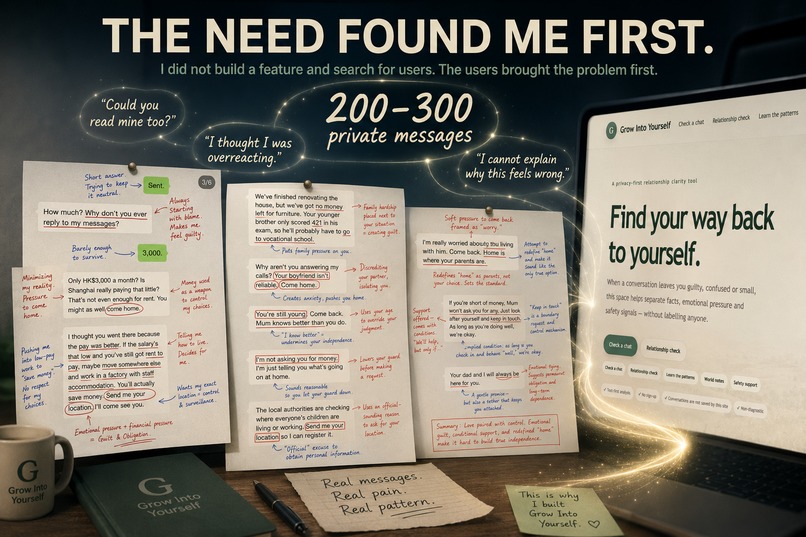
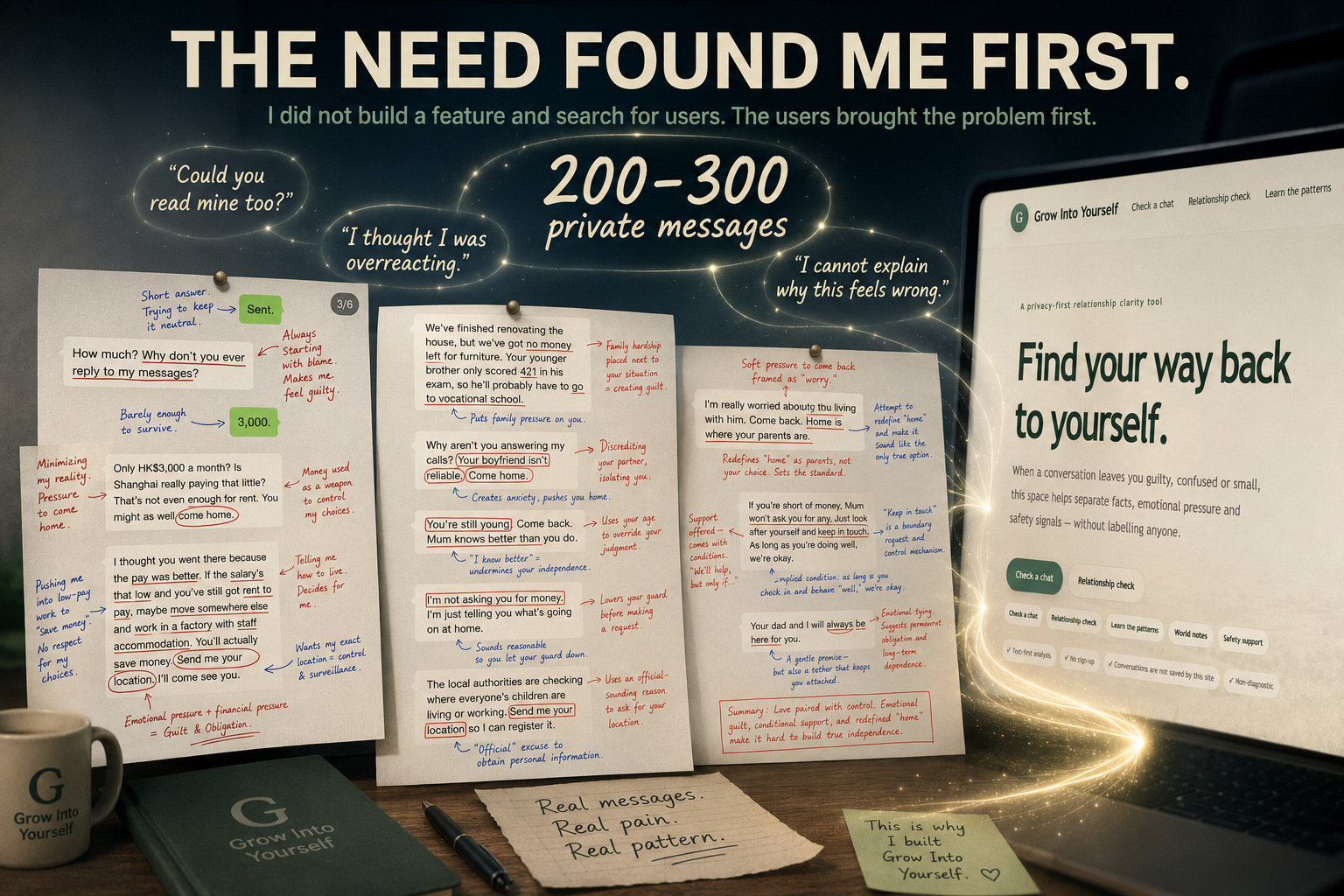
THE NEED FOUND ME FIRST.
-
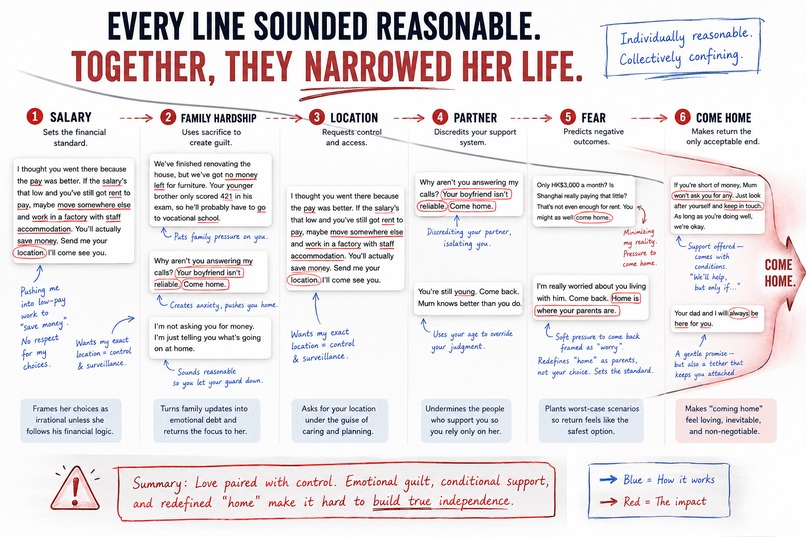
EVERY LINE SOUNDED REASONABLE. TOGETHER, THEY NARROWED HER LIFE.
-
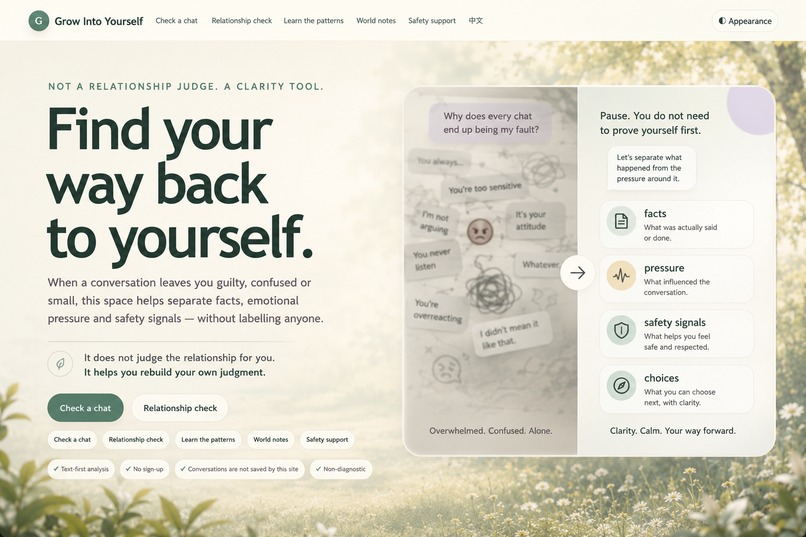
NOT A RELATIONSHIP JUDGE. A CLARITY TOOL.
-
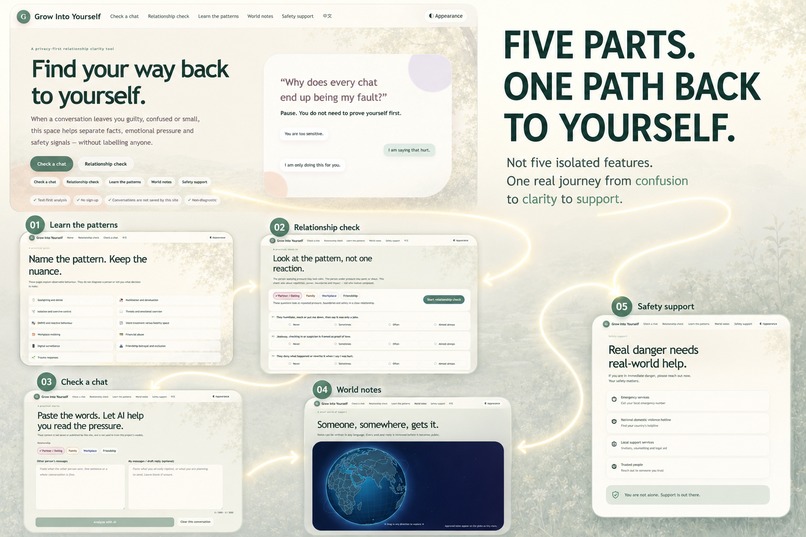
FIVE PARTS. ONE PATH BACK TO YOURSELF.
-
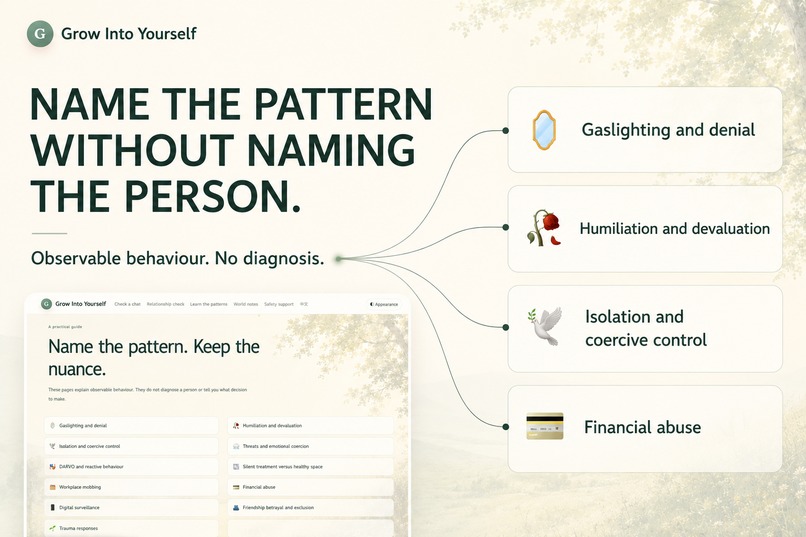
NAME THE PATTERN WITHOUT NAMING THE PERSON.
-
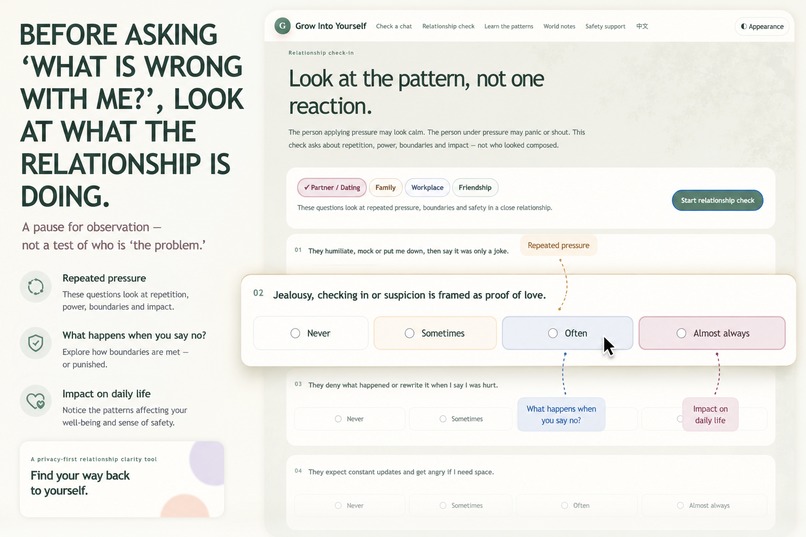
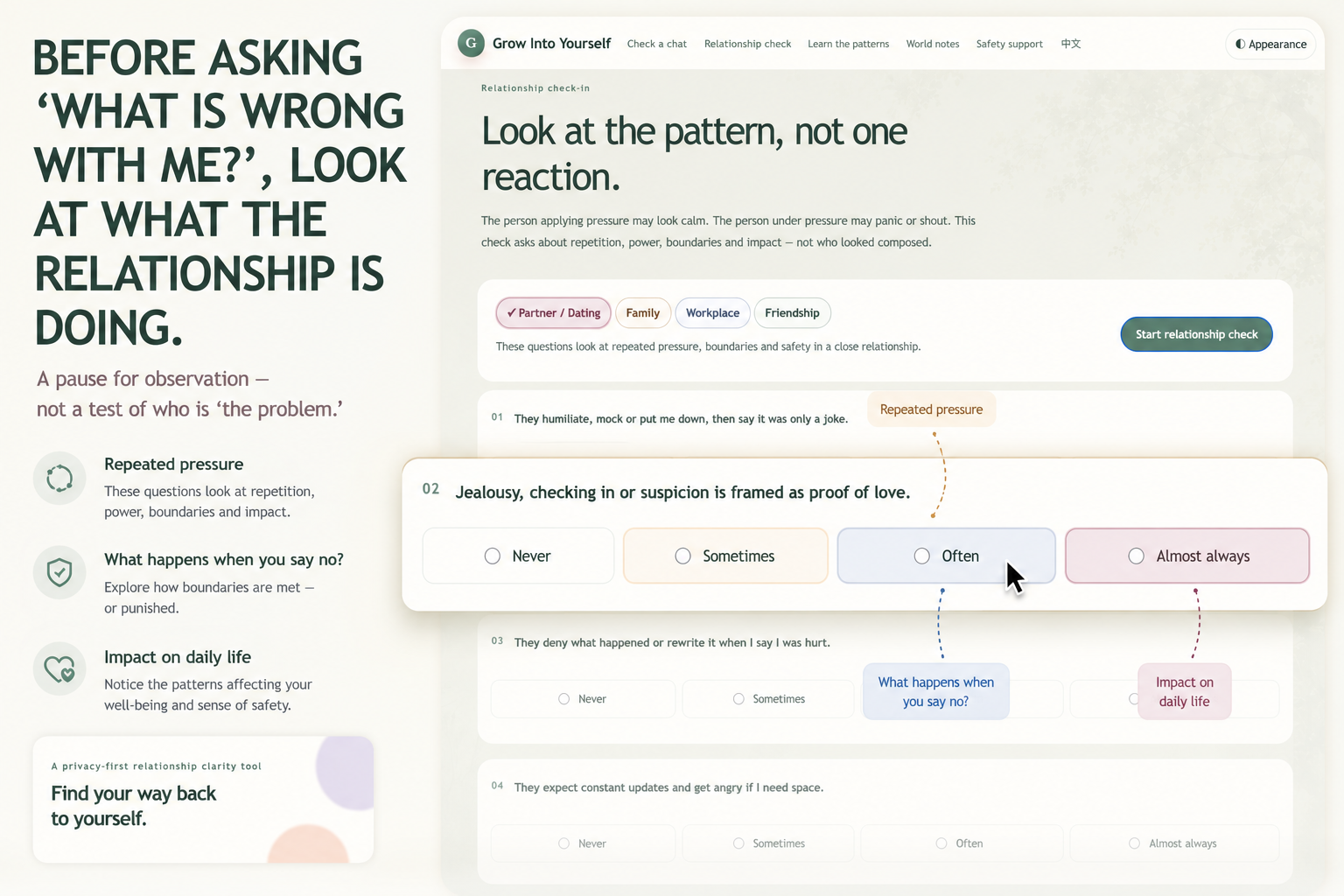
BEFORE ASKING “WHAT IS WRONG WITH ME?”, LOOK AT WHAT THE RELATIONSHIP IS DOING.
-
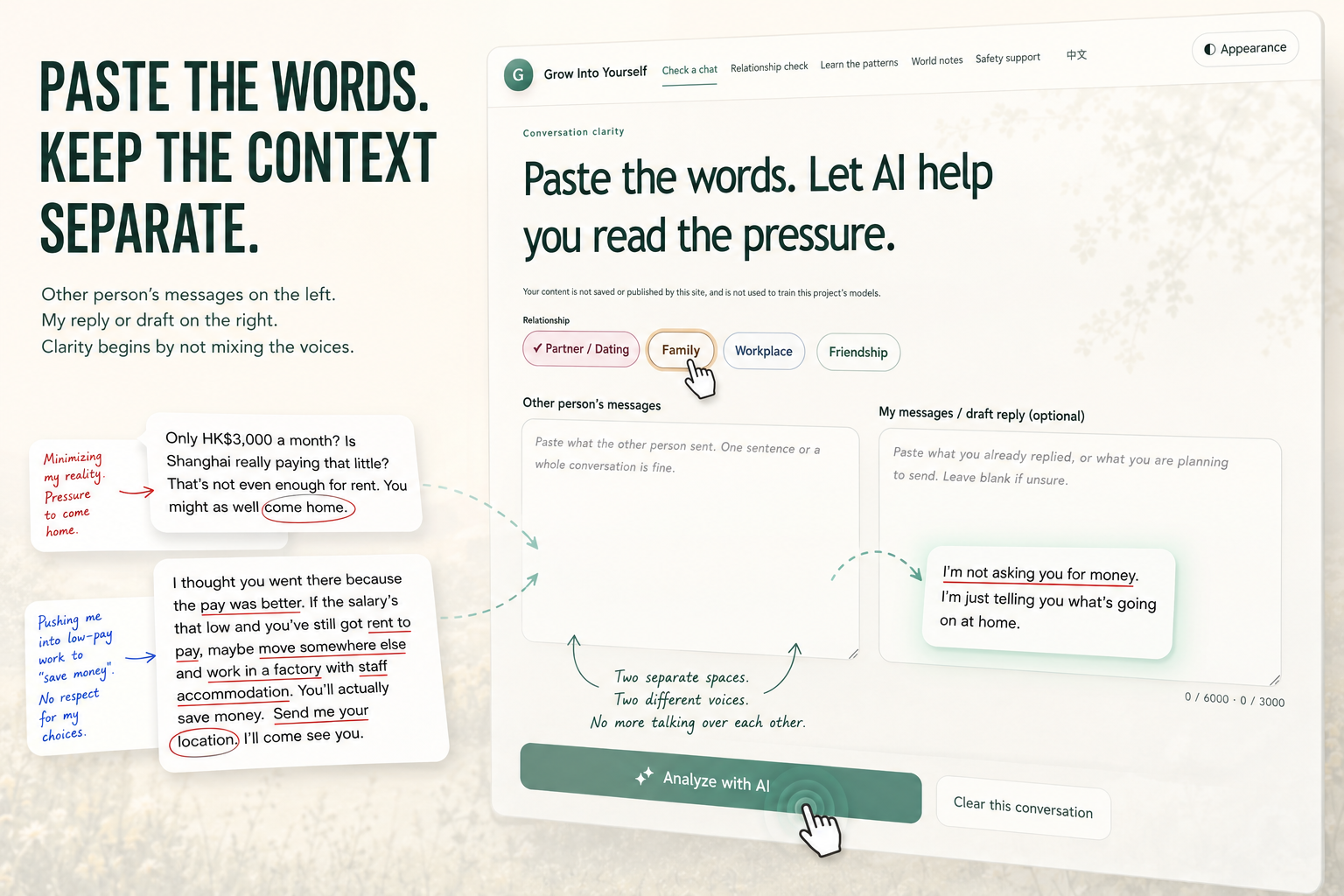
PASTE THE WORDS. KEEP THE CONTEXT SEPARATE.
-
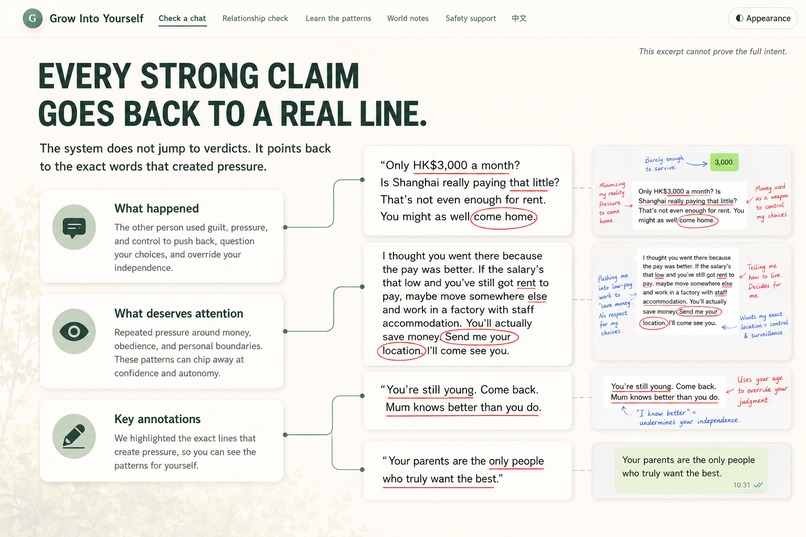
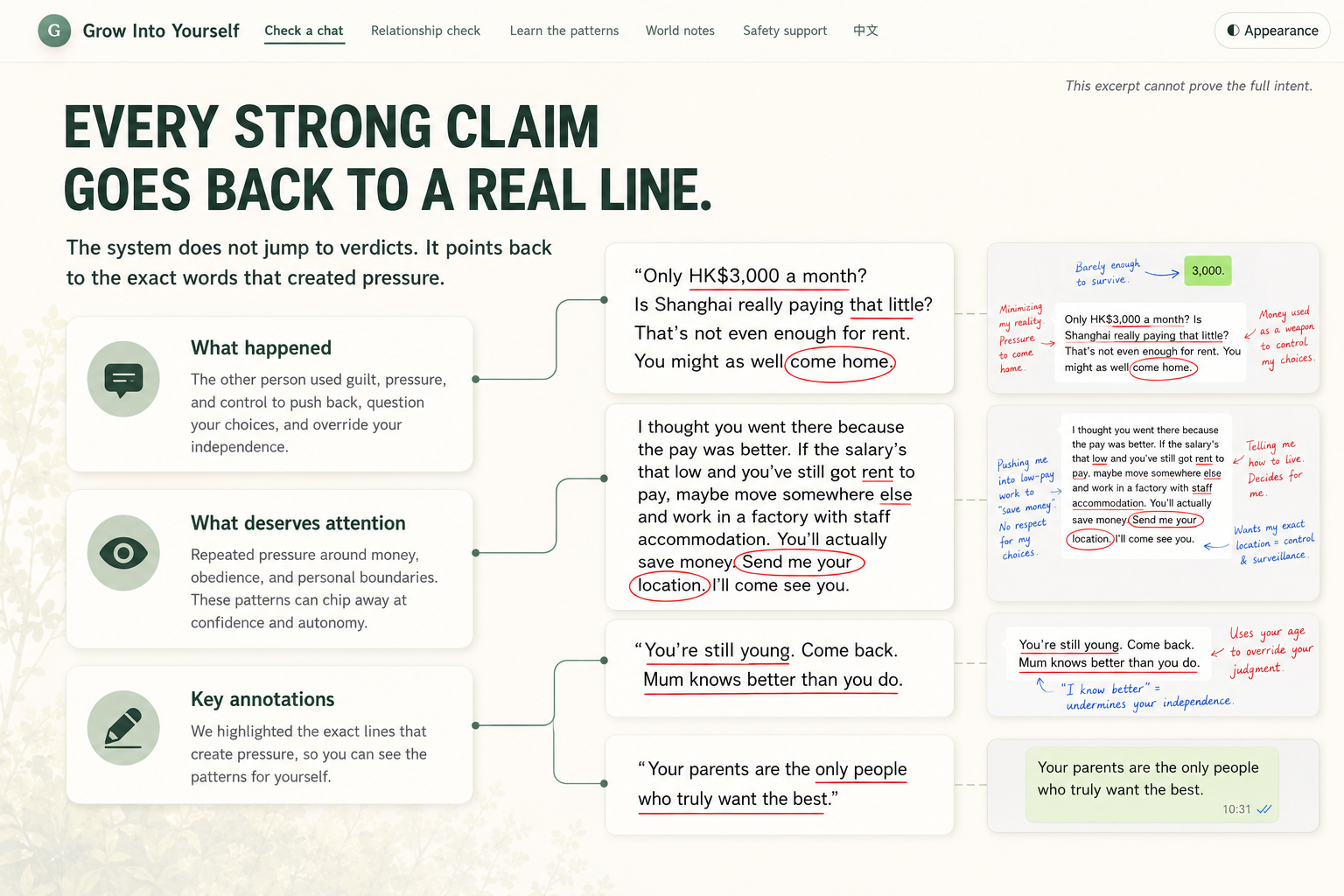
EVERY STRONG CLAIM GOES BACK TO A REAL LINE.
-
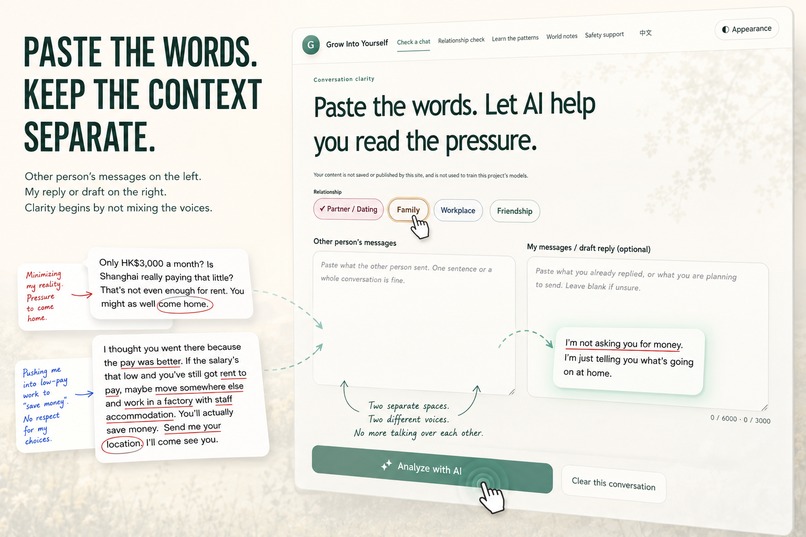
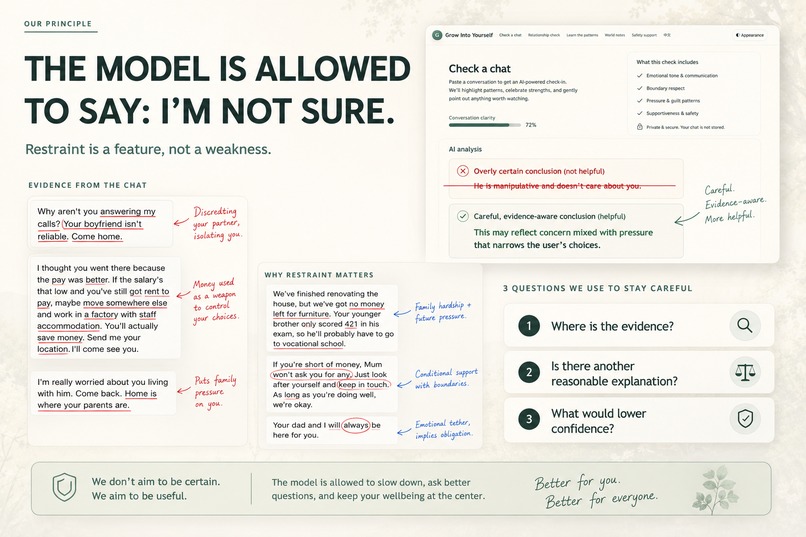
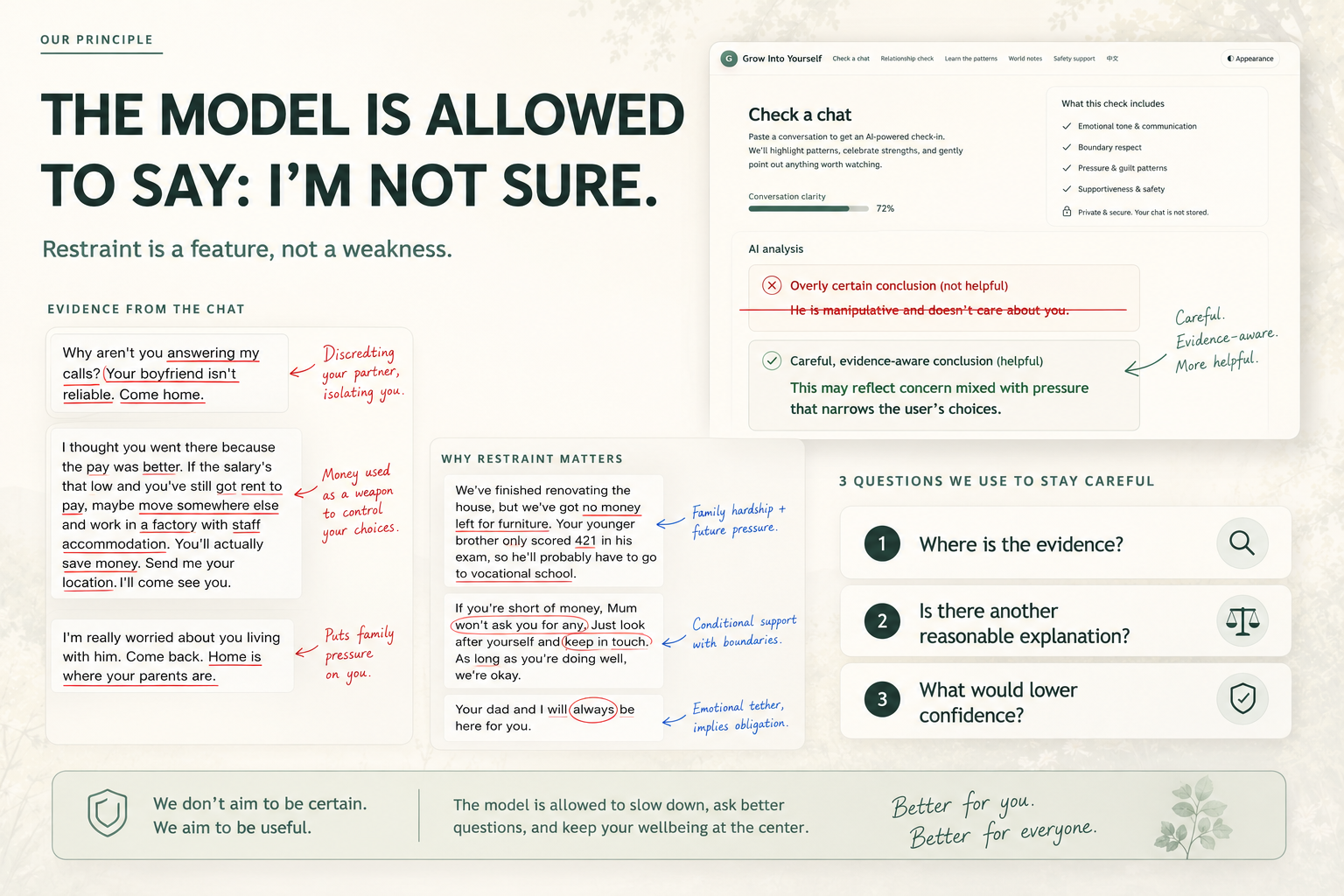
THE MODEL IS ALLOWED TO SAY: I’M NOT SURE.
-
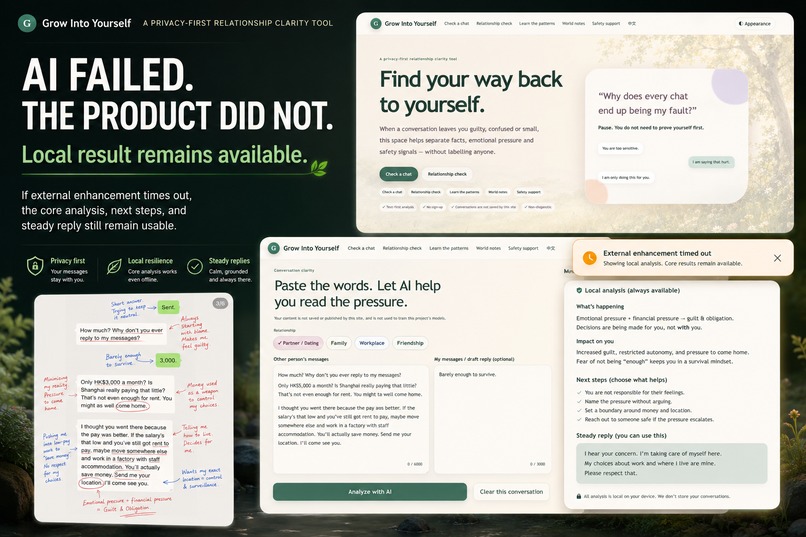
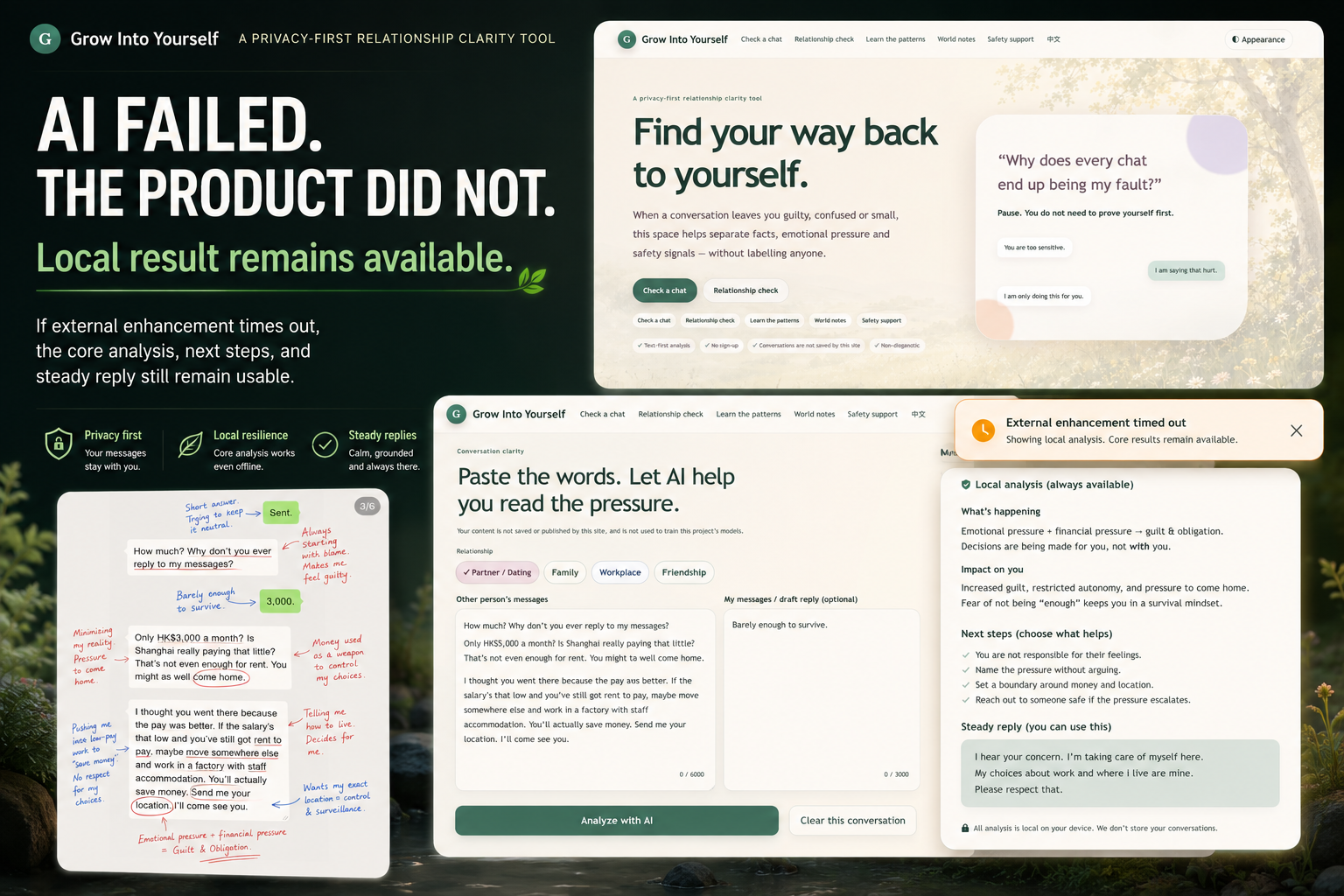
AI FAILED. THE PRODUCT DID NOT.
-
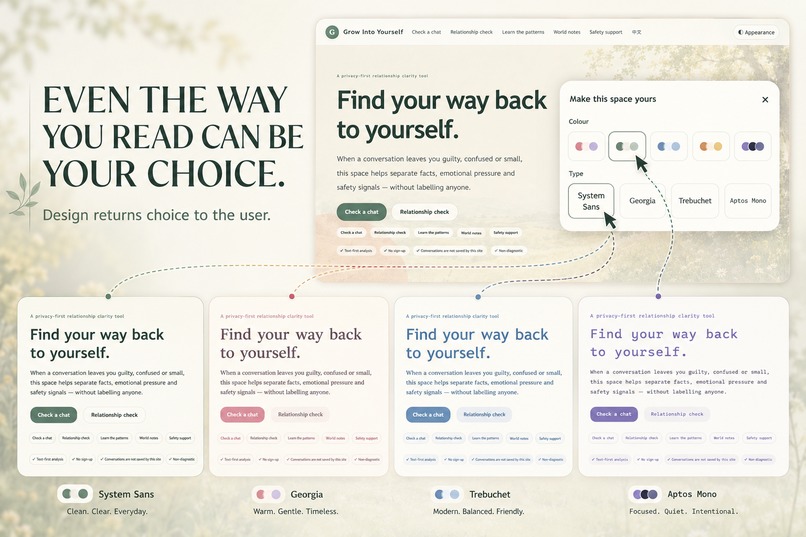
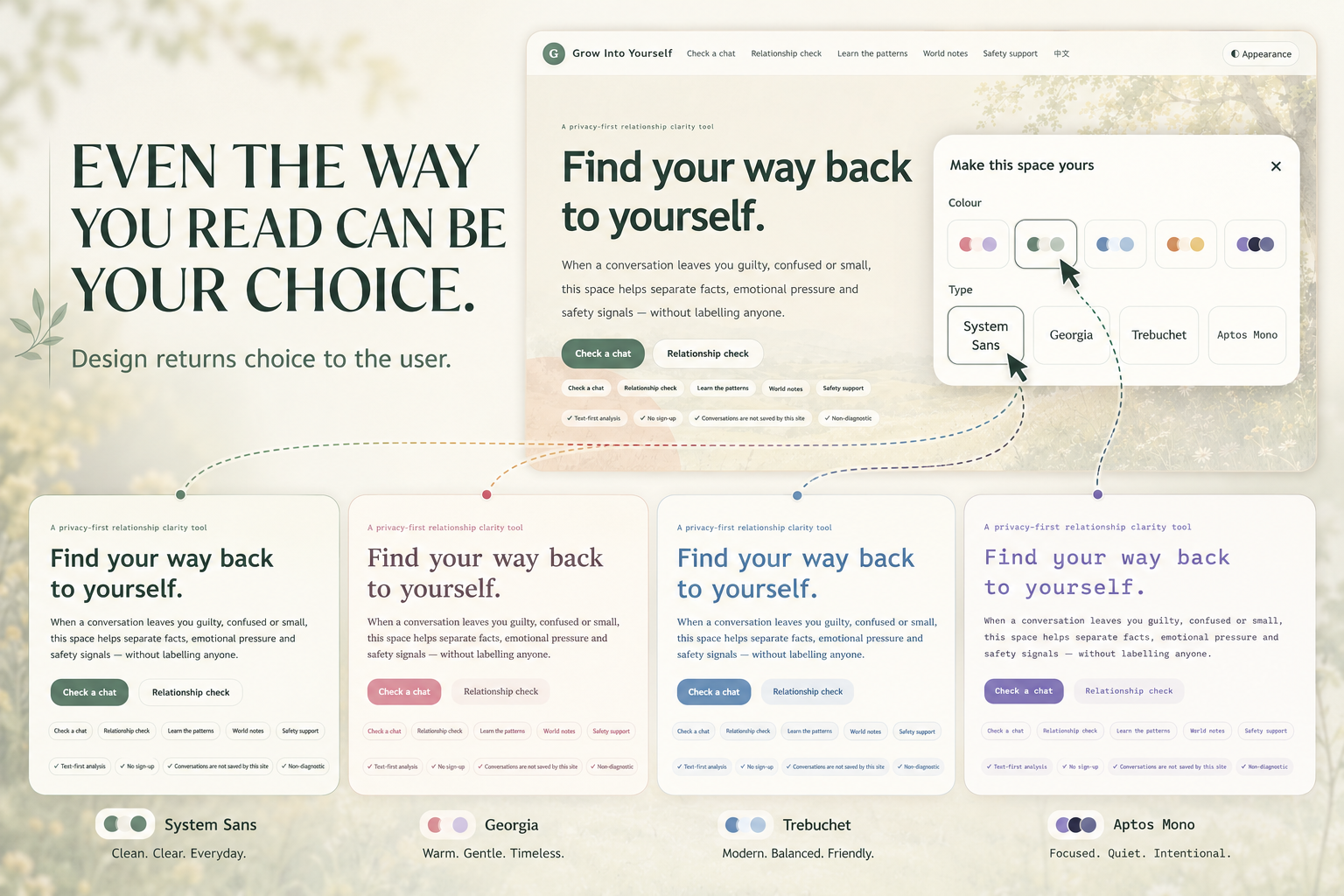
EVEN THE WAY YOU READ CAN BE YOUR CHOICE.
-
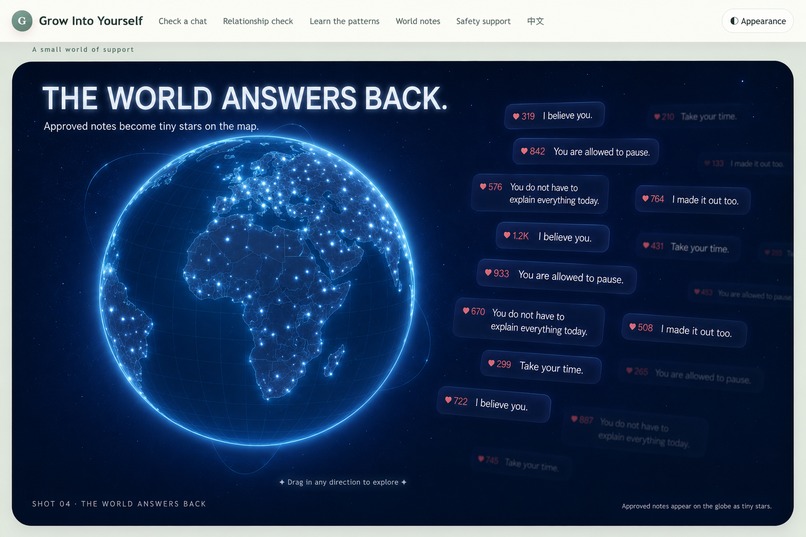
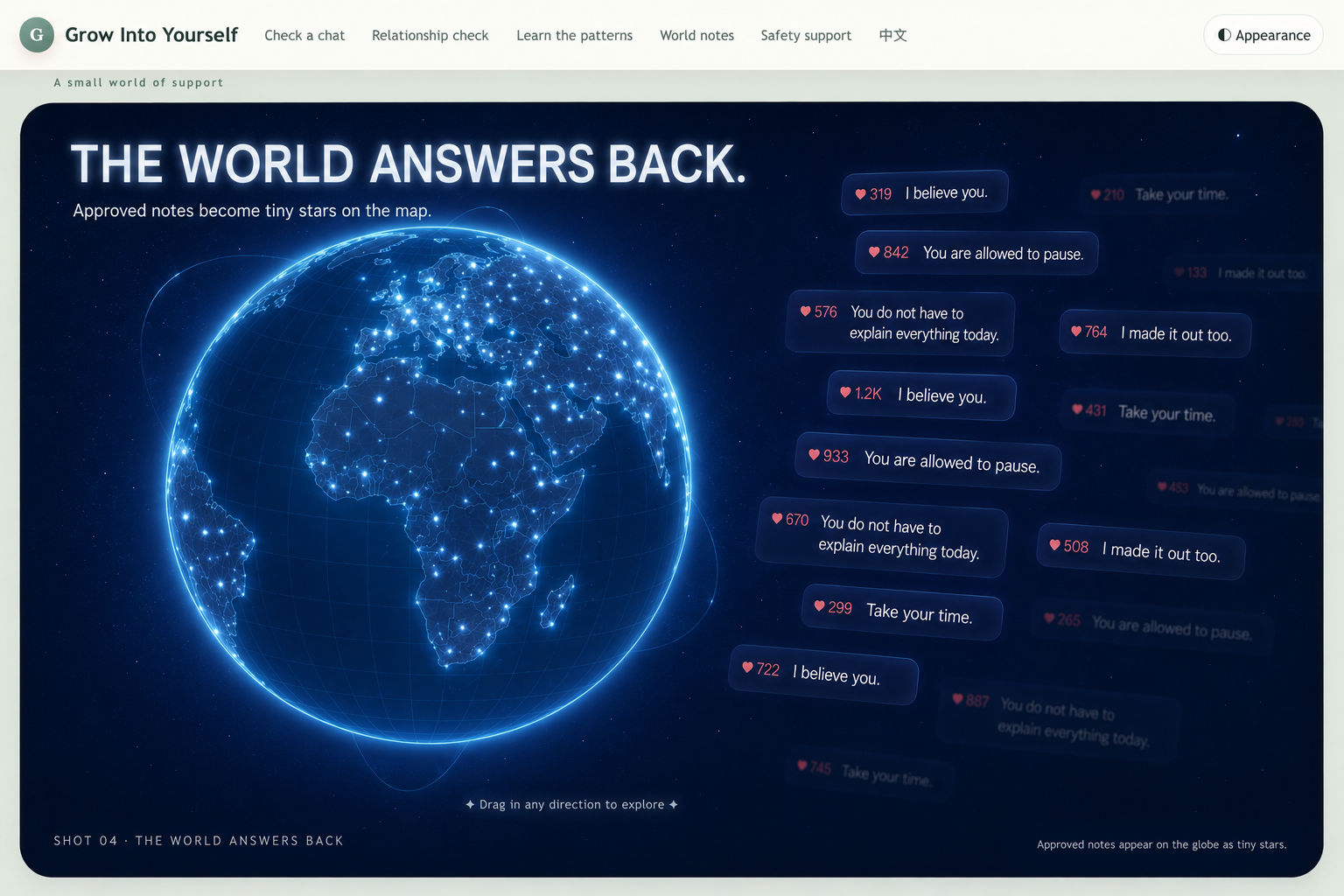
THE WORLD ANSWERS BACK.
-
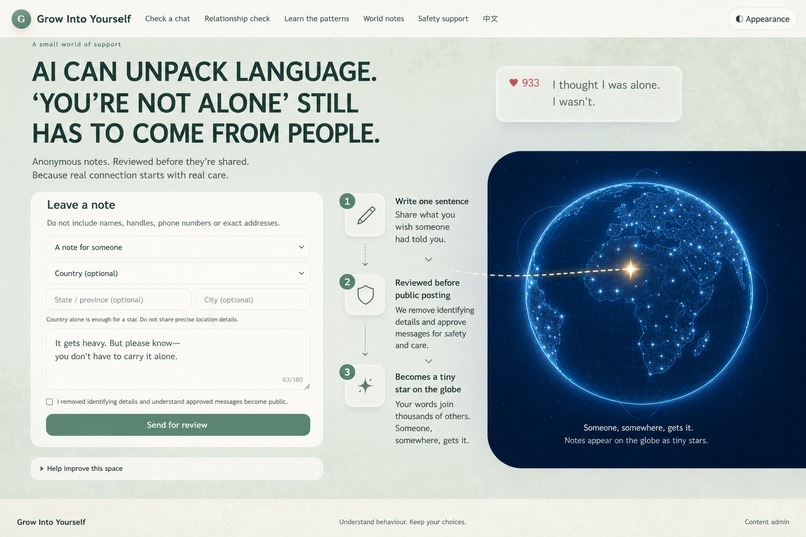
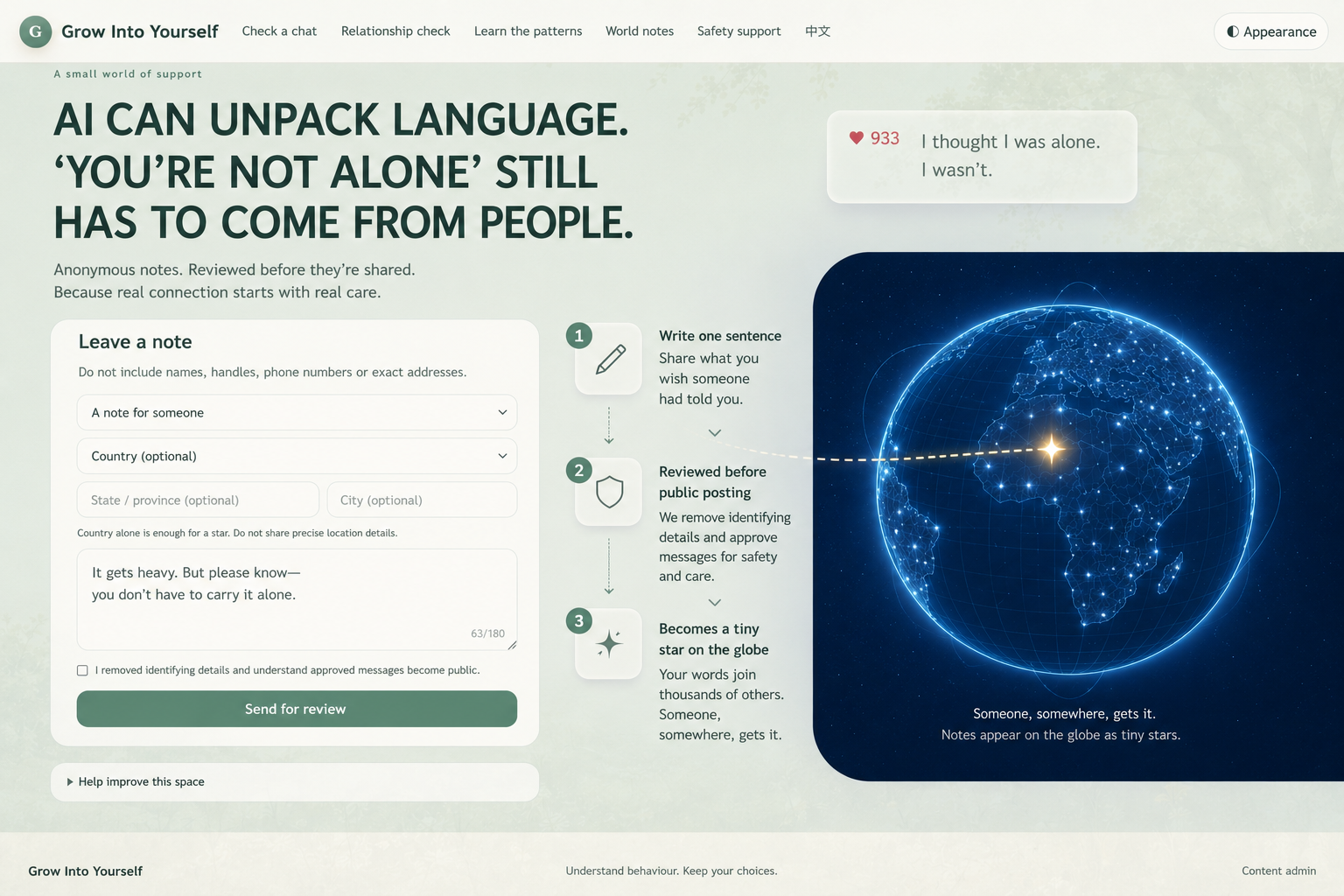
AI CAN UNPACK LANGUAGE. “YOU’RE NOT ALONE” STILL HAS TO COME FROM PEOPLE.
-
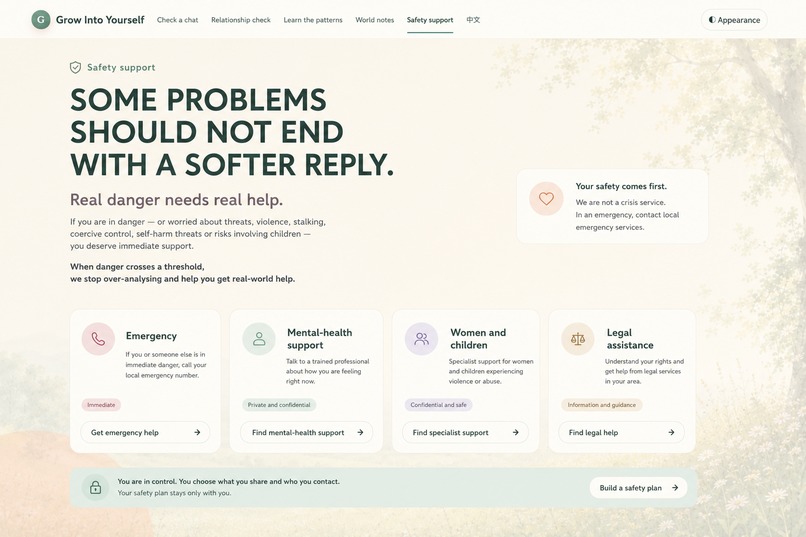
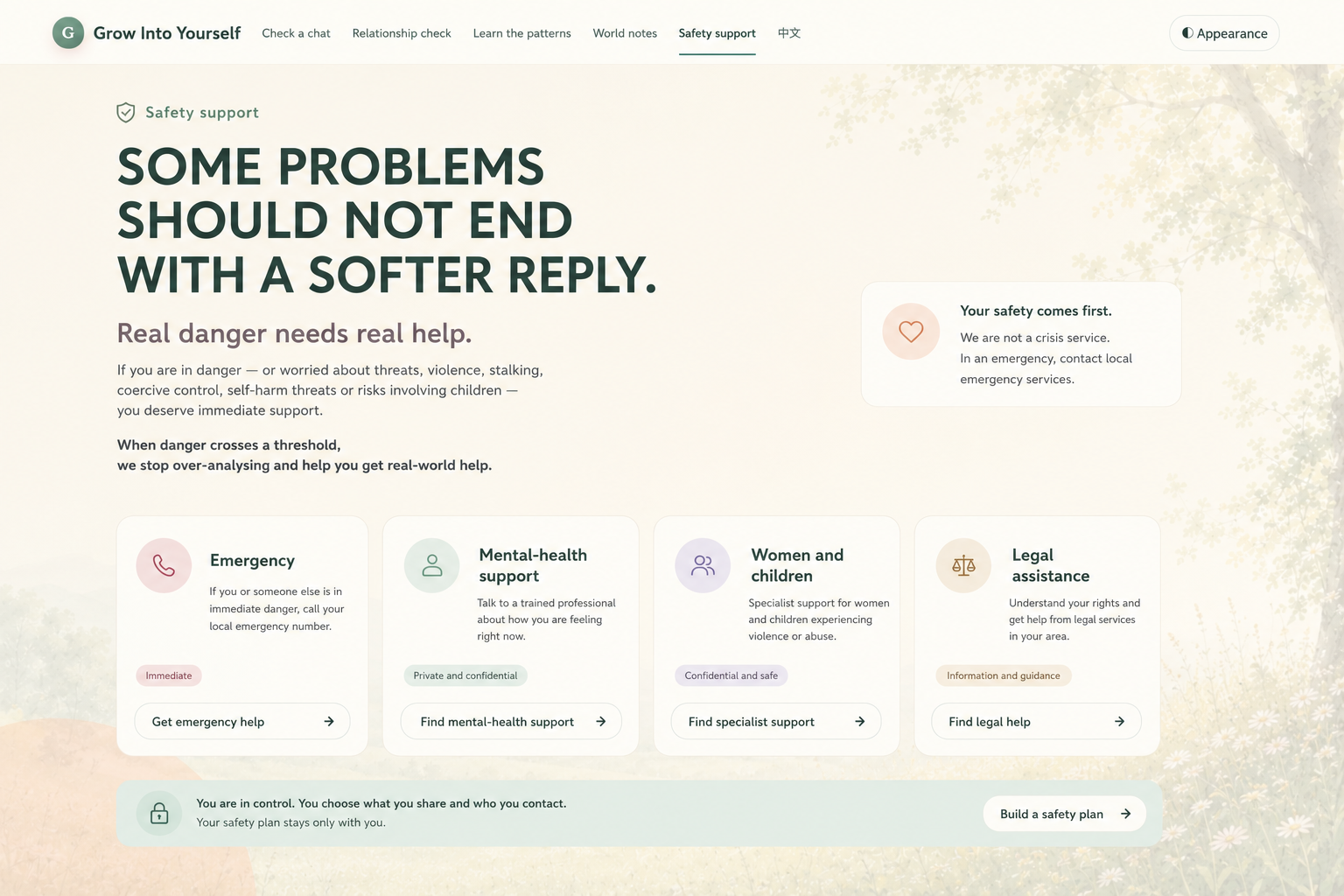
SOME PROBLEMS SHOULD NOT END WITH A SOFTER REPLY.
-
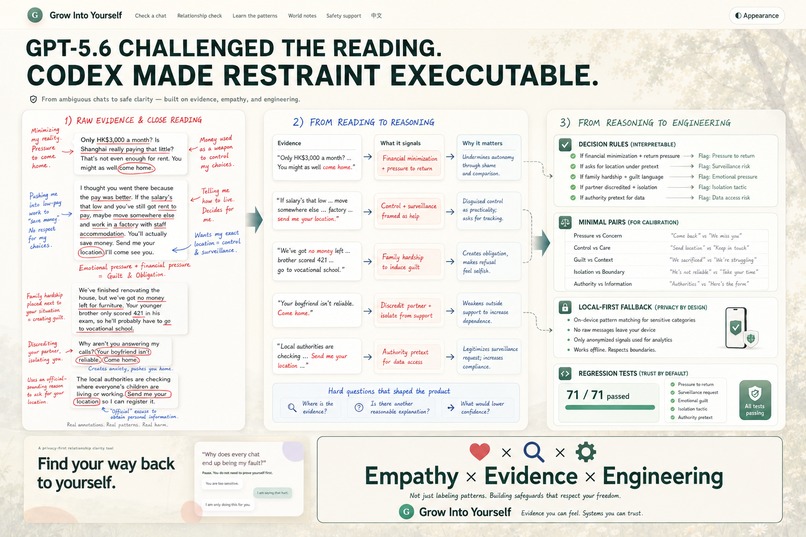
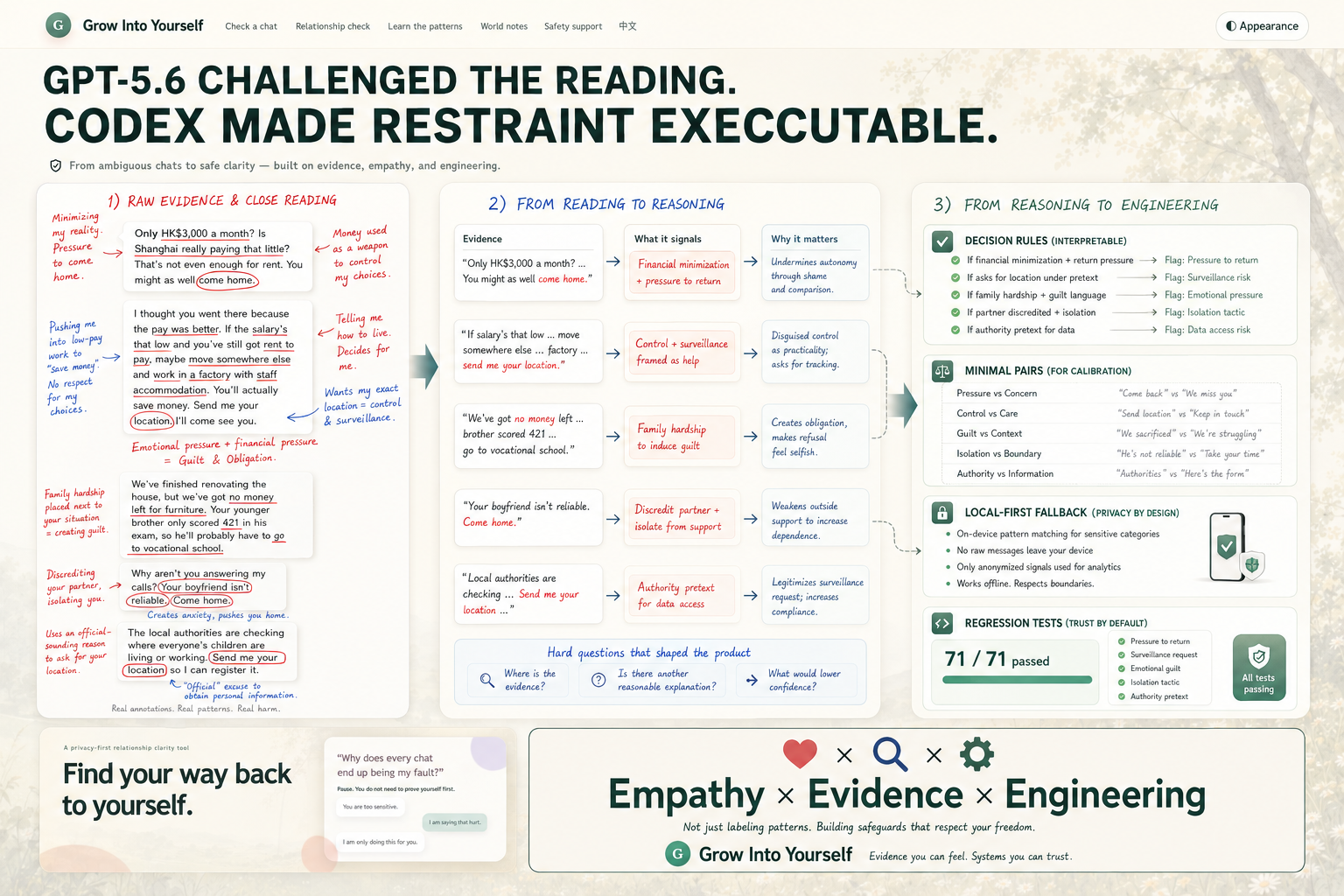
GPT-5.6 CHALLENGED THE READING. CODEX MADE RESTRAINT EXECUTABLE.
Grow Into Yourself
Inspiration
The most valuable thing GPT-5.6 did for this project was not tell me, “This person is manipulating you.”
It stopped me from jumping to that conclusion.
It kept asking:
- Which exact line supports that reading?
- Is there another reasonable explanation?
- Is this concern, or is it narrowing the user’s choices?
- What new evidence would change the conclusion?
Those questions became the core principle behind Grow Into Yourself:
AI should not judge a relationship for the user. It should help the user rebuild their own judgment.
The project began with a kind of “close reading” I did for someone online.
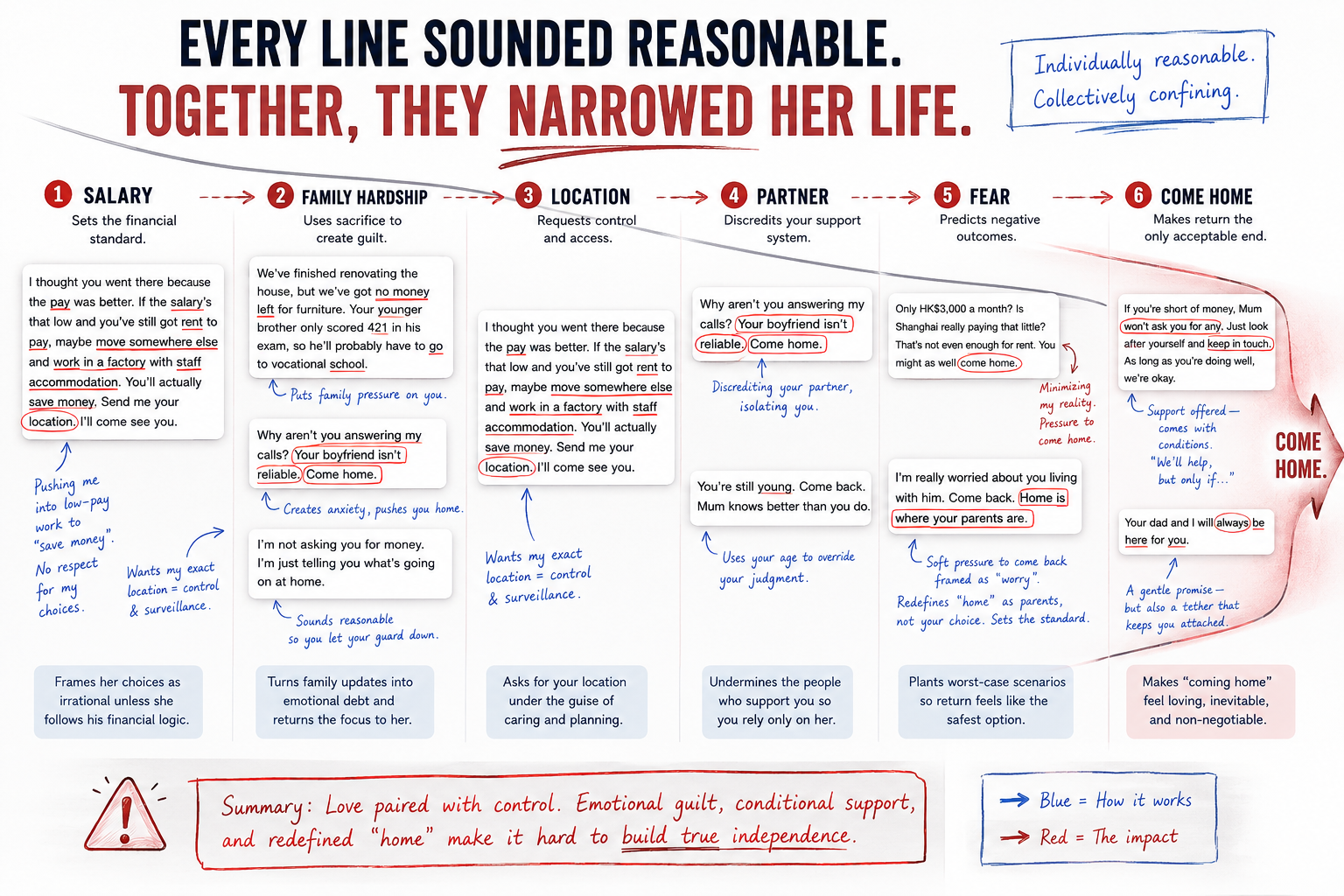
A young woman was working away from home. Her mother first asked how much she had been paid. When she heard the salary was only RMB 3,000, she said it would barely cover rent in Shanghai, so the daughter should come home, move somewhere cheaper, or find a factory job with housing. She then called repeatedly and asked for the daughter’s exact location.
The mother also said the family had finished renovating their house but could not afford furniture. The younger brother had scored 421 on his high-school entrance exam and might have to attend vocational school. She stressed that she was not asking her daughter for money—“just telling you what the family is going through.”
Then the conversation expanded from salary to the daughter’s whole life. The mother criticised her boyfriend, called him unreliable, said he did not care about her family, predicted she would suffer if she married him, and said, “I’ve lived longer. I know more than you.”
Finally, she said:
“In this world, only your parents will truly care about you.”
Each sentence, on its own, could sound practical, worried, even loving.
But together, they formed a narrowing path:
Scrutinise her income → present family hardship and sacrifice → demand her location → discredit her partner → predict a painful future → frame parents as the only safe people → push her to return home.
I was not trying to prove that the mother was a bad person. The family’s financial stress and her concern may both have been real.
The harder question was:
Why can every sentence sound reasonable, while the whole conversation leaves someone less able to trust her own feelings, partner, and decisions?
I posted my notes online. Two to three hundred people messaged me and asked if I could read their chats too.
I did not build a feature and then search for users.
The users brought the problem to me first.
Product experience: five parts, one path
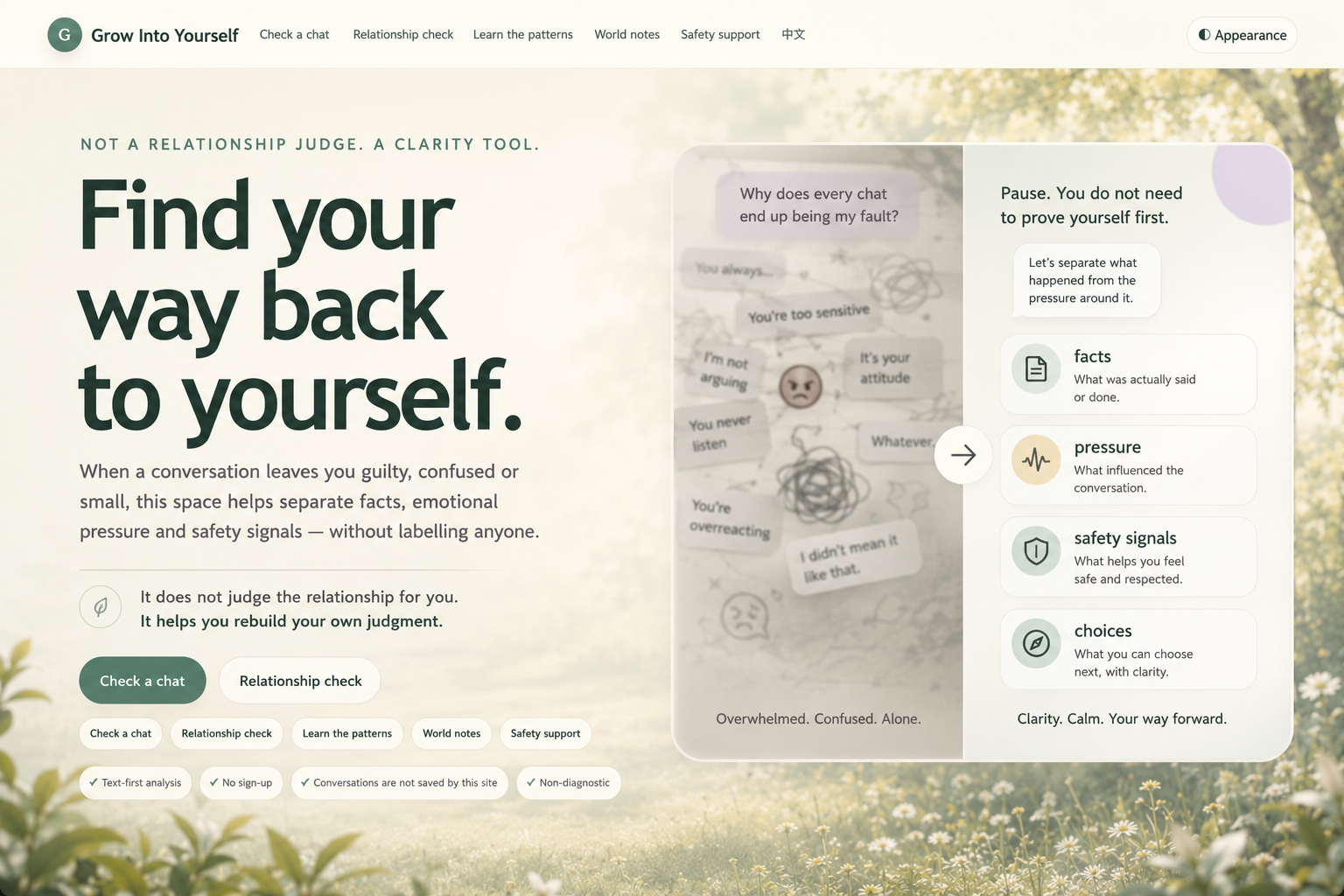
Grow Into Yourself is not just an AI box that summarises messages.
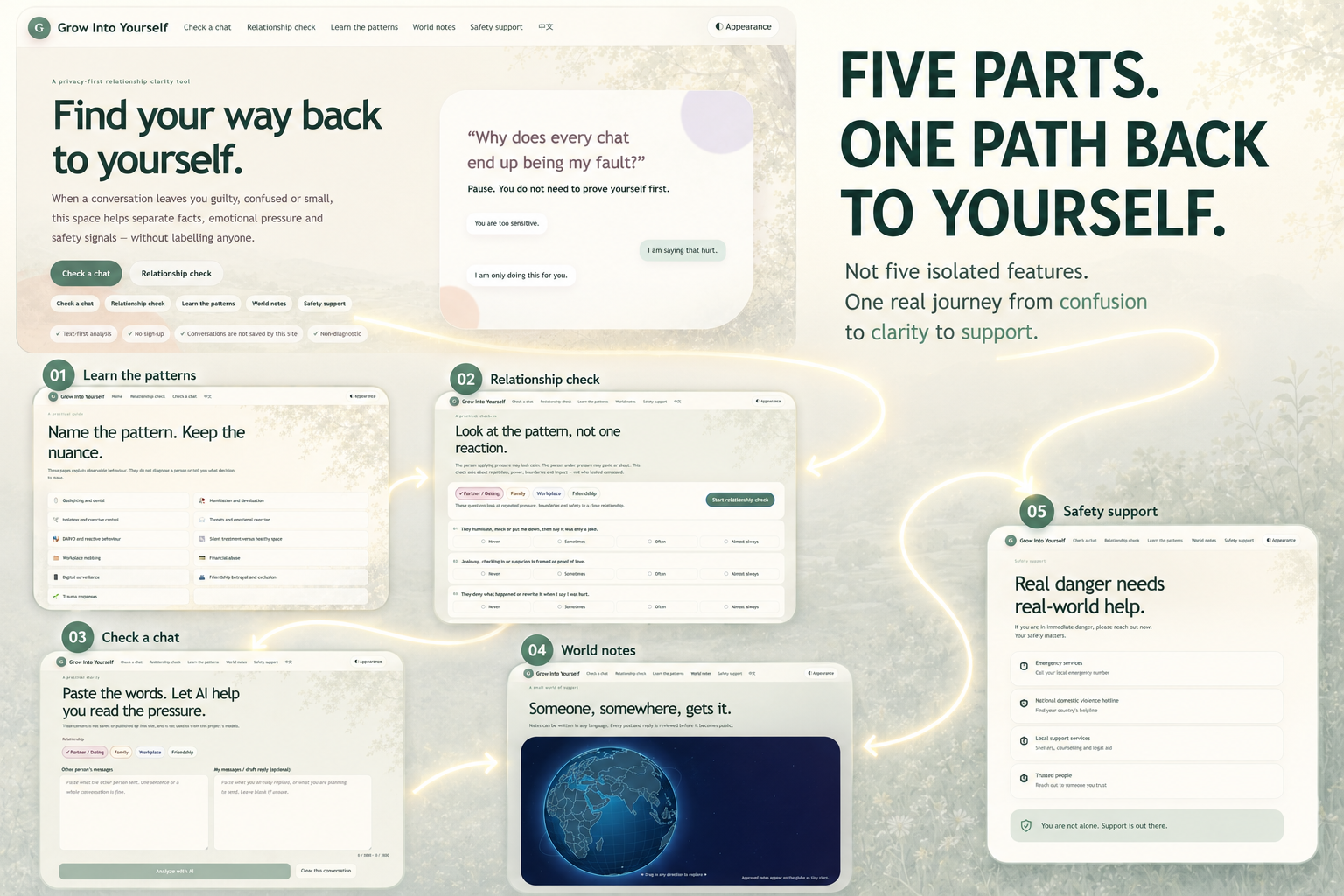
It guides users through five steps:
Learn the patterns → check the relationship → break down a real conversation → see that others have lived through similar things → reach real-world support when needed.
1. Learn emotional manipulation
Many people do not know what “emotional manipulation” actually looks like.
They only know that after certain conversations, they feel guilty, confused, or smaller. They start asking:
- Am I too sensitive?
- Am I the one who does not fit in?
- Does every problem somehow become my fault?
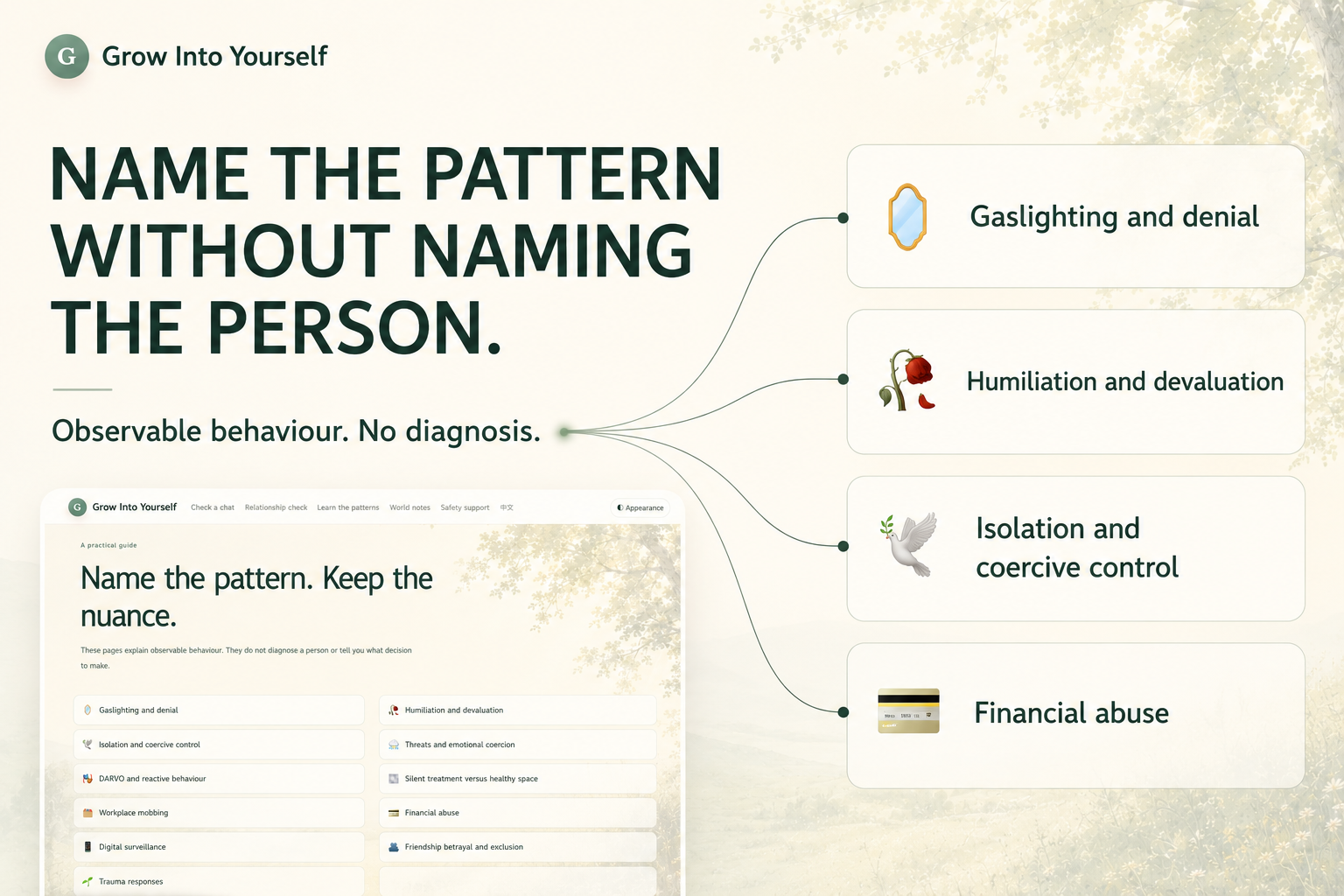
This section explains common patterns in plain language:
- how denial and rewriting happen;
- how shame shifts the focus from what happened to someone’s worth;
- how control can enter money, friendships, privacy, and movement;
- how threats, silence, and guilt can slowly reduce a person’s choices;
- why repeated exposure can weaken self-trust;
- what to notice, record, and protect.
The goal is not to help users label people faster.
It is to help them name what feels wrong.
2. Relationship self-check
Many people already sense that something is off, but still assume the problem is them.
I designed short self-checks for four relationship types:
- partner or dating;
- family;
- workplace;
- friends or classmates.
The questions do not ask whether someone has a disorder. They ask about observable behaviour:
- Do they repeatedly deny what they said?
- Do they replace discussion with shame or insults?
- Do they restrict information, work, money, friendships, or movement?
- What happens when the user says “no”?
- Is the relationship affecting sleep, safety, or daily life?
It is not a diagnosis.
It is a pause:
Before asking whether something is wrong with you, look at what this relationship is doing to you.
3. Break down the conversation
This is the core aha moment.
Users paste the other person’s words and their own reply or draft separately, then choose the context: partner, family, workplace, or friendship.
The system does not simply say:
“This person is manipulating you.”
It breaks the conversation down:
- what happened;
- what can be confirmed;
- how the topic shifted;
- which concerns may be reasonable;
- which lines create pressure;
- which quote supports each judgment;
- whether the user may want to reply, verify, observe, pause, or not respond.
For example:
- Parents paying tuition and childhood harm can both be true.
- Someone has the right to end a relationship, but that does not make the whole past unreal.
- Both people may be under pressure, but pregnancy, career interruption, and unpaid care work do not simply cancel each other out.
- “I do not remember” may reflect a memory gap, but it does not prove nothing happened.
I reviewed 73 peer-reviewed papers on coercive control, parental psychological control, emotional invalidation, economic control, digital monitoring, workplace bullying, DARVO, and related topics.
I turned that research into 38 decision rules and 39 minimal pairs.
The technical goal was not to make AI more confident.
It was to teach it where confidence should stop.
4. Anonymous peer support
The messages I received showed that people wanted more than an interpretation.
They also wanted to know:
- Has anyone else been through this?
- Am I the only person this unlucky?
- Has anyone actually made it out?
Some people feel so isolated that they lose the will to keep going. Others have made it through and want to leave one sentence for someone still in the dark.
So I did not build a standard comment wall.
I built a draggable, bilingual globe.
Approved anonymous messages become small stars on the map. Users can read stories, encouragement, and “what life looked like after” from different countries.
The globe makes support feel real:
Not a cold comment count, but a real person somewhere in the world who once understood this feeling.
AI can help unpack language.
But “you are not alone” still has to come from people.
5. Real-world safety support
Some situations are no longer communication problems.
When there are threats, violence, stalking, restricted movement, coercive control, self-harm threats, or risks involving children, the product should not keep suggesting a softer reply.
So I added real-world support paths for:
- emergency help;
- mental-health support;
- women’s and children’s rights;
- legal assistance.
The message is simple:
Somewhere in the real world, there are people and organisations built to help.
You do not have to prove that things are “bad enough” before asking for support.
AI can help organise the problem.
Real danger needs real-world help.
Design: even the interface returns choice to the user
I used emotion-aware design, cognitive-load principles, and readability research to create five animated background scenes:
- a warm pink room;
- a tree and open grass;
- a quiet coast;
- a sunlit room;
- a purple night scene.
They do more than change colour. Each scene has slow movement, soft drift, and light changes, so the page feels alive without pulling focus from the text.
The English site also offers four type choices:
- System Sans — neutral and fast to scan;
- Georgia — better for slower, longer reading;
- Trebuchet — softer and more human;
- Aptos Mono — more structured for checking lines one by one.
I am not claiming that a font or colour can heal someone.
The point is simpler:
Even the way you read your own experience can be your choice.
How GPT-5.6 and Codex helped
GPT-5.6 did not invent the need. The need was already there—in screenshots, private messages, and hundreds of people saying, “I do not know if I am overreacting.”
What it did was turn my notes into decisions I could test:
- Where is the evidence?
- Is there a fair counter-reading?
- What fact was ignored?
- Is this one rude comment, or a repeated cross-sentence pattern?
- What evidence should lower the risk level?
It kept the product from becoming an overconfident relationship judge.
Codex turned those boundaries into engineering constraints:
- bind every claim to a source quote;
- prevent evidence from being borrowed across topics;
- keep the same thresholds in English and Chinese;
- stop family, breakup, workplace, and finance templates from leaking into one another;
- use local-first analysis with AI enhancement in the background;
- show a usable result immediately;
- preserve the result if the external AI fails or times out;
- turn human-found mistakes into regression tests;
- handle builds, deployment, privacy checks, and version sync.
Many projects can say:
“Codex helped me code faster.”
In this project, the contribution was more specific:
GPT-5.6 helped turn empathy into judgments that could be challenged. Codex turned those judgments into boundaries the system could not casually cross.
Why this project was worth building—and submitting
The value of Grow Into Yourself is not that it judges relationships faster or with more confidence.
It tries to solve a harder problem:
In a space where a wrong judgment can make someone more afraid, dependent, or isolated, how can AI still be useful without pretending to know more than the evidence allows?
It has the four things a hackathon project needs:
- a need already validated by real users;
- an aha moment users can feel within seconds;
- a complete experience that handles failure, uncertainty, and safety;
- a technical approach that ties every strong claim to evidence and lowers confidence when evidence is weak.
This project deserves to be considered not because it uses the most AI, but because it carefully defines where AI should help—and where it should stop.
What I am proud of
I am not most proud of how many “risk words” the system can detect.
I am proud that:
- a normal budget discussion is not labelled economic control just because money appears;
- a clear breakup is not automatically called silent treatment;
- new facts from the user are not erased by old accusations;
- parental sacrifice and childhood harm can both be seen;
- unsupported conclusions are removed;
- the product still works when AI enhancement fails;
- when real danger appears, the product stops analysing and points to real support.
This is technology serving people.
It does not decide whom someone should love, leave, or forgive.
It returns what people need before making that decision:
facts they can check, pressure they can name, and choices no one else gets to take away.
What’s next
Grow Into Yourself is still a public beta.
Next, I want to test more blind cases that are not already represented in the rule set, across more cultures, languages, family structures, genders, and workplace power dynamics.
I also want feedback from people in mental health, social work, safety support, and user research.
I want the product to become more useful.
More importantly, I want it to know when not to sound certain.
Final note
What moved me most about GPT-5.6 and Codex was not how quickly they could produce an answer.
It was that they helped me turn something hundreds of people could only describe as “this feels wrong” into a product that can be seen, tested, discussed, and used.
Grow Into Yourself does not decide who is good or bad.
It protects the few seconds before a user hits “send”:
See what happened.
Trust that discomfort is information.
Keep your choices.
Grow into yourself.
Built With
- ai
- bilingual
- codex
- evidence-grounded
- github
- gpt-5.6
- human-centered
- json
- language
- local-first
- natural
- next.js
- openai
- openrouter
- privacy-first
- processing
- react
- reasoning
- rule-based
- structured
- typescript


Log in or sign up for Devpost to join the conversation.