-
landing page
-
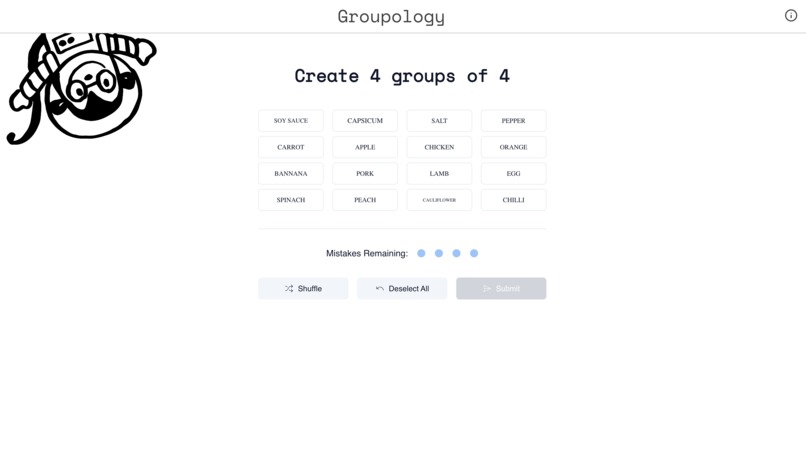
game!


Inspiration
Groupology is born from a love for language-learning and for word games. Learning a second language is a necessary process for many, and it is often a grueling and difficult journey. Many programs have been developed to tackle this issue, including apps such as Duolingo and Rosetta. However, most of these programs target language learning through rote memorization-based methods, which is not necessarily the best method for gaining an in-depth understanding of a target language. Groupology tackles these challenges to make language learning a more fun and engaging process. Based on the popular New York Times "Connection" word game, Groupology aims to help language learners experience a more personalized learning experience!
What it does
Groupology is a game where users input a list of vocabulary terms that they view as "cards" in their target language. In a grid of these cards, the user then must group these terms into groups of equal sizes with no hints as to what the categories for each group are. Each time a user has chosen a group of words, they can submit their group for validation. If correct, the word cards will present as one group, and the category name as well as the translation to their native language will be shown. To successfully complete the game, the user must find all of the groups in the puzzle within four tries.
How we built it
Using React, we designed a website for the Groupology. The website consists of a landing page, an instructions page, a "create" page where users can input their target language, preferred size of puzzle, and vocabulary terms. OpenAI's gpt-3.5-turbo is used to generate the categories and translations for the vocabulary terms inputted by the user. The last page of the website, the puzzle, was also built using React and JSON files to store the data used to build the puzzle. CSS was used to format the website and create a cohesive style across all pages.
Challenges we ran into
A major challenge was producing the translations of the vocabulary words after each grouping of words was completed. Due to the different writing systems of many foreign characters, it was difficult to output the correct terms through React and link each English term to its correct translation in the user's native language. Overcoming this issue required troubleshooting with the React syntax and understanding how data files are passed in React.
What's next for Groupology
We hope to be able to better incorporate user input in Groupology by allowing users to select a wider range of languages and a more accessible input method for their vocabulary terms. We also hope to fully flesh out a backend of our website to integrate OpenAI's capabilities of categorizing inputted vocabulary terms and translating them.

Log in or sign up for Devpost to join the conversation.