What Inspired Us:
Group projects are supposed to be collaborative, but in reality they are often chaotic. Tasks are unclear, workloads become unbalanced, and deadlines sneak up because no one truly knows how far along the team is. We have all worked on teams where some people are overloaded while others do not know what to do, or where the project lacks structure until it is too late.
We wanted to fix this. We envisioned an AI powered project coordinator that removes confusion, enforces fairness, and helps student teams work together more efficiently. This sparked the creation of Group Sync, an adaptive system that manages a group project from start to finish.
How Group Sync Works
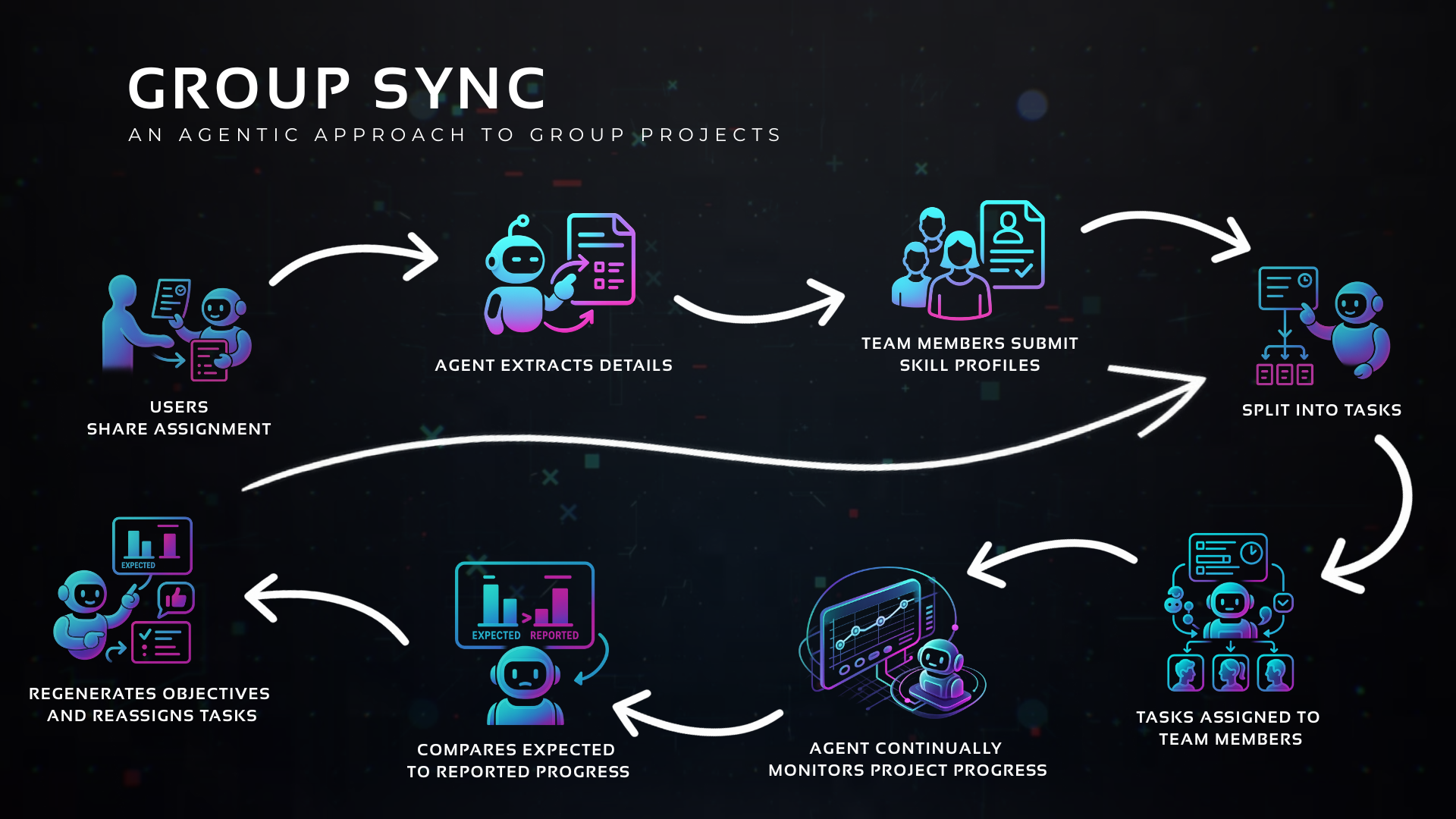
Group Sync is an adaptive, multi agent project management system built with LangGraph. It functions like an intelligent project manager that automates planning, task allocation, progress monitoring, and dynamic adjustments.
- Understanding the Assignment
Students upload the assignment brief, marking criteria, and deadlines. A parsing agent extracts the key components, including: • required tasks • deliverables • milestones • dependencies • timing constraints
This turns vague text into a structured project blueprint.
- Profiling Each Student’s Skills
Each student submits: • skills • past experience • availability • working style • CV or portfolio
The skill profiling agent converts this into competency vectors that quantify strengths and availability.
- Breaking the Project Into Tasks
Using the assignment structure and deadlines, the task decomposition agent: • generates tasks and subtasks • identifies dependencies • estimates difficulty • predicts time requirements • maps everything relative to deadlines
This produces a complete task graph for the project.
- Allocating Tasks to the Right People
The task allocation agent assigns tasks based on: • skill match • workload balance • time availability • urgency and difficulty
This gives each student a personalised task list that fits their strengths.
- Monitoring Progress Continuously
As students work, a progress agent tracks: • expected progress • reported progress • delays or bottlenecks • workload imbalance
This allows Group Sync to maintain an up to date view of the project’s status.
- Adapting in Real Time
If progress falls behind, Group Sync automatically: • reallocates tasks • adjusts deadlines • redistributes workload • provides feedback
Group Sync behaves like a real project manager that is always paying attention and responding quickly.
How We Built Group Sync
We used a LangGraph based architecture that orchestrates multiple agents working together. The system includes:
Assignment Parsing Agent
Extracts structure and requirements from unstructured text.
Skill Profiling Agent
Transforms user inputs into numerical competency vectors using embeddings.
Task Decomposition Agent
Breaks assignments into tasks with dependencies.
Task Allocation Agent
Matches tasks to students using scoring and reasoning.
Monitoring Agent
Tracks expected versus actual progress.
Reallocation Agent
Updates the plan when the project state changes.
Everything is connected within a shared LangGraph state that agents read and update as the project evolves.
What We Learned
We learned: • How powerful agentic workflows can be • The complexity of accurate task decomposition • How to translate subjective skills into structured data • The importance of strong state management • How difficult it is to model progress and compare expectations to reality
Challenges We Faced
- Extracting Tasks From Messy Briefs
Assignment instructions vary widely. The model sometimes missed details or invented steps. Iterative prompting and validation helped solve this.
- Fair Workload Balancing
Designing a scoring system that considered skills, difficulty, time, and workload required experimentation.
- Coordinating Shared Project State
Ensuring that updates from one agent did not break another agent’s reasoning was a major challenge.
- Creating Clear Visuals
We invested time refining visual diagrams and arrows to clearly illustrate the workflow.
- Working Under Hackathon Constraints
Time pressure pushed us to simplify, prioritise, and collaborate efficiently.
Summary
Group Sync is an adaptive AI system that ingests a project brief, profiles team members, decomposes the work, assigns tasks intelligently, monitors progress, and adjusts the plan automatically. Inspired by our own frustrations with group work, we built a fully agentic workflow that functions like a real project manager and helps student teams stay organised, efficient, and aligned.
Built With
- fastapi
- langchain
- langgraph
- react

Log in or sign up for Devpost to join the conversation.