-
-
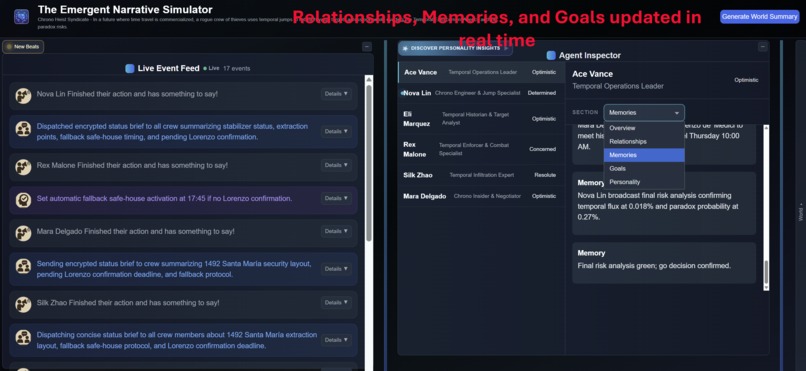
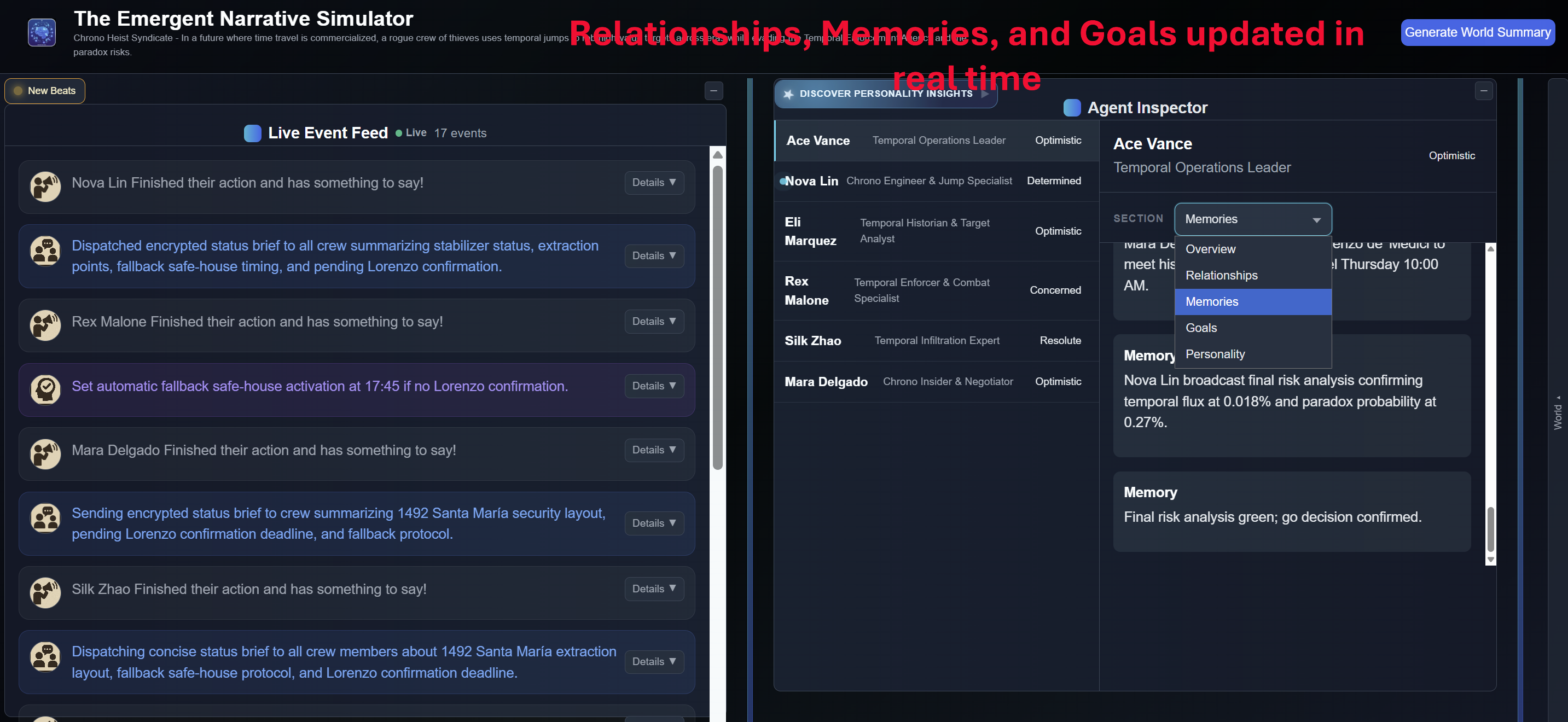
Continuous interaction and real-time updates
-
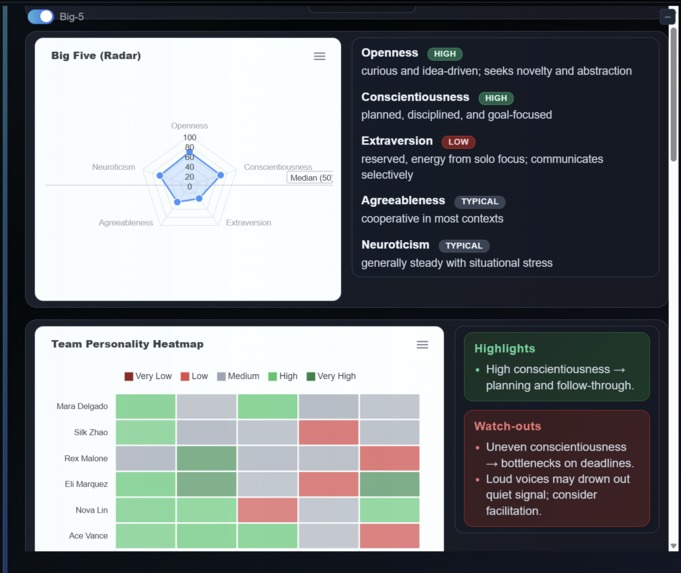
Real psychometric personality assessments
-
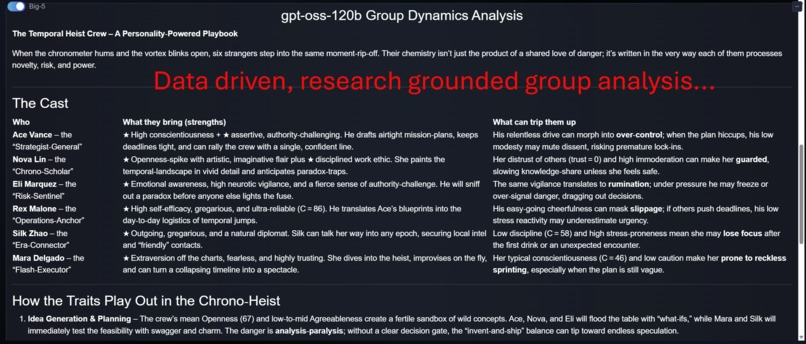
With data-driven analysis
Inspiration
Groups make meaning. We wanted a sandbox where personalities collide—sometimes like a startup stand-up, sometimes like a space opera—and where you can steer the drama with Rumors and Events while seeing clear psychological signals. Only the unique combination of speed and intelligence of the gpt-oss models made this possible.
What it does
Group Narrative Simulator spins up personality and goal-driven agents and lets them co-author real-time “beats.” You can:
- Define a cast and world (from real-world teams to wild fiction) with simple prompts and gpt-oss-120b will create the individual agent definitions and world-state context.
- Watch live
actions(e.gspeakTo,moveTo,decide, etc. via tool/function calls) with rationales, memory updates, and evolving story context. - See team-level signals (cohesion, tension, influence, risk) plus readable Highlights & Risks.
- Nudge the arc by injecting Rumors or Events.
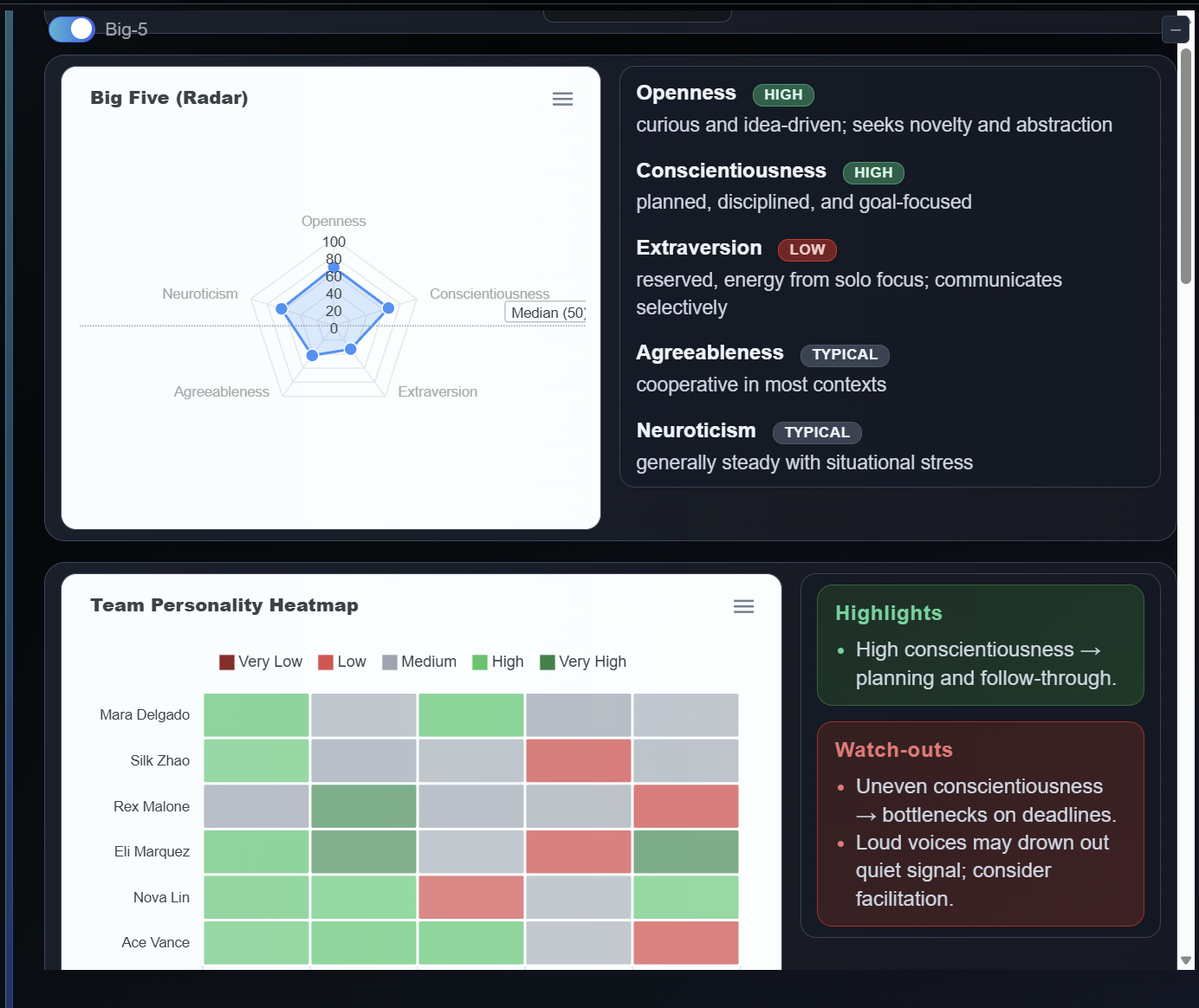
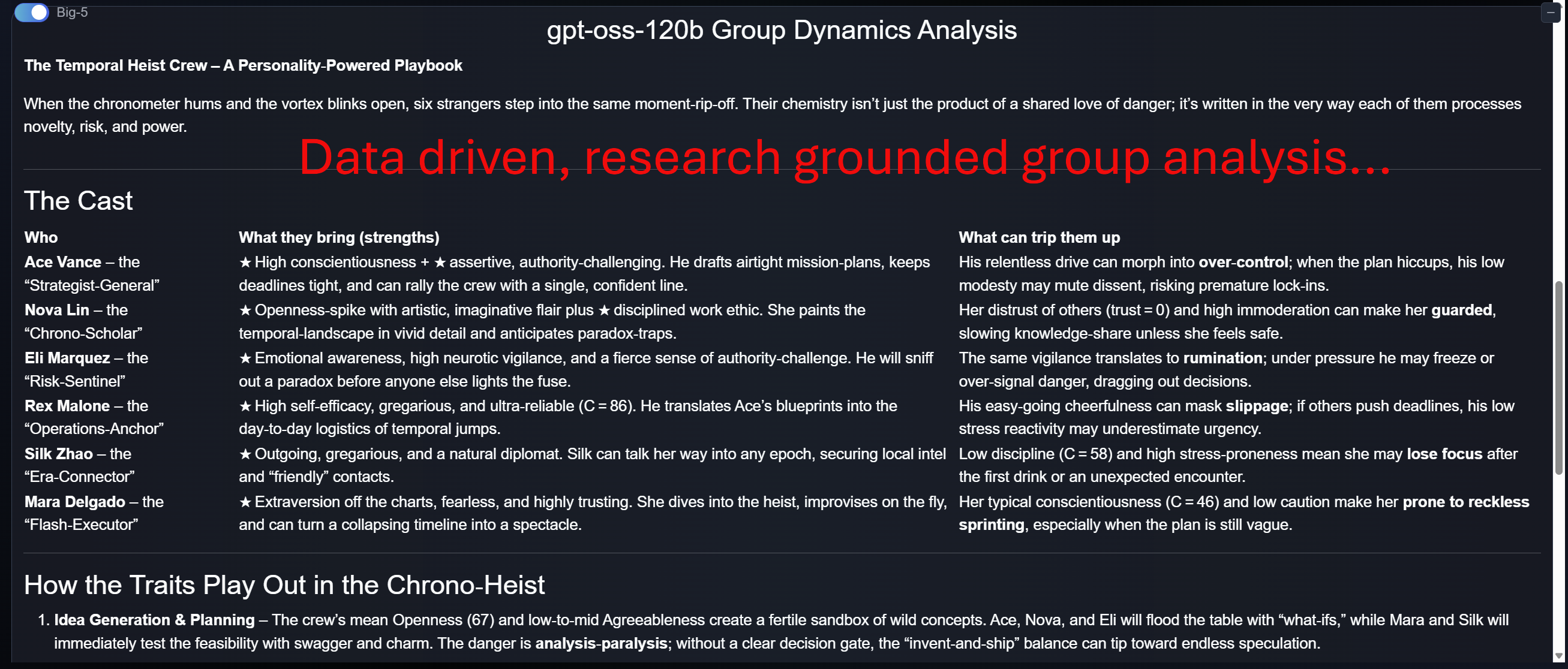
Alongside live narrative beats and updates, Group Narrative Simulator generates a research-grounded Group Assessment: gpt-oss-120b ingests the team’s OCEAN + NEO PI-R facets (from Sentino/Symanto) and the scenario brief to produce a context-aware analysis of likely strengths, fault lines, decision styles, communication patterns, and risk posture—then surfaces plain-language analysis tied back to measurable traits - all grounded in the latest peer-reviewed research.
How we built it
- Models & Reasoning: gpt-oss open-weight models via OpenRouter's high-throughput inference providers; pick 20B or 120B per task complexity.
- Agent Orchestration: C#/.NET with Semantic Kernel to coordinate agent thinking, tool use, memory, and beat assembly.
- Beat Engine: turns each turn’s agent action set into dramatized narrative beats—maintaining causality, pacing, and continuity.
- Psychometrics: Sentino and Symanto APIs analyze written text (bios, briefs) to produce Big-5 scores and NEO PI-R facets; traits are fixed for the run.
- Group Assessment synthesis: gpt-oss-120b consumes the group trait matrix (OCEAN + NEO PI-R facets from Sentino/Symanto) plus scenario context. A structured prompt template aligns explanations with established findings in personality and team dynamics, and every claim is anchored to observable trait bands or facet clusters.
- Visualization: charts rendered with the apex charts library driven by normalized per-agent and team metrics.
- Performance & Context: rolling summaries, per-agent memory buffers, and bounded prompts to keep runs fast and interpretable.
Challenges we ran into
- Creativity vs. control: freeform agents drift; rigid schemas flatten drama. The Beat Engine strikes the balance with action→cause→effect beats.
- Trait stability, behavior dynamism: keep personalities constant while allowing behaviors to adapt to Rumors/Events.
- Real-time UX: streaming events while updating two charts cleanly in Blazor required careful diffing and minimal re-renders.
- Context creep: solved with periodic world-state summaries and per-agent memory pruning.
Accomplishments that we’re proud of
- A real-time, inspectable multi-agent simulator you can measure and nudge.
- A consultant-style Group Assessment generated in seconds that is scientifically grounded, and directly traceable to Big-5 OCEAN + NEO PI-R facet patterns.
- Clean visuals that communicate a lot of information at a glance.
- Fully open-weight model flow with high-throughput endpoints for fast, reproducible demos.
- A tidy C# orchestration layer (Semantic Kernel) that others can extend.
What we learned
- Standardized psychometric services (Sentino/Symanto) give reliable baselines and facet-level nuance that make agent actions/behavior legible. A well-grounded LLM analysis of that data makes it approachable and interesting.
- Beat-level assembly is a quiet superpower: coherence improves while token/context costs stay in check.
What’s next for Group Narrative Simulator
- Deeper measures: HEXACO and interpersonal circumplex; richer team analytics (authority gradients, subgroups).
- Scenario packs: workplaces, classrooms, genre fiction; seeded crises for repeatable demos.
- Learning loops: optional logs → DPO/GRPO to shape pacing, escalation, and tone.
- Collab mode: shared sessions with live Rumor/Event moderation.
- Exports & APIs: beat timelines, comic-panel exports, and endpoints for writing tools or org sims.
A compact “social physics” lab for storycraft and organizational what-ifs—showcasing what open-weight reasoning models can do beyond chat.


Log in or sign up for Devpost to join the conversation.