group'd
A better group generator—still random, but customized.
🏆 Achievements
MathHacks 3rd Place Winner
Recognized for its unique approach to balanced randomization and user-friendly interface.



What is it?
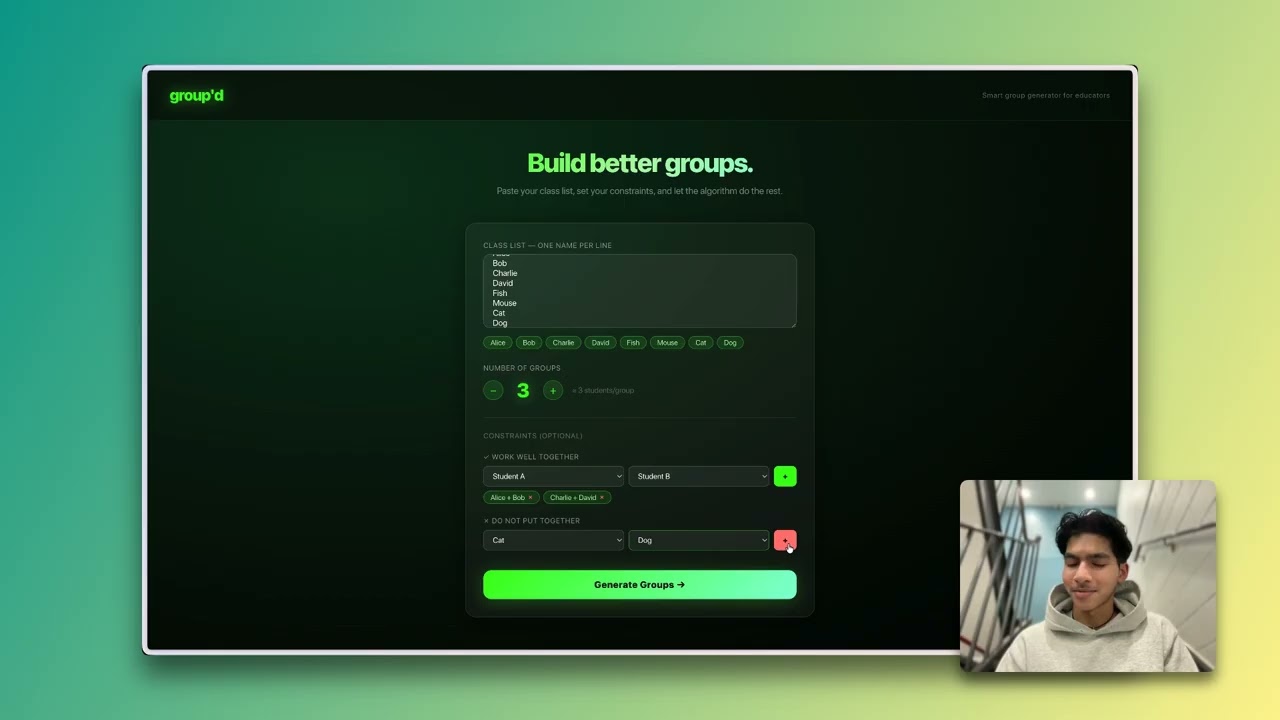
Teachers spend way too much time manually splitting students into groups — trying to remember who works well together, who absolutely shouldn't be paired, and making sure groups are balanced. group'd automates all of that.
Paste your class list, define your constraints, and the algorithm runs 5,000 iterations to find the optimal arrangement in seconds.
Features
- Constraint-aware grouping — specify pairs who work well together or should be kept apart
- Optimisation algorithm — scores every random arrangement and keeps the best one
- Cryptex animation — satisfying lock-cracking animation while groups are generated
- Early exit — algorithm stops immediately when a perfect score of 0 is reached
- Responsive UI — works on desktop and mobile
How it works
The core is a randomised optimisation algorithm:
- Shuffle the student list randomly
- Distribute students across groups using round-robin assignment (
student index % num_groups) - Score the arrangement —
+10for every "together" pair that was split,+50for every "not together" pair that ended up in the same group - Repeat 5,000 times, keeping the lowest-scoring result
- Return the best arrangement found
The scoring intentionally punishes "not together" violations more harshly (50 vs 10), since keeping conflicting students apart is more important than guaranteeing preferred pairings.
Tech stack
The algorithm was originally written in Python and later ported to JavaScript so the app runs entirely in the browser — no backend or server needed.
| Layer | Technology |
|---|---|
| UI framework | React (Vite) |
| Styling | Inline CSS with CSS keyframe animations |
| Algorithm | Vanilla JavaScript (ported from Python) |
Running locally
# Clone the repo
git clone https://github.com/yourusername/groupd-app.git
cd groupd-app

# Install dependencies
npm install

# Start the dev server
npm run dev
Then open http://localhost:5173 in your browser.
Original Python version
The algorithm was first built as a CLI tool in Python. You can still run it directly:
python groupd.py students.txt
Where students.txt is a plain text file with one student name per line.
What's next
- [ ] Save and export group results as PDF
- [ ] Teacher accounts with class rosters
- [ ] Session history — view past group arrangements
- [ ] Flask backend option for persistent storage
Built at MathHacks · Made with 🟢 and a lot of `random.shuffle()`

Log in or sign up for Devpost to join the conversation.